Strategies for the IELTS 1 – Test 5
23/10/2024 2024-10-23 2:15Strategies for the IELTS 1 – Test 5
PART 1
Questions
1 – 11
Questions 1-10. Complete the notes below. Write NO MORE THAN TWO WORDS AND/OR A NUMBER for each answer.
Costwise Car Hire Example: Number of offices in Sydney: 3 Booking reference number: 1
Office just by 2
terminal. Opening hours: 3
to 4
After-hours charge: 5$
Cheapest model of car available: 6
Information needed when booking: 7
number Length of hire period: 8
Reduce cost by driving under 9
Insurance does not cover: 10
After hours put keys in box near the office on 11the
PART 2
Questions
12 – 16
Questions 11-15. The following are essential requirements for which jobs?
Essential requirements
|
Questions
17 – 21
Questions 16-20. Choose FIVE answers from the box and write the correct letter, A-G, next to questions 16-20.
|
PART 3
Questions
22 – 23
Questions 21 and 22. Choose TWO letters, A-E. Which TWO possible objections to a roof garden are discussed?
- 2223
- Aproblems of accessBthe cost of constructionCthe time needed to install itDwho will look after itEhow to support the weight of it
Questions
24 – 25
Questions 23 and 24. Choose TWO letters, A-E. Which TWO recent developments in roof-garden building are mentioned?
- 2425
- Awaterproof barrier materialsBdrainage systemsCtank designsDlightweight construction materialsEwatering systems
Questions
26 – 31
Questions 25-30. Label the diagram below. Write the correct letter, A-H, next to questions 25-30.
PART 4
Questions
32 – 37
Questions 31-36. Complete the notes below. Write NO MORE THAN TWO WORDS for each answer.
The Argus system Developed by Rob Holman in N. Carolina with other researchers. Research is vital for understanding of 32
Matches information from under the water with information from a 33
. According to S. Jeffress Williams, useful because can make observations during a 34
. Dr Holman’s sand collection Dr H. has samples from every 35
Used in teaching students of 36
e.g. US East Coast display: grains from south are small, light-coloured and 37
in shape
Questions
38 – 41
Questions 37-40. Complete the flow-chart below. Write NO MORE THAN THREE WORDS for each answer.
Chỗ trống 38
Chỗ trống 39
Chỗ trống 40
Chỗ trống 41
PART 1
Questions
1 – 11Questions 1-10. Complete the notes below. Write NO MORE THAN TWO WORDS AND/OR A NUMBER for each answer.
Giải thích đáp án
Woman: Hello, how can I help you?
Man: Hi. I’m Carlton Mackay, and you booked me some flights recently, to Australia – and some internal ones?
Woman: Oh, yes, Mr Mackay, I remember you now, of course.
Man: Well, I find I’m going to need a car hire while I’m in Sydney after all. I think you said you could recommend a good-value company?
Woman: Yes, that’s right. Costwise Cars. They’re very good and don’t charge lots of extras. They have three offices in the Sydney area, including one office right at the airport.
Man: So, I’ll just book it online?
Woman: Yes, you can book online but you should have their phone number too, just in case.
Man: Mm, of course.
Woman: That’s 1800 705 639. It’s on the website. And you can get a discount if you quote your booking reference from us.
Man: Oh, what’s that?
Woman: I mean the one you got from me when we booked your flights. (Q1) I have it here – 743002. [Tôi có nó ở đây – 743002]
Man: Oh, thanks. I guess I’ve got it at home, but I’ll write it down again in case. A discount is good. So where exactly is the office? I’ll be coming to the domestic terminal from Melbourne.
Woman: (Q2) It’s immediately outside the international terminal. [Nó ngay bên ngoài nhà ga quốc tế.]
Man: OK. And, another thing I want to check is, will they be open when I arrive? Or is it just office hours?
Woman: Mm … (Q3) they open at quarter to seven (= 6.45) and close at 6.15 in the evening. [họ mở cửa lúc 7 giờ kém 15 và đóng cửa lúc 6 giờ 15 phút tối]
(Cho phép các đáp án: (0)6.45 (A.M./AM) + (0)6.15 (P.M./PM) [OR] (0)6.45 (A.M./AM) + 18.15)
Woman: So, let’s see, you’re due to land at ten past six. (Q4) By the time you’ve collected your bags and so on, which will take a little while, they won’t be open, but if you arrange it in advance, they can wait for you (= after hours). You do have to pay an extra $30 for that, though. [Đến khi bạn lấy hành lý, v.v., sẽ hơi lâu, họ sẽ không còn mở cửa, nhưng nếu bạn sắp xếp trước, họ có thể đợi bạn. Tuy nhiên, bạn phải trả thêm $30 cho việc đó]
Man: OK. Well, I’m staying near the airport the first night, so I could go back in the morning and save a day’s hire?
Woman: Yes, that’d be better. That’d save you about $50.
Man: Do you know what kind of cars they have?
Woman: Quite a variety, I think. Er, (Q5) the best value (= cheapest) should be under $60 a day with luck. That would be the ‘Echo‘. [giá tốt nhất sẽ là dưới 60 đô la một ngày nếu may mắn. Đó sẽ là dòng xe ‘Echo’] I guess.
Man: Sorry?
Woman: E-C-H-O, like when your voice bounces back?
Man: I suppose I have to book online before I leave?
Woman: Mm, that’s the best way. (Q6) Er, they won’t deduct any charges until you finish with the car, but they do need your credit card number when you book [Ồ, họ sẽ không khấu trừ bất kỳ khoản phí nào cho đến khi bạn hoàn thành việc lấy xe, nhưng họ cần số thẻ tín dụng của bạn khi bạn đặt xe] and of course they’ll want to see your driving license when you collect. How long will you need it?
Man: (Q7) I’m in Sydney for seven days. [Tôi ở Sydney trong bảy ngày.] I’ll only actually need to use it on three or four of those days. I hope, but I’ll keep it for the whole week. I guess it’s going to be a few hundred dollars. Can you suggest anything I can do to keep the cost down?
Woman: (Q8) Oh, you get quite a big discount if you do less than (= reduce cost by driving under) 1,000 kilometres in the week. [Ồ, bạn được giảm giá khá nhiều nếu bạn đi ít hơn 1.000 km trong tuần.]
Man: Oh, that’s good. I don’t suppose I will be driving that far, actually.
Woman: But, oh, yes, the other thing I should mention is the insurance. It’s included in the price.
Man: Oh, that is good value then.
Woman: Yes, but what you must remember is that it doesn’t cover anything except the car, so you must be careful not to leave anything at all in it when you park because (Q9) your luggage isn’t insured [hành lý của bạn không được bảo hiểm], even if it’s out of sight, locked in the boot.
Man: Yeah, well, I think my travel policy will cover that actually.
Woman: Good!
Man: OK. And can I return the car outside office hours? My flight home is very early in the morning. Can I put the keys through the door, or something?
Woman: (Q10) There’s a secure box just outside the office on the pavement. You just drop the keys in there. [Có một hộp an toàn ngay bên ngoài văn phòng trên vỉa hè. Bạn chỉ cần thả chìa khóa vào đó]
Man: Oh, good.
Woman: And one other thing: you should remember to buy petrol before you leave it. If you don’t drop the car back with a full tank you get charged to fill it. I recommend you go to a supermarket before you go out to the airport.
Man: Thanks for the tip!
Woman: Not at all. Do call in again if there’s anything else I can help with.
Man: I will. Many thanks.
PART 2
Questions
12 – 16Questions 11-15. The following are essential requirements for which jobs?
Essential requirements
|
Bạn chưa trả lời câu hỏi này
A
Bạn chưa trả lời câu hỏi này
C
Bạn chưa trả lời câu hỏi này
B
Bạn chưa trả lời câu hỏi này
C
Bạn chưa trả lời câu hỏi này
A
Giải thích đáp án
Good morning. It’s a great pleasure to be here in London and to see so many people interested in working in hotels. We in the International Finest Group of hotels are very proud of our business and we are always on the lookout for quality recruits in every department.
Now, I’m going to outline some of the areas of work where we are currently recruiting and the essential skills or qualifications for them, then I’ll run through our recruitment procedure. OK?
At the moment we’re looking for a number of people for administrative posts in different parts of the world and also some roles which involve a lot of traveling. One of our main business streams is hosting special events for other businesses.
(Q11) If you have good communication and organizational skills with a good level of fluency in at least one European and one non-European language (= foreign languages) (=> A), I’d suggest you think about becoming part of the team which sets up these events for all our centres. [Nếu bạn có kỹ năng giao tiếp và tổ chức tốt với mức độ thông thạo ít nhất một ngôn ngữ Châu Âu và một ngôn ngữ không phải Châu Âu, tôi khuyên bạn nên nghĩ đến việc trở thành một phần của nhóm tổ chức các sự kiện này cho tất cả mọi người các trung tâm của chúng tôi.]
This would mean being based full-time in our London office. The work ranges from setting up small meetings a few days ahead to organizing international conferences two years in advance, so there’s plenty of variety. Some of the conferences we run have as many as a thousand delegates, so it’s quite challenging.
Then there are some posts available for professionals in the catering field. Chefs we can find; it seems this is a popular career choice in many parts of the world as in the UK these days, in spite of the exacting standards, (Q12) but people to manage catering departments need more than a love of producing quality food (= professional qualification) (=> C). [nhưng những người quản lý bộ phận phục vụ ăn uống cần nhiều hơn là tình yêu sản xuất thực phẩm chất lượng]
We’re after really energetic and totally efficient young managers, who already have the relevant business qualifications – no training on the job here – and they must share the team’s determination to make everything run smoothly at any time of the day or night.
Or, if you are the type of person who enjoys a challenge, what about becoming one of our relief housekeepers? You’ll be a good person, well organised, and supremely flexible.
As well as covering UK holidays, maternity and paternity leave, (Q13) there will be times when you have to fill a key post when someone’s sick, which could be anywhere in our European, Middle Eastern or Far Eastern hotels so you must be prepared to hop on a plane at five minutes’ notice (= willingness to travel abroad). (=> B) [sẽ có lúc bạn phải làm thay một vị trí quan trọng khi ai đó bị ốm, có thể ở bất kỳ đâu trong các khách sạn Châu Âu, Trung Đông hoặc Viễn Đông của chúng tôi, vì vậy bạn phải chuẩn bị sẵn sàng để lên máy bay trước năm phút]
The International Finest brand name attracts visitors from all over the world and on all kinds of business and leisure trips. Our swimming pools and gyms (= fitness centre) need to be run by people with the highest standards of customer service.
You don’t have to be a great athlete, but smart appearance and a pleasant manner are necessary. (Q14) A diploma in sports science would be the minimum requirement here (= professional qualification). (=> C) [Bằng tốt nghiệp về khoa học thể thao sẽ là yêu cầu tối thiểu ở đây]
Lastly, I’d just like to mention that the main London office has another vacancy. Most bookings come online, especially from the Far East for people coming to Europe.
(Q15) If you
have fluency and some keyboard skills in, for example, Spanish, or any Far Eastern languages, either having taken a degree, or preferably from having lived and worked overseas (= foreign languages) (=> A), you might be just the person we’re looking for to deal with email booking and queries (= reservations assistant) in the office here. [Nếu bạn thông thạo và có một số kỹ năng bàn phím, chẳng hạn như tiếng Tây Ban Nha hoặc bất kỳ ngôn ngữ Viễn Đông nào, hoặc đã có bằng cấp hoặc tốt nhất là đã sống và làm việc ở nước ngoài, thì bạn có thể chính là người mà chúng tôi đang tìm để xử lý việc đặt chỗ qua email và các yêu cầu trong văn phòng tại đây.] A flexible attitude to working hours is also important as you may have to come in outside normal office hours.
Questions
17 – 21Questions 16-20. Choose FIVE answers from the box and write the correct letter, A-G, next to questions 16-20.

|
Bạn chưa trả lời câu hỏi này
F
Bạn chưa trả lời câu hỏi này
A
Bạn chưa trả lời câu hỏi này
G
Bạn chưa trả lời câu hỏi này
E
Bạn chưa trả lời câu hỏi này
D
Giải thích đáp án
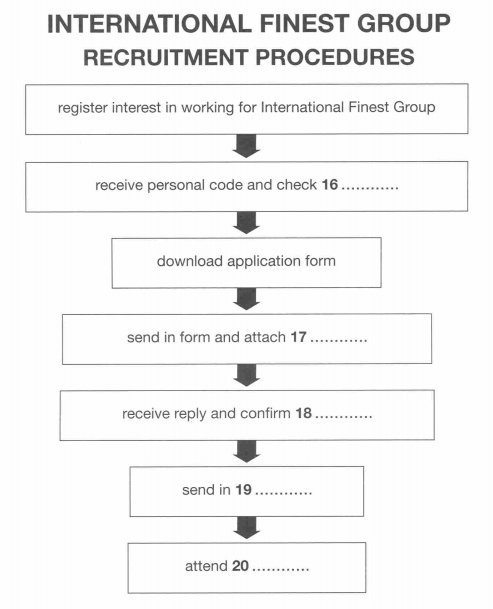
So that’s an overview of the kind of jobs, now how to get them! First of all, provided you have a UK work permit, you can go online and register an interest in working for us. By return, you’ll receive a unique applicant’s code, which is your personal identification number and which we’ll use in all communications. Along with that you get access to the Human Resources website, where you should (Q16) make sure you understand the legal terms and conditions which apply to all our employees (= conditions of employment) (=> F). [đảm bảo bạn hiểu các điều khoản và điều kiện pháp lý áp dụng cho tất cả nhân viên của chúng tôi] (Q17) That’s also where you can then download the application form – fill it in and send it back along with (= attach) your CV. (=> A) [Đó cũng là nơi bạn có thể tải xuống mẫu đơn đăng ký – điền vào và gửi lại cùng với CV của bạn.] You’ll know within 48 hours whether you’re being considered as you get an automated response. Sorry if it’s a bit impersonal, but at least it’s quick. Hopefully, if we like the sound of you, there will be in that automated response (Q18) a list of times for an initial interview which will take place by telephone (=> G) [một danh sách thời gian cho một cuộc phỏng vấn ban đầu sẽ diễn ra qua điện thoại] during the following week. You confirm by email which of the time slots will suit you. Provided the interview is satisfactory, at that point (Q19) we’ll ask for any evidence of qualifications required, which might be your degree or diploma certificate or so on, which you have to send certified copies of, and we contact your referees. (=> E) [chúng tôi sẽ yêu cầu bất kỳ bằng chứng nào về trình độ nếu cần thiết, có thể là bằng cấp hoặc chứng chỉ văn bằng của bạn, v.v. những thứ mà bạn phải gửi bản sao có chứng thực và chúng tôi sẽ liên hệ với người giới thiệu của bạn] The last thing you have to do is you come along and have a look round the International Finest Group head office, get to know some of our team in Human Resources face to face, and (Q20) participate in (= attend) one-day recruitment seminar (=> D) [tham gia hội thảo tuyển dụng], which involves a number of group and individual activities along with other potential employees.
Then, with luck, we’ll offer you a job! So, I hope you like the sound of joining our organization.
PART 3
Questions
22 – 23Questions 21 and 22. Choose TWO letters, A-E. Which TWO possible objections to a roof garden are discussed?
- 2223
- Aproblems of access
Bạn chọn thiếu đáp án này
Bthe cost of constructionCthe time needed to install itBạn chọn thiếu đáp án này
Dwho will look after itEhow to support the weight of it
Giải thích đáp án
CÂU HỎI 21 & 22 | TRANSCRIPT & GIẢI THÍCH |
Which TWO possible objections to a roof garden are discussed? A. problems of access B. the cost of construction C. the time needed to install it D. who will look after it E. how to support the weight of it | Tutor: OK. So you’ve done a bit of reading already? What benefits would there be for the client? Why do you think a supermarket chain would be willing to meet the expense of construction? (=> B) [Tại sao bạn nghĩ rằng một chuỗi siêu thị sẽ sẵn sàng đáp ứng chi phí xây dựng?] You do realize that would be the first thing they raise. … Tutor: OK. But they might feel the expense of maintenance would be an issue. After all, supermarkets don’t normally employ gardeners. (=> D) [Nhưng họ có thể cảm thấy chi phí bảo trì sẽ là một vấn đề. Xét cho cùng, các siêu thị thường không thuê người làm vườn.]
|
DỊCH NGHĨA | |
HAI ý kiến phản đối vườn trên mái nhà nào đã được thảo luận? A. vấn đề tiếp cận B. chi phí xây dựng C. thời gian cần thiết để cài đặt nó D. ai sẽ chăm sóc nó E. làm thế nào để hỗ trợ trọng lượng của nó |
Questions
24 – 25Questions 23 and 24. Choose TWO letters, A-E. Which TWO recent developments in roof-garden building are mentioned?
- 2425
Bạn chọn thiếu đáp án này
Awaterproof barrier materialsBdrainage systemsCtank designsDlightweight construction materialsBạn chọn thiếu đáp án này
Ewatering systems
Giải thích đáp án
CÂU HỎI 23 & 24 | TRANSCRIPT & GIẢI THÍCH |
Which TWO recent developments in roof-garden buildings are mentioned? A. waterproof barrier materials B. drainage systems C. tank designs D. lightweight construction materials E. watering systems | Student: Yes, because rainwater is best for the garden, if you can store it for when it’s needed. What I’ve been looking at are some buildings which use fairly conventional storage tanks, the kind that have been in use for decades, but have them linked to modern automatic watering systems. (=> E) [Những gì tôi đang xem xét là một số tòa nhà sử dụng bể chứa khá thông thường, loại đã được sử dụng trong nhiều thập kỷ, nhưng chúng được kết nối với hệ thống tưới nước tự động hiện đại] … Tutor: Perhaps even ridge tiles like they use on roofs? Student: Oh, yes, that’d be just the sort of thing. And that’d make it waterproof. Um and then the heavy duty electric wiring comes up through the floor just outside the planted area and into the wall. Then it’s brought through a projector low in the side of the wall, and that sends a beam of light along the fibre optic cable. (=> A) [Và điều đó sẽ làm cho nó không thấm nước. Ừm và sau đó hệ thống dây điện nặng xuyên qua sàn ngay bên ngoài khu vực trồng cây và đi vào tường. Sau đó, nó được đưa qua một máy chiếu thấp ở bên cạnh bức tường và điều đó sẽ gửi một chùm ánh sáng dọc theo cáp quang.] |
DỊCH NGHĨA | |
Bài viết đề cập đến HAI sự phát triển nào gần đây trong tòa nhà vườn trên mái? A. vật liệu chống thấm nước B. hệ thống thoát nước C. thiết kế xe tăng D. vật liệu xây dựng nhẹ E. hệ thống tưới nước |
Questions
26 – 31Questions 25-30. Label the diagram below. Write the correct letter, A-H, next to questions 25-30.

Bạn chưa trả lời câu hỏi này
F
Bạn chưa trả lời câu hỏi này
H
Bạn chưa trả lời câu hỏi này
C
Bạn chưa trả lời câu hỏi này
D
Bạn chưa trả lời câu hỏi này
B
Bạn chưa trả lời câu hỏi này
A
Giải thích đáp án
Student: Well, I was really impressed by something I saw on a roof in Cornwall and I’d like to design something similar. Um, you have an area of planting, and l’m thinking of installing this lighting in an area filled with low-growing evergreen shrubs.
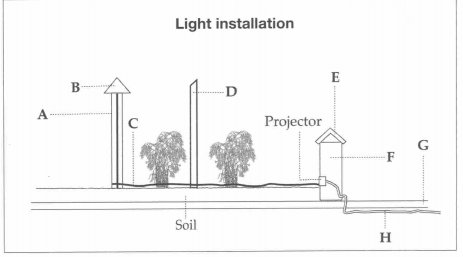
Tutor: Mmm. You’d have to have lights and things well away from anywhere children might be. How would it work? On this drawing, this is a section view? (Q25) You have this low wall on the right? (=> F) [Bạn sẽ để bức tường thấp này bên phải này hả?]
Student: Yes, that’s it. This is just one element and these areas would be repeated all round the planted area. I think this will probably be a wooden wall, using reclaimed timbers, with an angled ceramic top surface.
Tutor: Perhaps even ridge tiles like they use on roofs?
Student: Oh, yes, that’d be just the sort of thing. And that’d make it waterproof. Um and then (Q26) the heavy duty electric wiring comes up through the floor just outside the planted area and into the wall. (=> H) [hệ thống dây điện hạng nặng đi xuyên qua sàn ngay bên ngoài khu vực trồng cây và đi vào tường] Then it’s brought through a projector low in the side of the wall, and that sends a beam of light along the fibre optic cable.
Tutor: So there’s no electricity in the actual lights. It’s in the actual lights. (Q27) The fibre optic goes across the surface of the soil in the planting area. (=> C) [Sợi quang đi qua bề mặt đất trong khu vực trồng cây]
Student: Yes, that’s the beauty of it. The shrubs will soon grow to cover it up, of course, and then (Q28) the cable goes past a wooden post which is between the shrubs, (=> D) [dây cáp đi qua một cột gỗ nằm giữa các bụi cây] and can be a support for them as they grow bigger, and then runs up into each element of the installation.
Tutor: So (Q29) the light beam is carried up to the top of each element and illuminates a kind of conical glass cap? (=> B) [vậy là chùm sáng được truyền lên đỉnh của mỗi phần tử và chiếu sáng một loại nón thuỷ tinh?] I see! Is that the bit which would glow in the dark?
Student: Yes.
Tutor: And what’s the cap supported on? Is it a wall?
Student: No, (Q30) it’s a slender acrylic rod, er, like the stem of a flower or mushroom, which the cable runs up inside of. (=> A) [đó là một thanh acrylic mảnh, giống như cuống hoa hoặc nấm, có dây cáp chạy bên trong]
Tutor: Well, I’ll be interested to see the final drawings.
Student: Thank you! I’m looking forward to putting it all together.
PART 4
Questions
32 – 37Questions 31-36. Complete the notes below. Write NO MORE THAN TWO WORDS for each answer.
Giải thích đáp án
First, I would like to tell you how the Argus computerized photography system has helped marine researchers. Then I shall talk a bit about sand collecting.
Well, Argus is the system Doctor Rob Holman developed when he was working at a research pier on the coast of North Carolina about 20 years ago.
This pier stretches out over the water, and it’s the longest research pier in the world, with an observation tower on the end of it. The researchers there make precise measurements of how the sand moves about under the waves. (Q31) This research is critical to the study of (= research is vital for understanding of) beach erosion in places where the coastline is being worn away. [Nghiên cứu này rất quan trọng đối với việc nghiên cứu xói mòn bãi biển ở những nơi mà bờ biển đang bị bào mòn]
The Argus system helps to solve the difficulties encountered by these researchers. (Q32) The system correlates (= matches) the data from under the water with what Dr Holman gets from his (fixed) camera, which is mounted above the water on the pier [Hệ thống tương quan dữ liệu từ dưới nước với những gì Tiến sĩ Holman nhận được từ máy ảnh cố định của mình, được gắn trên mặt nước trên bến tàu] and uses time-lapse photography.
Some of Doctor Holman’s results have changed the way people understand how sand moves. To quote S. Jeffress Williams, a coastal geologist with the United States Geological Survey, the system is ‘a critical piece of new technology’ and (Q33) ‘The Argus system allows us to quantify and document visually (= make observations) the changes to the coast on a variety of different time frames. A lot of these take place when there is (= during) a storm [‘Hệ thống Argus cho phép chúng tôi định lượng và ghi lại một cách trực quan những thay đổi đối với bờ biển trên nhiều khung thời gian khác nhau. Rất nhiều trong số này diễn ra khi có một cơn bão] or at other times when it is difficult to have people out on the beach making observations and taking measurements.’
Up to now Argus installations have been installed in places in Oregon, California, Hawaii, England, the Netherlands, Australia, New Zealand, Spain, Italy and Brazil, as well as in North Carolina.
Now I’d like to introduce Dr Holman’s sand collection. He started collecting sand in the 1980s, and he still collects it now, even though he has around a thousand samples. They come from his travels and from geologists and amateurs all over the world – and (Q34) the collection includes sand from each continent, including Antarctica. [bộ sưu tập bao gồm cát từ mỗi lục địa, bao gồm cả Nam Cực]
People send him sand in envelopes, plastic bags, paper towels and all sorts! Each is stored in a glass jar, which Dr Holman labels by latitude and longitude of its origin, as well as he can work them out – sometimes the information is a bit sketchy!
Anyway, (Q35) it’s mainly geology students at the university who study his collection [chủ yếu là sinh viên địa chất tại trường đại học nghiên cứu bộ sưu tập của anh ấy], and they can learn a lot from it.
For instance, one set of tubes displays sand from the East Coast of the US. So you can see that the sand gets lighter and finer from north to south. By the time a grain of sand eventually washes up on a beach in Florida (Q36) at the southern end of that journey, it has been battered by waves for a long time so the grains are fine and rounded [ở đầu phía nam của hành trình, lâu ngày được sóng vỗ nên hạt mẩy, căng tròn] because most of the time sand is not stationary on the beach.
OK, so if you’d like to collect sand and maybe even send some to Dr Holman, How should you go about it? Well, the list of equipment is very short and easy to find, but you should keep a supply when you’re travelling, as you never know when you’ll come across an interesting sand sample.
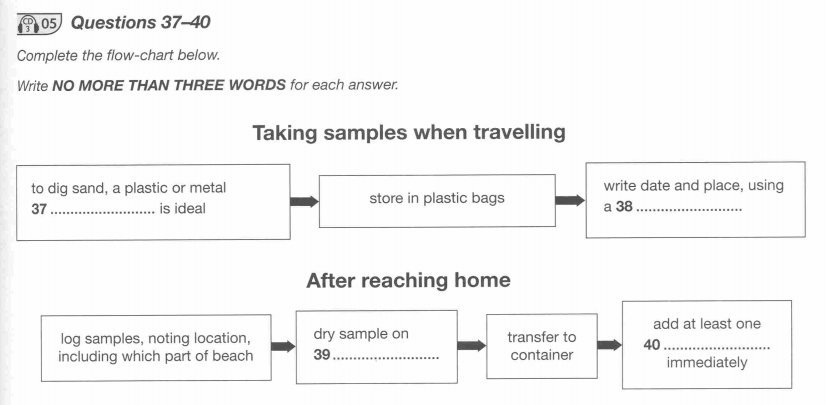
(Q37) One really handy thing for digging sand, especially if it’s hard or frozen, is a spoon, it’s perfect (= ideal) for that. [Một thứ thực sự tiện dụng để đào cát, đặc biệt nếu nó cứng hoặc đông cứng là một cái thìa, nó hoàn hảo cho việc đó] If you’re travelling by air it’ll have to be plastic, but metal is preferable, as plastic tends to break. You need something to put the samples in that is damp-proof and easy to carry. You can just use plastic bags, (Q38) but you need to record the location and date on the bag, so you must also have a permanent marker with you [nhưng bạn cần ghi lại địa điểm và ngày tháng trên túi, vì vậy bạn cũng phải mang theo bút dạ vĩnh cửu bên mình], because you can never assume you will remember where you gathered a sample from later on and you don’t want it to rub off before you get home.
And that’s about all you need in the field to collect sand. When you get home, your samples should be logged in a notebook or computer. You need to note the location and be really specific as to exactly whereabouts on the beach you gathered your sample – low tide mark, under cliff area, etc.
Then, you store your sample. You want to keep everything in good condition and avoid contamination. So first you make absolutely sure that each sample is perfectly dry. You don’t need any complicated apparatus for this, (Q39) you can just air it out on (layers of) newspaper [bạn chỉ có thể phơi nó trên các báo], which is suitably absorbent. Most people find that’s the best way.
Then, lastly, but this is really important, before there can be any chance of confusing this latest sample with another, you put it in a clean small bag or a jar, and (Q40) you must stick an (identification) label on straight away (= immediately). [bạn phải dán nhãn ngay lập tức] Some people put one inside as well in case the outer label falls off, but that’s up to you.
Well, that’s about all you need to know to get started as a sand collector.
Any questions?
Questions
38 – 41Questions 37-40. Complete the flow-chart below. Write NO MORE THAN THREE WORDS for each answer.

Giải thích đáp án
OK, so if you’d like to collect sand and maybe even send some to Dr Holman, how should you go about it? Well, the list of equipment is very short and easy to find, but you should keep a supply when you’re travelling, as you never know when you’ll come across an interesting sand sample.
One really handy thing for digging sand, especially if it’s hard or frozen, is a spoon. It’s perfect for that. If you’re travelling by air it’ll have to be plastic, but metal is preferable, as plastic tends to break. You need something to put the samples in that is damp-proof and easy to carry. You can just use plastic bags, but you need to record the location and date on the bag, so you must also have a permanent marker with you, because you can never assume you will remember where you gathered a sample from later on and you don’t want it to rub off before you get home.
And that’s about all you need in the field to collect sand. When you get home, your samples should be logged in a notebook or computer. You need to note the location and be really specific as to exactly whereabouts on the beach you gathered your sample-low tide mark, under cliff area, etc.
Then, you store your sample. You want to keep everything in good condition and avoid contamination. So first you make absolutely sure that each sample is perfectly dry. You don’t need any complicated apparatus for this, you can just air it out on layers of newspaper, which is suitably absorbent. Most people find that’s the best way.
Then, lastly, but this is really important, before there can be any chance of confusing this latest sample with another, you put it in a clean small bag or a jar, and you must stick an identification label on straight away. Some people put one inside as well in case the outer label falls off, but that’s up to you.
Well, that’s about all you need to know to get started as a sand collector.
Any questions?