
Strategies for the IELTS 2 – Test 3
23/10/2024 2024-10-23 2:43Strategies for the IELTS 2 – Test 3
PART 1
Questions
1 – 5
Questions 1-10. Complete the notes below. Write ONE WORD AND / OR A NUMBER for each answer.
New Apartment Example Answer Landlady’s Name: Mary Jones GENERAL – partly furnished – no 1
are allowed KITCHEN – nice and big – there is a new 2
LOUNGE – some 3
will be built soon BEDROOM – good clothes storage – need to bring a 4
BATHROOM – only a shower – the water is heated by 5
PART 2
Questions
11 – 15
Questions 11-12. Choose TWO letters, A-E. Which TWO tasks will volunteers be required to do at Eskdale Wood?
- 12
- Afix fencesBremove branchesCcollect litterDbuild bird boxesEcut down trees
Questions
16 – 20
Questions 13-14. Choose TWO letters, A-E. Which TWO things must volunteers bring with them?
- 34
- AglovesBtoolsCsnacksDsunscreenEboots
Questions 15-20. Complete the flow-chart below. Choose SIX answers from the box and write the correct letter, A-H, next to Questions 15-20
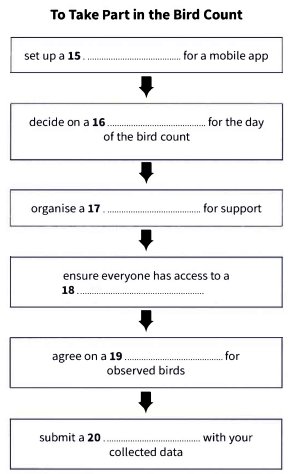
A clear photograph B rough estimate C new account D suitable location E council permit F basic competition G good team H visual guide |
PART 3
Questions
21 – 22
Questions 21-25. Choose the correct letter, A, B or C
- 11
Presentation on restoring and reproduction of paintings
The students agree that the introduction to their presentation should include
- A
reasons why paintings need to be restored.
Bexamples of poor restoration work.
Ca general description of what restoration involves.
- 12
When the students visited the museum, they were surprised by
- A
the time it took to restore a single painting.
Bthe academic backgrounds of the restores.
Cthe materials used in restoration work.
- 13
What does Oliver say would put him off a career in art restoration?
- A
the reaction of the owners of a painting
Bthe possibility of working in dangerous conditions
Cthe requirements to be able draw very well
- 14
What do students agree about the restored Dutch landscape painting?
- A
It shows how taste in art varies amongst different people.
BIt is an example of a work that was once undervalued.
CIt demonstrates how cleaning techniques have greatly improved.
- 15
What is Oliver’s attitude to the digital reproduction of famous paintings?
- A
It requires a great deal of skill.
BThere is something dishonest about it.
CIt makes art accessible to more people.
Questions
23 – 24
Questions 26-30. What challenge did the Factum Arte team face with reproducing the following paintings? Choose FIVE answers from the box and write the correct letter, A-G, next to Questions 26-30.
Challenges the Factum Arte team faced A they only had a photo of a badly restored version of the painting B they needed to see under the damaged surface of the painting C they had to get permission to analyze a very similar painting D they had to rely on similar drawings of the same subject E they had to negotiate with relations of the original artist F they were unable to view other examples of the artist’s work G they had only limited time to produce the painting |
PART 4
Questions
31 – 40
Questions 31-40. Complete the notes below. Write ONE WORD ONLY for each answer.
The Engineer Sarah Guppy, 1770 – 1852 BACKGROUND – women were active in many areas of 19th-century British society, e.g. Jane Harrison was the first female 31
by the end of the century there were 140 female dentists and 212 32
, as well as many musicians and actors SARAH GUPPY – was born in Birmingham and moved to Bristol with her husband – designed bridges that could survive 33
– built 34
of the Clifton Suspension Bridge – was a significant 35
in the Clifton Suspension Bridge together with her husband – designed a ‘barnacle buster’ that allowed 36
to go faster – helped stop 37
near railway lines – built an amusing machine for making different parts of 38
at the same time – designed an early type of 39
equipment CONCLUSIONS – other women worked as engineers, e.g Ada Lovelace and Hertha Marks Ayrton – it was not until 1906 that a woman 40
in engineering
PART 1
Questions
1 – 10Questions 1-10. Complete the notes below. Write ONE WORD AND / OR A NUMBER for each answer.
Giải thích đáp án
Man: Oh, hello. Is this the right number to call for the short film competition?
Organizer: Yes. How can I help?
Man: I know the competition’s been running for ten years, but I’ve never taken part before. I want to be clear on the rules. Is 20 minutes the maximum length of the film?
Organizer: That’s correct. So should I run through some of the other rules for entry?
Man: That’d be great. I’ll make some notes.
Organizer: (Q1) Alright, so the deadline for getting the whole film made and sending it in to us is on Wednesday, May 15th. [Được rồi, hạn chót để hoàn thành toàn bộ phim và gửi cho chúng tôi là vào thứ Tư, ngày 15 tháng Năm]
Man: Oh, really? I thought the submission date was some time at the end of June the 30th.
Organizer: That’s when the judges announce the winners.
Man: Right. I guess I don’t have as much time to make this film as I thought.
Organizer: Now, just so it’s clear, one of the rules is about the team of people you have working with you. Will you be doing most of the filming yourself?
Man: Probably yes.
Organizer: Okay. But perhaps you’ll be needing some technical support with editing and the audio.
Man: I imagine so.
Organizer: That’s fine. (Q2) But you can’t employ any (= don’t use) professional (= with experience) actors I’m afraid. [Nhưng bạn không thể sử dụng bất kỳ diễn viên chuyên nghiệp nào, tôi e là vậy] They all need to be new to acting. Having a go for the first time
Man: I see, not a problem. Now, I know that one of the rules is about the things you need to include in your film.
Organizer: That’s right. Last year all films had to include a scene with a broken pair of glasses.
Man: What about this year?
Organizer: (Q3) Well, it’s been decided that one of your main characters has to be a child or if you prefer, it could be an animal instead. [Chà, người ta đã quyết định rằng một trong những nhân vật chính của bạn phải là một đứa trẻ hoặc nếu bạn thích, đó có thể là một con vật] But we have to see them in a number of scenes. Okay?.
Man: All right. I’ll have a think about that. I’m not sure which one would be easier to work with.
Organizer: It can certainly be a challenge, but that’s what the competition is all about. Now. It’s not just our rules you need to think about. (Q4) You might also need to get permission, say, for example, if you decided you wanted to add some music to the film. [Bạn cũng có thể cần xin phép, chẳng hạn như nếu bạn quyết định muốn thêm nhạc vào phim]
Man: That sounds complicated. I suppose I could use a local band. People I know that would help out. I wouldn’t need permission in that case.
Organizer: Good idea. Then you don’t need to worry about the legal side of things.
Man: All right. That’s clearer, actually is that right that the film doesn’t need to be in English?
Organizer: Yes. Because if a film wins the competition in this country, it could end up being part of an international competition. (Q5) But if you’re going to use another language, you’ve got to provide subtitles and those do have to be in English and 100% accurate (= contain no mistakes). [Nhưng nếu bạn định sử dụng một ngôn ngữ khác, bạn phải cung cấp phụ đề và những phụ đề đó phải bằng tiếng Anh và chính xác 100%.] If they’re not, your film won’t be accepted in the competition.
Man: Seems fair.
Man: I don’t suppose you could give me any advice about making the film, I mean
Organizer: Of course, in my opinion, (Q6) it’s the script that you should concentrate on (= focus on). That comes first (= before doing anything else), work out what everyone’s going to say and go from there. [Kịch bản là thứ mà bạn nên tập trung vào. Kịch bản trước tiên, viết ra những điều mọi người sẽ nói và bắt đầu từ đó.]
Man: Okay. Thanks for that. And I read somewhere that you shouldn’t have too many characters or locations.
Organizer: Yeah, I’d agree with that.
Man: I also read that with short films, the judges have their preferences. I mean, they seem to like films with a serious message, like a documentary. (Q7) I guess I shouldn’t do (= avoid) a comedy because not everyone laughs at the same thing. [Tôi đoán tôi không nên làm một bộ phim hài vì không phải ai cũng cười về cùng một thứ]
Organizer: Yes. Stay away from that kind of film. A story with a clear beginning, middle and end, that’s what the judges look for.
Man: I was thinking I could look at some of the films from last year’s competition. You know, to give me a better idea of what to do.
Organizer: Yes, you could certainly do that. (Q8) If you go to our website, have a look at last year’s winner. His name was Greg Hyslop. [Nếu bạn truy cập trang web của chúng tôi, hãy xem người chiến thắng năm ngoái. Tên anh ấy là Greg Hyslop]
Man: How do you spell that last name?
Organizer: Sure. It’s H-Y-S-L-O-P. His film was actually one of the shorter ones, but the judges really liked it.
Man: Actually, I’m wondering if I’ve seen that one already, isn’t it about an artist, someone who no one appreciates, but then she ends up selling lots of her paintings?
Organizer: That’s right. (Q9) If you want to have another look, the film is called Imagine. [Nếu bạn muốn có một cái nhìn khác, bộ phim có tên là Imagine] It really holds your attention.
Man: Thanks. I’ll have another look after this call.
Organizer: So you know what the prices are? It’s $500 for third place, up to $2,000 for the overall winner. And, of course, the winning films are shown in a theater so the public can see them, too.
Man: That would be an amazing thing to happen. (Q10) So that would be the Bridge theater. [Thế nên đó sẽ là nhà hát Bridge ư?] Would it in the city center?
Organizer: Yes. That’s my favorite theater, actually. Lovely view of the river. So, do you have any more questions that you want to run by?
PART 2
Questions
11 – 12Questions 11-12. Choose TWO letters, A-E. Which TWO tasks will volunteers be required to do at Eskdale Wood?
- 1112
Bạn chọn thiếu đáp án này
Afix fencesBạn chọn thiếu đáp án này
Bremove branchesCcollect litterDbuild bird boxesEcut down trees
Giải thích đáp án
CÂU HỎI 11 & 12 | TRANSCRIPT & GIẢI THÍCH |
Which TWO tasks will volunteers be required to do at Eskdale Wood? A. fix fences B. remove branches C. collect litter D. build bird boxes E. cut down trees | A few big branches have come down and they’re blocking the parts. We need volunteers to pull them off and pile them up somewhere else so they’re not in the way. (=> B) [Một vài cành cây lớn đã đổ xuống và chúng đang chặn hết các phần đường. Chúng tôi cần những người tình nguyện kéo chúng ra và chất chúng thành đống ở một nơi khác để chúng không cản đường] While you’re working, have a look at the bird boxes we placed in the wood last summer. We’re sure that most of them have been used, so that was a job worth doing. The storm has also blown down the fences on the north side of the wood. So we’ll need you to give a hand with repairs. (=> A) [Cơn bão cũng đã thổi bay hàng rào ở phía bắc khu rừng. Vì vậy, chúng tôi sẽ cần bạn giúp một tay với việc sửa chữa] |
DỊCH NGHĨA | |
HAI nhiệm vụ nào tình nguyện viên sẽ được yêu cầu thực hiện tại Eskdale Wood? A. sửa hàng rào B. loại bỏ các cành cây C. nhặt rác D. xây chuồng chim E. chặt cây |
Questions
13 – 14Questions 13-14. Choose TWO letters, A-E. Which TWO things must volunteers bring with them?
- 1314
Bạn chọn thiếu đáp án này
AglovesBtoolsCsnacksDsunscreenBạn chọn thiếu đáp án này
Eboots
Giải thích đáp án
CÂU HỎI 13 & 14 | TRANSCRIPT & GIẢI THÍCH |
Which TWO things must volunteers bring with them? A. gloves B. tools C. snacks D. sunscreen E. boots | What do you need to bring with you? Gloves are essential. You don’t want to end up with cuts and dirt all over your hands. If you don’t have a good pair already, I’d suggest popping into town and buying a pair from the garden center. (=> A) [Găng tay là cần thiết. Bạn không muốn có vết cắt và bụi bẩn trên tay. Nếu bạn chưa có một cặp găng tay tốt, tôi khuyên bạn nên vào thị trấn và mua một cặp từ trung tâm vườn] They seem to have a good range. Now the forecast is for clouds, but at least it’ll be a dry weekend. You can leave your sunscreen at home. As usual, we’ll be handing out any tools you need at the start of the day. Spades, sores, hammers, it’ll all be supplied. There are parts of Eskdale Wood which are still muddy after the storm, so I’d recommend boots. You’ll need to supply your own (=> E) [Có những phần của Eskdale Wood vẫn còn lầy lội sau cơn bão, vì vậy tôi khuyên bạn nên đi ủng. Bạn sẽ cần phải tự mang của mình đi] and I’d put them on in the car park if I were you before you enter the woods. |
DỊCH NGHĨA | |
HAI thứ nào tình nguyện viên phải mang theo? A. găng tay B. dụng cụ C. đồ ăn nhẹ D. kem chống nắng E. ủng |
Questions
15 – 20Questions 15-20. Complete the flow-chart below. Choose SIX answers from the box and write the correct letter, A-H, next to Questions 15-20
A clear photograph B rough estimate C new account D suitable location E council permit F basic competition G good team H visual guide |
Bạn chưa trả lời câu hỏi này
C
Bạn chưa trả lời câu hỏi này
D
Bạn chưa trả lời câu hỏi này
G
Bạn chưa trả lời câu hỏi này
H
Bạn chưa trả lời câu hỏi này
B
Bạn chưa trả lời câu hỏi này
A
Giải thích đáp án
Right. Some of you have expressed an interest in taking part in this year’s Bird Count. The bird count is really useful. It tells us which native birds are doing well or if their numbers are declining. And we can also find out if there are any new species of birds, birds that don’t normally inhabit the woods. So if you decide to take part in the Bird Count, there are a few things you need to do. Nowadays, people don’t tend to record what they see on paper. It’s all done through a mobile app. To get one of those, you’ll need to go online and find a website like Ebird or Nest Watch. (Q15) If you’ve never signed up with them before, register your details (= set up a new account) and they’ll send the mobile app to your phone. (=> C) [Nếu bạn chưa từng đăng ký với họ trước đây, hãy đăng ký thông tin chi tiết của bạn và họ sẽ gửi ứng dụng dành cho thiết bị di động đến điện thoại của bạn] Once you’ve got that sorted, (Q16) you need to consider exactly where you’re going to count (= decide on a suitable location) the birds. (=> D) [bạn cần xem xét chính xác nơi bạn sẽ đếm những con chim] You might decide to spend the day, say, just in a single field, or you might want to cover a wider area. It’s up to you. Stay away from privately owned land because you’d need to get authorization for that.
(Q17) The next thing to do is get some other people to come along and help you (= good team) (=> G). [Điều tiếp theo cần làm là nhờ một số người khác đi cùng và giúp bạn] A group that are also interested in birds and that are capable of using the technology. Yes, because by yourself, it’s easy to miss the birds that might be in the trees behind you. (Q18) Then on the day of the Bird Count, you need to give all your helpers a printout showing pictures of the birds (= visual guide) you’re hoping to see. (=> H) [Sau đó, vào Ngày Đếm Chim, bạn cần đưa cho tất cả những người trợ giúp của mình một bản in có hình ảnh của những con chim mà bạn mong được nhìn thấy] The picture should be clear enough so people can really distinguish between similar looking species. So yes, the document should be in color really. Also remind people that the bird count is not a race to find the most birds possible. It’s supposed to be a group effort with everyone staying in the same place. What else? Okay, at the end of the day, once all the counting’s been finished, get together with the rest of the group. How many birds of one species has everyone seen? Compare notes. It doesn’t really matter if your totals are slightly different. (Q19) Just get everyone to work out and decide more or less what the probable number (= rough estimate) was. (=> B) [Chỉ cần yêu cầu mọi người làm việc và quyết định xấp xỉ con số có thể có] Finally, when you’re ready to submit all the data you’ve collected, have a look at the pictures you’ve taken. Choose the best one. (Q20) You want a sharp image (= clear photo) of a single bird rather than an image of a whole lot of birds in the distance. Upload it (= submit) with your data (=> A) [Bạn sẽ muốn có một hình ảnh sắc nét của một con chim đơn lẻ hơn là hình ảnh của rất nhiều con chim ở xa. Tải nó lên với dữ liệu của bạn] and you never know you might get a prize if yours is the best shot. Alright, let’s move on to the date.
PART 3
Questions
21 – 25Questions 21-25. Choose the correct letter, A, B or C
- 21
Presentation on restoring and reproduction of paintings
The students agree that the introduction to their presentation should include
Bạn chưa trả lời câu hỏi này
- A
reasons why paintings need to be restored.
Bexamples of poor restoration work.
Ca general description of what restoration involves.
Giải thích đáp án
CÂU HỎI 21 | TRANSCRIPT & GIẢI THÍCH |
The students agree that the introduction to their presentation should include A. reasons why paintings need to be restored. B. examples of poor restoration work. C. a general description of what restoration involves. | Oliver: Is that necessary? Let’s start in a visual way, show some paintings that have been restored and talk about why it was necessary. [Hãy bắt đầu một cách trực quan, cho xem một số bức tranh đã được khôi phục và nói về lý do tại sao nó cần thiết] So, for instance, a painting that was damaged by water and another one by insects or by sunlight. Chloe: Okay, let’s go with that. [Được rồi, hãy chọn phương án đó] |
DỊCH NGHĨA | |
Các sinh viên đồng ý rằng phần giới thiệu bài thuyết trình của họ nên bao gồm A. lý do tại sao các bức tranh cần được khôi phục. B. ví dụ về việc khôi phục kém. C. một mô tả chung về những gì liên quan đến phục hồi. |
- 22
When the students visited the museum, they were surprised by
Bạn chưa trả lời câu hỏi này
- A
the time it took to restore a single painting.
Bthe academic backgrounds of the restores.
Cthe materials used in restoration work.
Giải thích đáp án
CÂU HỎI 22 | TRANSCRIPT & GIẢI THÍCH |
When the students visited the museum, they were surprised by … A. the time it took to restore a single painting. B. the academic backgrounds of the restorers. C. the materials used in restoration work. | Chloe: Yes, it was great to see people restoring paintings in front of us. Did you know that most of the restores we met didn’t have a degree in art history? They’ve done things like chemistry and archaeology. I never would have imagined that. [Bạn có biết rằng hầu hết những người phục chế mà chúng tôi gặp đều không có bằng cấp về lịch sử nghệ thuật không? Họ đã làm những việc như hóa học và khảo cổ học. tôi không bao giờ có thể tưởng tượng ra điều đó] Oliver: Me neither. I had no idea those kinds of skills would be useful. [Tôi cũng không. Tôi không biết những loại kỹ năng đó sẽ hữu ích] |
DỊCH NGHĨA | |
Khi các sinh viên đến thăm bảo tàng, họ đã rất ngạc nhiên bởi A. thời gian cần thiết để khôi phục một bức tranh. B. nền tảng học vấn của những người khôi phục. C. các vật liệu được sử dụng trong công việc trùng tu. |
- 23
What does Oliver say would put him off a career in art restoration?
Bạn chưa trả lời câu hỏi này
- A
the reaction of the owners of a painting
Bthe possibility of working in dangerous conditions
Cthe requirements to be able draw very well
Giải thích đáp án
CÂU HỎI 23 | TRANSCRIPT & GIẢI THÍCH |
What does Oliver say would put him off a career in art restoration? A. the reaction of the owners of a painting. B. the possibility of working in dangerous conditions. C. the requirement to be able to draw very well. | Oliver: I wouldn’t mind that. But the thing is, when someone owns the painting you’re working on, you’ve got to get it right. What if they didn’t like the colors you’d used? Too much pressure. [Nhưng vấn đề là, khi ai đó sở hữu bức tranh mà bạn đang thực hiện, bạn phải làm cho đúng. Điều gì sẽ xảy ra nếu họ không thích màu bạn đã sử dụng? Quá nhiều áp lực] |
DỊCH NGHĨA | |
Oliver nói điều gì sẽ khiến anh ấy rời bỏ sự nghiệp phục hồi nghệ thuật? A. phản ứng của chủ nhân bức tranh. B. khả năng làm việc trong điều kiện nguy hiểm. C. yêu cầu về việc có thể vẽ rất tốt. |
- 24
What do students agree about the restored Dutch landscape painting?
Bạn chưa trả lời câu hỏi này
- A
It shows how taste in art varies amongst different people.
BIt is an example of a work that was once undervalued.
CIt demonstrates how cleaning techniques have greatly improved.
Giải thích đáp án
CÂU HỎI 24 | TRANSCRIPT & GIẢI THÍCH |
What do the students agree about the restored Dutch landscape painting? A. It shows how taste in art varies amongst different people. B. It is an example of a work that was once undervalued. C. It demonstrates how cleaning techniques have greatly improved. | Chloe: Yes, the original artist had painted a whale on the beach. And later, I suppose the paint was bought by someone who sought the whale ruined a pretty scene. And they paid another artist to cover it up. [Vâng, nghệ sĩ ban đầu đã vẽ một con cá voi trên bãi biển. Sau này, tôi cho rằng bức tranh được mua bởi một người cho rằng cá voi đã phá hỏng một khung cảnh đẹp đẽ. Và họ đã trả tiền cho một nghệ sĩ khác để che nó đi] Oliver: You must be right. Not everyone judges a painting in the same way, obviously. [Bạn nói đúng đấy. Rõ ràng là không phải ai cũng đánh giá một bức tranh theo cùng một cách] Anyway, we’ll have plenty to say about restoration. What about digital reproduction? |
DỊCH NGHĨA | |
Học sinh đồng ý điều gì về bức tranh phong cảnh Hà Lan được khôi phục? A. Nó cho thấy thị hiếu về nghệ thuật giữa những người khác nhau khác nhau như thế nào. B. Đó là một ví dụ về tác phẩm đã từng bị định giá thấp. C. Nó cho thấy kỹ thuật làm sạch đã được cải thiện rất nhiều như thế nào. |
- 25
What is Oliver’s attitude to the digital reproduction of famous paintings?
Bạn chưa trả lời câu hỏi này
- A
It requires a great deal of skill.
BThere is something dishonest about it.
CIt makes art accessible to more people.
Giải thích đáp án
CÂU HỎI 25 | TRANSCRIPT & GIẢI THÍCH |
What is Oliver’s attitude to the digital reproduction of famous paintings? A. It requires a great deal of skill. B. There is something dishonest about it. C. It makes art accessible to more people. | Oliver: I guess the difference between a digital reproduction and a fake painting is no one’s pretending it was painted by the original artist. And what I like about digital reproduction is you could potentially make lots of copies so a wider audience can see them. [Và điều tôi thích về sao chép kỹ thuật số là bạn có khả năng tạo ra nhiều bản sao để nhiều khán giả hơn có thể xem chúng]
|
DỊCH NGHĨA | |
Oliver có thái độ như thế nào đối với việc tái tạo kỹ thuật số các bức tranh nổi tiếng? A. Nó đòi hỏi rất nhiều kỹ năng. B. Có điều gì đó không trung thực về nó. C. Nó làm cho nghệ thuật có thể tiếp cận được với nhiều người hơn. |
Questions
26 – 30Questions 26-30. What challenge did the Factum Arte team face with reproducing the following paintings? Choose FIVE answers from the box and write the correct letter, A-G, next to Questions 26-30.
Challenges the Factum Arte team faced A they only had a photo of a badly restored version of the painting B they needed to see under the damaged surface of the painting C they had to get permission to analyze a very similar painting D they had to rely on similar drawings of the same subject E they had to negotiate with relations of the original artist F they were unable to view other examples of the artist’s work G they had only limited time to produce the painting |
Bạn chưa trả lời câu hỏi này
C
Bạn chưa trả lời câu hỏi này
A
Bạn chưa trả lời câu hỏi này
D
Bạn chưa trả lời câu hỏi này
B
Bạn chưa trả lời câu hỏi này
F
Giải thích đáp án
Chloe: Okay. So if we’re talking about digital reproduction of art, we have to mention the company factum, are they and how they reproduced famous paintings that have been lost or damaged so they can go on public display?
Oliver: Good idea.
Chloe: Let’s note down the challenges the team faced. What about Vincent Van Gogh’s Six Sunflowers? The original painting was destroyed. The team had a photo of it, but it wasn’t very clear
Oliver: Right. They couldn’t see how Van Gogh had used his brush. They knew the National Gallery had a nearly identical Sunflower painting (= a very similar painting) by Van Gogh, (Q26) and so they had to ask the Gallery whether the team would be allowed to study and scan it so they could reproduce the brush strokes (= had to get permission to analyse) in the right way. (=> C) [và vì vậy họ phải hỏi Phòng trưng bày xem liệu nhóm có được phép nghiên cứu và scan nó để họ có thể tái tạo các nét vẽ đúng cách hay không]
Chloe: They got approval in the end. [Kết quả là họ đã nhận được sự chấp thuận]
Oliver: What about The Concert? The original was stolen, right?
Chloe: (Q27) The team had a photo they could use, but the problem was, it was a photo of the concert after someone had tried to touch it up (= had a photo of a badly restored version of the painting) with fresh paint. (=> A) [Nhóm đã có một bức ảnh mà họ có thể sử dụng, nhưng vấn đề là, đó là bức ảnh của buổi hòa nhạc sau khi ai đó đã cố gắng chỉnh sửa nó bằng sơn mới.]
Oliver: And they’d done a terrible job, haven’t they?
Chloe: Yes. But the team were happy with the reproduction. In the end, we should mention the Portrait of Sir Winston Churchill.
Oliver: Churchill hated that portrait, so his wife burnt it and nothing was left.
Chloe: (Q28) So the phantom arty team had to search for the pencil sketches the artist had also made of Churchill (= had to rely on similar drawings of the same subject) as part of his preparation. (=> D) [Vì vậy, nhóm ma thuật phải tìm kiếm các bản phác thảo bằng bút chì mà nghệ sĩ cũng đã thực hiện về Churchill như một phần trong quá trình chuẩn bị của anh ấy]
Oliver: Right. For me, I was most interested in the Water Lilies.
Chloe: By Cloud Mane. In that case, the painting wasn’t lust, but the top layer of paint had turned completely black because of smoke from a fire. (Q29) The team had to work out what the colors beneath (= needed to see under the damaged surface) that layer had been. (=> B) [Nhóm phải tìm ra màu sắc bên dưới lớp đó là gì]
Oliver: And then there was Myrto, a painting by Tamara De Lempicka. No one knows for sure what happened to the original. At least a team had a black and white photo they could work from.
Chloe: But they needed to know what colors Lim Pico would have used. (Q30) And most of her other paintings (= the artist’s work) are held in private collections. Because of that, they couldn’t go and see them (= unable to view other examples) (=> F) [Và hầu hết các bức tranh khác của cô ấy được giữ trong các bộ sưu tập tư nhân. Vì vậy, họ không thể đi xem chúng.] That’s a shame, because her work would have been…
PART 4
Questions
31 – 40Questions 31-40. Complete the notes below. Write ONE WORD ONLY for each answer.
Giải thích đáp án
Hello, everyone. So I’d like to tell you about some of the challenges of living in space. We’ll start with the International Space Station, or ISS, as it’s often called. The ISS has been in space in orbit around the Earth since 1998. Over 1200 astronauts have lived on board, and one of the biggest challenges for them is living in microgravity. So, what happens when you’re living in microgravity 24 hours a day for months?
For a start, it affects your blood circulation on Earth. Your blood would naturally be pulled towards your feet. But in space it goes to your head and we’ll talk a bit more about the consequences of that later. (Q31) But it also goes to your chest. [Nhưng nó cũng đi vào ngực của bạn] And that’s why astronauts have to be careful about their blood pressure. Microgravity also affects the minerals stored inside your body over time. (Q32) For example, the amount of calcium inside your bones begins to decrease (= lose), so the bones become weaker. [Ví dụ, lượng canxi bên trong xương của bạn bắt đầu giảm, do đó xương trở nên yếu hơn Yes, it’s not much fun living in space. The astronauts have to maintain a very strict exercise program. (Q33) They do 2.5 hours of exercise six days a week if they don’t, what happens is that their muscle begins to waste (= loss). [Họ tập thể dục 2,5 giờ sáu ngày một tuần, nếu họ không tập thể dục, điều xảy ra là cơ bắp của họ bắt đầu hao mòn] Some of it also turns into fat. And one final problem that some astronauts experience, they find that when they get back to Earth, they can’t see clearly. (Q34) Scientists aren’t exactly sure why this happens, but it seems that the astronauts vision can be permanently affected. [Các nhà khoa học không chắc chắn chính xác tại sao điều này lại xảy ra, nhưng có vẻ như tầm nhìn của các phi hành gia có thể bị ảnh hưởng vĩnh viễn.]
Another challenge with living in the ISS is you have to take everything you need with you. So space agencies like NASA are constantly improving the way they recycle things. Water, of course, is a vital resource, and every little bit counts. (Q35) That means that even the sweat that the astronauts produce is recycled. [Điều đó có nghĩa là ngay cả mồ hôi mà các phi hành gia tiết ra cũng được tái chế] I know that doesn’t sound very nice, but NASA says their water is purer than anything you’d drink on Earth.
So, what’s next? Humans are already living in space in the space station, but now the goal is to live on the Moon or Mars. For this, we need to make buildings. And the challenges for engineers and architects are even harder. (Q36) It’s incredibly expensive to transport materials into space, so they need to be as light as possible. [Vận chuyển vật liệu vào không gian cực kỳ tốn kém, vì vậy chúng cần phải càng nhẹ càng tốt] The alternative is to use materials which already exist on the moon or mars. And this does seem to be the sensible way forward. So to make buildings on the moon, for example, we could use rock, and the moon also has plenty of useful minerals. These can be made into metal into brick. (Q37) And some engineers are also suggesting they could produce paint. [Và một số kỹ sư cũng gợi ý rằng họ có thể sản xuất sơn] So it seems everything we need for a basic building might already be on the moon. (Q38) Actually, there’s one thing that NASA hasn’t managed yet, and that’s to increase the size (= make large) of the windows on the ISS, they’re very small. [Trên thực tế, có một điều mà NASA chưa làm được và đó là tăng kích thước các cửa sổ trên ISS, chúng rất nhỏ] And if people were going to live in buildings on the moon, this is something NASA still has to work on.
So, even if we managed to create a network of buildings for people to live in on the Moon or Mars and grow food and be self-sufficient, they would still need mental stimulation and opportunities to relax and stay in touch with what was happening back on Earth. Virtual reality could be the answer. (Q39) Imagine you’re living on the moon, but you could use virtual reality to walk around (= to visit) a museum and see all the exhibits. [Hãy tưởng tượng bạn đang sống trên mặt trăng, nhưng bạn có thể sử dụng thực tế ảo để đi bộ xung quanh một bảo tàng và xem tất cả các cuộc triển lãm] That would be incredible. (Q40) And by using virtual reality, you could continue your education by, say, studying for (= get) a qualification that might be useful in your current environment, or once you’re back on Earth. [Và bằng cách sử dụng thực tế ảo, bạn có thể tiếp tục việc học của mình bằng cách học lấy bằng cấp có thể hữu ích trong môi trường hiện tại của bạn hoặc sau khi bạn quay lại Trái đất] Now Mars is a different thing….
