
Strategies for the IELTS 2 – Test 4
23/10/2024 2024-10-23 4:18Strategies for the IELTS 2 – Test 4
PART 1
Questions
1 – 10
Questions 1-10. Complete the notes below. Write NO MORE THAN TWO WORDS AND / OR A NUMBER for each answer.

Chỗ trống 1
Chỗ trống 2
Chỗ trống 3
Chỗ trống 4
Chỗ trống 5
Chỗ trống 6
Chỗ trống 7
Chỗ trống 8
Chỗ trống 9
Chỗ trống 10
PART 2
Questions
11 – 15
Questions 11-15. Choose the correct letter, A, B, or C.
- 11
What was recently discovered at this site?
- A
a written text about the area
Bvarious tools used for farming
Csome drawings showing the garden
- 12
This location is good for gardening because
- A
the weather is warm.
Bthere is enough water.
Cit is protected from the wind.
- 13
In 1860, what was built on this site?
- A
a medical centre
Ba type of factory
Ca base for soldiers
- 14
Today, the fruit and vegetables from the gardens
- A
are sold to businesses in the area.
Bare given to certain local people.
Care used by those who work in the garden.
- 15
The local college now uses the gardens
- A
as a location for scientific research.
Bfor educating the wider community.
Cto teach its students gardening skills.
Questions
16 – 20
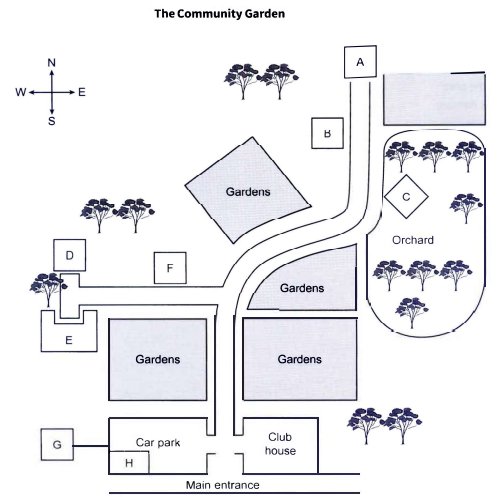
Questions 16-20. Label the map below. Write the correct letter, A-H, next to Questions 16-20.
PART 3
Questions
21 – 25
Questions 21-25. Choose the correct letter, A, B or C.
- 21
According to Alya and Jason, Dr Franklin showed that video games have
- A
been used in therapy for a long time.
Bonly a limited number of uses in therapy.
Cbeen accepted by most doctors working in therapy.
- 22
According to the students, what is the biggest advantages of games in therapy?
- A
Some injuries occur less frequently.
BCosts are lower than other treatments.
CPatients work harder at the researchers.
- 23
When discussing the Singapore study, the students disagree about
- A
the purpose of the research.
Bthe methodology used in the research.
Cthe conclusions reached by the researchers.
- 24
What impresses the students about the anxiety research?
- A
the variety of games that were used
Bresults were confirmed in another study
Cboth patients and their families benefitted
- 25
The students agree that the Rode Island research
- A
provided reliable evidence.
Bhas received widespread publicity.
Chas been criticised by some academics.
Questions
26 – 30
Questions 26-30. Choose FIVE answers from the box and write the correct letter, A-G, next to Questions 26-30.
PART 4
Questions
31 – 40
Questions 31-40. Complete the notes below. Write ONE WORD ONLY for each answer.
Traditional Polynesian Navigation +) Introduction – the islands of Polynesia are in the Pacific Ocean – the Polynesian peoples originally migrated from 31
to the Pacific islands – European explorers were impressed that Polynesian canoes were 32
than European ships +) Equipment on ocean-going canoes – paddles were use for 33
– sails were made from the pandanus plant – warm clothes were made from 34
of the paper mulberry tree +) How Polynesians navigated at sea – they did not have the magnetic compass – they remembered where stars rose and set by making up detailed 35
– when it was cloudy, they found the direction by using 36
+) Finding new islands – they could identify certain 37
that only live near land – close to land, they could read changes in the sea’s 38
+) Recent history – in 1967 the canoe Hokule’a sailed from Hawaii to Tahiti without 39
– now replica traditional canoes have sailed across the Pacific and around the world – as well as sailing, these voyages have created fresh interest in Polynesian culture, music and 40
PART 1
Questions
1 – 10Questions 1-10. Complete the notes below. Write NO MORE THAN TWO WORDS AND / OR A NUMBER for each answer.
Giải thích đáp án
Brian: Good morning. Island Transport company, this is Brian speaking.
Jenny: Morning. This is Jenny Cartwright here. I’m visiting the island next week and I want to hire some form of transport.
Brian: No problem, Jenny. Island Transport can offer a range of different vehicles to hire. So, um, the first option is a motor scooter – they’re very popular.
Jenny: Oh right. And how much do they cost to hire?
Brian: Well, you can hire them by the hour or by the day. Per hour, it’s $15.50.
Jenny: And what about for a day?
Brian: (Q1) Daily (=per day), it’s $49.99. (Mỗi ngày là 49,99 đô la.) That includes a full tank of petrol, but you need to fill it up before you bring it back.
Jenny: Is a scooter a good way to get around the island?
Brian: Oh yes, it’s a lot of fun. Visitors really enjoy it.
Jenny: (Q2) Do you provide helmets? (Bạn có cung cấp mũ bảo hiểm không?)
Brian: Yes of course, all sizes. We can also let you have gloves as well – it’s not a bad idea. (Có tất nhiên, tất cả các kích cỡ. Chúng tôi cũng có thể đưa bạn găng tay – đó không phải là một ý kiến tồi)
Jenny: Oh yes, I hadn’t thought of that.
Brian: The only thing is with the scooters, you have to keep to sealed roads. (Q3) That means you can’t ride on Battenburg Road – so you can’t visit the far end of the island. (Điều đó có nghĩa là bạn không thể đi xe trên Đường Battenburg – vì vậy bạn không thể đến thăm nơi xa nhất của hòn đảo)
Jenny: Sorry, I didn’t catch the name of the road. Could you spell it?
Brian: Sure, it’s spelt: B-A-T-T-E-N-B-U-R-G. But there are still plenty of other places you can explore on a scooter.
Jenny: OK. And what about a car?
Brian: Yes, we’ve got a range of cars.
Jenny: Well, there’s four of us. But if we do go for the car option, we’d be happy with a very small, basic one.
Brian: An ‘economy car’ would be $87.80 per day. That’s for a four-door car, it can take five passengers.
Jenny: Right, OK.
Brian: (Q4) And a car is the best way to see the whole island. You can drive on all the roads. And if you’d like to go for a swim, you can drive right down to Green Bay, which visitors love. (Và ô tô là cách tốt nhất để ngắm nhìn toàn bộ hòn đảo. Bạn có thể lái xe trên tất cả các con đường. Và nếu bạn muốn đi bơi, bạn có thể lái xe ngay xuống Green Bay, nơi du khách yêu thích)
Jenny: Well, a car is definitely something to consider. It’s certainly a good price, if we split it between the four of us.
Brian: Exactly.
Jenny: (Q5) Only thing is, it’s pretty hot at this time of year. Does the car have air conditioning? (Chỉ có điều là thời tiết khá nóng vào thời điểm này trong năm. Xe có máy lạnh không?)
Brian: Not that model, no. (Không phải mẫu đó, không). You’d need one of our bigger cars if you want that.
Jenny: Well, maybe it doesn’t matter.
Now listen and answer questions 6 to 10.
Brian: The other option to consider is an E-Bike. These are very popular – like a normal bicycle, but with electric power to help you along.
Jenny: How much are they?
Brian: (Q6) Normally they’re $59 per day, but I can offer you a discounted rate at the moment of $52.20 (Thông thường chúng có phí 59 đô la mỗi ngày, nhưng tôi có thể cung cấp cho bạn mức chiết khấu tại thời điểm này là 52,20 đô la). Jenny: Oh, OK.
Brian: To be honest, a lot of our customers these days prefer E-Bikes to motor scooters, because they’re so quiet and peaceful. (Q7) On some E-Bikes, the battery is really (=very) heavy, but on these bikes it’s nice and light. (Với một số Xe đạp điện, pin thực sự nặng, nhưng trên những chiếc xe đạp này thì pin rất đẹp và nhẹ)
Jenny: I’ve never ridden an E-Bike before. How difficult is it?
Brian: Not difficult at all. You’ll find they are very easy to handle. Like I say, just like a normal pedal bike really, but you don’t have to do too much work. Which is a good thing because the island is quite hilly. (Q8) These are good quality bikes too. Well made with high quality brakes both front and back, so you won’t have any problems. (Đây cũng là những chiếc xe đạp chất lượng tốt. Được chế tạo tốt với hệ thống phanh chất lượng cao ở cả trước và sau, vì vậy bạn sẽ không gặp bất kỳ vấn đề gì)
Jenny: Well, that does sound like a lot of fun. Do they come with GPS?
Brian: No, but (Q9) we can provide you with a map. (chúng tôi có thể cung cấp cho bạn một bản đồ)
Jenny: What about a lock? (Còn khóa thì sao?)
Brian: Yup, one of those as well (Yup, cả nó nữa), with each bike, so you can leave it securely if you want to.
Jenny: I think my friends will like the idea of an E-Bike. A good compromise.
Brian: Like I say, they’re very popular these days. (Q10) And another big advantage is that you don’t have to have a license for this type of vehicle. (Và một lợi thế lớn nữa là bạn không cần phải có bằng lái cho loại phương tiện này)
Jenny: Well, let me discuss it with my friends and I’ll get back to you.
Brian: No problem. Thanks for your…
PART 2
Questions
11 – 15Questions 11-15. Choose the correct letter, A, B, or C.
- 11
What was recently discovered at this site?
Bạn chưa trả lời câu hỏi này
- A
a written text about the area
Bvarious tools used for farming
Csome drawings showing the garden
Giải thích đáp án
CÂU HỎI | TRANSCRIPT & GIẢI THÍCH |
11. What was recently discovered at this site? A. a written text about the area B. various tools used for farming C. some drawings showing the garden
| Well, recently we made an interesting discovery at the garden. Before, we didn’t know much about the history of this site. We only had a few documents and records. Then we found some ancient implements, like spades and forks, for digging. They were buried in the earth. Experts say these are at least 1000 years old. So people have been using this land for growing produce for a long time. (Sau đó, chúng tôi tìm thấy một số dụng cụ cổ xưa, như thuổng và đinh ba, để đào đất. Chúng đã bị chôn vùi trong đất. Các chuyên gia cho biết những thứ này có ít nhất 1000 năm tuổi. Vì vậy, người dân đã sử dụng vùng đất này để trồng trọt trong một thời gian dài) |
DỊCH NGHĨA | |
11. Những gì gần đây đã được phát hiện tại địa điểm này? A. một văn bản viết về khu vực B. các công cụ khác nhau được sử dụng để làm nông C. một số bản vẽ khu vườn
|
- 12
This location is good for gardening because
Bạn chưa trả lời câu hỏi này
- A
the weather is warm.
Bthere is enough water.
Cit is protected from the wind.
Giải thích đáp án
CÂU HỎI | TRANSCRIPT & GIẢI THÍCH |
12. This location is good for gardening because A. the weather is warm. B. There is enough water. C. it is protected from the wind.
| So, why was this location so good for gardening? As you can see, we’re in a slight valley. And storms blow very hard up this valley, which can be a problem. But being in a valley, we get good freezing frosts here in winter, which gardeners like because it kills the bugs. The great thing, though, is the stream that runs through the valley, so we can irrigate the gardens even through long, dry summers. (Tuy nhiên, điều tuyệt vời là dòng suối chảy qua thung lũng, vì vậy chúng tôi có thể tưới cho các khu vườn ngay cả trong mùa hè khô hạn kéo dài) |
DỊCH NGHĨA | |
12. Vị trí này rất tốt cho việc làm vườn vì A. thời tiết ấm áp. B. Có đủ nước. C. nó được bảo vệ khỏi gió.
|
- 13
In 1860, what was built on this site?
Bạn chưa trả lời câu hỏi này
- A
a medical centre
Ba type of factory
Ca base for soldiers
Giải thích đáp án
CÂU HỎI | TRANSCRIPT & GIẢI THÍCH |
13. In 1860, what was built on this site? A. a medical center B. a type of factory C. a base for soldiers
| Now what we do know is that in 1860, gardening stopped here. This was a time of rapid development in this area. And on that date, the City Infirmary was constructed on this site, so this is where doctors and surgeons worked to take care of the health needs of the growing population (Và vào ngày đó, Bệnh xá Thành phố được xây dựng trên địa điểm này, vì vậy đây là nơi các bác sĩ và bác sĩ phẫu thuật làm việc để chăm sóc nhu cầu sức khỏe của dân số ngày càng tăng) Also, many new houses were put up for people who commuted into the city each day to work. There was even talk of a new military camp, although that never happened in the end. |
DỊCH NGHĨA | |
13. Vào năm 1860, cái gì được xây dựng ở địa điểm này? A. một trung tâm y tế B. một loại nhà máy C. căn cứ cho binh lính
|
- 14
Today, the fruit and vegetables from the gardens
Bạn chưa trả lời câu hỏi này
- A
are sold to businesses in the area.
Bare given to certain local people.
Care used by those who work in the garden.
Giải thích đáp án
CÂU HỎI | TRANSCRIPT & GIẢI THÍCH |
14. Today, the fruit and vegetables from the gardens are … A. sold to businesses in the area. B. given to certain local people. C. used by those who work in the garden.
| Then in the 1980s, the old buildings here were removed. And this land again became a productive garden. Today, these gardens produce large quantities of fruit and vegetables. Each plot of land is worked by a volunteer member of the garden, and they donate what they grow to families in this neighborhood who are struggling financially (Mỗi mảnh đất do một tình nguyện viên của khu vườn chăm sóc và họ tặng những gì họ trồng được cho những gia đình đang gặp khó khăn về tài chính trong khu phố này). Occasionally we are approached by local businesses and restaurants wanting to buy our organic produce, but we just don’t have enough. |
DỊCH NGHĨA | |
14. Ngày nay, trái cây và rau quả từ các khu vườn… A. được bán cho các doanh nghiệp trên địa bàn. B. được trao cho một số người dân địa phương. C. được sử dụng bởi những người làm việc trong vườn. |
- 15
The local college now uses the gardens
Bạn chưa trả lời câu hỏi này
- A
as a location for scientific research.
Bfor educating the wider community.
Cto teach its students gardening skills.
Giải thích đáp án
CÂU HỎI | TRANSCRIPT & GIẢI THÍCH |
15. The local college now uses the gardens A. as a location for scientific research. B. for educating the wider community. C. to teach its students gardening skills. | We also have a good relationship with the local college. In fact, several of the academics there are members of the garden. Each week, undergraduates enrolled on the college’s horticulture course have a class here, to learn about their subject first hand (Trên thực tế, một số học giả ở đó là thành viên của khu vườn. Mỗi tuần, sinh viên đã đăng ký khóa học làm vườn của trường đại học có một lớp học ở đây để tìm hiểu trực tiếp về môn học của họ). And in future the college hopes to hold workshops here, to help local people establish vegetable gardens at home. |
DỊCH NGHĨA | |
15. Trường đại học địa phương hiện đang sử dụng các khu vườn A. làm địa điểm nghiên cứu khoa học. B. để giáo dục cộng đồng rộng lớn hơn. C. dạy học sinh kỹ năng làm vườn. |
Questions
16 – 20Questions 16-20. Label the map below. Write the correct letter, A-H, next to Questions 16-20.
Bạn chưa trả lời câu hỏi này
F
Bạn chưa trả lời câu hỏi này
C
Bạn chưa trả lời câu hỏi này
G
Bạn chưa trả lời câu hỏi này
E
Bạn chưa trả lời câu hỏi này
A
Giải thích đáp án
Man: OK, now I’ll just point out a few places of interest around the gardens. So, can you all look at your maps please? OK, so we’re now standing at the main entrance to the gardens, outside the club house.
So, you might be interested in our worm farms. This is where we make fertilizer. (Q16) To get there, from the main entrance, head north. You’ll pass gardens on either side of the path. Just before the path curves round to the right, there’s a turning on the left. Go down there and the worm farms are inside the first building you come to. (Để đến đó, từ lối vào chính, đi về phía bắc. Bạn sẽ đi qua những khu vườn ở hai bên đường. Ngay trước khi con đường vòng qua bên phải, có một ngã rẽ ở bên trái. Đi xuống đó và các trang trại trùn sẽ ở bên trong tòa nhà đầu tiên bạn đến)
It’s also worth visiting our seed store. (Q17) Again, head north and follow the path as it curves round to the right through the gardens. You’ll come to the orchard. Follow the path around the edge of the orchard – but don’t go too far. The seed store is actually located inside the orchard – a very pretty spot. (Một lần nữa, đi về phía bắc và đi theo con đường khi nó uốn quanh bên phải qua các khu vườn. Bạn sẽ đến vườn cây ăn quả. Đi theo con đường quanh rìa vườn cây ăn quả – nhưng đừng đi quá xa. Cửa hàng hạt giống thực sự nằm bên trong vườn cây ăn quả – một nơi rất đẹp)
Now the machinery shed might interest some of you. (Q18) From the main entrance, just go into the car park and walk right to the end. You’ll see a little path heading out to the west – it’s down there. (Từ lối vào chính, chỉ cần đi vào bãi đậu xe và đi bộ đến cuối. Bạn sẽ thấy một con đường nhỏ hướng ra phía tây – nó ở dưới đó)
Our compost heaps are also pretty impressive. (Q19) So, head north from the main entrance, go past the first gardens and take the first turn on the left. Go to the end of that path. The compost heaps are built in the shape of a letter ‘U’. (Vì vậy, hãy đi về phía bắc từ lối vào chính, đi qua những khu vườn đầu tiên và rẽ trái ở ngã rẽ đầu tiên. Đi đến cuối con đường đó. Các đống ủ được xây dựng theo hình chữ ‘U’)
The drying room is also interesting. (Q20) This is where we dry fruit, to preserve it. To see how it’s done, walk up through the gardens till you come to the orchard. Keep heading north and the drying room is right at the very end of that path – as far as you can go. (Đây là nơi chúng tôi sấy khô trái cây để bảo quản. Để xem nó được thực hiện như thế nào, hãy đi bộ qua các khu vườn cho đến khi bạn đến vườn cây ăn quả. Tiếp tục đi về phía bắc và phòng sấy khô ở ngay cuối con đường đó – càng xa càng tốt)
Now one other thing I’ll mention…
PART 3
Questions
21 – 25Questions 21-25. Choose the correct letter, A, B or C.
- 21
According to Alya and Jason, Dr Franklin showed that video games have
Bạn chưa trả lời câu hỏi này
- A
been used in therapy for a long time.
Bonly a limited number of uses in therapy.
Cbeen accepted by most doctors working in therapy.
Giải thích đáp án
CÂU HỎI | TRANSCRIPT & GIẢI THÍCH |
21. According to Alya and Jason, Dr Franklin showed that video games have … A. been used in therapy for a long time. B. only a limited number of users in therapy. C. been accepted by most doctors working in therapy.
| Alya: Yes, the use of games in therapy. Jason: So, we’ll need to explain what kind of ‘therapy’ he’s talking about Alya: OK, so it’s treating people after accidents or illnesses – rebuilding their body strength. Jason: Exactly. And Dr Franklin sees huge potential for games. Alya: But he made the point that this isn’t new. Really, since the 1990s, therapists have been experimenting with games (Nhưng anh ấy đã đưa ra quan điểm rằng điều này không phải là mới. Thực sự, từ những năm 1990, các nhà trị liệu đã thử nghiệm với các trò chơi). |
DỊCH NGHĨA | |
21. Theo Alya và Jason, Tiến sĩ Franklin đã chỉ ra rằng trò chơi điện tử có… A. đã được sử dụng trong trị liệu trong một thời gian dài. B. chỉ một số lượng hạn chế người dùng trong trị liệu. C. được chấp nhận bởi hầu hết các bác sĩ làm việc trong lĩnh vực trị liệu.
|
- 22
According to the students, what is the biggest advantages of games in therapy?
Bạn chưa trả lời câu hỏi này
- A
Some injuries occur less frequently.
BCosts are lower than other treatments.
CPatients work harder at the researchers.
Giải thích đáp án
CÂU HỎI | TRANSCRIPT & GIẢI THÍCH |
22. According to the students, what is the biggest advantage of games in therapy? A. Some injuries occur less frequently. B. Costs are lower than other treatments. C. Patients work harder at their recovery.
| Jason: Yeah, but so are conventional exercises. I don’t think that’s an issue. Alya: No, OK. But I read that the games are really motivating. People are much more prepared to spend hours on rehabilitation, when a game’s involved. (Đúng vậy. Nhưng tôi đọc được rằng các trò chơi thực sự tạo động lực. Người ta sẵn sàng để dành hàng giờ cho việc phục hồi chức năng hơn nhiều khi có trò chơi.). Jason: I think you’re right. That’s the most important benefit. In fact, I read some people actually get so caught up in the game they hurt themselves, and the therapists have to slow them down. (Tôi nghĩ bạn đúng. Đó là lợi ích quan trọng nhất. Trên thực tế, tôi đã đọc một số người thực sự bị cuốn vào trò chơi đến nỗi họ tự làm tổn thương chính mình và các nhà trị liệu phải làm họ chậm lại) |
DỊCH NGHĨA | |
22. Theo học viên, ưu điểm lớn nhất của trò chơi trong trị liệu là gì? A. Một số chấn thương ít xảy ra hơn. B. Chi phí thấp hơn so với các phương pháp điều trị khác. C. Bệnh nhân làm việc chăm chỉ hơn trong quá trình phục hồi của họ.
|
- 23
When discussing the Singapore study, the students disagree about
Bạn chưa trả lời câu hỏi này
- A
the purpose of the research.
Bthe methodology used in the research.
Cthe conclusions reached by the researchers.
Giải thích đáp án
CÂU HỎI | TRANSCRIPT & GIẢI THÍCH |
23. When discussing the Singapore study, the students disagree about … A. the purpose of the research. B. the methodology used in the research. C. The conclusions reached by the researchers.
| Alya: That’s right. They got a group of teenagers and over-60s together for 30 minutes a day playing video games. Jason: But the subjects weren’t all in the same place. They were playing online. (Nhưng các đối tượng không phải ở cùng một nơi. Họ đang chơi trực tuyến). Alya: No, they were all together in a room. That’s how the experiment was conducted. (Không, tất cả họ đều ở cùng nhau trong một căn phòng. Đó là cách thí nghiệm được tiến hành) Jason: We should check, I’m sure it was online |
DỊCH NGHĨA | |
23. Khi thảo luận về du học Singapore, các sinh viên không đồng ý về … A. mục đích của nghiên cứu. B. phương pháp được sử dụng trong nghiên cứu. C. các kết luận đạt được bởi các nhà nghiên cứu.
|
- 24
What impresses the students about the anxiety research?
Bạn chưa trả lời câu hỏi này
- A
the variety of games that were used
Bresults were confirmed in another study
Cboth patients and their families benefitted
Giải thích đáp án
CÂU HỎI | TRANSCRIPT & GIẢI THÍCH |
24. What impresses the students about the anxiety research? A. the variety of games that were used B. results were confirmed in another study C. both patients and their families benefited
| Jason: Well, just simple ones on handheld devices. And they found that the children who played games experienced considerably less stress and anxiety. Games distract the mind – that’s the theory. Alya: Better for the children, but also better for the parents. That’s what I like about this. (Tốt hơn cho trẻ em, nhưng cũng tốt hơn cho cha mẹ chúng. Đó là những gì tôi thích về nó) Jason: Yeah good point – it reduces the stress for everybody. There just needs to be some additional research to support the finding. |
DỊCH NGHĨA | |
24. Điều gì gây ấn tượng với sinh viên về nghiên cứu lo âu? A. nhiều trò chơi đã được sử dụng B. kết quả đã được xác nhận trong một nghiên cứu khác C. cả bệnh nhân và gia đình họ đều được hưởng lợi
|
- 25
The students agree that the Rode Island research
Bạn chưa trả lời câu hỏi này
- A
provided reliable evidence.
Bhas received widespread publicity.
Chas been criticised by some academics.
Giải thích đáp án
CÂU HỎI | TRANSCRIPT & GIẢI THÍCH |
25. The students agree that the Rhode Island research … A. provided reliable evidence. B. has received widespread publicity. C. has been criticized by some academics.
| A: We should also mention the Rhode Island research J: Maybe, but the finding just reinforced what’s been shown in earlier studies. The people can be distracted from their bad habits like eating junk food or drinking fizzy drinks by playing games. A: But no one had used MRI scans before, and the brain scans showed that games activate the same reward center in the brain as the drinks or junk food. This study has supplied valid proof as to why games work this way (Nhưng trước đây chưa có ai sử dụng quét MRI và quét não cho thấy trò chơi kích hoạt cùng một trung tâm phần thưởng trong não giống như đồ uống hoặc đồ ăn vặt. Nghiên cứu này đã cung cấp bằng chứng hợp lệ về lý do tại sao trò chơi hoạt động theo cách này) J: Actually, that’s a good point
|
DỊCH NGHĨA | |
25. Các sinh viên đồng ý rằng nghiên cứu của Rhode Island … A. cung cấp bằng chứng đáng tin cậy. B. đã nhận được sự công khai rộng rãi. C. đã bị chỉ trích bởi một số học giả. |
Questions
26 – 30Questions 26-30. Choose FIVE answers from the box and write the correct letter, A-G, next to Questions 26-30.
Bạn chưa trả lời câu hỏi này
F
Bạn chưa trả lời câu hỏi này
B
Bạn chưa trả lời câu hỏi này
D
Bạn chưa trả lời câu hỏi này
G
Bạn chưa trả lời câu hỏi này
E
Giải thích đáp án
Alya: So, then in the presentation, we need some more research findings.
Jason: Well, I read an interesting study about surgeons. It was in the USA. And it found that surgeons perform better when they play video games in their free time.
Alya: (Q26) That makes sense. I mean, games are obviously going to improve hand to eye coordination. (Cũng hợp lý. Ý tôi là, các trò chơi rõ ràng sẽ cải thiện khả năng phối hợp giữa tay và mắt)
Jason: Yeah, I guess it’s predictable. Still interesting, though.
Alya: Absolutely. Challenges the idea that games are just a waste of time. Then there was a study about vision and eyesight. Apparently, games may actually improve vision. Game players in the study could see differences in gray colors more effectively.
Jason: (Q27) That’s odd, though, isn’t it, because there are also studies showing a link between electronic screens and eye damage. (Tuy nhiên, điều đó thật kỳ lạ phải không, bởi vì cũng có những nghiên cứu cho thấy mối liên hệ giữa màn hình điện tử và tổn thương mắt)
Alya: Yeah, it’s certainly controversial.
Jason: I also read a study about sports. There’s a company that makes video games which are supposed to encourage physical exercise. The idea is, you play the sport first in the game, and then you’re more likely to do it for real. And the study, apparently, confirmed it.
Alya: (Q28) Well, I doubt that’s really true. (Chà, tôi nghi ngờ điều đó thực sự đúng)
Jason: I know. Seems highly unlikely to me (Với tôi thi có vẻ như rất khó xảy ra). Maybe just a marketing tactic by the company.
Alya: The study about aging was a good one. Scientists in Germany found that games have a positive influence on older people by keeping their brains active.
Jason: (Q29) And that’s going to be more and more significant as the population ages (Và điều đó sẽ ngày càng trở nên quan trọng hơn khi dân số già đi). Good news for game manufacturers!
Alya: I also read that games can actually help your career. The problem solving, decision-making and leadership that are developed in some games can actually make you more effective in the workplace.
Jason: (Q30) And there’s been quite a lot of previous research to back that up, too (Và cũng có khá nhiều nghiên cứu trước đây đã chứng minh điều đó). Interesting.
Alya: Then another…
PART 4
Questions
31 – 40Questions 31-40. Complete the notes below. Write ONE WORD ONLY for each answer.
Giải thích đáp án
Student: Hi everyone. Today I’m going to be talking about traditional Polynesian navigation and voyaging. Now, in case you don’t know, the islands of Polynesia are in the Pacific Ocean and include Hawaii, Tahiti and Samoa.
All of these islands were originally uninhabited by humans. And for many years there was a debate about where the Polynesian people had migrated from. It was once suggested that they came from the Americas. (Q31) However, that debate has been settled. Today, anthropologists recognise that the Polynesians began their journeys in Asia and from there migrated eastwards to the Pacific islands. (Tuy nhiên, cuộc tranh luận đó đã được giải quyết. Ngày nay, các nhà nhân chủng học công nhận rằng người Polynesia bắt đầu cuộc hành trình của họ ở châu Á và từ đó di cư về phía đông đến các đảo Thái Bình Dương). It’s believed all the Polynesian islands had been settled by the 13th century. (Q32) When European explorers arrived in the Pacific in the 17th and 18th centuries, they were impressed by the local canoes. European ships were much stronger, but the indigenous vessels were considerably faster when under sail. (Khi các nhà thám hiểm châu Âu đến Thái Bình Dương vào thế kỷ 17 và 18, họ đã bị ấn tượng bởi những chiếc ca nô địa phương. Các tàu châu Âu khỏe hơn nhiều, nhưng các tàu bản địa nhanh hơn đáng kể khi ra khơi)
What we now know is that Polynesians sailed across the open ocean – out of sight of land – long before this occurred elsewhere. And to make these voyages possible, they built remarkable ocean-going canoes. The canoes had two hulls – so they are sometimes called ‘catamarans’. (Q33) They were equipped with large paddles, but these were not a form of propulsion. Instead the paddles were positioned at the back of the canoe to make steering the vessel possible. (Chúng được trang bị mái chèo lớn, nhưng chúng không phải là một dạng động cơ đẩy. Thay vào đó, các mái chèo được đặt ở phía sau ca nô để có thể điều khiển con tàu).
All these ocean-going canoes had sails. Polynesian sails were triangular in shape and made from the ‘pandanus’ plant, which grows on nearly all Pacific islands. It was also necessary to make warm clothing, as even in tropical waters people could get cold on long voyages. Materials like wool and cotton were unknown to Polynesians. (Q34) However, the paper mulberry tree grows on most Pacific islands and its bark was remarkably flexible and was used in the manufacture of clothing (Tuy nhiên, cây dâu tằm mọc trên hầu hết các đảo ở Thái Bình Dương và vỏ của nó rất dẻo và được dùng để sản xuất quần áo).
Next we come to the issue of navigation at sea. How did Polynesians find their way, once they were out of sight of land? We know that they did not have the magnetic compass, which told other navigators which direction was north. But the Polynesian navigators understood where numerous stars rose and set on the horizon. And using this, they could identify 32 different directions. (Q35) However, this information about the stars was extremely complex and therefore remembering it all was a challenge. So the navigators had created (=making up) long and complicated songs to help them recall (=remember) all the information they needed. (Tuy nhiên, thông tin về các ngôi sao này cực kỳ phức tạp và do đó, việc ghi nhớ tất cả là một thách thức. Vì vậy, các nhà hàng hải đã tạo (=tạo nên) các bài hát dài và phức tạp để giúp họ nhớ lại (=nhớ) tất cả thông tin họ cần)
Using the stars to navigate was effective – so long as the sky was clear. But when it was cloudy, the navigators couldn’t see the stars. (Q36) How did they find direction then? Well, they still knew which way (=found the directions) to sail the canoe by studying the waves, which usually came from predictable directions in the Pacific at different times of the year. (Làm thế nào mà họ tìm thấy hướng sau đó? Chà, họ vẫn biết cách (=tìm ra hướng đi) để lái ca nô bằng cách nghiên cứu các con sóng, thường đến từ các hướng có thể dự đoán được ở Thái Bình Dương vào các thời điểm khác nhau trong năm.)
Sometimes they were sailing between islands they had visited before. But very often they were trying to find new islands. How did they know that land was nearby, just over the horizon? (Q37) Well, there were various techniques. The navigators were experts at recognising (=identify) those particular birds whose habitat was the open ocean, and those that lived close to islands (Vâng, có nhiều kỹ thuật khác nhau. Các nhà hàng hải là những chuyên gia trong việc nhận ra (=xác định) những loài chim cụ thể có môi trường sống là đại dương mở và những loài sống gần các đảo). So this was one way they knew that land wasn’t far away. They were also skilled at noticing changes to the sea itself. (Q38) The temperature of the water is constant in that part of the Pacific but its color could vary in the proximity of land, and that was something else that they were able to detect (=read). (Nhiệt độ của nước không đổi ở khu vực đó của Thái Bình Dương nhưng màu sắc của nó có thể thay đổi ở những vùng gần đất liền và đó là một thứ khác mà họ có thể phát hiện ra).
Well, as technology developed, traditional voyaging all but died out. The Polynesian peoples traveled by steam ship and later airplane, like everyone else. However, in recent history, there has been renewed interest in traditional voyaging. (Q39) It began in 1976 when a new canoe named Hokule’a was built as a replica of traditional Polynesian vessels. This canoe sailed from Hawaii to Tahiti, a distance of more than 4000 kilometers across the open ocean. And all the navigation was done using the techniques I’ve outlined today – the crew did not use modern instruments on the voyage (Nó bắt đầu vào năm 1976 khi một chiếc xuồng mới tên là Hokule’a được chế tạo như một bản sao của những chiếc thuyền truyền thống của người Polynesia. Chiếc ca nô này đã đi từ Hawaii đến Tahiti, một quãng đường dài hơn 4000 km trên đại dương bao la. Và tất cả việc điều hướng đã được thực hiện bằng cách sử dụng các kỹ thuật mà tôi đã vạch ra hôm nay – thuyền viên đã không sử dụng các thiết bị hiện đại trong chuyến đi). Since then there has been a remarkable renaissance of traditional voyaging. Numerous canoes have been built in different Polynesian countries, which have sailed to almost every part of the Pacific. (Q40) And the Hokule’a has now completed a 3-year circumnavigation of the world. As well as sailing, these voyages have sparked renewed interest among Polynesians in learning about their traditional cultures. The canoes themselves operate as floating classrooms teaching young people about, for example, the music their ancestors once enjoyed. Another aspect of this has been the teaching of Polynesian languages, some of which were in danger of dying out (Và Hokule’a hiện đã hoàn thành hành trình vòng quanh thế giới kéo dài 3 năm. Cũng như chèo thuyền, những chuyến đi này đã khơi dậy mối quan tâm mới của người Polynesia trong việc tìm hiểu về các nền văn hóa truyền thống của họ. Bản thân những chiếc ca nô hoạt động như những lớp học nổi dạy những người trẻ tuổi về âm nhạc mà tổ tiên họ từng yêu thích chẳng hạn. Một khía cạnh khác của điều này là việc giảng dạy các ngôn ngữ Polynesian, một số trong đó có nguy cơ bị mai một)
Now one thing I’d like to add is…
