
Strategies for the IELTS 2 – Test 6
23/10/2024 2025-07-13 22:02Strategies for the IELTS 2 – Test 6

PART 1
Questions
1 – 10
Questions 1-10. Complete the form below. Write ONE WORD AND / OR A NUMBER for each answer.
Kingstown Tours
| Name of tour | Price | Main activities | Other information |
| Cave Explorers | Example $93 | • go in a small 1………………….to the other side of the lake • explore the caves | • minimum age of 2…………………. years |
| Silver Fjord | $220 | • travel by 3 ……………….. to the fjord • at Easten go for a 4…………………. • cruise on the fjord • see mountains and a large 5…………………. | • eat a barbecue lunch • see marine life such as seals and 6 …………………. |
| High Country | $105 | • visit a historic home lunch is in the 7 …………………. • in the afternoon visit a 8………………… | • this tour has excellent reviews |
| Zipline | $75 | •travel on a zipline above an old 9…………………. | • reach speeds of 10……………….miles per hour |
– Address: 102 2
Street, Northbridge – Phone number: 3
DESCRIPTION OF DAMAGE – Date of incident: Sunday, 17th June – Cause of incident: the house was damaged during a 4
– Items client is claiming for: +) a pair of child’s 5
+) a new 6
+) a torn 7
+) repairs to the door of the 8
BUILDER DEALING WITH DAMAGE – Full name: Steven 9
– Client to send in photographs of damaged 10
before building work start
PART 2
Questions
11 – 12
Questions 11-15. Choose the correct letter, A, B or C.
Willford Living Museum
- 1
In the early 1800s most land in Willford was
- A
occupied by houses.
B
used for farming.
C
covered in trees.
- 2
What happened in 1830 in Willford?
- A
Ships started to be built nearby.
B
The first trains arrived in the town.
C
Valuable substances were found underground.
- 3
By the 1870s Willford was most famous for making
- A
various metal objects.
B
all types of clothing.
C
plates and cups.
- 4
What does the guide say about visitors to the museum these days?
- A
900 visitors enter on a typical day.
B
7,600 visitors arrive every week.
C
300,000 visitors come each year.
- 5
The museum is also sometimes used
- A
as a location for filming
B
for business conferences.
C
by people getting married.
Questions
13 – 14
Questions 16-20. Label the map below. Write the correct letter, A – H, next to Questions 16 – 20.
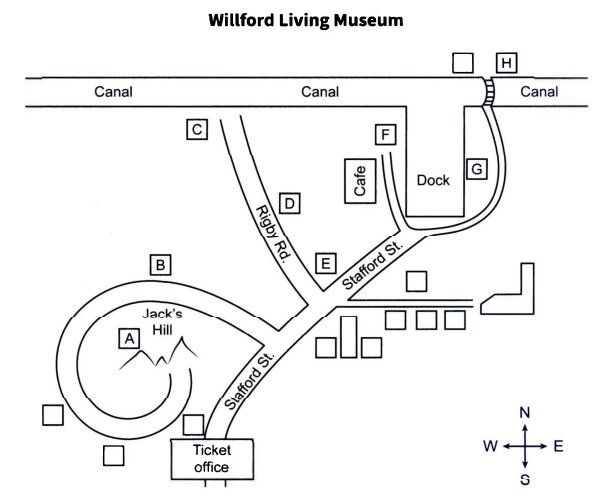 6Old bakeryChọn đáp án7Doctor’s surgeryChọn đáp án8Cooper’s CottageChọn đáp án9StablesChọn đáp án10Old schoolChọn đáp án
PART 3
Questions
21 – 26
Questions 21 – 22. Choose TWO letters, A – E. According to the students, what are the TWO most important benefits of market research?
- 1112
- ASelecting the best advertising BReducing the levels of risks CBuilding confidence among employees DSaving money in the long run EIdentifying new opportunities
Questions
27 – 30
Questions 23 – 24. Choose TWO letters, A — E. Which do the students agree are TWO valid criticisms of market research?
- 1314
- AIt does not reveal any new information. BIts benefits are hard to measure. CIt takes too much time to carry out. DIt makes use of too much specialist language. EIts findings are sometimes wrong.
Questions 25 – 26. Choose TWO letters, A — E. The students are surprised by the success of which TWO sources of information.
- 1516
- Aface-to-face communication Bofficial government statistics Cthe media and social media Donline surveys of public opinion Efilming customers as they shop
Questions 27 – 30. Complete the flow-chart below. Choose FOUR answers from the box and write the correct letter, A – F, next to Questions 27-30.
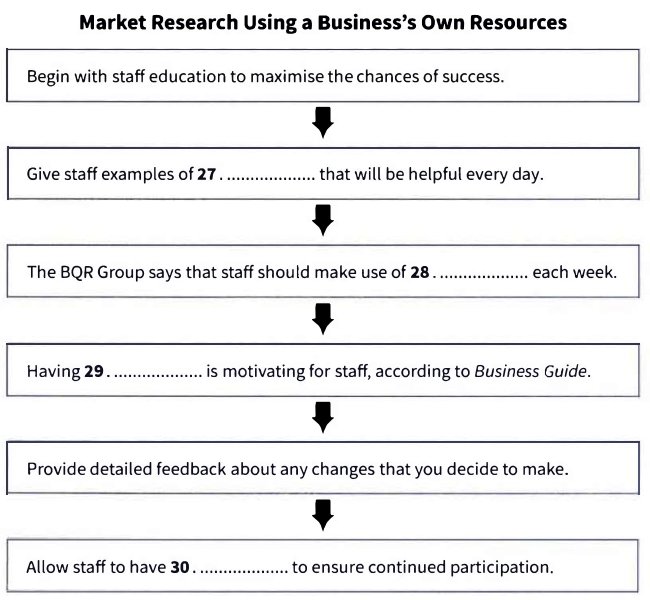 1727Chọn đáp án1828Chọn đáp án1929Chọn đáp án2030Chọn đáp án
PART 4
Questions
31 – 40
Questions 31-37. Complete the notes below. Write ONE WORD ONLY for each answer.
along the way. – The Chilkoot Trail was very 32
so it could take three months. – On both trails, gold-seekers gave up because of starvation, disease and the fear of 33
– At Lake Bennet, gold-seekers stayed in a 34
until spring arrived. – At Miles Canyon, it was necessary to hire an experienced 35
to continue the journey. – Gold-seekers finally reached Dawson and the Klondike river. The Equipment gold-seekers had to take – The 36
provided gold-seekers with a list. – The list included +) clothes, e.g. boots, thick coats +) tea and food such as 37
+) tools, e.g. rope and several 38
People who became successful because of the gold rush – Some business-minded people sold supplies or set up hotels. – Jack London created sense of 39
In his stories. – Annie Hall Strong and Emma Kelly contributed to various 40
In Canada and the US.
Questions 38 – 40. Complete the summary below. Write ONE WORD ONLY for each answer.
when they have drunk enough. But occasionally people have become sick from too much water, particularly groups of 22
. This may be because they have high levels of 23
in their blood. The best advice is to drink when you are thirsty.
PART 1
Questions
1 – 10
Questions 1-10. Complete the form below. Write ONE WORD AND / OR A NUMBER for each answer.
Kingstown Tours
| Name of tour | Price | Main activities | Other information |
| Cave Explorers | Example $93 | • go in a small 1………………….to the other side of the lake • explore the caves | • minimum age of 2…………………. years |
| Silver Fjord | $220 | • travel by 3 ……………….. to the fjord • at Easten go for a 4…………………. • cruise on the fjord • see mountains and a large 5…………………. | • eat a barbecue lunch • see marine life such as seals and 6 …………………. |
| High Country | $105 | • visit a historic home lunch is in the 7 …………………. • in the afternoon visit a 8………………… | • this tour has excellent reviews |
| Zipline | $75 | •travel on a zipline above an old 9…………………. | • reach speeds of 10……………….miles per hour |
Giải thích đáp án
David: Morning. Kingstown tourist information. This is David speaking. How can I help you?
Woman: Oh, hi. Look, I’m coming to Kingstown on holiday and wondered if you could give me some information about tours’
David: Yes, of course. Is there anything particular you’re interested in?
Woman: Well, I heard there was a glow worm tour.
David: Yes indeed. It’s $93 and lasts for 3 hours.
Woman: And what are the main activities?
David: Well, the first thing is travelling to the other side of the lake.
Woman: You mean by boat?
David: No, (Q1) it’s the little (= small) train that runs along the shore of the lake (= the other side of the lake). (đó là con tàu nhỏ chạy dọc theo bờ hồ.) It’s very popular.
Woman: Oh, my children will love that.
David: And that’s how you get round to the caves. This is where the glow worms live. So you spend some time exploring the caves and looking at the remarkable lights and patterns given off by the worms in the dark.
Woman: That does sound interesting. And, any other information?
David: Oh, just one thing. How old are your children?
Woman: Er, 7 and 10. Why?
David: No, that’s OK. (Q2) It’s just that children must be 5 or older (= minimum age) to go in the caves. (Chỉ là trẻ em từ 5 tuổi trở lên mới được vào hang.) Otherwise they might get scared in the dark. But yours will be fine.
Woman: OK, well that’s one to think about. And what about Silver Fjord – that’s so famous, we’d like to go there,
David: Well, a day trip costs $220.
Woman: And how do we travel down to the fjord – fly? (làm thế nào để chúng ta đi được xuống vịnh hẹp nhỉ – bằng máy bay sao?)
David: That’s a lot more expensive I’m afraid. (Q3) On this tour you go in a coach. (Trong chuyến tham quan này, bạn sẽ di chuyển bằng xe khách.) It’s about a 2-hour drive, through fantastic scenery.
Woman: Do we get a break? I think my children might get a bit bored.
David: Yes, you stop at Easten. (Bạn sẽ dừng chân tại Easten.)
Woman: (Q4) That’s to take a walk, is it? (Để đi bộ, có phải vậy không?)
David: Yes, there’s a nice path by the river. You stop in Easten for half an hour, so there’s plenty of time.
Woman: That sounds nice.
David: So, then you get down to Silver Fjord. And you really spend most of the day going for a cruise on the fjord. (Q5) It’s spectacular mountain scenery. And you also cruise past a huge (= large) waterfall (Đó là phong cảnh núi non ngoạn mục. Và bạn cũng được đi thuyền qua một thác nước lớn), which is another highlight of the day.
Woman: Well, that does sound amazing. And should we bring our own food, or is lunch provided?
David: No, lunch is included. It’s a barbecue on the boat.
Woman: And what about marine life? (vậy còn sinh vật biển thì sao?)
David: Yes, you’ll definitely see seals. (bạn chắc chắn sẽ được nhìn thấy hải cẩu.)
Woman: Dolphins?
David: No, not in that part of the country. But (Q6) if you’re lucky there will be whales as well. (nếu may mắn thì bạn cũng sẽ thấy cả cá voi ở đó nữa.)
Woman: Oh, well, my kids would absolutely love that.
David: Then another popular option is the High Country tour. That’s $105
Woman: Oh, I heard about this. You visit a historic home, don’t you?
David: Yes, that’s right. And they serve you lunch. (họ phục vụ bữa trưa cho bạn.)
Woman: Is that actually inside the house?
David: No, (Q7) at this time of year it’ll be the garden, which is really pretty. (vào thời điểm này trong năm, bạn sẽ có bữa trưa trong một khu vườn xinh đẹp.)
Woman: Oh, I like the sound of that.
David: Yes, it’s a really great meal apparently.
Woman: And what about in the afternoon? (còn trong buổi chiều thì sao nhỉ?)
David: (Q8) You go up and have a look around the farm – it’s just close to the house. (Bạn cứ đi lên và nhìn quanh trang trại – nó ở ngay gần ngôi nhà.) So if you’re from the city, it’s a chance to really see what life is like here. The High Country tour gets excellent reviews from visitors.
Woman: Great. So then what about the zipline? My children really want to do that. How much is it?
David: The zipline is $75.
Woman: And is it safe?
David: Absolutely. You are suspended from the wire in a special harness. And then you just glide down the wire.
Woman: (Q9) My friend said that below you, you’ve got this amazing, ancient (= old) forest. (Bạn tôi nói rằng ở ngay phía dưới bạn thôi, là một khu rừng cổ xưa tuyệt vời.)
David: That’s right. And it’s really special to see it from above. Not something we do very often, if you think about it.
Woman: No, I suppose that’s true. And, I mean, how fast (= speeds) do you go? (bạn di chuyển với tốc độ thế nào?)
David: Hang on, I’ve got the information here – 68 kilometres an hour.
Woman: That doesn’t mean much to me. What’s that in miles?
David: Er, oh yes, (Q10) it’s here, in miles per hour it’s about 43. (đây rồi, nó khoảng 43 dặm trên giờ.)
Woman: Wow, my kids will definitely want to do that. OK, well, look, I’ll just talk it over with my husband and…
PART 2
Questions
11 – 15
Questions 11-15. Choose the correct letter, A, B or C.
Willford Living Museum
- 11
In the early 1800s most land in Willford was
Bạn chưa trả lời câu hỏi này
occupied by houses.
used for farming.
covered in trees.
Giải thích đáp án
CÂU HỎI | TRANSCRIPT & GIẢI THÍCH |
11. In the early 1800s most land in Willford was A. occupied by houses B. used for farming C. covered in trees | Well, if we go back to the early 1800s, Willford was very different to what you see today. (nếu chúng ta quay trở lại thời điểm đầu những năm 1800, Willford rất khác so với những gì bạn thấy ngày nay.) At that time, the forests had already been cut down. But there were no large urban settlements here, just a few small villages, and this whole area was a place where local people kept animals or grew crops – those were the only economic activities. (toàn bộ khu vực này là nơi người dân địa phương nuôi động vật hoặc trồng trọt – đó là những hoạt động kinh tế duy nhất ở nơi đây.) |
DỊCH NGHĨA | |
11. Vào đầu những năm 1800, phần lớn đất đai ở Willford A. bị chiếm để làm nhà B. được dùng để trồng trọt C. được bao phủ bởi cây xanh |
- 12
What happened in 1830 in Willford?
Bạn chưa trả lời câu hỏi này
Ships started to be built nearby.
The first trains arrived in the town.
Valuable substances were found underground.
Giải thích đáp án
CÂU HỎI | TRANSCRIPT & GIẢI THÍCH |
12. What happened in 1830 in Willford? A. Ships started to be built nearby. B. The first trains arrived in the town. C. Valuable substances were found underground. | But then in 1830, something happened in Willford that transformed the area. The discovery of rich deposits of coal and other minerals opened up many commercial possibilities. Mines were built, so these deposits could be brought to the surface. (Việc phát hiện ra mỏ than và các khoáng sản phong phú khác đã mở ra nhiều triển vọng thương mại. Các mỏ khai khoáng đã được xây dựng để có thể đưa quặng lên mặt đất.) |
DỊCH NGHĨA | |
12. Chuyện gì đã xảy ra vào năm 1830 ở Willford? A. Những con tàu đã bắt đầu được xây dựng gần đó. B. Những chuyến xe lửa đầu tiên đã đến thị trấn. C. Các tài nguyên có giá trị đã được tìm thấy dưới lòng đất. |
- 13
By the 1870s Willford was most famous for making
Bạn chưa trả lời câu hỏi này
various metal objects.
all types of clothing.
plates and cups.
Giải thích đáp án
CÂU HỎI | TRANSCRIPT & GIẢI THÍCH |
13. By the 1870s Willford was most famous for making A. various metal objects. B. all types of clothing. C. plates and cups. | By the 1870s, Willford had become an important manufacturing centre. A few factories successfully produced fabrics from cotton and wool. However, what Willford was best known for, was manufacturing all sorts of tools, machinery and other items out of iron and steel. (điều khiến Willford được biết đến nhiều nhất là việc sản xuất tất cả các loại công cụ, máy móc và các vật dụng khác bằng sắt và thép.) |
DỊCH NGHĨA | |
13. Vào những năm 1870, Willford nổi tiếng nhất với việc chế tạo A. các đồ vật khác nhau bằng kim loại B. tất cả các loại quần áo. C. đĩa và cốc. |
- 14
What does the guide say about visitors to the museum these days?
Bạn chưa trả lời câu hỏi này
900 visitors enter on a typical day.
7,600 visitors arrive every week.
300,000 visitors come each year.
Giải thích đáp án
CÂU HỎI | TRANSCRIPT & GIẢI THÍCH |
14. What does the guide say about visitors to the museum these days? A. 900 visitors enter on a typical day. B. 7,600 visitors arrive every week. C. 300,000 visitors come each year. | When the museum first opened in 1976, 2000 visitors came on the first weekend alone. Since then, visitor numbers have just grown and grown. They now stand at 300,000 per year and we anticipate further growth in the years to come. (Hiện có khoảng 300,000 du khách đến đây mỗi năm và chúng tôi dự đoán rằng con số này còn lớn hơn nữa trong những năm sắp tới.) In fact, just recently we welcomed our 9 millionth visitor, which was an exciting day for us. |
DỊCH NGHĨA | |
14. Hướng dẫn viên nói gì về du khách đến bảo tàng ngày này? A. 900 du khách đến trong ngày thường. B. 7.600 du khách đến mỗi tuần. C. 300.000 du khách đến mỗi năm. |
- 15
The museum is also sometimes used
Bạn chưa trả lời câu hỏi này
as a location for filming
for business conferences.
by people getting married.
Giải thích đáp án
CÂU HỎI | TRANSCRIPT & GIẢI THÍCH |
15. The museum is also sometimes used A. as a location for filming. B. for business conferences. C. by people getting married. | As well as that, those making movies and television shows often come to the museum because it makes a great set for historical scenes. (những người làm phim và chương trình truyền hình thường đến bảo tàng, bởi nó là một bối cảnh tuyệt vời cho những cảnh quay lịch sử.) There’s even a possibility in future we may open up the museum for weddings and other private events. |
DỊCH NGHĨA | |
15. Bảo tàng đôi khi cũng được sử dụng A. làm địa điểm quay phim. B. cho các cuộc hội nghị kinh doanh. C. cho hôn lễ. |
Questions
16 – 20
Questions 16-20. Label the map below. Write the correct letter, A – H, next to Questions 16 – 20.
16Old bakery
Bạn chưa trả lời câu hỏi này
C
17Doctor’s surgery
Bạn chưa trả lời câu hỏi này
F
18Cooper’s Cottage
Bạn chưa trả lời câu hỏi này
A
19Stables
Bạn chưa trả lời câu hỏi này
H
20Old school
Bạn chưa trả lời câu hỏi này
E
Giải thích đáp án
Guide: OK, so if you take out your maps, I’ll just point out a few places you might like to visit. So right now, we’re standing in the ticket office, at the bottom of your maps.
So, one place I’d recommend is the old bakery. This is a typical bakery from this area, from about 100 years ago. (Q16) To get there from the ticket office, walk up Stafford Street. And then turn into Rigby Road. Walk down Rigby Road, there are a few interesting places along the way, and the old bakery is right next to the canal. (=> C) (Để đến được đó từ phòng vé, hãy đi bộ lên Phố Stafford. Sau đó rẽ vào Đường Rigby. Đi bộ theo đường Rigby, dọc đường đi có một vài địa điểm thú vị và tiệm bánh cũ nằm ngay cạnh con kênh.)
Another interesting place is the doctor’s surgery. This was moved here, brick by brick, and rebuilt on the museum site. (Q17) Walk up Stafford Street, until you reach the dock. You see the café. Walk past that, and the doctor’s surgery is just there. (=> F) (Đi bộ lên Phố Stafford đến chỗ bến tàu. Bạn sẽ thấy quán cà phê. Hãy đi qua đó, và bạn sẽ thấy phòng mổ của bác sĩ ở ngay đó.)
Cooper’s Cottage is also fascinating – a worker’s cottage from the 19th century. (Q18) Walk up Stafford Street and take the first turning on the left. The road curves round to the west, then south, as it climbs Jack’s Hill. You’ll pass a few little houses on the way up, and Cooper’s Cottage is right on the summit of Jack’s hill. (=> A) (Đi bộ lên Phố Stafford và rẽ trái ở ngã rẽ đầu tiên. Con đường uốn vòng về phía tây, sau đó về phía nam, vì con đường ấy dẫn lên đồi Jack. Bạn sẽ đi qua một vài ngôi nhà nhỏ trên đường lên đó và Ngôi nhà của Cooper nằm ngay trên đỉnh đồi Jack.)
The stables are also great. This is where they kept all the horses. Again, (Q19) walk up Stafford Street to the dock, and turn right. Walk round the dock till you get to the canal. Then cross the bridge over the canal to reach the stables. (=> H) (đi bộ lên Phố Stafford đến chỗ bến tàu rồi rẽ phải. Đi vòng quanh bến tàu cho đến khi tới con kênh. Sau đó băng qua cây cầu bắc qua kênh để đến chuồng ngựa.)
Also, be sure to visit the old school. So, (Q20) walk north-east up through the museum. And it’s not too far. The old school is right on the corner of Stafford Street and Rigby Road. (=> E) (đi bộ về phía đông bắc qua bảo tàng. Và nó không quá xa. Ngôi trường cũ nằm ngay góc đường Stafford và đường Rigby.)
Now one other thing…
PART 3
Questions
21 – 22
Questions 21 – 22. Choose TWO letters, A – E. According to the students, what are the TWO most important benefits of market research?
- 2122
- ASelecting the best advertising
Bạn chọn thiếu đáp án này
BReducing the levels of risks CBuilding confidence among employees
Bạn chọn thiếu đáp án này
DSaving money in the long run EIdentifying new opportunities
Giải thích đáp án
CÂU HỎI | TRANSCRIPT & GIẢI THÍCH |
21 – 22: According to the students, what are the TWO most important benefits of market research? A. Selecting the best advertising B. Reducing the levels of risks C. Building confidence among employees D. Saving money in the long run E. Identifying new opportunities | Stella: I like that, nice and clear. So then, we need to establish the benefits of market research. (chúng ta cần xác định những lợi ích của việc nghiên cứu thị trường.) […] Nathan: I agree. To me, it’s about unpredictability. Markets can change unexpectedly. But if you’ve done research, you can minimise the chance that something will go wrong in your own business. (=> B) (nếu bạn thực hiện nghiên cứu, bạn có thể giảm thiểu khả năng xảy ra sai sót trong hoạt động kinh doanh của chính mình.) […] Stella: No, you’re right. But I do think, the sums you invest in market research, you’ll see a return on that eventually. (=> D) (số tiền mà bạn đầu tư vào nghiên cứu thị trường, cuối cùng bạn cũng sẽ nhận được lợi nhuận từ số tiền đó.) |
DỊCH NGHĨA | |
21 – 22: Theo sinh viên, HAI lợi ích quan trọng nhất của nghiên cứu thị trường là gì? A. Chọn lựa ra cách quảng cáo tốt nhất B. Giảm thiểu mức độ rủi ro C. Tạo niềm tin cho nhân viên D. Tiết kiệm tiền trong thời gian dài E. Xác định các cơ hội mới |
Questions
23 – 24
Questions 23 – 24. Choose TWO letters, A — E. Which do the students agree are TWO valid criticisms of market research?
- 2324
- AIt does not reveal any new information. BIts benefits are hard to measure. CIt takes too much time to carry out.
Bạn chọn thiếu đáp án này
DIt makes use of too much specialist language.
Bạn chọn thiếu đáp án này
EIts findings are sometimes wrong.
Giải thích đáp án
CÂU HỎI | TRANSCRIPT & GIẢI THÍCH |
23 – 24: Which do the students agree are TWO valid criticisms of market research? A. It does not reveal any new information. B. Its benefits are hard to measure. C. It takes too much time to carry out. D. It makes use of too much specialist language. E. Its findings are sometimes wrong. | Stella: OK, fair enough. But I read an interesting study out of the USA showing that the results of a lot of market research are just unreliable. The supposed developments identified by the research never occur. (=> E) (kết quả của nhiều cuộc nghiên cứu thị trường không đáng tin cậy. Những sự tiến triển giả định được phát hiện thông qua nghiên cứu lại chưa từng xảy ra.) […] Nathan: Yeah OK. Though you’ve got to admit, market researchers love jargon. These are examples from one report I read – ‘psychographics’, ‘coolhunting’ and ‘asynchronous research’. Some people are bound to be put off by these terms. (=> D) (các nhà nghiên cứu thị trường thích sử dụng nhiều thuật ngữ. Đây là những ví dụ từ một báo cáo mà tôi đã đọc được – ‘phân khúc người dùng’, ‘săn tìm những cái hay’ và ‘nghiên cứu không đồng bộ’. Một số người chắc chắn sẽ bị nản trước những thuật ngữ này.) |
DỊCH NGHĨA | |
23 – 24: Sinh viên đồng tình rằng đâu là HAI nhận định đúng (mang tính phê phán) về việc nghiên cứu thị trường? A. Nó không tiết lộ bất kỳ thông tin mới nào. B. Rất khó để tính toán được những lợi ích nó mang lại. C. Mất quá nhiều thời gian để thực hiện. D. Nó sử dụng quá nhiều ngôn ngữ chuyên ngành. E. Những phát hiện đôi khi có sai sót. |
Questions
25 – 26
Questions 25 – 26. Choose TWO letters, A — E. The students are surprised by the success of which TWO sources of information.
- 2526
Bạn chọn thiếu đáp án này
Aface-to-face communication Bofficial government statistics
Bạn chọn thiếu đáp án này
Cthe media and social media Donline surveys of public opinion Efilming customers as they shop
Giải thích đáp án
CÂU HỎI | TRANSCRIPT & GIẢI THÍCH |
25 – 26: The students are surprised by the success of which TWO sources of information? A. face-to-face communication B. official government statistics C. the media and social media D. online surveys of public opinion E. filming customers as they shop | Stella: Yes, that’s well documented. But I read that managers can learn a lot about social trends just by doing really obvious things, like keeping up with the news on TV, radio and digital networking sites. I hadn’t thought it could be that simple. (=> C) (những người quản lý có thể học hỏi được rất nhiều về các xu hướng xã hội chỉ bằng cách làm những công việc thực sự rõ ràng, chẳng hạn như cập nhật tin tức trên TV, đài phát thanh và các trang mạng kỹ thuật số. Tôi không ngờ rằng nó lại có thể đơn giản như vậy.) […] Stella: Maybe, but it depends on the business. What I hadn’t expected, though, was the evidence showing that talking to consumers directly about their preferences really works. (=> A) (Tuy nhiên, điều mà tôi không ngờ tới là bằng chứng cho thấy việc nói chuyện trực tiếp với người tiêu dùng về sở thích của họ thực sự mang lại hiệu quả.) |
DỊCH NGHĨA | |
25 – 26: Sinh viên cảm thấy ngạc nhiên trước sự thành công của HAI nguồn thông tin nào? A. giao tiếp trực tiếp B. các số liệu thống kê chính thức của chính phủ C. phương tiện truyền thông và xã hội D. thăm dò dư luận trực tuyến E. quay phim khách hàng khi họ mua sắm |
Questions
27 – 30
Questions 27 – 30. Complete the flow-chart below. Choose FOUR answers from the box and write the correct letter, A – F, next to Questions 27-30.
2727
Bạn chưa trả lời câu hỏi này
C
2828
Bạn chưa trả lời câu hỏi này
A
2929
Bạn chưa trả lời câu hỏi này
F
3030
Bạn chưa trả lời câu hỏi này
D
Giải thích đáp án
Nathan: All right. So, if a business wants to use its own resources for market research, what’s the process?
Stella: Good question. Let’s think about a company that isn’t using outside consultants, but doing it internally. Then I think the first step is staff education. You’ve got to get all employees committed, to maximise the chances of success.
Nathan: Agreed. Then, you need to show staff examples (= give staff examples) of what they can do every day (= that will be helpful everyday). (bạn cần cho cho nhân viên những ví dụ về những gì họ có thể làm hàng ngày.)
Stella: You mean in their interactions with customers?
Nathan: Yes. (Q27) What, precisely, should they ask customers (= specific questions) in order to get valuable information? (=> C) (Chính xác thì họ nên hỏi khách hàng điều gì để có được những thông tin có giá trị?) Show staff the sorts of things they can ask on a daily basis.
Stella: OK. And next, I was reading an article by the BQR Group. Apparently, staff need to keep an account of what the customers are saying. (nhân viên cần lưu lại những điều khách hàng đang nói đến.)
Nathan: You mean on computer, or by hand?
Stella: The format doesn’t matter. But, say, (Q28) every Friday (= each way), they should add to the document (= written records). (=> A) (vào thứ Sáu hàng tuần, họ thêm các thông tin đó vào tư liệu.) So they build up a picture of customer opinions, and the insights aren’t lost.
Nathan: Good point. Right, next, I read about ways of motivating staff. Business Guide magazine had a report on the importance of maintaining motivation.
Stella: So, what, by looking ahead and deciding what to do next?
Nathan: Well, in fact, (Q29) Business Guide’s approach is to get your staff together round a table as frequently as possible (= regular meetings) to discuss their findings. (=> F) (Phương pháp tiếp cận của Business Guide là tập hợp nhân viên của mình lại với nhau thường xuyên nhất có thể để thảo luận về những thông tin mà họ có được.)
Stella: That sounds like a good approach. Next, you need to provide detailed feedback about any changes you decide. So everyone can see the outcomes of the research.
Nathan: Nice idea. Then you have to ensure continued participation by the staff. You want market research to be ongoing, not just a one-off.
Stella: Oh, this is (Q30) the idea of delegating (= individual responsibility), so that each staff member is accountable for market research in one area of the business. (=> D) (ý tưởng về việc ủy thác, để mỗi nhân viên đều có trách nhiệm với việc nghiên cứu thị trường trong một lĩnh vực của doanh nghiệp.)
Nathan: Yeah, exactly. And then another aspect of this is…
PART 4
Questions
31 – 37
Questions 31-37. Complete the notes below. Write ONE WORD ONLY for each answer.
INTRODUCTION
– Drinking water is essential for human life.
– The ‘8 glasses a day’ rule is a myth, except for the 31
SOME EFFECTS OF WATER ON THE BODY
– Drinking before 32 may assist weight loss.
– Dr. Amaldi’s study shows that water speeds up 33digestion
– A US research study showed that dehydrated bodies cannot control 34temperature so well.
– There is no evidence that drinking water results in better 35
THE BRAIN
– Women who drank lots of water had fewer 36headaches
– Men suffered more 37anxiety with insufficient water.
Giải thích đáp án
Student: Hi everyone. My presentation today is looking at drinking water. Now, we know that water is a vital nutrient for human life. But exactly how much of it do we need to drink? Well, today I’m going to review some of the research.
So, for example, there’s a common idea that we should drink 8 glasses of water every day. But researchers say that the 8-glasses-a-day rule is a myth. (quy tắc 8 ly nước một ngày chỉ là lời đồn.) Some people might need more than 8 glasses, some a lot less. (Q31) The only group for whom the rule is useful (= except) seems to be the elderly (nhóm người duy nhất mà quy tắc này trở nên hữu dụng có lẽ là người già), because they don’t always feel thirsty, even when their bodies are actually short of water. So for them 8 glasses a day might be a good rough guide.
OK, let’s look next at what effects water has on the body. One issue of interest is weight loss. And there are lots of theories about this. It’s been claimed that dieters should drink more at night time, or drink when they first wake up, but there’s no research to back this up. But actually, there is some evidence from studies to show that (Q32) subjects who drank a lot of water, and then (= drinking before) had their meals, lost more weight (= weight loss) (những người uống nhiều nước và có bữa ăn ngay sau đó thì giảm cân nhiều hơn). But that may only be because the water filled them up and reduced their appetites.
I also read some of the research done by Dr Amaldi, who’s looked in depth at this whole issue of drinking water. And one of his studies does support the common claim that water is good for the stomach. In particular, (Q33) it seems to increase the rate (= speeds up) at which digestion takes place (nó dường như làm tăng tốc độ tiêu hóa), which overall has a number of health benefits.
Another interesting study I read about took place in the US. And this one was investigating the effects of dehydration – that is, not having enough water in the body. And what the US study indicated was that when a (Q34) subject was low on water (= dehydrated), their body’s ability to regulate its own temperature was compromised (= cannot control), compared to a properly hydrated subject. (khi một người uống ít nước, thì khả năng điều chỉnh nhiệt độ cơ thể của họ bị hao tổn hơn so với một người uống đủ nước.)
Now there’s another frequent claim about water that I was interested in looking into. But in my reading anyway (Q35) I could find no evidence at all to support the idea that hydration improves or enhances (= better) the skin in any specific way. (Tôi không thể tìm thấy bằng chứng nào chứng minh cho việc uống đủ nước giúp cải thiện làn da theo cách riêng.) So that claim may be a bit of a myth as well.
Another interesting aspect of this concerns the brain. And I read about a couple of research studies investigating how water intake may affect brain function. In the first study, the research subjects were female (= women). And (Q36) the less hydrated group were affected more frequently by headaches compared to those who drank more water. (nhóm người uống ít nước thường xuyên bị đau đầu hơn so với những người uống nhiều nước.)
In the second study, the research subjects were all male. And this time, a lack of water in the body was associated with a number of findings. In particular, (Q37) the subjects in this group (= male) reported increased (= more) feelings of anxiety when dehydrated (= with insufficient water). (các đối tượng trong nhóm người này cho biết cảm giác lo lắng gia tăng khi cơ thể bị mất nước.)
So, in summary we can see that, yes, there are some health benefits from drinking plenty of water. But in many of these studies, the benefit was quite small. And it’s probably true that in general, on the internet and so on, the benefits of drinking lots of water are overstated.
Questions
38 – 40
Questions 38 – 40. Complete the summary below. Write ONE WORD ONLY for each answer.
Drinking too much water is not a common problem. Australian research has shown that people have difficulty 38swallowing when they have drunk enough. But occasionally people have become sick from too much water, particularly groups of 39athletes. This may be because they have high levels of 40 in their blood. The best advice is to drink when you are thirsty.
Giải thích đáp án
But what about the opposite – can you drink too much water? Well, it’s possible, but it’s not a common problem. Actually, the human body kind of prevents us drinking too much. (Q38) Australian researchers discovered that when subjects were fully hydrated, they actually found swallowing problematic (= have difficulty) – their bodies just wouldn’t allow it so easily. (Những nhà nghiên cứu người Úc đã phát hiện ra rằng khi các đối tượng uống đủ nước, họ thực sự thấy khó nuốt – cơ thể họ không cho phép làm điều đó dễ dàng như vậy. ) So that’s an interesting finding.
It is true that (Q39) people do occasionally become sick from drinking too much water, although it is rare. So, I mean, there are recorded instances of illness among athletes who have been encouraged to drink a lot, for example. (mọi người thỉnh thoảng bị ốm do uống quá nhiều nước, mặc dù trường hợp này khá hiếm gặp. Ví dụ như những trường hợp bệnh được ghi nhận ở các vận động viên, những người cần uống nhiều nước là 1 điển hình.)
According to doctors, people who have drunk too much water, too quickly, have become what’s called ‘hyponatremic’. Basically, this means that (Q40) the make-up of their blood has changed and it now contains such a high proportion (= high levels) of salt that they suffer an adverse effect. (thành phần trong máu của họ đã thay đổi và lượng muối trong máu cao đến mức gây ra ảnh hưởng xấu đến cơ thể.) But it’s very rare for this sort of hyponatremia to be a dangerous condition.
So, based on the reading I’ve done, the best advice is to trust your body. Drink water when you’re thirsty, but you probably don’t need to drink more often than that.
