
Path to Success – Test 4
24/10/2024 2024-10-24 0:40Path to Success – Test 4
Part 1
Questions
1 – 5
Questions 1-6 Complete the table below. Write NO MORE THAN ONE WORD AND/OR A NUMBER for each answer.
SARAH’S HEALTH & FITNESS CLUB MEMBERSHIP FORM First name: Harry (Example) Last name: 1
Date of Birth: Day: 11th; Month: December; Year: 2
Type of Membership: 3
Activities: Badminton and 4
Payment details: – Total: £450 – To be paid 5
Questions
6 – 10
Questions 7-10 Complete the sentences below. Write ONE WORD ONLY for each answer.
Lifestyle questionnaire What exercise do you do regularly? 6
. Do you have any injuries? has a 7
. What is your goal or target? a better 8
. What is your occupation? a 9
. How did you hear about the club? 10
.
Part 2
Questions
11 – 14
Questions 11 and 12 Choose TWO letters, A-E. Which TWO tasks will the volunteers in Group A be responsible for?
- 12
- Awidening pathwaysBplanting treesCpicking up rubbishDputting up signsEbuilding fences
Questions
15 – 17
Questions 13 and 14 Choose TWO letters, A-E. Which TWO items should volunteers in Group A bring with them?
- 34
- Afood and waterBbootsCglovesDraincoatsEtheir own tools
Questions
18 – 20
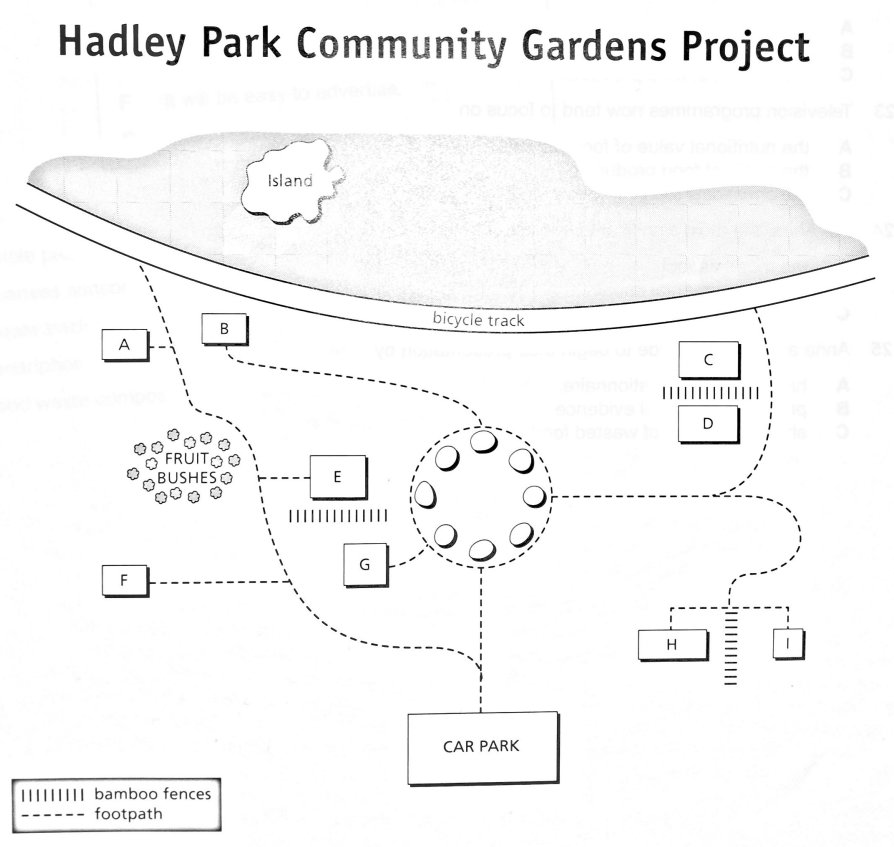
Questions 15-20 Label the plan below.
Part 3
Questions
21 – 25
Questions 21-25 Choose the correct letter, A, B or C.
- 11
What point does Robert make about the 2013 study in Britain?
- A
It focused more on packaging than wasted food.
BIt proved that households produced more waste than restaurants.
CIt included liquid waste as well as solid waste.
- 12
The speakers agree that food waste reports should emphasise the connection between carbon dioxide emissions and
- A
food production.
Btransport of food to landfill sites.
Cdistribution of food products.
- 13
Television programmes now tend to focus on
- A
the nutritional value of food products.
Bthe origin of food products.
Cthe chemicals found in food products.
- 14
For Anna, the most significant point about food waste is
- A
the moral aspect.
Bthe environmental impact.
Cthe economic effect.
- 15
Anna and Robert decide to begin their presentation by
- A
handing out a questionnaire.
Bproviding statistical evidence.
Cshowing images of wasted food.
Questions
26 – 30
Questions 26-30 What advantage do the speakers identify for each of the following projects? Choose FIVE answers from the box and write the correct letter, A-G, next to Questions 26-30.
Part 4
Questions
31 – 38
Questions 31-40 Complete the notes below. Write ONE WORD for each answer.
HAIR Facts about hair – main purposes – warmth and 31
– main component keratin – makes fingernails 32
– full head of hair can support a large weight – equal to two 33
– average number of strands of hair 34
for an adult – large amount of money spent on 35
for hair in the UK Structure of hair Three main parts: a) bulb – like a 36
over end of hair follicle b) root – contains glands that supply 37
to hair strand c) shaft – not 38
Part 1
Questions
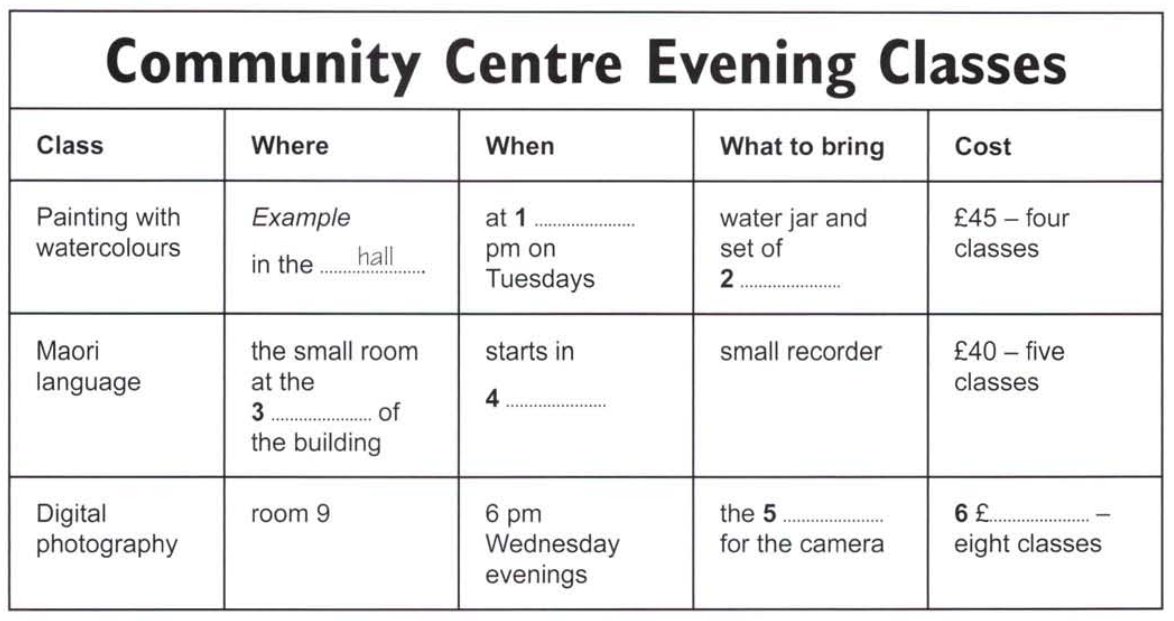
1 – 6Questions 1-6 Complete the table below. Write NO MORE THAN ONE WORD AND/OR A NUMBER for each answer.
Giải thích đáp án
Woman: Hello. Eastwood Community Centre.
Man: Oh, hello. My name’s Andrew Dyson. I’m calling about the evening classes you offer.
Woman: OK, Mr Dyson, are there any classes in particular that you’re interested in?
Man: Yes, you’ve got a class called ‘Painting with watercolors’, I believe.
Woman: That’s right. It’s a popular class so this term it’ll be moving to the hall, so they’ve got more room.
Man: Right. I know it’s on Tuesdays but what time exactly?
Woman: (Q1) It was 6.30 last term, but let me just have a look at the details. OK, it’ll be 7.30 this time, probably it suits more people (Học kỳ trước là 6h30, nhưng hãy để tôi kiểm tra. OK, lần này sẽ là 7h30, có lẽ nó phù hợp với nhiều người hơn)
Man: Well, it’s my wife who’s really interested and that’ll be good for her because she’s home from work by 7.15 – that’ll give her just enough time to get there. Um, what does she need to bring?
Woman: (Q2) OK, well paints are provided by the tutor, I know that. Um, the information says she’ll need just a jar for water – and some pencils for drawing. (OK, tôi biết là gia sư sẽ cung cấp màu sơn,. Um, thông tin nói rằng cô ấy sẽ chỉ cần một cái bình đựng nước – và vài cây bút chì để vẽ.) There are also lots of aprons here, so she needn’t worry what she’s wearing. And the cost for four classes is £45, including paints, as I said.
Man: OK, now we’re both quite keen on the Maori language class.
Woman: There are spaces on the next course, so you could join that.
Man: Oh, good. Which room will that be in?
Woman: (Q3) When you come in through the entrance of the community center building, you’ll need to go straight up the stairs in front of you, all the way to the top. And it’s the small room you’ll find there (Khi bạn đi qua lối vào của tòa nhà trung tâm cộng đồng, bạn sẽ cần phải đi thẳng lên cầu thang trước mặt, lên đến tầng cao nhất. Và đó là căn phòng nhỏ mà bạn sẽ tìm thấy ở đó)
Man: I see. All right, and let me just check when it’s starting. (Q4) I heard from someone that the July course has been delayed until August (Tôi nghe ai đó nói rằng khóa học tháng 7 đã bị hoãn đến tháng 8)
Woman: I’m afraid so (Tôi e là đúng vậy). And we’re halfway through the June course at the moment so there’s not much point you taking that.
Man: I guess we’ll have to wait, then.
Woman: Well, when you do come, the tutor recommends bringing a small recorder with you just so you can listen again later, and er, the cost for five classes is currently £40.
Man: OK, useful information to know. Um, there’s one more class I’m interested in – that’s the digital photography class.
Woman: Oh, I’ve taken that class myself. The tutor’s very good. That’ll be in room 9 and it’s starting in two weeks’ time – in the evening – every Wednesday at 6 o’clock.
Man: (Q5) Um, obviously I need to bring the camera with me. I suppose it’d be useful to have the instructions that go with the camera, too (Ừm, rõ ràng là tôi cần mang theo máy ảnh. Tôi cho rằng sẽ hữu ích nếu có các hướng dẫn đi kèm với máy ảnh)
Woman: I’d say so. Um, some people bring along a lot of accessories like extra lenses, but there’s really no need for this class. It’s mainly focusing on composition really, and getting the most out of the basic camera.
Man: That’s exactly what I need. And how much does it cost?
Woman: (Q6) Let’s see. For four classes, it’s £35, but if you take eight, it works out as £55, so you’re making a bit of a saving – £15 that is (Để xem nào. Đối với bốn lớp học, đó là £35, nhưng nếu bạn học tám lớp, nó tính ra là £55, vì vậy bạn đang tiết kiệm được một chút – là £15)
Man: I see.
Questions
7 – 10Questions 7-10 Complete the sentences below. Write ONE WORD ONLY for each answer.
Giải thích đáp án
The watercolors class suits people who are {{beginners}}.
To find out about the Maori language class, contact Jason {{Kahui}}.
For the photography class, check the {{battery}} for the camera.
There is a trip to a local {{show}} in the final week of the photography class.
Man: OK, now just another question for the watercolors class, I’ve just remembered that my wife asked me to find out about the level – who’s it for?
Woman: (Q7) OK, well you don’t have to be very skilled or anything like that. It’s designed for (=suits) beginners, actually (OK, bạn không cần phải có kỹ năng cao hay bất cứ điều gì tương tự. Nó thực tế được thiết kế cho người mới bắt đầu). People who might see art as a hobby rather than as a professional opportunity.
Man: That sounds like my wife. And er, who do I talk to if I want to find out some more about the Maori language classes?
Woman: (Q8) Probably best to talk to (=contact) the tutor directly. He’ll be in the office in about half an hour. His name’s Jason Kahui. That’s K-A-H-U-I (Có lẽ tốt nhất là nói chuyện trực tiếp với gia sư. Anh ấy sẽ ở văn phòng trong khoảng nửa giờ nữa. Tên anh ấy là Jason Kahui. Đó là K-A-H-U-I).
Man: Good – I’ll give him a call.
Woman: (Q9) Oh, if you do decide to come to the photography class, don’t forget to look at your camera battery and make sure it’s charged (Ồ, nếu bạn quyết định tham gia lớp chụp ảnh, đừng quên kiểm tra pin máy ảnh của bạn và đảm bảo rằng nó đã được sạc đầy). I know it sounds obvious but I’ve seen a few people suddenly find the camera’s stopped working right in the middle of class.
Man: Yes, I can imagine it’d be easy to forget that. (Q10) Oh, that reminds me, in the final week of the photography course, is it right that there’s a visit (=a trip) to a show in the local area? (Ồ, điều đó nhắc tôi nhớ, trong tuần cuối cùng của khóa học nhiếp ảnh, có đúng là có một chuyến đi đến buổi biểu diễn ở khu vực địa phương không?) I work in the city, you see, so I might have to come home early for that one
Woman: Yes. They’ll decide the date once the class has started. Is there anything else I can…
Part 2
Questions
11 – 12Questions 11 and 12 Choose TWO letters, A-E. Which TWO tasks will the volunteers in Group A be responsible for?
- 1112
- Awidening pathways
Bạn chọn thiếu đáp án này
Bplanting treesCpicking up rubbishDputting up signsBạn chọn thiếu đáp án này
Ebuilding fences
Giải thích đáp án
CÂU HỎI | TRANSCRIPT & GIẢI THÍCH |
11&12. Which TWO tasks will the volunteers in group A be responsible for? A. widening pathways B. planting trees C. picking up rubbish D. putting up signs E. building fences
| The priority for you will be to give us a hand with the new wooden fencing – it needs constructing along parts of the bicycle track, as there are parts which have now fallen down or broken. (Ưu tiên của bạn là giúp chúng tôi xây dựng hàng rào gỗ mới dọc theo các phần của đường dành cho xe đạp vì có những phần hiện đã bị đổ hoặc gãy). => E The other thing we’re doing is getting rid of some of the foreign species that are growing in the gardens and putting back some native plants and trees. So you’ll be doing some digging for us and getting those into the ground. (Một việc khác mà chúng tôi đang làm là loại bỏ một số loài ngoại lai đang mọc trong vườn và trồng lại một số cây bản địa. Vì vậy, bạn sẽ thực hiện một số công việc đào bới cho chúng tôi và đưa chúng vào lòng đất). => B |
DỊCH NGHĨA | |
11&12. HAI nhiệm vụ nào mà các tình nguyện viên trong nhóm A sẽ chịu trách nhiệm? A. mở rộng con đường B. trồng cây C. nhặt rác D. dựng biển báo E. xây hàng rào |
Questions
13 – 14Questions 13 and 14 Choose TWO letters, A-E. Which TWO items should volunteers in Group A bring with them?
- 1314
- Afood and water
Bạn chọn thiếu đáp án này
BbootsBạn chọn thiếu đáp án này
CglovesDraincoatsEtheir own tools
Giải thích đáp án
CÂU HỎI | TRANSCRIPT & GIẢI THÍCH |
13&14. Which TWO items should volunteers in group A bring with them? A. food and water B. boots C. gloves D. raincoats E. their own tools | So Group A, there are some items you’ll need to bring along with you. I was going to say raincoat, but the forecast has changed so you can leave those at home. I definitely recommend a strong pair of boots’ waterproof. It’s quite muddy at the moment, and your own gloves would also be advisable. (Tôi sẽ gợi ý mang một đôi ủng bền, và tốt nhất là chúng nên không thấm nước;. hiện tại khu vực khá lầy lội, và bạn cũng nên đeo găng tay) |
DỊCH NGHĨA | |
13&14. HAI món đồ nào tình nguyện viên trong nhóm A nên mang theo? A. thức ăn và nước uống B. ủng C. găng tay d.áo mưa E. công cụ của riêng họ |
Questions
15 – 20Questions 15-20 Label the plan below.
Bạn chưa trả lời câu hỏi này
G
Bạn chưa trả lời câu hỏi này
I
Bạn chưa trả lời câu hỏi này
B
Bạn chưa trả lời câu hỏi này
E
Bạn chưa trả lời câu hỏi này
C
Bạn chưa trả lời câu hỏi này
A
Giải thích đáp án
Okay, Group B, your turn. Does everyone have a copy of the plan? Oh, great. Okay, we’ll all be meeting in the car park that’s on the bottom of the plan see. Now, if you’ve been assigned to the vegetable beds to get there, you go out of the car park and go up the footpath until you reach the circle of trees. There they are – in the middle of the plan, and you see that the footpath goes all the way around them. (bạn ra khỏi bãi đỗ xe cho ô tô và đi dọc theo phần đường dành cho người đi bộ tới khi thấy một vòng tròn bằng cây. Nó ở giữa bản đồ, và bạn có thể thấy lối đi dẫn vòng quanh nó) (Q15) Well, on the left-hand side of that circular footpath, there’s a short track which takes you directly to the vegetable beds. You could see a bamboo fence marked just above them. (À, ở phía bên trái của lối đi vòng tròn đó, có một con đường mòn ngắn dẫn bạn thẳng đến chỗ trồng rau. Bạn sẽ thấy một hàng rào tre được đánh dấu ngay phía trên chúng)
Alright. Okay. If you’re helping out with the beehives, pay attention. Look again at the circle of trees in the middle of the plan and the footpath that goes around them. On the right side of that circle, you can see that the footpath goes off in an easterly direction, heading towards the right-hand side of the plan. And then the path splits into two and you can either go up or down. (Ở phía bên phải của vòng tròn đó, bạn có thể thấy rằng lối đi bộ đi theo hướng đông, hướng về phía bên phải của bản đồ. Và sau đó con đường chia thành hai và bạn có thể đi lên hoặc đi xuống). (Q16) You want the path that heads down, and at the end of this, you see two areas divided by a bamboo fence. And as we’re looking at the plan, the beehives are on the right of the fence. (Bạn cần đi con đường dốc xuống, và ở cuối con đường này, bạn thấy hai khu vực được phân chia bởi một hàng rào tre. Và như chúng ta đang xem bản kế hoạch, các tổ ong ở phía bên phải hàng rào). The smaller section, I mean. Now, don’t worry. All these have been removed. You just need to transport the hives back to the car park.
Okay, for this seating, look at the circular footpath at the top of it. (Q17) There’s a path that goes from there and takes you up to the seating area alongside the bicycle track and with a good view of the island, I suppose (Có một con đường đi từ đó và đưa bạn đến khu vực chỗ ngồi dọc theo đường dành cho xe đạp và với tầm nhìn đẹp ra hòn đảo, tôi cho là vậy)
Okay, if you’re volunteering for the adventure playground area, let’s start from the car park again and go up the footpath but then you want the first left hand. (lại bắt đầu từ bãi gửi xe ô tô và đi thẳng lên lối đi bộ nhưng sau đó bạn cần rẽ trái). (Q18) Go out there and then you see, there’s a short path that goes off to the right. Go down there and that’s the adventure playground area above the bamboo fence. (Đi ra ngoài rồi bạn thấy có một con đường ngắn rẽ phải. Đi xuống đó và đó là khu vực sân chơi mạo hiểm phía trên hàng rào tre.) That fence does need repairing, I’m afraid. ).
Right. What else? Oh, yes, the sand area. We’ve got that circular footpath in the middle. (Q19) Find the track that goes east towards the right-hand side of the plan and where that track divides, you need the little path that goes up towards the bicycle track. The sand area is just above the bamboo fence there. (Tìm đường đi về phía đông về phía bên tay phải của bản vẽ và nơi đường đó chia cắt, bạn cần một con đường nhỏ đi lên phía đường dành cho xe đạp. Khu vực cát ở ngay trên hàng rào tre ở đó)
(Q20) And finally, the pond area. So it’s on the left-hand side of your plan – towards the top – just above the fruit bushes, and to the left of the little path. (Và cuối cùng là khu vực ao. Vậy, nó nằm ở phía bên trái bản kế hoạch của bạn – về phía trên cùng – ngay phía trên bụi cây ăn quả và bên trái con đường nhỏ.)
Part 3
Questions
21 – 25Questions 21-25 Choose the correct letter, A, B or C.
- 21
What point does Robert make about the 2013 study in Britain?
Bạn chưa trả lời câu hỏi này
- A
It focused more on packaging than wasted food.
BIt proved that households produced more waste than restaurants.
CIt included liquid waste as well as solid waste.
Giải thích đáp án
CÂU HỎI | TRANSCRIPT & GIẢI THÍCH |
21. What point does Robert make about the 2013 study in Britain? A. It focused more on packaging than wasted food. B. It proved that households produced more waste than restaurants. C. It included liquid waste as well as solid waste. | Robert: Well, I was looking at a British study from 2013. It basically concluded that £12 billion worth of food and drink was thrown away each year – all of it ending up in landfill sites (Về cơ bản, nghiên cứu này kết luận rằng thực phẩm và đồ uống trị giá 12 tỷ bảng Anh đã bị vứt bỏ mỗi năm – tất cả đều được đưa đến các bãi rác).
|
DỊCH NGHĨA | |
21. Robert đưa ra quan điểm gì về nghiên cứu năm 2013 ở Anh? A. Nó tập trung vào bao bì hơn là lãng phí thực phẩm. B. Nó đã chứng minh rằng các hộ gia đình tạo ra nhiều rác thải hơn các nhà hàng. C. Nó bao gồm cả rác thải lỏng và rác thải rắn. |
- 22
The speakers agree that food waste reports should emphasise the connection between carbon dioxide emissions and
Bạn chưa trả lời câu hỏi này
- A
food production.
Btransport of food to landfill sites.
Cdistribution of food products.
Giải thích đáp án
CÂU HỎI | TRANSCRIPT & GIẢI THÍCH |
22. The speakers agree that food waste reports should emphasize the connection between carbon dioxide emissions and A. food production. B. transport of food to landfill sites. C. distribution of food products.
| Robert: I know what you’re going to say. They never refer to the fuel that farms and factories require to produce the food and the carbon dioxide that releases (Họ không bao giờ đề cập đến nhiên liệu mà các trang trại và nhà máy yêu cầu để sản xuất thực phẩm và khí carbon dioxide thải ra) Anna: Exactly, we could really cut down on carbon emissions if less food was supplied in the first place. (chính xác, chúng ta thực sự có thể giảm lượng khí carbon nếu trước tiên có ít thực phẩm được cung cấp hơn). To my mind, the reports talked too much about the carbon dioxide produced by the trucks that deliver the fresh goods to the shops and take the waste away. They forget about one of the key causes of carbon dioxide.
|
DỊCH NGHĨA | |
22. Các diễn giả đồng ý rằng các báo cáo về lãng phí thực phẩm nên nhấn mạnh mối liên hệ giữa lượng khí thải carbon dioxide và A. sản xuất lương thực. B. vận chuyển thực phẩm đến các bãi rác. C. phân phối hàng thực phẩm. |
- 23
Television programmes now tend to focus on
Bạn chưa trả lời câu hỏi này
- A
the nutritional value of food products.
Bthe origin of food products.
Cthe chemicals found in food products.
Giải thích đáp án
CÂU HỎI | TRANSCRIPT & GIẢI THÍCH |
23. Television programmes now tend to focus on A. the nutritional value of food products. B. the origin of food products. C. the chemicals found in food products.
| Robert: My point exactly. These days, they all seem to be focusing on where your meat, fruit, and vegetables are sourced from (Tôi cũng nghĩ vậy. Ngày nay, dường như tất cả bọn họ đều tập trung vào nguồn gốc của thịt, trái cây và rau của bạn). We’re being encouraged to buy locally, not from overseas. That’s probably a good thing, but I’d still like to see something about waste.
|
DỊCH NGHĨA | |
23. Các chương trình truyền hình hiện nay có xu hướng tập trung vào A. giá trị dinh dưỡng của sản phẩm thực phẩm. B. nguồn gốc của sản phẩm thực phẩm. C. các hóa chất được tìm thấy trong các sản phẩm thực phẩm. |
- 24
For Anna, the most significant point about food waste is
Bạn chưa trả lời câu hỏi này
- A
the moral aspect.
Bthe environmental impact.
Cthe economic effect.
Giải thích đáp án
CÂU HỎI | TRANSCRIPT & GIẢI THÍCH |
24. For Anna, the most significant point about food waste is A. the moral aspect. B. the environmental impact. C. the economic effect. | Anna: What concerns me above all else is that in a recession, governments should be encouraging business to find ways to cut costs. Apparently, supermarkets in the USA lose about 11% of their fruit to waste. That’s throwing money away (Rõ ràng, các siêu thị ở Hoa Kỳ mất khoảng 11% trái cây để lãng phí. Đó thật là lãng phí). |
DỊCH NGHĨA | |
24. Đối với Anna, điểm quan trọng nhất về lãng phí thực phẩm là A. khía cạnh đạo đức. B. tác động môi trường. C. hiệu quả kinh tế. |
- 25
Anna and Robert decide to begin their presentation by
Bạn chưa trả lời câu hỏi này
- A
handing out a questionnaire.
Bproviding statistical evidence.
Cshowing images of wasted food.
Giải thích đáp án
CÂU HỎI | TRANSCRIPT & GIẢI THÍCH |
25. Anna and Robert decide to begin their presentation by A. handing out a questionnaire. B. providing statistical evidence. C. showing images of wasted food. | Anna: I agree. How about we give the other students a set of questions to answer about what they suspect they waste every day? (Anna: Tôi đồng ý. Hay là chúng ta đưa cho các sinh viên khác một bộ câu hỏi để trả lời về những gì họ nghĩ là họ lãng phí hàng ngày?) Robert: I’m fine with that (tôi thấy điều đó ổn đó). Probably a better option than showing pictures of landfill sites. It will be more personalized that way.
|
DỊCH NGHĨA | |
25. Anna và Robert quyết định bắt đầu bài thuyết trình của họ bằng A. Phát phiếu điều tra. B. cung cấp bằng chứng thống kê. C. trưng bày hình ảnh lãng phí thức ăn |
Questions
26 – 30Questions 26-30 What advantage do the speakers identify for each of the following projects? Choose FIVE answers from the box and write the correct letter, A-G, next to Questions 26-30.
Bạn chưa trả lời câu hỏi này
(G) It will involve very little cost.
Bạn chưa trả lời câu hỏi này
(A) It should save time.
Bạn chưa trả lời câu hỏi này
(D) It will make money.
Bạn chưa trả lời câu hỏi này
(C) It will benefit local communities.
Bạn chưa trả lời câu hỏi này
(E) It will encourage personal responsibility.
Giải thích đáp án
Anna: All right, now, let’s start.
Robert: Okay, Shall we now have a look at the projects that different researchers and organizations are working on?
Anna: For me, the project I really liked was the one at Tufts University. You know where they’ve invented tiny edible patches to stick on fresh foods that show you what level of bacteria is present and so whether you can still eat it.
Robert: It’s a great idea, as it tells you if you need to hurry up and eat the food before it goes off. (Q26) The other good thing about the patches is that apparently, they’ll be cheap to manufacture (=involve little cost) (Một ưu điểm khác của các miếng dán ăn được là có vẻ không tốn nhiều chi phí để sản xuất chúng).
Anna: Good. Then the other thing I thought was great was the Massachusetts Institute of Technology Project.
Robert: I hadn’t seen that.
Anna: Well, they’ve developed these sensors that can detect tiny amounts of ethylene. Ethylene is the natural plant hormone in fruit that makes them turn ripe. (Q27) Apparently, the researchers think that they can attach the sensors to cardboard boxes, and then supermarkets can scan the sensors with a portable device to see how ripe the fruit inside it. That’s got to be a quicker way (=save time) to check for ripeness than taking each box off the shelf and opening it. (Có vẻ là, các nhà nghiên cứu nghĩ rằng họ có thể gắn các cảm biến vào các hộp các tông, và sau đó các siêu thị có thể quét các cảm biến bằng một thiết bị cầm tay để xem độ chín của trái cây bên trong. Đó sẽ là một cách nhanh hơn để kiểm tra độ chín hơn là lấy từng hộp ra khỏi giá và mở nó ra)
Robert: Definitely. (Q28) And I thought that Lynn Path was worth mentioning too. Their waste tracking technology means that caterers can see how much food is being wasted and why that’ll increase profits (=make money) for them eventually. (Và tôi nghĩ rằng Lynn Path cũng đáng được nhắc tới. Công nghệ theo dõi rác thải của họ có nghĩa là những người cung cấp thực phẩm có thể thấy bao nhiêu thực phẩm đang bị lãng phí và tại sao điều đó cuối cùng sẽ làm tăng lợi nhuận cho họ).
Anna: Yes, and did you read about Zero Percent? They’ve produced this smartphone application that allows restaurants to send donation alerts to food charities. The charities can then pick up the unwanted food and distribute it to people in need.
Robert: (Q29) In the long run, that’ll definitely benefit poor families in the neighborhood (=benefit local community). No kid should go to school hungry. (Về lâu dài, điều đó chắc chắn sẽ mang lại lợi ích cho những gia đình nghèo trong khu phố. Không đứa trẻ nào nên đi học mà bị đói)
Anna: I agree. And I read that quite a few local governments in the USA are thinking about introducing compulsory composting in their states. So you can’t put any food waste into your rubbish bins. Just the compost bin.
Robert: Well, I guess that means a bit more work for people. I mean, they have to separate the organic and inorganic waste themselves before they take it out to the compost bin, and you know how lazy some people are. (Q30) But I guess if we all start composting, we’d be doing something positive about the problem of food waste ourselves (=personal) rather than relying on the government to sort it out (Nhưng tôi đoán nếu tất cả chúng ta bắt đầu làm phân bón, chúng ta sẽ tự mình làm điều gì đó tích cực về vấn đề lãng phí thực phẩm hơn là dựa vào chính phủ để phân loại nó). Having said that, not everyone has a garden so…
Part 4
Questions
31 – 40Questions 31-40 Complete the notes below. Write ONE WORD for each answer.
Giải thích đáp án
Well, good morning, everyone. As you know, we’ve been looking at different kinds of art and craft that were practiced by the Maori people of New Zealand at least before the Europeans began to arrive in the 18th century. So the focus of this lecture is kite making. How the kites were made, their appearance, and the purposes they served.
Well, let’s start with the way they were made. As with other Maori artistic traditions, kite making involved certain rituals. So firstly, only priests were allowed to fly and handle the largest, most sacred kites. There were rules, too, for the size and scale of the kites that the priests had to follow. (Q31) And during the preparation of both small and large kites, food was strictly forbidden (=not allowed) (Và trong quá trình chuẩn bị cho cả diều nhỏ và lớn, thức ăn bị nghiêm cấm). (Q32) In terms of appearance, kites were frequently designed in the image of (=represented) a native bird or a Maori God, and sometimes perhaps less often a well-known hero (Về hình thức bên ngoài, diều thường được thiết kế theo hình ảnh của một loài chim bản địa hoặc một vị thần Maori, và đôi khi có lẽ ít được phổ biến hơn là một anh hùng nổi tiếng). You can imagine that when Maori first arrived in the new country in New Zealand, it may have taken some time to find suitable materials for their kites – but through trial and error no doubt, they found plants and trees that provided bark and even roots that they could use to make the frames and wings of their kites. And after the frame had been constructed, the kite then had to be decorated. For this, the priests used long grasses and these, when the kite was in the air, would stream along behind it. (Q33) They also used a variety of feathers to add color to their creations. (Họ cũng sử dụng nhiều loại lông vũ để thêm màu sắc cho tác phẩm của mình.) Well, all this meant it was easy to see a kite in the sky, but you could also hear Maori kites ( . (Q34) They could be quite noisy indeed, and this was because some priests liked to hang (=attached to) a long row of shells from the kite (Chúng có thể gây ồn ào, và điều này là do một số linh mục thích treo một hàng dài vỏ sò trên diều). You can imagine how they’d rattle and clatter in the wind – how they might completely capture your attention.
As I said before, the most common image was probably a bird, and that’s the same for other kite-making cultures. (Q35) But the kites were designed in particular shapes, so there were kites that were triangular, rectangular, and also shaped like a diamond (Những cánh diều đó được thiết kế theo hình dạng đặc biệt, vì vậy có những con diều hình tam giác, hình chữ nhật và cũng có hình dạng như một viên kim cương). And some of them were so large – it would actually require several men to operate them. Hmm, (Q36) some of the kites were also covered in patterns, and to make these patterns, the Maori used different pigments of red and black. And these were either made from a charcoal base or from red-brown clay, which had been combined (=mixed) with oil obtained from a local species of shark (một số con diều cũng được phủ hoa văn và để tạo ra những hoa văn này, người Maori đã sử dụng các sắc tố đỏ và đen khác nhau. Và những thứ này hoặc được làm từ than củi hoặc từ đất sét màu nâu đỏ, được kết hợp với dầu thu được từ một loài cá mập địa phương).
Now, before I forget, if you have a chance, do visit the Auckland Museum because they have the last surviving ‘birdman’ kite on display. This is the kind of kite that has a wooden mask at the top of the frame. (Q37) It’s a mask of a human head, and you can clearly see it has a tattoo and also a set of teeth (Đó là một chiếc mặt nạ hình đầu người, và bạn có thể thấy rõ ràng nó có một hình xăm và cả một bộ răng). Quite impressive and a good example of Maori craftsmanship, and symbolism.
Turning to the purpose and function of the kites, they certainly had multiple uses. (Q38) Primarily, the flying of kites was a way of communicating with the gods and when the kites rose into the air, the Maori used them to deliver (=send) messages – perhaps requesting a good harvest, good fortune in war, a successful hunting expedition. (Về cơ bản, thả diều là một cách giao tiếp với các vị thần và khi những con diều bay lên không trung, người Maori sử dụng chúng để gửi thông điệp – có thể là thỉnh cầu cho một vụ mùa bội thu, may mắn trong chiến tranh, một chuyến đi săn thành công).
So these kites were incredibly valuable to a community – treasured objects that one generation would pass to the next. People would also fly kites for other reasons, for example, to attract the attention of a neighboring village. (Q39) This was done when a meeting was required (=necessary) between Maori elders, a convenient method indeed (Điều này được thực hiện khi một cuộc họp được triệu tập giữa những bô lão Maori, một phương pháp thực sự thuận tiện). (Q40) And finally, when it comes to war, there are traditional stories that describe how when a Maori warrior found himself surrounded by his enemies, a kite could actually provide the possibility of escape (Và cuối cùng, khi nói đến chiến tranh, có những câu chuyện truyền thống mô tả khi một chiến binh Maori khi bị kẻ thù bao vây, một chiếc diều thực sự có thể mang lại khả năng trốn thoát) – the kites were powerful enough to take a man up into the air, and for this reason, they could also be used to lower him into enemy fortifications so that an attack could begin from the inside. Well, I’m happy to say there seems to be a revival and growing interest in kite making, and…
