
Path to Success – Test 5
24/10/2024 2024-10-24 1:03Path to Success – Test 5
Part 1
Questions
1 – 10
Questions 1-10 Complete the form below. Write ONE WORD AND/OR A NUMBER for each answer
City Transport Lost Property Enquiry Main item lost: suitcase. (Example) Description of main item: black with thin 1
stripes Other items: – a set of 2
keys – some documents – a 3
in a box – a blue 4
Journey details – Date and time: 2.00-2.30 pm on 5
– Basic route: caller travelled from the 6
to Highbury – Mode of travel: caller thinks she left the suitcase in a 7
Personal details – Name: Lisa 8
– Address: 15A 9
Rd, Highbury – Phone number: 10
Part 2
Questions
11 – 15
Questions 11-15 Label the map below. Write the correct letter, A-H, next to Questions 11-15.
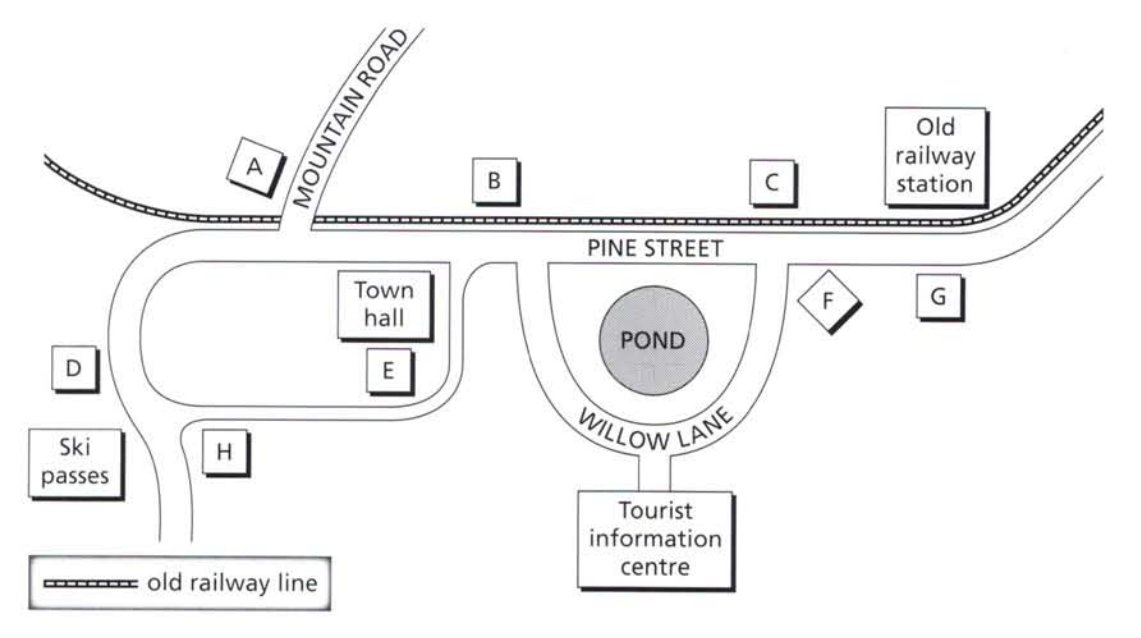
Questions
16 – 20
Questions 16-20 What comment does the speaker make about each of the following tracks? Write the correct letter, A, B or C, next to Questions 16-20.
Part 3
Questions
21 – 25
Questions 21-25 Choose the correct letter, A, B or C.
- 21
Why has James chosen to do a case study on the company Furniture Rossi?
- A
It has enjoyed global success.
BIt is still in a developmental phase.
CIt is an example of a foreign company being rebranded for Australia.
- 22
According to James, why did Luca Rossi start a furniture company?
- A
Furniture-making was already a family occupation.
BRossi saw a need for hand-crafted furniture.
CThe work Rossi had done previously was unrewarding.
- 23
What gave Furniture Rossi a competitive advantage over other furniture companies?
- A
its staff
Bits lower prices
Cits locally sourced products
- 24
What does the tutor recommend James does when writing the second draft of his case study?
- A
provide more detailed references
Bcheck for written accuracy
Cadd his own views
- 25
What do the tutor and James agree was wrong with James‘ last presentation?
- A
It was too short.
BIt focused too much on statistics.
CThere was not enough interaction with the audience.
Questions
26 – 30
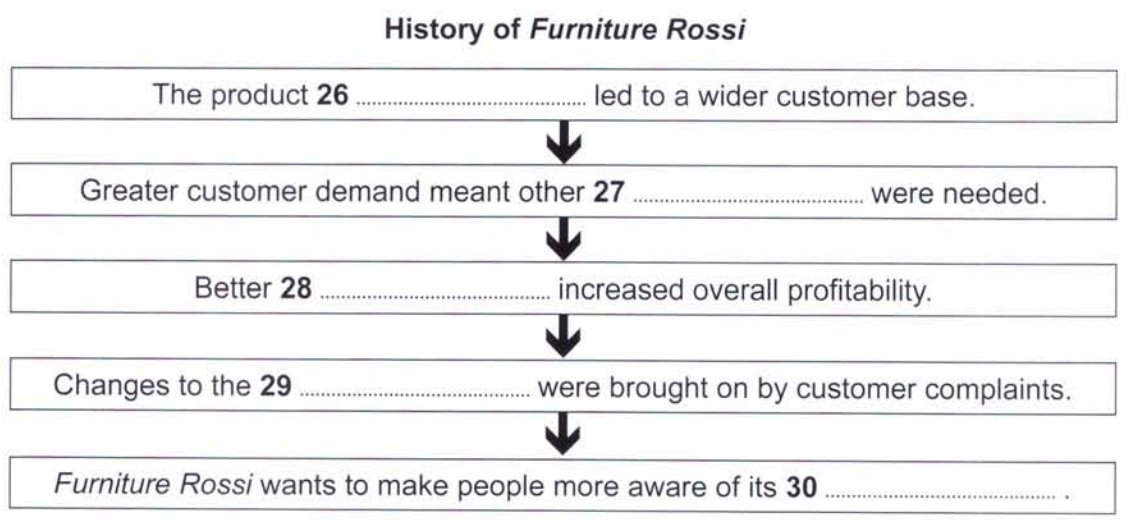
Questions 26-30 Complete the flow-chart below. Choose FIVE answers from the list below and write the correct letter, A-G, next to Questions 26-30.
Part 4
Questions
31 – 36
Questions 31-36 Complete the notes below. Write ONE WORD ONLY for each answer
Rock art Why rock art is important to researchers: It provides evidence about • evolution 31•
Global similarities in rock art: • humans often had large 32
• animals were common, but a 33
was always drawn from the side or from above. • unlikely that contact through 34
resulted in similar artistic styles Why our ancestors produced rock art: Research suggests rock art was produced • firstly for reasons of 35
• later for social, spiritual and 36
reasons.
Questions
37 – 40
Questions 37-40 Answer the questions below. Write ONE WORD ONLY for each answer.
What TWO images drawn by Aboriginal people show their contact with Europeans? 37•
• 38
Which human activities does the lecturer say are the main threats to Aboriginal rock art? 39•
• vandalism • 40
Part 1
Questions
1 – 10Questions 1-10 Complete the form below. Write ONE WORD AND/OR A NUMBER for each answer
Giải thích đáp án
Staff member: Hello. City Transport Lost Property. How can I help you?
Woman: Oh, hello, Yes, I’m, er, calling about a suitcase I lost yesterday, I don’t suppose I’ll get it back but I thought I’d try.
Staff member: Well, some people do hand lost items in so you might be lucky. Let’s put the details into the computer.
Woman: OK.
Staff member: Right, so, let’s start with a description of the suitcase.
Woman: OK, well, it’s small, and it’s the type you can pull along on wheels.
Staff member: How about the colour?
Woman: (Q1) Yes – it’s black but not exactly plain black – it has some narrow stripes down it, sort of grey. Actually – no, they’re white now I think about it [Vâng – nó có màu đen nhưng không hoàn toàn là đen tuyền – có một số sọc hẹp dọc theo nó, màu hơi xám. Trên thực tế – không phải vậy đâu, bây giờ tôi nghĩ nó màu trắng cơ].
Staff member: OK, I’ll just add that information. Now were there any items inside it?
Woman: Yes. I had a big bunch of keys in there. Luckily my assistant manager has an identical set so she’s going out this morning to get some copies made.
Staff member: (Q2) So, they’re for your office? [Vậy đó là cho văn phòng của bạn à?]
Woman: That’s right. My house keys were in my pocket, thank goodness.
Staff member: Anything else?
Woman: Um, there were a lot of documents, but they’re saved on my laptop anyway, so they don’t matter so much. But the thing I’m really worried about – (Q3) I mean, I haven’t even taken it out of the box yet – is a camera I just bought [Ý tôi là, tôi thậm chí còn chưa lấy nó ra khỏi hộp – là một chiếc máy ảnh tôi mới mua]. That’s really why I’m calling. I can’t believe I’ve lost it already.
Staff member: I see. Well, let’s hope we can find it for you. Was there anything else?
Woman: I don’t think so.
Staff member: Any credit cards?
Woman: They were in my handbag. And I had my passport inside my jacket pocket.
Staff member: Money, clothing, any personal items?
Woman: Oh, let me think. (Q4) I had an umbrella. It was black, no, blue, but obviously, that isn’t as important as the other things [Tôi đã có một chiếc ô. Nó màu đen, không, màu xanh lam chứ, nhưng rõ ràng là nó không quan trọng bằng những thứ khác].
Staff member: No, but it all helps us identify your property and get it back to you. Anyway, I just need to ask you for some basic details about your journey. So it was yesterday, was it?
Woman: That’s right. In the afternoon – around 2 pm, maybe 2.30.
Staff member: (Q5) OK. So that’d be May 13th [OK. Vậy đó sẽ là ngày 13 tháng 5].
Woman: Yes. I was heading to Highbury. That’s where I live.
Staff member: All right, and you mentioned a passport, I think. (Q6) So you were coming from the airport, I presume [Thế nên tôi đoán là bạn đã đi từ sân bay].
Woman: Yes – and I was looking forward to getting home so much – and what with being tired and everything – I think that’s why I just forgot about the case.
Staff member: And how were you travelling when you lost your property? I mean, what kind of transport were you using?
Woman: (Q7) I thought about getting the train, but that would have meant a bus journey as well, and I couldn’t be bothered so I decided to take a taxi eventually. That’s where I must have left it [Tôi đã nghĩ đến việc đi tàu, nhưng điều đó cũng đồng nghĩa với việc đi xe buýt, và tôi không muốn bị làm phiền nên cuối cùng tôi quyết định bắt taxi. Đó hẳn là nơi tôi để lại nó].
Staff member: Well, that’s good news in a way. It’s more likely that a driver would have found it and handed it in.
Woman: I hope so.
Staff member: Well, I need your personal details now. Can I have your full name, please?
Woman: (Q8) Yes. It’s Lisa Docherty [Đúng. Tôi tên là Lisa Docherty]. I’ll spell that for you. It’s D-O-C-H-E-R-T-Y.
Staff member: Thank you. And next, if I could have your address – the best address to send you the property if we manage to locate it?
Woman: (Q9) Sure. It’s number 15A River Road – and that’s Highbury, as I said [Chắc chắn rồi. Đó là số 15A đường River – ở Highbury, như tôi đã nói].
Staff member: Thank you. Just a moment. There’s just one final thing – that’s your phone number.
Woman: I guess my mobile would be best. Er, hang on, I can never remember my own number. OK, I’ve got it. (Q10) It’s 07979605437 [Số điện thoại là 07979605437].
Staff member: Very well. I think that’s everything we need at this end, I’ll have a look at the data on…
Part 2
Questions
11 – 15Questions 11-15 Label the map below. Write the correct letter, A-H, next to Questions 11-15.
Bạn chưa trả lời câu hỏi này
G
Bạn chưa trả lời câu hỏi này
D
Bạn chưa trả lời câu hỏi này
A
Bạn chưa trả lời câu hỏi này
E
Bạn chưa trả lời câu hỏi này
C
Giải thích đáp án
Welcome to everyone here. I hope you enjoy your stay in our village and enjoy the local scenery. I’ll tell you a bit about the forest and mountain tracks in a minute, but first, I’ll just give you an idea of where everything is in the village.
So, we’re here in the tourist information centre, and when you come out of the centre, you’re on Willow Lane, just opposite the pond. (Q11) If you want to get to the supermarket for your supplies of food and water, go right, that’s the quickest way, and then turn right at the top of Willow Lane, and it’s the second building you come to, opposite the old railway station (=> G) [Nếu bạn muốn đến siêu thị để mua thực phẩm và nước uống, hãy đi bên phải, đó là con đường nhanh nhất, sau đó rẽ phải ở đầu Willow Lane, và nó sẽ là tòa nhà thứ hai bạn đi qua, đối diện với ga xe lửa cũ].
If you’re planning on doing some serious climbing and you need some equipment, we do have an excellent climbing supplies store just five minutes’ walk away. (Q12) Turn left once you’re outside the tourist information centre, take Willow Lane all the way up to Pine Street – you want to go left along here – then keep walking and go past Mountain Road on your right, until you come to the next turning on the left – head down there, and you’ll come to the climbing supplies store (=> D) [Rẽ trái khi bạn đã ra khỏi trung tâm thông tin du lịch, đi hết đường Willow Lane để đến Phố Pine – bạn sẽ cần rẽ trái dọc theo chỗ này – sau đó tiếp tục đi và băng qua Đường Mountain ở phía bên phải bạn cho đến khi bạn đến ngã rẽ tiếp theo bên trái – đi xuống đó, rồi bạn sẽ đến cửa hàng dụng cụ leo núi]. If you get to the small building that sells ski passes, you’ll know you’ve gone too far.
You also need to head to Pine Street for the museum – it’s small but well worth a visit if you’re interested in the history of the village and the old gold mining industry. (Q13) So, when you reach Pine Street from here, you’ll see the old railway line on the other side of the road Turn left into Pine Street, and keep going until you come to Mountain Road, and just up here, the museum will be on your left, just behind the railway line (=> A) [Vì vậy, khi bạn đến phố Pine từ đây, bạn sẽ thấy tuyến đường sắt cũ ở phía bên kia đường. Rẽ trái vào phố Pine, tiếp tục đi cho đến khi bạn đến đường Mountain, ở ngay phía trên đây, bảo tàng sẽ ở phía bên trái, ngay phía sau tuyến đường sắt]. Don’t worry about crossing over the tracks. The trains stopped running through here in 1985.
If you’re planning on following one of the easier forest walks, you might like to hire a bicycle. (Q14) To get to the hire shop, again you need to head to Pine Street. On the left-hand side of Pine Street, you’ll see the Town Hall, go down the little road that you come to just before it, and you’ll find the bike hire shop just behind the hall (=> E) [Để đến cửa hàng cho thuê, một lần nữa bạn cần đến phố Pine. Ở phía bên tay trái của phố Pine, bạn sẽ thấy Tòa thị chính, đi xuống con đường nhỏ mà bạn đi ngay trước đó rồi bạn sẽ tìm thấy cửa hàng cho thuê xe đạp ngay phía sau sảnh]. They have a good range of bikes so I’m sure you’ll find something that suits your needs.
Last but not least, if you’re hungry after a long day’s trek I can recommend our local café. (Q15) Again, when you leave the tourist information centre, turn right, and follow Willow Lane until it joins Pine Street – and right opposite – on the far side of the railway tracks – is the café (=> C) [Một lần nữa, khi bạn rời khỏi trung tâm thông tin du lịch, hãy rẽ phải và đi theo Willow Lane cho đến khi nó nối với Phố Pine – và ngay đối diện – ở phía xa của đường ray xe lửa – là quán cà phê].
Questions
16 – 20Questions 16-20 What comment does the speaker make about each of the following tracks? Write the correct letter, A, B or C, next to Questions 16-20.
Bạn chưa trả lời câu hỏi này
(B) It only offers basic accommodation.
Bạn chưa trả lời câu hỏi này
(A) It is possible to get lost here.
Bạn chưa trả lời câu hỏi này
(C) It requires physical strength.
Bạn chưa trả lời câu hỏi này
(C) It requires physical strength.
Bạn chưa trả lời câu hỏi này
(A) It is possible to get lost here.
Giải thích đáp án
OK, let me tell you a little bit about the different tracks we have here. All of them start at the end of Mountain Road – and you’ll find a parking lot there where you can leave your vehicles. Let’s start with North Point track. It’s a gentle route through lowland forest – good for biking and probably the one for you if you have small children. (Q16) There’s a wooden hut where you can stay at the end of the track but be aware that it’s really just an overnight shelter (= only offers basic accommodation) and you’ll need to take your own sleeping bags and cooking equipment (=> B) [Có một túp lều bằng gỗ nơi bạn có thể ở tại cuối đường đua nhưng lưu ý rằng đó thực sự chỉ là nơi trú ẩn qua đêm và bạn sẽ cần mang theo túi ngủ và dụng cụ nấu nướng của riêng mình] .
Another option is the Silver River track. As the name suggests, you’d be following the river for most of the way, and you get to see some of our beautiful native birds, but the track also goes through a densely forested area. (Q17) Unfortunately, the signposting isn’t very good in places and you do need good map-reading skills to avoid becoming disoriented, which happens to visitors a little too frequently (= possible to get lost), I’m afraid (=> A) [Thật không may, biển chỉ dẫn ở các địa điểm không tốt lắm và bạn cần có kỹ năng đọc bản đồ tốt để tránh bị mất phương hướng, điều này xảy ra với du khách khá thường xuyên, tôi lo là vậy].
(Q18) Valley Crossing will take you through some stunning scenery but there are several points along the way where you’ll need the level of fitness required (= requires physical strength) to get over some pretty big rocks (=> C) [Thung lũng Crossing sẽ đưa bạn qua một số cảnh quan tuyệt đẹp nhưng có một số nơi trên đường sẽ yêu cầu bạn có mức độ thể lực cần thiết để vượt qua một vài tảng đá khá lớn]. (Q19) Stonebridge is one of the shorter tracks, but very steep as it takes you up to the waterfall, and you do need to be in good condition to manage (= requires physical strength) it (=> C) [Stonebridge là một trong những con đường ngắn hơn, nhưng rất dốc vì nó thẳng lên thác nước, và bạn cần phải có thể trạng tốt để vượt qua được nó].
Lastly, the Henderson Ridge track will take you all the way to the summit of the mountain. (Q20) Do bear in mind, though, that at this time of year the weather is very changeable and if the cloud suddenly descends, it’s all too easy to wander off the track (= possible to get lost) (=> A) [Tuy nhiên, hãy nhớ rằng vào thời điểm này trong năm, thời tiết rất hay thay đổi và nếu mây đột ngột kéo xuống, bạn rất dễ đi lạc đường].
It’s best to check with us for a weather report on the morning you think you want to go. On the way to the summit, there’s a hotel which provides comfortable rooms and quality meals, so it’s worth climbing all…
Part 3
Questions
21 – 25Questions 21-25 Choose the correct letter, A, B or C.
- 21
Why has James chosen to do a case study on the company Furniture Rossi?
Bạn chưa trả lời câu hỏi này
Giải thích đáp án
CÂU HỎI 21 | TRANSCRIPT & GIẢI THÍCH |
Why has James chosen to do a case study on the company Furniture Rossi? A. It has enjoyed global success. B. It is still in a developmental phase. C. It is an example of a foreign company being rebranded for Australia. | James: Well, as you know, furniture, Rossi is an Australian company, still comparatively small compared to some of the High Street stores. But it’s got plans to expand into foreign markets, so I chose it for that reason. It’s going through a transition [Nhưng nó có kế hoạch mở rộng ra thị trường nước ngoài, vì vậy tôi đã chọn nó vì lý do đó. Nó đang trải qua một quá trình chuyển đổi]. It’s a family-run business aiming to build a global brand. |
DỊCH NGHĨA | |
Tại sao James chọn thực hiện nghiên cứu tình huống về công ty Nội thất Rossi? A. Nó đã đạt được thành công toàn cầu. B. Nó vẫn đang trong giai đoạn phát triển. C. Đó là một ví dụ về một công ty nước ngoài được đổi thương hiệu cho Úc.
|
- 22
According to James, why did Luca Rossi start a furniture company?
Bạn chưa trả lời câu hỏi này
Giải thích đáp án
CÂU HỎI 22 | TRANSCRIPT & GIẢI THÍCH |
According to James, why did Luca Rossi start a furniture company? A. Furniture-making was already a family occupation. B. Rossi saw a need for hand-crafted furniture. C. The work Rossi had done previously was unrewarding. | James: Well, he just got an arts degree, hadn’t he? And people were trying to talk him into an academic profession, but he wanted a practical job, something he thought would be more satisfying in the long run. His grandfather had been a craftsman. He had made furniture in Italy, and he’d passed this skill onto Luca’s father and well Lucas thought he’d like to continue the tradition [Ông nội của anh ấy đã từng là một thợ thủ công. Ông đã làm đồ nội thất ở Ý rồi và đã truyền kỹ năng này cho cha của Luca, và Lucas nghĩ rằng anh ấy muốn tiếp tục truyền thống].
|
DỊCH NGHĨA | |
Theo James, tại sao Luca Rossi thành lập công ty nội thất? A. Làm đồ nội thất đã là nghề nghiệp của gia đình. B. Rossi nhận thấy nhu cầu về đồ nội thất thủ công. C. Công việc mà Rossi đã làm trước đây không được đền đáp xứng đáng. |
- 23
What gave Furniture Rossi a competitive advantage over other furniture companies?
Bạn chưa trả lời câu hỏi này
Giải thích đáp án
CÂU HỎI 23 | TRANSCRIPT & GIẢI THÍCH |
What gave Furniture Rossi a competitive advantage over other furniture companies? A. its staff B. its lower prices C. its locally sourced products | James: I wouldn’t think it was price. It’s always been at the higher end of the market. But according to my research, it was to do with the attitude of the employees. They were really focused on giving good customer service [Nhưng theo nghiên cứu của tôi, đó là do thái độ của nhân viên. Họ đã thực sự tập trung vào việc cung cấp dịch vụ khách hàng tốt]. |
DỊCH NGHĨA | |
Điều gì đã tạo nên lợi thế cạnh tranh cho Nội thất Rossi so với các công ty nội thất khác? A. nhân viên B. giá cả thấp hơn C. các sản phẩm có nguồn gốc địa phương |
- 24
What does the tutor recommend James does when writing the second draft of his case study?
Bạn chưa trả lời câu hỏi này
Giải thích đáp án
CÂU HỎI 24 | TRANSCRIPT & GIẢI THÍCH |
What does the tutor recommend James does when writing the second draft of his case study? A. provide more detailed references B. check for written accuracy C. add his own views | Tutor: Yes, what I like to see more of is your opinion, a bit more critical thinking rather than the bare facts [Vâng, những gì tôi muốn xem nhiều hơn là ý kiến của bạn, một chút tư duy phản biện hơn là sự thật rành rành], but it’s good to see you’ve been careful with your referencing this time. |
DỊCH NGHĨA | |
Gia sư khuyên James nên làm gì khi viết bản nháp thứ hai cho nghiên cứu tình huống của anh ấy? A. cung cấp tài liệu tham khảo chi tiết hơn B. kiểm tra độ chính xác của văn bản C. thêm quan điểm của riêng mình |
- 25
What do the tutor and James agree was wrong with James‘ last presentation?
Bạn chưa trả lời câu hỏi này
Giải thích đáp án
CÂU HỎI 25 | TRANSCRIPT & GIẢI THÍCH |
What do the tutor and James agree was wrong with James’ last presentation? A. It was too short. B. It focused too much on statistics. C. There was not enough interaction with the audience. | Tutor: Understandably but while you’re writing the case study, I’d recommend you think about what kind of information would be suitable to use in your presentation. Remember the last time you gave a presentation on a company you spent a considerable part of the time providing the audience with financial data, but I probably needed to hear more about company strategy [Hãy nhớ rằng lần trước bạn thuyết trình về một công ty, bạn đã dành phần lớn thời gian để cung cấp cho khán giả dữ liệu tài chính, nhưng có lẽ tôi cần nghe thêm về chiến lược của công ty]. |
DỊCH NGHĨA | |
Gia sư và James đồng ý rằng bài thuyết trình lần trước của James sai ở điểm gì? A. Nó quá ngắn. B. Nó tập trung quá nhiều vào số liệu thống kê. C. Không có đủ tương tác với khán giả. |
Questions
26 – 30Questions 26-30 Complete the flow-chart below. Choose FIVE answers from the list below and write the correct letter, A-G, next to Questions 26-30.
Bạn chưa trả lời câu hỏi này
(E) quality
Bạn chưa trả lời câu hỏi này
(B) locations
Bạn chưa trả lời câu hỏi này
(G) software programs
Bạn chưa trả lời câu hỏi này
(A) website
Bạn chưa trả lời câu hỏi này
(F) values
Giải thích đáp án
Tutor: Good. Okay, so let’s just think about the content of your case study the history of furniture Rossi. I see here in paragraph four, you’re talking about how Luca Rossi raised the capital for his new business venture. And then you’re talking about the customer base growing much wider (= a wider customer base). But what was it that prompted this growth?
James: (Q26) Well, that was to do with the quality of the furniture products that the company was selling. People love that it was all handmade and would last (=> E) [Chà, điều đó liên quan đến chất lượng của các sản phẩm nội thất mà công ty đang bán. Mọi người thích việc tất cả đều được làm thủ công và sẽ tồn tại lâu dài].
Tutor: And because demand from customers kept growing (= greater customer demand)?
James: (Q27) Well, then Rossi needed to take on more craftsmen so they could make sure the orders were ready on time. And then he also had to set up two new warehouses (= locations) to make distribution quicker (=> B) [Vậy thì Rossi cần tuyển thêm thợ thủ công để họ có thể đảm bảo các đơn đặt hàng luôn sẵn sàng đúng hạn. Và sau đó anh ấy cũng phải bố trí hai nhà kho mới để phân phối nhanh hơn].
Tutor: Yes, and from there the company really grew. But I think what happened next? They started looking at ways to increase their profits (= increased overall profitability) and called in a consultant. And what he saw immediately was that the infrastructure was completely outdated. They were paying three full-time admin staff just for data entry. (Q28) So, he recommended they upgrade their software programs and that in turn cut operational costs and just speeded everything up (=> G) [Vì vậy, anh ấy đề nghị họ nâng cấp các chương trình phần mềm của mình và điều đó sẽ cắt giảm chi phí vận hành và tăng tốc mọi thứ].
James: I’m surprised they didn’t get onto that earlier, but I suppose Luca Rossi was more interested in the design aspect rather than the finance side of things.
Tutor: Yes, I imagine that’s why he eventually turned the day-to-day running of the company over to his son. And in fact, it was the son Marco who persuaded his father to move on from traditional television advertising and go online instead.
James: I guess that’s the best way to reach people.
Tutor: It can be but initially customers actually complained.
James: Why?
Tutor: (Q29) Well, some users found it hard to navigate their way around the website, so they were getting frustrated and giving up (= customer complaints) (=> A) [Một số người dùng cảm thấy khó điều hướng trên trang web, vì vậy họ cảm thấy thất vọng và bỏ cuộc]. So then the company called in a professional to improve it.
James: Oh, I see. He must have done a good job. They’ve had a continuous three-year rise in revenue, so things must be going well.
Tutor: Indeed and what of the future?
James: Well, I probably need to talk about this a bit more in the concluding paragraphs, don’t I? Consumers are already
aware of the quality of the furniture, that’s for sure. (Q30) But I think the company is aiming to publicize (= make people more aware) their values (=> F) [Nhưng tôi nghĩ công ty đang hướng tới việc công khai các giá trị của họ]. The fact that they have respect for beauty, durability, and functionality, and the environment. Lots of companies are already…
Part 4
Questions
31 – 36Questions 31-36 Complete the notes below. Write ONE WORD ONLY for each answer
Giải thích đáp án
Hello everyone and welcome as part of this series of lectures on the development of early humans. Today we’re looking at rock art, the paintings, and drawings produced by prehistoric peoples as they spread across the continents. If you’ve been lucky enough to look at a piece of rock art close up, you’ll know it’s an experience that makes you wonder about the passage of time and our own history. But rock art also has a practical value for researchers, and let’s start by considering why that is. Firstly, it provides vital information about the way that people evolved – information not always easily obtainable from excavated artifacts alone.
(Q31) Secondly, rock art tells us about (= provides evidence about) migration [Thứ hai, nghệ thuật trên đá cho chúng ta biết về việc di cư]: where people came from, and where perhaps they went next. Rock art is found all over the world, and this in itself is not surprising. But what is rather amazing, you might think, is how similar some images are, whether you’re looking at a rock face in South Africa or standing inside a cave in Spain. Let me give you an example. When our ancestors drew humans, they would often draw them as stick figures. (Q32) But if they drew a face, then the eyes were almost always very prominent, very open and wide (= large) [Nhưng nếu họ vẽ một khuôn mặt, thì đôi mắt hầu như luôn rất nổi bật, mở rộng và to]. And of course, animals are very common in rock art. (Q33) But one animal, which is very interesting to researchers, is the lizard because whenever you see a prehistoric painting of one, it’s depicted either in profile or looking down on it from above (= drawn from the side or from above) [Nhưng có một loài động vật rất thú vị đối với các nhà nghiên cứu, đó là thằn lằn bởi vì bất cứ khi nào bạn nhìn thấy một bức tranh thời tiền sử về một con thằn lằn, nó sẽ được mô tả nghiêng hoặc nhìn từ trên cao xuống). And these drawings are produced by people of totally different cultural backgrounds. Amazing, but how can this be the case that similar artistic styles exist in such distant locations?
(Q34) In the past, archaeologists believed that trade must have brought people together and that it gave them the opportunity to observe each other’s culture, including art styles (= similar artistic styles). But this didn’t prove to be the case (= unlikely) [Trong quá khứ, các nhà khảo cổ tin rằng thương mại hẳn đã mang mọi người lại với nhau và nó cho họ cơ hội quan sát văn hóa của nhau, bao gồm cả phong cách nghệ thuật. Nhưng điều này đã không được chứng minh là đúng]. Recently researchers have come up with a new theory. They believe that (Q35) the brains of our ancestors evolved to notice certain images before others, and this was important, actually essential because, in an environment full of constant danger, it was necessary for survival [bộ não của tổ tiên chúng ta đã tiến hóa để ghi nhận một số hình ảnh trước những hình ảnh khác, và điều này rất quan trọng, thực sự cần thiết bởi vì trong một môi trường đầy nguy hiểm thường trực, nó cần thiết để sinh tồn]. So, the need to quickly recognize things that could be helpful or harmful could have had a great influence on rock art and explain why some images are more common across cultures than others. (Q36) Later on, there would have been other reasons why communities produced art – certainly for spiritual and social purposes (= reasons) and no doubt for political ones, too [Sau này, sẽ có những lý do khác khiến các cộng đồng sản xuất nghệ thuật – đương nhiên là vì mục đích xã hội, tinh thần và chắc chắn là vì mục đích chính trị nữa], as different tribes looked for allies and struggled against their enemies.
Well, as I said before, you confined rock art all over the world, but I’d like to focus now on the rock art of the Aboriginal people of Australia, the images that survive in this part of the world span at least 20,000 years. In fact, the Aborigines were still practicing this art form in the late 18th century, when the Europeans began to arrive and certain images point to the contact between them (=
contact with Europeans). (Q37/Q38) For example, the Aborigines began to draw (= images drawn by Aboriginal) ships, which they would have seen along the coast [Ví dụ, thổ dân bắt đầu vẽ những con tàu mà họ có thể nhìn thấy dọc theo bờ biển]. It’s hard for us to imagine what they must have thought when these first began to appear. (Q37/Q38) Another image that is evidence of European arrival (= contact with Europeans) is that of horses [Một hình ảnh khác là bằng chứng về sự xuất hiện của người châu Âu là hình ảnh những con ngựa], an animal that would have been very alien to the Australian landscape. It isn’t actually known how many sites there are across Australia where rock art can be found, but unfortunately, we do know that much of the art is being lost to us. Erosion, of course, is one of the key reasons for its destruction. But human activity is also increasingly responsible. (Q39/Q40) Since the 19 sixties, industry alone has destroyed (= main threats) around an estimated 10,000 pieces of art [Kể từ những năm 1960, ước tính cho rằng chỉ riêng ngành công nghiệp đã phá hủy khoảng 10.000 tác phẩm nghệ thuật]. At this rate in 50 years, half of all Australian rock art could have disappeared for good. Vandalism is, sadly another factor. (Q39/Q40) And although most people, I believe, would wish to preserve this art, I’m afraid that tourism is another reason why the art is disappearing (= main threats) [Và mặc dù tôi tin rằng hầu hết mọi người đều mong muốn bảo tồn nghệ thuật này, nhưng e rằng du lịch là một lý do khác khiến nghệ thuật này đang biến mất]. In some cases, the art is damaged…
Questions
37 – 40Questions 37-40 Answer the questions below. Write ONE WORD ONLY for each answer.
Giải thích đáp án
Well, as I said before, you can find rock art all over the world,but Id like to focus now on the rock art of the Aboriginalpeople of Australia. The images that survive in this part of theworld span at least 20,000 years. In fact, the Aborigines werestill practising this art form in the late 18th century, when the Europeans began to arrive, and certain images point to thecontact between them. For example, the Aborigines began todraw ships which they would have seen along the coast – it’s hard for us to imagine what they must have thought when these first began to appear. Another image that is evidence of European arrival is that of horses; an animal that would have been very alien to the Australian landscape. Um, it isn’tactually known how many sites there are across Australiawhere rock art can be found – but unfortunately we do knowthat much of the art is being lost to us. Erosion, of course, isone of the key reasons for its destruction, but human activityis also increasingly responsible. Since the 1960s, industryalone has destroyed around an estimated 10,000 pieces of art.At this rate, in 50 years, half of all Australian rock art couldhave disappeared for good. Vandalism is sadly another factor. And although most people, I believe, would wish to preservethis art, I’m afraid that tourism is another reason why the artis disappearing. In some cases, the art is damaged when …
