
Path to Success – Test 8
24/10/2024 2024-10-24 1:40Path to Success – Test 8
Part 1
Questions
1 – 6
Questions 1-10: Complete the notes below. Write NO MORE THAN TWO WORDS AND/OR A NUMBER for each answer.
Chỗ trống 1: 1
Chỗ trống 2: 2
Chỗ trống 3: 3
Chỗ trống 4: 4
Chỗ trống 5: 5
Chỗ trống 6: 6
Part 2
Questions
11 – 16
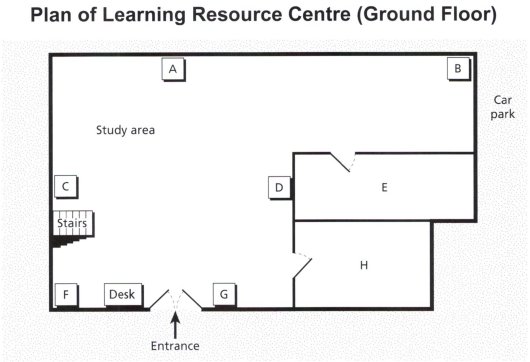
Questions 11-15: Label the plan below. Write the correct letter, A-H, next to Questions 11-15.
Questions
17 – 20
Questions 16-20: Complete the table below. Write ONE WORD ONLY for each answer.
New staff responsibilities Jenny Reed: Buying 6
for the Centre Phil Penshurst: Help with writing 7
for courses Tom Salisbury: Information on topics related to the 8
Saeed Aktar: Finding a 9
Shilpa Desai: Help with 10
Part 3
Questions
21 – 26
Questions 21-27: What helped Stewart with each of the following stages in making his training film for museum employees? Choose SEVEN answers from the box and write the correct letter, A-I, next to Questions 21-27.
Questions
27 – 30
Questions 28-30: Complete the notes below. Write ONE WORD ONLY for each answer.
Notes on specific sections of marketing report Executive summary – Give a brief overview including the 27
. Problems – Link each problem to a 28
which explains it Implementation – Practical solutions to problems – Include details such as participants, 29
and sequence – Section is often poorly done because of lack of 30
. Conclusion – Don’t use new material here
Part 4
Questions
31 – 40
Questions 31-40 Complete the notes below. Write ONE WORD ONLY for each answer.
History of Fireworks in Europe 13th-16th CENTURIES Fireworks were introduced from China. Their use was mainly to do with: – war – 31
(in plays and festivals) 17th CENTURIES Various features of 32
were shown in fireworks displays. Scientists were interested in using ideas from fireworks displays: – to make human 33
possible – to show the formation of 34
. LONDON Scientists were distrustful at first Later, they investigated 35
uses of fireworks (e.g. for sailors) ST PETERSBURG Fireworks were seen as a method of 36
for people PARIS Displays emphasized the power of the 37
. Scientists aimed to provide 38
. 18th CENTURIES Italian fireworks specialists became influential. Servandoni’s fireworks display followed the same pattern as an 39
. The appeal of fireworks extended to the middle classes. Some displays demonstrated new scientific discoveries such as 40
.
Part 1
Questions
1 – 10Questions 1-10: Complete the notes below. Write NO MORE THAN TWO WORDS AND/OR A NUMBER for each answer.
Giải thích đáp án
Cathy: Hello, Hilary Lodge retirement home, Cathy speaking.
John: Hello, my name’s John Shepherd. Could I ask if you’re the manager of the home?
Cathy: That’s right.
John: Oh, good. Hello, Cathy. A friend of mine is a volunteer at Hillary Lodge, and I’d like to help out, too, if you need more people. I work part-time, so I have quite a lot of free time.
Cathy: We’re always glad of more help, John. Shall I tell you about some of the activities that volunteers get involved in?
John: Please.
Cathy: Well, on Monday evenings we organise computer training. We’ve got six laptops, and five or six residents come to the sessions regularly. They’re all now fine at writing and sending emails, but our trainer has just moved away, and (Q1) we need two or three volunteers who can help the residents create documents. Just simple things, really. [chúng tôi cần hai hoặc ba tình nguyện viên có thể giúp cư dân tạo tài liệu. Chỉ là các tài liệu đơn giản thôi, thật đấy]
(Cho phép đáp án: simple documents)
John: I’d certainly be interested in doing that.
Cathy: Great. Then on Tuesday afternoons, we have an informal singing class, which most of the residents attend. (Q2) We’ve got a keyboard, and someone who plays [Chúng tôi có đàn phím và người chơi rồi], but if you’d like to join in the singing, you’d be very welcome.
John: I work on Tuesdays at the moment, though that might change. I’ll have to give it a miss for now, I’m afraid.
Cathy: OK. Then on Thursday mornings we generally have a session in our garden. (Q3) Several of our residents enjoy learning about flowers, where they grow best, how to look after them, and so on. [Một số cư dân của chúng tôi thích tìm hiểu về hoa, nơi chúng phát triển tốt nhất, cách chăm sóc chúng, v.v.] Is that something you’re keen on?
John: I’m no expert, but I enjoy gardening, so yes, I’d like to get involved. (Q4) Do you have your own tools at the home? [Các bạn có dụng cụ riêng tại nhà không?
Cathy: We’ve got a few, but not very many. [Chúng tôi có một vài, nhưng không nhiều lắm]
John: I could bring some in with me when I come.
Cathy: Thank you very much. One very important thing for volunteers is that we hold a monthly meeting where they all get together with the staff. It’s a chance to make sure we’re working well together, and that everyone knows how the residents are, and what’s going on in the home.
John: Uhuh.
Cathy: Now obviously we’d need to get to know you before you become one of our volunteers.
John: Of course.
Cathy: Could you come in for an informal interview – later this week, maybe?
John: (Q5) I’m busy the next couple of days, but would Saturday be possible? [Tôi bận trong vài ngày tới, nhưng thứ Bảy có được không?]
Cathy: Certainly. Just drop in any time during the day. [Chắc chắn là được chứ. Cứ ghé qua bất cứ lúc nào trong ngày] (Q6) I won’t be working then, so you’ll see my assistant, Mairead. [Lúc đó tôi sẽ không làm việc, vì vậy bạn sẽ gặp trợ lý của tôi, Mairead]
John: Sorry, how do you spell that?
Cathy: It’s M-A-I-R-E-A-D, Mairead. [Là M-A-I-R-E-A-D, Mairead]
John: OK, got that. It’s not a name I’m familiar with.
Cathy: It’s an Irish name. She comes from Dublin.
John: Right. (Q7) And the road that Hilary Lodge is in is called Bridge Road, isn’t it? [Và Hilary Lodge nằm trên con đường tên là Đường Bridge phải không?]
Cathy: That’s right. Number 73. [Đúng rồi. Số 73]
John: Fine.
Cathy: Oh, one other thing you might be interested in – we’re holding a couple of ‘open house’ days, and still need a few volunteers (= help), if you’re available.
John: What are the dates?
Cathy: There’s one on April 9th, and another on 14th May. They’re both Saturdays, and all-day events.
John: (Q8) I can certainly manage May 14th. [Tôi chắc chắn có thể sắp xếp vào ngày 14 tháng 5] I’ve got another commitment on April 9th, though.
Cathy: That would be a great help. We’re having several guest entertainers – singers, a brass band, and so on- and we’re expecting a lot of visitors. So one possibility is to help look after the entertainers, or you could spend an hour or so organising people as they arrive, and then just be part of the team making sure everything’s going smoothly.
John: (Q9) Well, shall I show people where they can park? [Chà, tôi nên chỉ cho mọi người nơi họ có thể đỗ xe chứ nhỉ?]
Cathy: Lovely. Thank you. One reason for holding the open house days is to get publicity for Hillary Lodge locally. (Q10) So you may find you have someone from a newspaper wanting to interview you. [Thế nên bạn có thể sẽ gặp một ai đó từ một tờ báo muốn phỏng vấn bạn] They’ll want to find out from two or three people why they volunteer to help at the home. We’re trying to get a TV station to come, too, but they don’t seem very interested.
John: I don’t mind being interviewed.
Cathy: Good. Well, if you come in for a chat, as we arranged, we’ll take it from there. Thank you very much for calling.
John: My pleasure. Goodbye.
Cathy: Bye.
Part 2
Questions
11 – 15Questions 11-15: Label the plan below. Write the correct letter, A-H, next to Questions 11-15.
Bạn chưa trả lời câu hỏi này
C
Bạn chưa trả lời câu hỏi này
B
Bạn chưa trả lời câu hỏi này
A
Bạn chưa trả lời câu hỏi này
H
Bạn chưa trả lời câu hỏi này
G
Giải thích đáp án
Hello. As some of you know, I’m Elaine Marriott, the head of the college’s Learning Resource Centre. We’ve invited all of you taking evening classes and leisure activities to come and see the changes we’ve made to the Centre in the last month.
One major change we’ve made here on the ground floor is to the layout – as you can see from looking around you. I’m sure you’ll recognise the desk – that’s still in the same place, as it has to be just inside the door. But you’ll see that there are now periodicals on the shelves in the corner behind the desk. We’ve brought them nearer the entrance because so many people like to come in just to read magazines. We now stock a far wider range of periodicals than we used to, so we’ve decided to separate them from newspapers. (Q11) This means the newspapers are now just on the other side of the stairs, near the study area. (=> C) [Điều này có nghĩa là các tờ báo bây giờ chỉ nằm ở phía bên kia của cầu thang, gần khu vực nghiên cứu]
Now, another thing is that we’ve brought the computers downstairs – people used to complain about having to go upstairs to use them. (Q12) So they’re now at the far side of the building on the right in the corner overlooking the car park. (=> B) [Bây giờ họ đang ở phía xa của tòa nhà, bên phải trong góc nhìn ra bãi đậu xe]
(Q13) We’ve now got an extra photocopier, so as well as the one upstairs, there’s one down here. You can see it right opposite the entrance, by the wall on the far side. (=> A) [Bây giờ chúng tôi có thêm một máy photocopy, nên ngoài cái ở tầng trên, còn có một cái ở dưới này. Bạn có thể nhìn thấy nó ngay đối diện lối vào, cạnh bức tường ở phía xa]
The biggest change, though, and one I’m sure many of you will welcome, is that (Q14) we now have a café at last – we’ve been asking for one for years. If you turn right as soon as you get past the desk, you’ll see the door ahead of you. (=> H) [cuối cùng chúng tôi cũng có một quán cà phê – chúng tôi đã yêu cầu một quán cà phê trong nhiều năm. Nếu bạn rẽ phải ngay khi đi qua bàn làm việc, bạn sẽ thấy cánh cửa phía trước bạn] It became possible to have a café because the building has been extended, and we’ve now got a new office and storeroom area.
What else should I tell you about before we walk round? Oh yes, (Q15) we’ve had so many requests for books on sport that we’ve bought a lot more, and they’re all together immediately to the right of the entrance. (=> G) [chúng tôi đã nhận được rất nhiều yêu cầu về sách thể thao nên đã mua thêm rất nhiều và tất cả chúng đều nằm ngay bên phải lối vào]
Questions
16 – 20Questions 16-20: Complete the table below. Write ONE WORD ONLY for each answer.
Giải thích đáp án
OK, that’s enough on the new layout. We’ll walk round in a moment, but before we do, something about the people who are here to help you. Of course, all the staff will do their best to answer your questions, but now we’re each going to specialise in certain areas. So if you ask a staff member about something, and they don’t think they can help you enough, they’ll direct you to our specialist.
(Q16) Jenny Reed is the person to see if there are any films you’d like us to stock, as she’s taken over responsibility for purchasing those. [Jenny Reed là người xem liệu có bất kỳ bộ phim nào mà bạn muốn chúng tôi cung cấp hay không, vì cô ấy chịu trách nhiệm mua những bộ phim đó] I’d better warn you that our budget is limited, so I’m afraid we can’t promise to buy everything you ask for!
(Q17) Phil Penshurst can help you to improve your writing if you need to produce reports for your course. [Phil Penshurst có thể giúp bạn cải thiện bài viết của mình nếu bạn cần tạo báo cáo cho khóa học] You can book a half-hour session with Phil to start with, then if you want more help, he’ll arrange follow-up sessions with you.
(Q18) I must mention Tom Salisbury. Many people are interested in doing research or just reading about this region – the people, occupations, changes over the years, and so on. Tom is a specialist in this particular field [Tôi phải nhắc đến Tom Salisbury. Nhiều người quan tâm đến việc nghiên cứu hoặc chỉ đọc về khu vực này – con người, nghề nghiệp, những thay đổi trong những năm qua, v.v. Tom là một chuyên gia trong lĩnh vực cụ thể này], so if you want any help, he can point you in the right direction – we’ve got a large collection of relevant documents from old maps to studies of the wildlife.
We have a new member of staff. Saeed Aktar. (Q19) I’m sure you’ll meet him soon and will find him very helpful. If you’re unemployed and want some advice on the practical aspects of looking for a job, Saeed is the person to talk to. [Tôi chắc rằng bạn sẽ sớm gặp anh ấy và sẽ thấy anh ấy có thể giúp đỡ rất nhiều. Nếu bạn đang thất nghiệp và muốn có một số lời khuyên về các khía cạnh thực tế khi tìm kiếm một công việc, Saeed là người bạn nên nói chuyện cùng] He’s also written a very useful book on the subject, which of course we’ve got on our shelves!
Many of you will know Shilpa Desai, who’s been working here for about five years. (Q20) Shilpa now has the additional responsibility of giving information and advice on anything to do with housing [Shilpa hiện có thêm trách nhiệm cung cấp thông tin và lời khuyên về bất cứ điều gì liên quan đến nhà ở], such as finding out what’s available, or whether you’re eligible for financial help.
Right, well that’s quite enough from me, so let’s walk round the library.
Part 3
Questions
21 – 27Questions 21-27: What helped Stewart with each of the following stages in making his training film for museum employees? Choose SEVEN answers from the box and write the correct letter, A-I, next to Questions 21-27.
Bạn chưa trả lời câu hỏi này
(E) good weather conditions
Bạn chưa trả lời câu hỏi này
(I) work on a previous assignment
Bạn chưa trả lời câu hỏi này
(C) being allowed extra time
Bạn chưa trả lời câu hỏi này
(G) support of a manager
Bạn chưa trả lời câu hỏi này
(B) information on a website
Bạn chưa trả lời câu hỏi này
(D) meeting a professional film maker
Bạn chưa trả lời câu hỏi này
(A) advice from friends
Giải thích đáp án
Tutor: Right Stewart, well I’ve read your draft report on your work placement at the Central Museum Association Sounds as if you had an interesting time. So you ended up making a film for them?
Stewart: Yeah. It was a film to train the employees in different museums in the techniques they should use for labelling ancient objects without damaging them. Some of them are really fragile.
Tutor: OK. So in your report, you go through the main stages in making the film. Let’s discuss that in a little more detail. You had to find a location – somewhere to shoot the film.
Stewart: That took quite a few days because I had to look at different museums all over the country, but I’d allowed time for it. (Q21) And even though it was the middle of winter, there wasn’t any snow (= good weather conditions), so I didn’t have any transport problems (=> E) [Và mặc dù đang là giữa mùa đông nhưng không có tuyết nên tôi không gặp vấn đề gì khi di chuyển]
Tutor: Right. Did you have to decide what equipment you’d need for the filming?
Stewart: (Q22) Yes. I think they were quite surprised at how well I managed that. It was just the luck of the draw actually, I’d done that project with you last year (= work on a previous assignment). (=> I) [Đúng. Tôi nghĩ họ đã khá ngạc nhiên về cách tôi quản lý việc đó tốt như thế nào. Thực ra đó chỉ là sự may mắn thôi , tôi đã thực hiện dự án đó với bạn vào năm ngoái]
Tutor: Oh, on recording technology? So you knew a bit about it from that, right.
Stewart: Yeah. (Q23) What I found really hard was actually writing the script. I had a deadline for that but the Association had to extend it (= being allowed extra time) (=> C). [Điều tôi thấy thực sự khó khăn là viết kịch bản. Tôi đã có hạn chót cho việc đó nhưng Hiệp hội đã phải gia hạn thêm] I couldn’t have done it otherwise.
Tutor: Would it have helped if you’d had some training there?
Stewart: I think you’re right, I probably needed that, yeah.
Tutor: Right. Now from your draft report it sounds as if you had one or two problems deciding who was going to actually appear in the video.
Stewart: The casting? Yeah. I’d expected that the people who worked for the Association would be really keen on taking part.
Tutor: But they weren’t?
Stewart: The thing was, they were all so busy. And it did mean some of them had to travel. (Q24) But Janice King, who I was reporting to for the project (= manager). She was great. She arranged for people to have time off and for their work to be covered (= support) (=> G). [Trừ Janice King, người mà tôi sẽ nộp báo cáo cho dự án lên cho. Cô ấy thật tuyệt. Cô ấy sắp xếp để mọi người có thời gian nghỉ ngơi và đảm nhận công việc của họ.] So that was a big help for me.
Tutor: Right. And it sounds like the filming itself went well. (Q25) I gather you found a company who provided an online introduction (= information on a website) to the techniques. (=> B) [Tôi tin rằng bạn đã tìm thấy một công ty cung cấp giới thiệu trực tuyến về các kỹ thuật]
Stewart: Yeah. It was really informative and very user-friendly. I learned a lot from it.
Tutor: And then the editing?
Stewart: (Q26) For that, the Association put me in touch with someone who works for one of the big movie companies (= meeting a professional filmmaker) and I went down to the studio and sat with him (=> D) [Vì vậy, Hiệp hội đã giúp tôi liên lạc với một người làm việc cho một trong những công ty điện ảnh lớn và tôi đã xuống trường quay và ngồi với anh ấy] in front of his computer for a day, learning how to cut and paste, and deal with the soundtrack and so on.
Tutor: So was that all?
Stewart: No, I didn’t include this in my draft report but I had to design the cover for the DVD as well… the lettering and everything.
Tutor: Have you done any of that sort of design work before?
Stewart: No, but (Q27) I did a rough draft and then talked it through with a couple of my mates and they gave me some more ideas (= advice from friends) (=> A) [Tôi đã làm một bản nháp sơ bộ và sau đó nói chuyện với một vài người bạn của tôi và họ đã cho tôi thêm một số ý tưởng], and when I’d finished it, I showed it to the people who worked at the Association and they really liked it.
Tutor: Excellent.
Questions
28 – 30Questions 28-30: Complete the notes below. Write ONE WORD ONLY for each answer.
Giải thích đáp án
Tutor: Now as well as your own draft report, I’ve also received some written evaluation from the Association on the work you did during your placement, and how it was of benefit to them. I noticed that you haven’t included anything on that in your report yet.
Stewart: How my project benefited the Association, you mean? So do I have to include that?
Tutor: Yes.
Stewart: Well, let’s think … I suppose if I hadn’t made the film for them, they’d have had to get an outside company to do it. (Q28) But because I was actually working for the Association, I’d got much more of a feeling for (= understanding of) what their aims are. [Nhưng vì tôi đang thực sự làm việc cho Hiệp hội nên tôi có nhiều cảm giác hơn về mục tiêu của họ là gì] Things like their responsibility for the conservation of the exhibits. I don’t think an outside company would have had that understanding, they’d have been more detached.
(Cho phép các đáp án: objectives/goals)
Tutor: Right. And the Association also said that because of your background, you had a good idea of where to go to get the best deal for the equipment you needed. They said the saving in expense made it worthwhile even though sourcing it took quite a bit of time.
Stewart: Yes, that’s true.
Tutor: (Q29) The Association also said making the film had a very positive effect in getting staff to work together more closely (= increased co-operation) [Hiệp hội cũng cho biết việc làm phim có tác dụng rất tích cực trong việc khiến cho các nhân viên làm việc với nhau chặt chẽ hơn]
Stewart: Oh. I hadn’t heard that. That’s good. And certainly, people weren’t afraid to tell me what they thought about it as I was making it, so (Q30) I was able to get lots of feedback at every stage (= continuous). [Tôi đã nhận được rất nhiều phản hồi ở mọi giai đoạn] That was useful for me but it also meant the final product worked better for them.
Tutor: Can you think of any other benefits?
Stewart: Well, I don’t think they’d really thought out what they’d do with the film once it was made. I made quite a few suggestions for the distribution – other people we could send it to as well as museum staff.
Tutor: Yes, they mentioned that. OK, good, well it sounds like they certainly …
Part 4
Questions
31 – 40Questions 31-40 Complete the notes below. Write ONE WORD ONLY for each answer.
Giải thích đáp án
I’m going to talk today about research into a particular species of bird, the New Caledonian crow, whose natural habitat is small islands in the Pacific Ocean. And it seems that these crows are exceptionally resourceful.
Using sticks or other tools to find food isn’t unknown among birds and animals. Some chimpanzees, for example, are known to bang nuts on stones, in order to break the shell and get at the edible kernel inside. (Q31) One New Caledonian crow, called Betty, bent some straight wire into (= made out of wire) a hook and used it to lift a small bucket of her favourite food from a vertical pipe. [Một con quạ New Caledonian, tên là Betty, đã uốn một số sợi dây thẳng thành một cái móc và dùng nó để nhấc một thùng nhỏ đựng thức ăn yêu thích của nó từ một đường ống thẳng đứng] This experiment was the first time she’d been presented with wire, which makes it very impressive. Another crow, called Barney, has demonstrated his skill at using sticks to forage for food.
In one research project, scientists from New Zealand and Oxford set captive New Caledonian crows (Q32) a three-stage problem: if they wanted to extract food from a hole, the crows first had to pull up a string to get a short stick (= to reach a short stick) [một vấn đề gồm ba giai đoạn: nếu chúng muốn lấy thức ăn từ một cái lỗ, trước tiên những con quạ phải kéo một sợi dây để lấy một cây gậy ngắn], then use that short stick to remove a long stick from a toolbox, and finally use the long stick to reach the food. Amazingly, they worked out how to do this successfully.
(Q33) Further experiments carried out at Oxford suggest that crows can also use sticks as tools to inspect (= investigate) all sorts of objects, possibly to assess whether or not they present a danger. [Các thí nghiệm tiếp theo được thực hiện tại Oxford cho thấy quạ cũng có thể sử dụng gậy làm công cụ để kiểm tra tất cả các loại đồ vật, có thể để đánh giá xem chúng có gây nguy hiểm hay không] The idea for the experiment came from observing the birds using tools to pick at random objects, such as a picture of a spider that was printed on some cloth. In this research, five pairs of crows – including Barney – underwent tests to see how they would react to a variety of objects, which were carefully chosen so the birds wouldn’t be tempted to view them as a possible source of food. As a further precaution, all the crows had been fed beforehand.
On eight occasions, a bird’s first contact was by using a tool. (Q34) In all three trials, Barney began by using a stick for inspection (= Barney used a stick to investigate). One involved a rubber snake. [Trong cả ba thử nghiệm, Barney bắt đầu bằng cách sử dụng một cây gậy để kiểm tra. Một trong số đó bao gồm một con rắn cao su.] First he approached it, but didn’t touch it, then retreated to pick up a stick. He then prodded it with the stick. After some more investigation, he discarded the stick and carried on pecking at the snake more confidently – apparently convinced that it wouldn’t move.
In other experiments, two different birds, called Pierre and Corbeau, also made a first approach with tools on three separate occasions. (Q35) Pierre used a short piece of woodchip to touch a light which was flashing, [Pierre dùng một mẩu gỗ ngắn để chạm vào một ngọn đèn đang nhấp nháy] and Corbeau was seen prodding a metal toad with a stick.
Significantly, the crows tended to use the sticks only to make their first contact with the object. Subsequently, they either ignored the object or dropped the tool and pecked at the object – which is very different from using the tool to get access to food.
So what conclusions can be drawn from the research? Evidence is building up from experiments such as these that the birds are able to plan their actions in advance, which is very interesting for understanding their cognition. They don’t seem to be responding in a pre-programmed sort of way: it may even be possible that they’re able to view a problem and work out what the answer is. (Q36) However, a major difficulty is assessing whether this tool-using behaviour is a sign of (= whether this is evidence of) intelligence. [Tuy nhiên, một khó khăn lớn là đánh giá liệu hành vi sử dụng công cụ này có phải là dấu hiệu của trí thông minh hay không] To some extent, this is related to the ecological circumstances in which the animal is found.
So scientists want to find out much more about how the crows behave in their native habitat, and a team from Exeter and Oxford universities is carrying out research in New Caledonia. They’re looking into whether the birds’ way of searching for food gives them any possible evolutionary advantage. The birds are hard to observe, as they live in a region of mountainous forest, (Q37) so the researchers have attached tiny cameras to the tail(s) of some birds [vì vậy các nhà nghiên cứu đã gắn những chiếc máy ảnh nhỏ vào đuôi của một số loài chim], as one method of investigating their behavior.
The birds are masters at using sticks to find their food, in particular beetle larvae from the trees. (Q38) It’s possible that the birds can derive so much (=plenty) energy from these grubs [Có thể là những con chim có thể lấy được rất nhiều năng lượng từ những con sâu này] that they only need to eat a few each day. This would mean that they wouldn’t have to spend most of their waking time searching for food, as most animals do.
(Q39) The beetle larvae have a distinct chemical make-up (= composition), which can be traced through the feathers and blood of birds that eat them (= can be identified in birds that feed on them). [Ấu trùng bọ cánh cứng có thành phần hóa học riêng biệt, có thể được tìm thấy qua lông và máu của những loài chim ăn chúng.] (Q40) Scientists have collected samples from crows in order to estimate the proportion of larvae in their (= analyse what the birds include in their) diet. [Các nhà khoa học đã thu thập các mẫu từ quạ để ước tính tỷ lệ ấu trùng trong chế độ ăn uống của chúng] They should then be able to gauge the extent to which individual birds depend on using sticks to feed themselves.
We’ve learnt a great deal about the ability of New Caledonian crows to use tools, and some very interesting research is being carried out into them.
