IELTS Handbook 16 – Test 2 – R

READING PASSAGE 1


You should spend about 20 minutes on Questions 1-13 which are based on Reading Passage 1 below.


The White Horse of Uffington

The cutting of huge figures or ‘geoglyphs’ into the earth of English hillsides has taken place for more than 3,000 years. There are 56 hill figures scattered around England, with the vast majority on the chalk downlands of the country’s southern counties. The figures include giants, horses, crosses and regimental badges. Although the majority of these geoglyphs date within the last 300 years or so, there are one or two that are much older.

The most famous of these figures is perhaps also the most mysterious – the Uffington White Horse in Oxfordshire. The White Horse has recently been re-dated and shown to be even older than its previously assigned ancient pre-Roman Iron Age* date. More controversial is the date of the enigmatic Long Man of Wilmington in Sussex. While many historians are convinced the figure is prehistoric, others believe that it was the work of an artistic monk from a nearby priory and was created between the 11th and 15th centuries.

The method of cutting these huge figures was simply to remove the overlying grass to reveal the gleaming white chalk below. However, the grass would soon grow over the geoglyph again unless it was regularly cleaned or scoured by a fairly large team of people. One reason that the vast majority of hill figures have disappeared is that when the traditions associated with the figures faded, people no longer bothered or remembered to clear away the grass to expose the chalk outline. Furthermore, over hundreds of years, the outlines would sometimes change due to people not always cutting in exactly the same place, thus creating a different shape to the original geoglyph. The fact that any ancient hill figures survive at all in England today is testament to the strength and continuity of local customs and beliefs which, in one case at least, must stretch back over millennia.

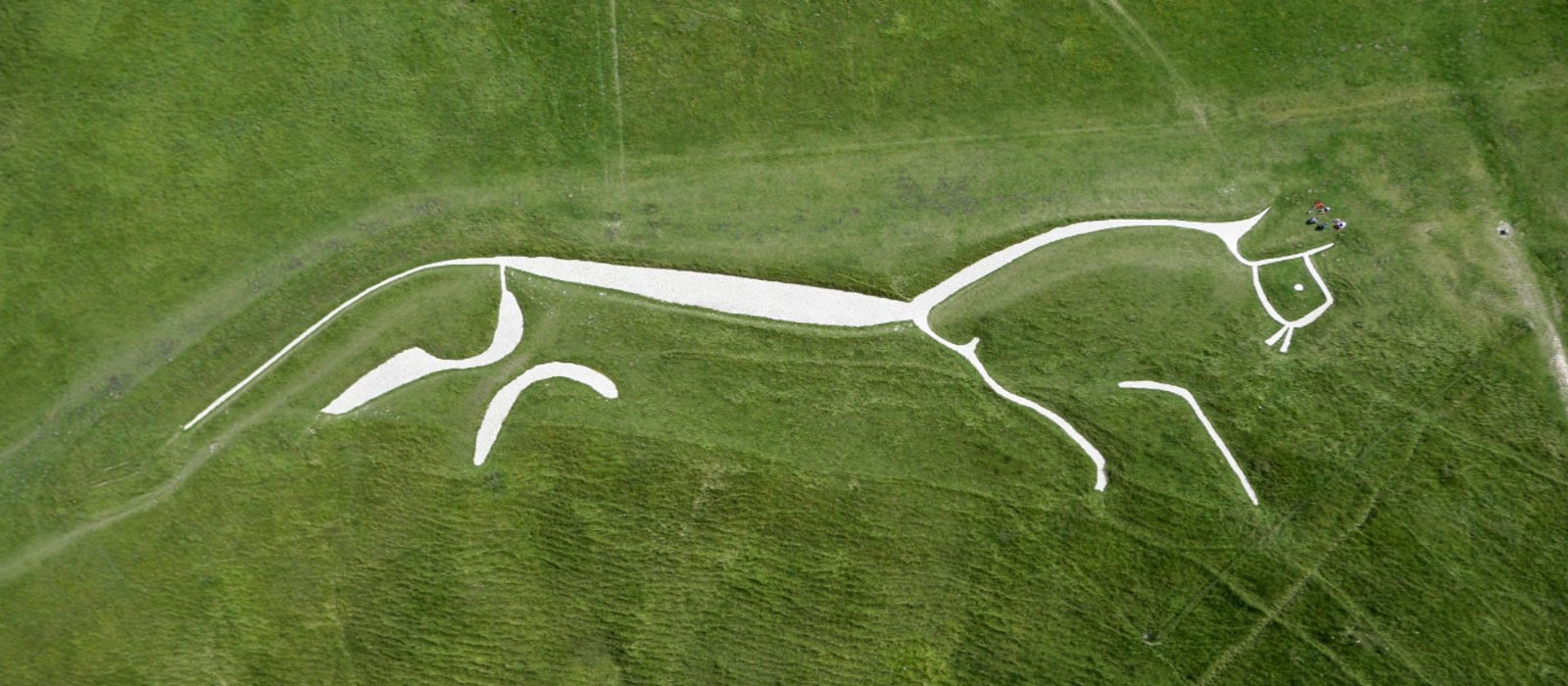
‘Iron Age: a period (in Britain 800 BCE – 43 CE) that is characterised by the use of iron tools. The Uffington White Horse is a unique, stylised representation of a horse consisting of a long, sleek back, thin disjointed legs, a streaming tail, and a bird-like beaked head. The elegant creature almost melts into the landscape. The horse is situated 2.5 km from Uffington village on a steep close to the Late Bronze Age* (c. 7th century BCE) hillfort of Uffington Castle and below the Ridgeway, a long-distance Neolithic** track.

The Uffington Horse is also surrounded by Bronze Age burial mounds. It is not far from the Bronze Age cemetery of Lambourn Seven Barrows, which consists of more than 30 well-preserved burial mounds. The carving has been placed in such a way as to make it extremely difficult to see from close quarters, and like many geoglyphs is best appreciated from the air. Nevertheless, there are certain areas of the Vale of the White Horse, the valley containing and named after the enigmatic creature, from which an adequate impression may be gained. Indeed on a clear day the carving can be seen from up to 30 km away.


The earliest evidence of a horse at Uffington is from the 1070s CE when ‘White Horse Hill’ is mentioned in documents from the nearby Abbey of Abingdon, and the first reference to the horse itself is soon after, in 1190 CE. However, the carving is believed to date back much further than that. Due to the similarity of the Uffington White Horse to the stylised depictions of horses on 1st century BCE coins, it had been thought that the creature must also date to that period.

However, in 1995 Optically Stimulated Luminescence (OSL) testing was carried out by the Oxford Archaeological Unit on soil from two of the lower layers of the horse’s body, and from another cut near the base. The result was a date for the horse’s construction somewhere between 1400 and 600 BCE – in other words, it had a Late Bronze Age or Early Iron Age origin.

The latter end of this date range would tie the carving of the horse in with occupation of the nearby Uffington hillfort, indicating that it may represent a tribal emblem making the land of the inhabitants of the hillfort. Alternatively, the carving may have been carried out during a Bronze or Iron Age ritual. Some researchers see the horse as representing the Celtic*** horse goddess Epona, who was worshipped as a protector of horses, and for her associations with fertility. However, the cult of Epona was not imported from Gaul (France) until around the first century CE. This date is at least six centuries after the Uffington Horse was probably carved. Nevertheless, the horse had great ritual and economic significance during the Bronze and Iron Ages, as attested by its depictions on jewellery and other metal objects. It is possible that the carving represents a goddess in native mythology, such as Rhiannon, described in later Welsh mythology as a beautiful woman dressed in gold and riding a white horse.

The fact that geoglyphs can disappear easily, along with their associated rituals and meaning, indicates that they were never intended to be anything more than temporary gestures. But this does not lessen their importance. These giant carvings are a fascinating glimpse into the minds of their creators and how they viewed the landscape in which they lived.


———-

*Bronze Age: a period (in Britain c. 2,500 BCE – 800 BCE) that is characterised by the development of bronze tools

**Neolithic: a period (in Britain c. 4,000 BCE – c. 2,500 BCE) that is significant for the spread of agricultural practices, and the use of stone tools

***Celtic: an ancient people who migrated from Europe to Britain before the Romans
Questions

– 7
 

Do the following statements agree with the information given in Reading Passage 1?

TRUE               if the statement agrees with the information

FALSE              if the statement contradicts the information

NOT GIVEN    if there is no information on this

  • 1

    Most geoglyphs in England are located in a particular area of the country.

     
  • A

    True

    B

    False

    C

    Not Given

  • 2

    There are more geoglyphs in the shape of a horse than any other creature.

     
  • A

    True

    B

    False

    C

    Not Given

  • 3

    A recent dating of the Uffington White Horse indicates that people were mistaken about its age.

     
  • A

    True

    B

    False

    C

    Not Given

  • 4

    Historians have come to an agreement about the origins of the Long Man of Wilmington. 

     
  • A

    True

    B

    False

    C

    Not Given

  • 5

    Geoglyphs were created by people placing white chalk on the hillside.

     
  • A

    True

    B

    False

    C

    Not Given

  • 6

    Many geoglyphs in England are no longer visible.

     
  • A

    True

    B

    False

    C

    Not Given

  • 7

    The shape of some geoglyphs has been altered over time. 

     
  • A

    True

    B

    False

    C

    Not Given

  • 1

    The fame of the Uffington White Horse is due to its size.

     
  • A

    True

    B

    False

    C

    Not Given

Questions

– 13
 

Complete the summary below. Choose ONE WORD ONLY from the passage for each answer. Write your answers in boxes 9-13

Reasons why polar bears should be protected People think of bears as unintelligent and 8
 
However, this may not be correct. For example: • In Tennoji Zoo, a bear has been seen using a branch as a 9
 
. This allowed him to knock down some 10
 
• A wild polar bear worked out a method of reaching a platform where a 11
 
was located. • Polar bears have displayed behaviour such as conscious manipulation of objects and activity similar to a 12
 
Bears may also display emotions. For example: • They may make movements suggesting 13
 
if disappointed when hunting. • They may form relationships with other species.
 

READING PASSAGE 2


You should spend about 20 minutes on Questions 14-26 which are based on Reading Passage 2 below. 


I contain multitudes

Wendy Moore reviews Ed Yong’s book about microbes

Microbes, most of the bacteria, have populated this planet since long before animal life developed and they will outlive us. Invisible to the naked eye, they are ubiquitous. They inhabit the soil, air, rocks, and water and are present within every form of life, from seaweed and coral to dogs and humans. And, as Yong explains in his utterly absorbing and hugely important book we mess with them at our peril.

Every species has its own colony of microbes, called a ‘microbiome’, and these microbes vary not only between species but also between individuals and within different parts of each individual. What is amazing is that while the number of human cells in the average person is about 30 trillion, the number of microbial ones is higher – about 39 trillion. At best, Yong informs us, we are only 50 percent human. Indeed, some scientists even suggest we should think of each species and its microbes as a single unit, dubbed a ‘holobiont’.

In each human, there are microbes that live only in the stomach, the mouth or the armpit and by and large they do so peacefully. So ‘bad’ microbes are just microbes out of context. Microbes that sit contentedly in the human gut (where there are more microbes than there are stars in the galaxy) can become deadly if they find their way into the bloodstream. These communities are constantly changing too. The right-hand shares just one-sixth of its microbes with the left hand. And, of course, we are surrounded by microbes. Every time we eat, we swallow a million microbes in each gram of food; we are continually swapping microbes with other humans, pets, and the world at large.

It’s a fascinating topic and Yong, a young British science journalist, is an extraordinarily adept guide. Writing with lightness and panache, he has a knack for explaining complex science in terms that are both easy to understand and totally enthralling. Yong is on a mission. Leading us gently by the hand, he takes us into the world of microbes – a bizarre, alien planet – in a bid to persuade us to love them as much as he does. By the end, we do.

For most of human history, we had no idea that microbes existed. The first man to see these extraordinarily potent creatures was a Dutch lens-maker called Antony van Leeuwenhoek in the 1670s. Using microscopes of his own design that could magnify up to 270 times, he examined a drop of water from a nearby lake and found it teeming with tiny creatures he called ‘animalcules’. It wasn’t until nearly two hundred years later that the research of French biologist Louis Pasteur indicated that some microbes caused disease. It was Pasteur’s ‘germ theory’ that gave bacteria the poor image that endures today.

Yong’s book is in many ways a plea for microbial tolerance, pointing out that while fewer than one hundred species of bacteria bring disease, many thousands more play a vital role in maintaining our health. The book also acknowledges that our attitude towards bacteria is not a simple one. We tend to see the dangers posed by bacteria, yet at the same time, we are sold yogurts and drinks that supposedly nurture ‘friendly’ bacteria. In reality, says Yong, bacteria should not be viewed as either friends or foes, villains or heroes. Instead, we should realize we have a symbiotic relationship, that can be mutually beneficial or mutually destructive.

What then do these millions of organisms do? The answer is pretty much everything. New research is now unravelling the ways in which bacteria aid digestion, regulate our immune systems, eliminate toxins, produce vitamins, affect our behaviour and even combat obesity. ‘They actually help us become who we are,’ says Yong. But we are facing a growing problem. Our obsession with hygiene, our overuse of antibiotics, and our unhealthy, low-fibre diets are disrupting the bacterial balance and may be responsible for soaring rates of allergies and immune problems, such as inflammatory bowel disease (IBD).

The most recent research actually turns accepted norms upside down. For example, there are studies indicating that the excessive use of household detergents and antibacterial products actually destroys the microbes that normally keep the more dangerous germs at bay. Other studies show that keeping a dog as a pet gives children early exposure to a diverse range of bacteria, which may help protect them against allergies later.

The readers of Yong’s book must be prepared for a decidedly unglamorous world. Among the less appealing case studies is one about a fungus that is wiping out entire populations of frogs and that can be halted by a rare microbial bacterium. Another is about squid that carries luminescent bacteria that protect them against predators. However, if you can overcome your distaste for some of the investigations, the reasons for Yong’s enthusiasm become clear. The microbial world is a place of wonder. Already, in an attempt to stop mosquitoes from spreading dengue fever – a disease that infects 400 million people a year – mosquitoes are being loaded with a bacterium to block the disease. In the future, our ability to manipulate microbes means we could construct buildings with useful microbes built into their walls to fight off infections. Just imagine a neonatal hospital ward coated in a specially mixed cocktail of microbes so that babies get the best start in life.

Questions

14 – 20
 

Choose the correct letter, A, B, C or D.

  • 2

    What point does the writer make about microbes in the first paragraph?

     
  • A

    They adapt quickly to their environment.

    B

    The risk they pose has been exaggerated.

    C

    They are more plentiful in animal life than plant life.

    D

    They will continue to exist for longer than the human race.

  • 3

     In the second paragraph, the writer is impressed by the fact that

     
  • A

    each species tends to have vastly different microbes.

    B

    some parts of the body contain relatively few microbes.

    C

    the average individual has more microbial cells than human ones.

    D

    scientists have a limited understanding of how microbial cells behave.

  • 4

    What is the writer doing in the fifth paragraph?

     
  • A

    explaining how a discovery was made

    B

    comparing scientists’ theories about microbes

    C

    describing confusion among scientists

    D

    giving details of how microbes cause disease

Questions

21 – 24
 

Complete the summary using the list of words, A-H, below. Write the correct letter, A-H, in boxes 17-20

A. solutionB. partnership C. destruction
D. exaggerationE. cleanlinessF. regulations
G. illnessH. nutrition 

We should be more tolerant of microbes

The Step Pyramid of Djoser The complex that includes the step Pyramid and its surroundings is considered to be as big as an Egyptian 21
 
of the past. The area outside the pyramid included accommodation that was occupied by 22
 
along with many other buildings and features. A wall ran around the outside of the complex and a number of false entrances were built into this. In addition, a long 23
 
encircled the wall. As a result, any visitors who had not been invited were cleverly prevented from entering the pyramid grounds unless they knew the 24
 
of the real entrance.

Questions

25 – 26
 

Do the following statements agree with the claims of the writer in Reading Passage 2?

YES                  if the statement agrees with the claims of the writer

NO                   if the statement contradicts the claims of the writer

NOT GIVEN    if it is impossible to say what the writer thinks about this

  • 5

    It is possible that using antibacterial products in the home fails to have the desired effect. 

     
  • A

    Yes

    B

    No

    C

    Not Given

  • 6

    It is a good idea to ensure that children come into contact with as few bacteria as possible. 

     
  • A

    Yes

    B

    No

    C

    Not Given

  • 7

    Yong’s book contains more cause studies than are necessary.

     
  • A

    Yes

    B

    No

    C

    Not Given

  • 8

    The case study about bacteria that prevent squid from being attacked may have limited appeal.

     
  • A

    Yes

    B

    No

    C

    Not Given

  • 9

    Efforts to control dengue fever have been surprisingly successful

     
  • A

    Yes

    B

    No

    C

    Not Given

  • 10

    Microbes that reduce the risk of infection have already been put inside the walls of some hospital wards.

     
  • A

    Yes

    B

    No

    C

    Not Given

  •  

READING PASSAGE 3


You should spend about 20 minutes on Questions 27-40 which are based on Reading Passage 3 below.


How to make wise decisions

Across cultures, wisdom has been considered one of the most revered human qualities. Although the truly wise may seem few and far between, empirical research examining wisdom suggests that it isn’t an exceptional trait possessed by a small handful of bearded philosophers after all – in fact, the latest studies suggest that most of us have the ability to make wise decisions, given the right context.

‘It appears that experiential, situational, and cultural factors are even more powerful in shaping wisdom than previously imagined,’ says Associate Professor Igor Grossmann of the University of Waterloo in Ontario, Canada. ‘Recent empirical findings from cognitive, developmental, social, and personality psychology cumulatively suggest that people’s ability to reason wisely varies dramatically across experiential and situational contexts. Understanding the role of such contextual factors offers unique insights into understanding wisdom in daily life, as well as how it can be enhanced and taught.’

It seems that it’s not so much that some people simply possess wisdom and others lack it, but that our ability to reason wisely depends on a variety of external factors. ‘It is impossible to characterize thought processes attributed to wisdom without considering the role of contextual factors,’ explains Grossmann. ‘In other words, wisdom is not solely an “inner quality” but rather unfolds as a function of situations people happen to be in. Some situations are more likely to promote wisdom than others.’

Coming up with a definition of wisdom is challenging, but Grossmann and his colleagues have identified four key characteristics as part of a framework of wise reasoning. One is intellectual humility or recognition of the limits of our own knowledge, and another is appreciation of perspectives wider than the issue at hand. Sensitivity to the possibility of change in social relations is also key, along with compromise or integration of different attitudes and beliefs.

Grossmann and his colleagues have also found that one of the most reliable ways to support wisdom in our own day-to-day decisions is to look at scenarios from a third-party perspective, as though giving advice to a friend. Research suggests that when adopting a first-person viewpoint we focus on ‘the focal features of the environment’ and when we adopt a third-person, ‘observer’ viewpoint we reason more broadly and focus more on interpersonal and moral ideals such as justice and impartiality. Looking at problems from this more expansive viewpoint appears to foster cognitive processes related to wise decisions.

What are we to do, then, when confronted with situations like a disagreement with a spouse or negotiating a contract at work, that require us to take a personal stake? Grossmann argues that even when we aren’t able to change the situation, we can still evaluate these experiences from different perspectives.

For example, in one experiment that took place during the peak of a recent economic recession, graduating college seniors were asked to reflect on their job prospects. The students were instructed to imagine their career either ‘as if you were a distant observer’ or ‘before your own eyes as if you were right there’. Participants in the group assigned to the ‘distant observer’ role displayed more wisdom-related reasoning (intellectual humility and recognition of change) than did participants in the control group.

In another study, couples in long-term romantic relationships were instructed to visualize an unresolved relationship conflict either through the eyes of an outsider or from their own perspective. Participants then discussed the incident with their partner for 10 minutes, after which they wrote down their thoughts about it. Couples in the ‘other’s eyes’ condition were significantly more likely to rely on wise reasoning – recognizing others’ perspectives and searching for a compromise – compared to the couples in the egocentric condition.

‘Ego-decentering promotes greater focus on others and enables a bigger picture, conceptual view of the experience, affording recognition of intellectual humility and change,’ says Grossmann.

We might associate wisdom with intelligence or particular personality traits, but research shows only a small positive relationship between wise thinking and crystallized intelligence and the personality traits of openness and agreeableness. ‘It is remarkable how much people can vary in their wisdom from one situation to the next, and how much stronger such contextual effects are for understanding the relationship between wise judgment and its social and affective outcomes as compared to the generalized “traits”,’ Grossmann explains. ‘That is, knowing how wisely a person behaves in a given situation is more informative for understanding their emotions or likelihood to forgive [or] retaliate as compared to knowing whether the person may be wise “in general”.’

Questions

27 – 30
 

Choose the correct letter, A, B, C or D.

  • 27

    What point does the writer make in the first paragraph?

     
  • A

    Wisdom appears to be unique to the human race.

    B

    A basic assumption about wisdom may be wrong.

    C

    Concepts of wisdom may depend on the society we belong to.

    D

    There is still much to be discovered about the nature of wisdom.

  • 28

    What does Igor Grossmann suggest about the ability to make wise decisions?

     
  • A

    It can vary greatly from one person to another.

    B

    Earlier research into it was based on unreliable data.

    C

    The importance of certain influences on it was underestimated.

    D

    Various branches of psychology define it according to their own criteria.

  • 29

    According to the third paragraph, Grossmann claims that the level of wisdom an individual shows

     
  • A

    can be greater than they think it is.

    B

    will be different in different circumstances.

    C

    may be determined by particular aspects of their personality.

    D

    should develop over time as a result of their life experiences.

  • 30

    What is described in the fifth paragraph?

     
  • A

    a difficulty encountered when attempting to reason wisely

    B

    an example of the type of person who is likely to reason wisely

    C

    a controversial view about the benefits of reasoning wisely

    D

    a recommended strategy that can help people to reason wisely

Questions

31 – 34
 

Complete the summary using the list of words, A-J, below. Write the correct letter, A-J, in boxes 31-35

A     opinionsB     confidenceC     viewD     modestyE     problems
F     objectivityG     fairnessH     experiencesI      rangeJ      reasons
The ‘algorithmization’ of jobs Stella Pachidi of Cambridge Judge Business School has been focusing on the ‘algorithmization’ of jobs which rely not on production but on 31
 
. While monitoring a telecommunications company, Pachidi observed a growing 32
 
on the recommendations made by AI, as workers begin to learn through the ‘algorithm’s eyes’. Meanwhile, staff are deterred from experimenting and using their own 33
 
and are therefore prevented from achieving innovation. To avoid the kind of situations which Pachidi observed, researchers are trying to make Al’s decision-making process easier to comprehend, and to increase users’ 34
 
with regard to the technology.

Questions

35 – 40
 

Do the following statements agree with the information given in Reading Passage 3?

TRUE               if the statement agrees with the information

FALSE              if the statement contradicts the information

NOT GIVEN    if there is no information on this

  • 11

    Students participating in the job prospects experiment could choose one of two perspectives to take.

     
  • A

    True

    B

    False

    C

    Not Given

  • 12

    Participants in the couples experiment were aware that they were taking part in a study about wise reasoning.

     
  • A

    True

    B

    False

    C

    Not Given

  • 13

    In the couples experiments, the length of the couples’ relationships had an impact on the results.

     
  • A

    True

    B

    False

    C

    Not Given

  • 14

    In both experiments, the participants who looked at the situation from a more detached viewpoint tended to make wiser decisions.

     
  • A

    True

    B

    False

    C

    Not Given

  • 15

    Grossmann believes that a person’s wisdom is determined by their intelligence to only a very limited extent.

     
  • A

    True

    B

    False

    C

    Not Given

Questions

– 8
 

Do the following statements agree with the information given in Reading Passage 1?

TRUE               if the statement agrees with the information

FALSE              if the statement contradicts the information

NOT GIVEN    if there is no information on this

  • 1

    Most geoglyphs in England are located in a particular area of the country.

     
  • A

    True

    B

    False

    C

    Not Given

Giải thích đáp án


Question 1 – True
Câu hỏi

Most geoglyphs in England are located in a particular area of the country.

Hầu hết các geoglyph ở Anh đều nằm trong một khu vực cụ thể của đất nước.

Định vị vùng thông tin

The cutting of huge figures or ‘geoglyphs’ into the earth of English hillsides has taken place for more than 3,000 years. There are 56 hill figures scattered around England, with the vast majority on the chalk downlands of the country’s southern counties.

Vết cắt các hình khổng lồ hay còn gọi là ‘geoglyphs’ vào trái đất của các sườn đồi ở Anh đã diễn ra trong hơn 3.000 năm. Có 56 ngọn đồi nằm rải rác trên khắp nước Anh, với phần lớn nằm trên vùng đất màu phấn của các quận phía nam của đất nước.

NOTE: Chi tiết “nằm rải rác” dễ đánh lừa người đọc nghĩ rằng đáp án là FALSE vì nó trái nghĩa với cụm “đều nằm trong khu vực cụ thể”. Tuy nhiên thứ nằm rải rác ở đây là các ngọn đồi, không phải là các geoglyphs
  • 2

    There are more geoglyphs in the shape of a horse than any other creature.

     
  • Bạn chưa trả lời câu hỏi này

  • A

    True

    B

    False

    C

    Not Given

Giải thích đáp án


Question 2 – Not given
Câu hỏi

There are more geoglyphs in the shape of a horse than any other creature.

Có nhiều geoglyphs trong hình dạng của một con ngựa hơn bất kỳ sinh vật nào khác.

Định vị vùng thông tin

The figures include giants, horses, crosses and regimental badges.

Các hình thù bao gồm người khổng lồ, ngựa, thánh giá và huy hiệu trung đoàn.

NOTE: Các geoglyphs gồm nhiều hình thì khác nhau, và không đề cập đến việc hình nào có nhiều hơn
  • 3

    A recent dating of the Uffington White Horse indicates that people were mistaken about its age.

     
  • Bạn chưa trả lời câu hỏi này

  • A

    True

    B

    False

    C

    Not Given

Giải thích đáp án


Question 3 – True
Câu hỏi

A recent dating of the Uffington White Horse indicates that people were mistaken about its age.

Cuộc xác định niên đại gần đây của Ngựa trắng Uffington chỉ ra rằng mọi người đã nhầm lẫn về tuổi của nó.

Định vị vùng thông tin

The White Horse has recently been re-dated and shown to be even older than its previously assigned ancient pre-Roman Iron Age date.

Ngựa Trắng gần đây đã được xác định lại niên đại và thậm chí còn được chỉ ra là lâu đời hơn so với niên đại thời kỳ đồ sắt tiền La Mã cổ đại được ấn định trước đó của nó.

  • 4

    Historians have come to an agreement about the origins of the Long Man of Wilmington. 

     
  • Bạn chưa trả lời câu hỏi này

  • A

    True

    B

    False

    C

    Not Given

Giải thích đáp án


Question 4 – False
Câu hỏi

Historians have come to an agreement about the origins of the Long Man of Wilmington

Các nhà sử học đã đi đến thống nhất về nguồn gốc của Long Man ở Wilmington

Định vị vùng thông tin

More controversial is the date of the enigmatic Long Man of Wilmington in Sussex. While many historians are convinced the figure is prehistoricothers believe that it was the work of an artistic monk from a nearby priory and was created between the 11th and 15th centuries.

Gây tranh cãi hơn là niên đại của Long Man bí ẩn của Wilmington ở SussexTrong khi nhiều nhà sử học tin rằng bức tượng này có từ thời tiền sửnhững người khác tin rằng nó là tác phẩm của một nhà sư nghệ thuật từ một giáo viện gần đó và được tạo ra giữa thế kỷ 11 và 15.

NOTE: Dựa vào cấu trúc ngữ pháp while many historians…, others believe… có thể biết đây là hai luồng quan điểm trái chiều
  • 5

    Geoglyphs were created by people placing white chalk on the hillside.

     
  • Bạn chưa trả lời câu hỏi này

  • A

    True

    B

    False

    C

    Not Given

Giải thích đáp án


Question 5 – False
Câu hỏi

Geoglyphs were created by people placing white chalk on the hillside.

Geoglyphs được tạo ra bởi những người đặt phấn trắng trên sườn đồi.

Định vị vùng thông tin

The method of cutting these huge figures was simply to remove the overlying grass to reveal the gleaming white chalk below. However, the grass would soon grow over the geoglyph again unless it was regularly cleaned or scoured by a fairly large team of people.

Phương pháp cắt những hình tượng khổng lồ này chỉ đơn giản là cắt bỏ lớp cỏ bên trên để lộ lớp phấn trắng lấp lánh bên dưới. Tuy nhiên, cỏ sẽ sớm mọc lại trên geoglyph trừ khi nó được làm sạch hoặc quét dọn thường xuyên bởi một nhóm khá đông người.

NOTE: Những người này chỉ làm sạch và quét dọn thường xuyên để giữ cho những hình này không bị cỏ mọc đè lên, không phải là người tạo ra những hình này.
  • 6

    Many geoglyphs in England are no longer visible.

     
  • Bạn chưa trả lời câu hỏi này

  • A

    True

    B

    False

    C

    Not Given

Giải thích đáp án


Question 6 – True
Câu hỏi

Many geoglyphs in England are no longer visible.

Nhiều geoglyph ở Anh không còn được nhìn thấy nữa.

Định vị vùng thông tin

One reason that the vast majority of hill figures have disappeared is that when the traditions associated with the figures faded, people no longer bothered or remembered to clear away the grass to expose the chalk outline.

Một lý do mà phần lớn các hình tượng trên đồi đã biến mất là khi những truyền thống gắn liền với các hình tượng bị phai nhạt, người ta không còn bận tâm hay nhớ đến việc dọn cỏ để phơi phấn.

  • 7

    The shape of some geoglyphs has been altered over time. 

     
  • Bạn chưa trả lời câu hỏi này

  • A

    True

    B

    False

    C

    Not Given

Giải thích đáp án


Question 7 – True
Câu hỏi

The shape of some geoglyphs has been altered over time.

Hình dạng của một số geoglyph đã bị thay đổi theo thời gian.

Định vị vùng thông tin

Furthermore, over hundreds of years, the outlines would sometimes change due to people not always cutting in exactly the same place, thus creating a different shape to the original geoglyph.

Hơn nữa, qua hàng trăm năm, các đường viền đôi khi sẽ thay đổi do không phải lúc nào người ta cũng cắt ở cùng một vị trí, do đó tạo ra một hình dạng khác với geoglyph ban đầu.

  • 8

    The fame of the Uffington White Horse is due to its size.

     
  • Bạn chưa trả lời câu hỏi này

  • A

    True

    B

    False

    C

    Not Given

Giải thích đáp án


Question 8 – Not given
Câu hỏi

The fame of the Uffington White Horse is due to its size.

Sự nổi tiếng của Ngựa trắng Uffington là do kích thước của nó.

Định vị vùng thông tin

The most famous of these figures is perhaps also the most mysterious – the Uffington White Horse in Oxfordshire. The Uffington White Horse is a unique, stylised representation of a horse consisting of a long, sleek back, thin disjointed legs, a streaming tail, and a bird-like beaked head.

Nhân vật nổi tiếng nhất trong số những nhân vật này có lẽ cũng là bí ẩn nhất – Ngựa trắng Uffington ở Oxfordshire. Hơn nữa ở đầu đoạn 4 cũng có thông tin Ngựa trắng Uffington là một hình ảnh đại diện độc đáo, cách điệu của một con ngựa bao gồm lưng dài, bóng bẩy, hai chân mỏng rời nhau, đuôi dài và đầu có mỏ giống chim.

NOTE: Lý do cho sự nổi tiếng của Ngựa trắng Uffington là 1 bí ẩn, không phải nổi tiếng nhờ kích thước của nó

  • Các đặc điểm như “a long, sleek back, thin disjointed legs, a streaming tail, and a bird-like beaked head” khiến cho nó trở nên “unique” (đặc biệt), không phải “famous” (nổi tiếng)

Questions

– 13
 

Complete the summary below. Choose ONE WORD ONLY from the passage for each answer. Write your answers in boxes 9-13

The Uffington White Horse The location of the Uffington White Horse: ● a distance of 2.5 km from Uffington village ● near an ancient road known as the 9
Ridgeway
● close to an ancient cemetery that has a number of burial mounds Dating the Uffington White Horse: ● first reference to White Horse Hill appears in 10
documents
from the 1070s ● horses shown on coins from the period 100 BCE – 1 BCE are similar in appearance ● according to analysis of the surrounding 11
soil
, the Horse is Late Bronze Age / Early Iron Age Possible reasons for creation of the Uffington White Horse: ● an emblem to indicate land ownership ● formed part of an ancient ritual ● was a representation of goddess Epona – associated with protection of horses and 12
fertility
● was a representation of a Welsh goddess called 13
Rhiannon

Giải thích đáp án


Question 9 – Ridgeway
Câu hỏi

The location of the Uffington White Horse:

● a distance of 2.5 km from Uffington village

●   near an ancient road known as the _____

Vị trí của Ngựa trắng Uffington:

● cách làng Uffington 2,5 km

gần một con đường cổ xưa được gọi là _____

Định vị vùng thông tin

The horse is situated 2.5 km from Uffington village on a steep slope close to the Late Bronze Age (c. 7th century BCE) hillfort of Uffington Castle and below the Ridgewaya long-distance Neolithic track. 

Con ngựa nằm cách làng Uffington 2,5 km trên một sườn dốc gần với ngọn đồi của Lâu đài Uffington vào thời kỳ đồ đồng muộn (khoảng thế kỷ thứ 7 trước Công nguyên) và bên dưới Ridgeway, một con đường dài của thời kỳ Đồ đá mới.

Question 10 – documents
Câu hỏi

Dating the Uffington White Horse:

● first reference to White Horse Hill appears in _____ from the 1070s

Xác định niên đại của Ngựa trắng Uffington:

● tài liệu tham khảo đầu tiên về Đồi Ngựa Trắng xuất hiện vào _____ từ những năm 1070

Định vị vùng thông tin

The earliest evidence of a horse at Uffington is from the 1070s CE when ‘White Horse Hill’ is mentioned in documents from the nearby Abbey of Abingdon

Bằng chứng sớm nhất về một con ngựa ở Uffington là từ những năm 1070 khi ‘White Horse Hill’ được đề cập trong các tài liệu từ Tu viện Abingdon gần đó

Question 11 – soil
Câu hỏi

●   according to analysis of the surrounding _____, the Horse is Late Bronze Age / Early Iron Age

● theo phân tích của _____ xung quanh, Con ngựa là cuối thời đại đồ đồng / thời đại tiền đồ sắt

Định vị vùng thông tin

However, in 1995 Optically stimulated Luminescence (OSL) testing was carried out by the Oxford Archaeological Unit on soil from two of the lower layers of the horse’s body, and from another cut near the base. The result was a date for the horse’s construction somewhere between 1400 and 600 BCE – in other words, it had a Late Bronze Age or Early Iron Age origin.

Tuy nhiên, vào năm 1995, thử nghiệm Phát quang kích thích quang học (OSL) đã được Đơn vị Khảo cổ học Oxford thực hiện trên đất từ hai trong số các lớp dưới của thân ngựa và từ một vết cắt khác gần chân ngựa. Kết quả là niên đại của việc xây dựng ngựa ở đâu đó giữa năm 1400 và 600 trước Công nguyên – nói cách khác, nó có nguồn gốc từ cuối thời kỳ đồ đồng hoặc thời kỳ tiền đồ sắt.

Question 12 – fertility
Câu hỏi

Possible reasons for creation of the Uffington White Horse:

●   an emblem to indicate land ownership

●   formed part of an ancient ritual

●   was a representation of goddess Epona – associated with protection of horses and _____

Những lý do có thể có để tạo ra Ngựa trắng Uffington:

● biểu tượng để biểu thị quyền sở hữu đất

● được hình thành một phần trong nghi lễ cổ xưa

● là đại diện của nữ thần Epona – gắn liền với sự bảo vệ của những con ngựa và _____

Định vị vùng thông tin

The latter end of this date range would tie the carving of the horse in with occupation of the nearby Uffington hillfort, indicating that it may represent a tribal emblem making the land of the inhabitants of the hillfort. Alternatively, the carving may have been carried out during a Bronze or Iron Age ritual. Some researchers see the horse as representing the Celtic horse goddess Epona, who was worshipped as a protector of horses and for her associations with fertility

Phần sau sau của phạm vi ngày này sẽ gắn việc khắc hình con ngựa với việc chiếm đóng ngọn đồi Uffington gần đó, cho thấy rằng nó có thể tượng trưng cho một biểu tượng bộ lạc tạo nên vùng đất của cư dân ở ngọn đồi. Ngoài ra, việc chạm khắc có thể đã được thực hiện trong một nghi lễ Thời đại đồ đồng hoặc đồ sắt. Một số nhà nghiên cứu coi con ngựa là đại diện cho nữ thần ngựa Epona của người Celtic, người được tôn thờ như một người bảo vệ ngựa và cho mối liên hệ của cô ấy với khả năng sinh sản

Question 13 – Rhiannon
Câu hỏi

●  was a representation of a Welsh goddess called _____

● là đại diện của một nữ thần xứ Wales được gọi là _____

Định vị vùng thông tin

It is possible that the carving represents a goddess in native mythology, such as Rhiannon, described in later Welsh mythology as a beautiful woman dressed in gold and riding a white horse.

Có thể bức chạm khắc đại diện cho một nữ thần trong thần thoại bản địa, chẳng hạn như Rhiannon, được mô tả trong thần thoại xứ Wales sau này là một người phụ nữ xinh đẹp mặc áo vàng và cưỡi ngựa trắng.

Questions

14 – 16
 

Choose the correct letter, A, B, C or D.

  • 14

    What point does the writer make about microbes in the first paragraph?

     
  • Bạn chưa trả lời câu hỏi này

  • A

    They adapt quickly to their environment.

    B

    The risk they pose has been exaggerated.

    C

    They are more plentiful in animal life than plant life.

    D

    They will continue to exist for longer than the human race.

Giải thích đáp án


*NOTE: Các từ được in đậm trong câu hỏi chính là từ khóa giúp bạn tìm được thông tin cần tìm nhanh hơn

Question 14
Câu hỏi

What point does the writer make about microbes in the first paragraph?

A. They adapt quickly to their environment.

B. The risk they pose has been exaggerated.

C. They are more plentiful in animal life than plant life.

D. They will continue to exist for longer than the human race.

Người viết đưa ra luận điểm gì về vi sinh vật trong đoạn đầu?

A. Chúng thích nghi nhanh chóng với môi trường sống.

B. Rủi ro mà họ gây ra đã được phóng đại.

C. Chúng phong phú hơn ở đời sống động vật so với đời sống thực vật.

D. Chúng sẽ tiếp tục tồn tại lâu hơn loài người.

Định vị vùng thông tin

Microbes, most of the bacteria, have populated this planet since long before animal life developed and they will outlive us 

Vi sinh vật, hầu hết là vi khuẩn, đã cư trú trên hành tinh này từ rất lâu trước khi sự sống của động vật phát triển và chúng sẽ tồn tại lâu hơn chúng ta

  • 15

     In the second paragraph, the writer is impressed by the fact that

     
  • Bạn chưa trả lời câu hỏi này

  • A

    each species tends to have vastly different microbes.

    B

    some parts of the body contain relatively few microbes.

    C

    the average individual has more microbial cells than human ones.

    D

    scientists have a limited understanding of how microbial cells behave.

Giải thích đáp án


*NOTE: Các từ được in đậm trong câu hỏi chính là từ khóa giúp bạn tìm được thông tin cần tìm nhanh hơn

Question 15
Câu hỏi

In the second paragraph, the writer is impressed by the fact that

A. each species tends to have vastly different microbes.

B. some parts of the body contain relatively few microbes.

C. the average individual has more microbial cells than human ones.

D. scientists have a limited understanding of how microbial cells behave.

Trong đoạn thứ hai, người viết bị ấn tượng bởi

A. mỗi loài có xu hướng có rất nhiều vi khuẩn khác nhau.

B. một số bộ phận của cơ thể chứa tương đối ít vi khuẩn.

C. trung bình cá thể có nhiều tế bào vi sinh vật hơn tế bào của người.

D. các nhà khoa học có hiểu biết hạn chế về cách hoạt động của tế bào vi sinh vật.

Định vị vùng thông tin

What is amazing is that while the number of human cells in the average person is about 30 trillion, the number of microbial ones is higher – about 39 trillion. 

Điều đáng kinh ngạc là trong khi số lượng tế bào của con người ở một người bình thường là khoảng 30 nghìn tỷ thì số lượng tế bào vi sinh vật lại cao hơn – khoảng 39 nghìn tỷ.

NOTE: 

Đáp án A (thông tin ở câu đầu đoạn 2) Mỗi loài đều có thuộc địa vi khuẩn của riêng mình, được gọi là ‘microbiome’ ⇒ trái ngược với “có rất nhiều vi khuẩn khác nhau”

Đáp án B (thông tin ở câu đầu đoạn 2) những vi khuẩn này không chỉ khác nhau giữa các loài mà còn giữa các cá thể và trong các bộ phận khác nhau của mỗi cá thể ⇒ Không có so sánh, ít hơn hay nhiều hơn giữa các bộ phận cơ thể, chỉ biết số lượng khác nhau. 

Đáp án D (thông tin ở câu cuối đoạn 2) một số nhà khoa học thậm chí còn gợi ý rằng chúng ta nên coi mỗi loài và vi khuẩn của chúng như một đơn vị duy nhất, được gọi là ‘holobiont’. ⇒ Không đề cập tới hiểu biết bị hạn chế

  • 16

    What is the writer doing in the fifth paragraph?

     
  • Bạn chưa trả lời câu hỏi này

  • A

    explaining how a discovery was made

    B

    comparing scientists’ theories about microbes

    C

    describing confusion among scientists

    D

    giving details of how microbes cause disease

Giải thích đáp án


*NOTE: Các từ được in đậm trong câu hỏi chính là từ khóa giúp bạn tìm được thông tin cần tìm nhanh hơn

Question 16
Câu hỏi

What is the writer doing in the fifth paragraph?

A. explaining how a discovery was made

B. comparing scientists’ theories about microbes

C. describing confusion among scientists

D. giving details of how microbes cause disease

Người viết đang làm gì trong đoạn văn thứ năm?

A. giải thích cách một khám phá được thực hiện

B. so sánh lý thuyết của các nhà khoa học về vi sinh vật

C. mô tả sự nhầm lẫn giữa các nhà khoa học

D. cho biết chi tiết về cách vi khuẩn gây bệnh

Định vị vùng thông tin

For most of human history, we had no idea that microbes existed.

Trong phần lớn lịch sử loài người, chúng ta không hề biết rằng vi khuẩn tồn tại.

NOTE: Câu chủ đề đưa ra bối cảnh về việc con người không có hiểu biết gì về vi khuẩn để dẫn dắt vào phần nội dung giải thích quá trình khám phá ra chúng

Questions

17 – 20
 

Complete the summary using the list of words, A-H, below. Write the correct letter, A-H, in boxes 17-20

A. solutionB. partnership C. destruction
D. exaggerationE. cleanlinessF. regulations
G. illnessH. nutrition 

We should be more tolerant of microbes

Yong’s book argues that we should be more tolerant of microbes. Many have a beneficial effect, and only a relatively small number lead to 17
G
. And although it is misleading to think of microbes as ‘friendly’, we should also stop thinking of them as the enemy. In fact, we should accept that our relationship with microbes is one based on 18
B
. New research shows that microbes have numerous benefits for humans. Amongst other things, they aid digestion, remove poisons, produce vitamins and may even help reduce obesity. However, there is a growing problem. Our poor 19
H
, our overuse of antibiotics, and our excessive focus on 20
E
are upsetting the bacterial balance and may be contributing to the huge increase in allergies and immune system problems.

Giải thích đáp án


Question 17 – G
Câu hỏi

Yong’s book argues that we should be more tolerant of microbes. Many have a beneficial effect, and only a relatively small number lead to _____

Sách của Yong lập luận rằng chúng ta nên khoan dung hơn với vi khuẩn. Nhiều vi khuẩn có tác dụng hữu ích, và chỉ một số tương đối nhỏ dẫn đến _____

Định vị vùng thông tin

Yong’s book is in many ways a plea for microbial tolerance, pointing out that while fewer than one hundred species of bacteria bring disease, many thousands more play a vital role in maintaining our health

Về nhiều mặt, cuốn sách của Yong là một lời kêu gọi sự khoan dung của vi sinh vật, chỉ ra rằng trong khi chưa đến một trăm loài vi khuẩn mang lại bệnh tật, thì hàng nghìn loài vi khuẩn khác đóng một vai trò quan trọng trong việc duy trì sức khỏe của chúng ta.

NOTE: disease = illness ⇒ đáp án G
Question 18 – B
Câu hỏi

And although it is misleading to think of microbes as ‘friendly’, we should also stop thinking of them as the enemy. In fact, we should accept that our relationship with microbes is one based on _____.

Và mặc dù thật sai lầm khi nghĩ vi khuẩn là “thân thiện”, chúng ta cũng nên ngừng nghĩ chúng là kẻ thù. Trên thực tế, chúng ta nên chấp nhận rằng mối quan hệ của chúng ta với vi sinh là dựa trên _____.

Định vị vùng thông tin

We tend to see the dangers posed by bacteria, yet at the same time, we are sold yogurts and drinks that supposedly nurture ‘friendly’ bacteria. Instead, we should realise we have a symbiotic relationship, that can be mutually beneficial or mutually destructive.

Chúng ta có xu hướng nhìn thấy những mối nguy hiểm do vi khuẩn gây ra, nhưng đồng thời, chúng ta được bán sữa chua và đồ uống được cho là nuôi dưỡng vi khuẩn “thân thiện”. Thay vào đó, chúng ta nên nhận ra rằng chúng ta có một mối quan hệ cộng sinh, có thể cùng có lợi hoặc cùng tiêu diệt.

NOTE: symbiotic = partnership ⇒ đáp án B
Question 19 – H và Question 20 – E
Câu hỏi

New research shows that microbes have numerous benefits for humans. Amongst other things, they aid digestion, remove poisons, produce vitamins and may even help reduce obesityHowever, there is a growing problem. Our poor _____, our overuse of antibiotics, and our excessive focus on _____ are upsetting the bacterial balance and may be contributing to the huge increase in allergies and immune system problems.

Nghiên cứu mới cho thấy vi khuẩn có rất nhiều lợi ích cho con người. Trong số những thứ khác, chúng hỗ trợ tiêu hóa, loại bỏ chất độc, sản xuất vitamin và thậm chí có thể giúp giảm béo phìTuy nhiên, có một vấn đề ngày càng tăng. _____ tội nghiệp của chúng ta, việc chúng ta lạm dụng thuốc kháng sinh và tập trung quá mức vào _____ đang làm đảo lộn sự cân bằng vi khuẩn và có thể góp phần làm gia tăng đáng kể các vấn đề về dị ứng và hệ miễn dịch.

Định vị vùng thông tin

New research is now unravelling the ways in which bacteria aid digestion, regulate our immune systems, eliminate toxins, produce vitamins, affect our behaviour and even combat obesity. ‘They actually help us become who we are,’ says Yong. But we are facing a growing problem. Our obsession with hygiene, our overuse of antibiotics, and our unhealthy, low-fibre diets are disrupting the bacterial balance and may be responsible for soaring rates of allergies and immune problems, such as inflammatory bowel disease (IBD).

Nghiên cứu mới hiện đang làm sáng tỏ các cách thức mà vi khuẩn hỗ trợ tiêu hóa, điều chỉnh hệ thống miễn dịch của chúng ta, loại bỏ độc tố, sản xuất vitamin, ảnh hưởng đến hành vi của chúng ta và thậm chí chống lại bệnh béo phì. Yong nói: “Chúng thực sự giúp chúng tôi trở thành con người của chính mình. Nhưng chúng tôi đang phải đối mặt với một vấn đề ngày càng tăng. Nỗi ám ảnh của chúng ta về vệ sinh, lạm dụng thuốc kháng sinh và chế độ ăn không lành mạnh, ít chất xơ đang phá vỡ sự cân bằng vi khuẩn và có thể là nguyên nhân làm tăng tỷ lệ dị ứng và các vấn đề miễn dịch, chẳng hạn như bệnh viêm ruột (IBD).

NOTE: Đây là 2 câu bẫy vì chúng ta phải đi tìm paraphrase của keyword để biết từ gì cần điền vào chỗ trống. Nếu điền theo thứ tự như ở bài viết thì dễ bị ngược 2 đáp án với nhau. 

Câu 19: diets = nutrition ⇒ đáp án H

Câu 20: hygiene = cleanliness ⇒ đáp án E

Questions

21 – 26
 

Do the following statements agree with the claims of the writer in Reading Passage 2?

YES                  if the statement agrees with the claims of the writer

NO                   if the statement contradicts the claims of the writer

NOT GIVEN    if it is impossible to say what the writer thinks about this

  • 21

    It is possible that using antibacterial products in the home fails to have the desired effect. 

     
  • Bạn chưa trả lời câu hỏi này

  • A

    Yes

    B

    No

    C

    Not Given

Giải thích đáp án


Question 21 – Yes
Câu hỏi

It is possible that using antibacterial products in the home fails to have the desired effect. 

Có thể việc sử dụng các sản phẩm diệt khuẩn trong nhà không mang lại hiệu quả như mong muốn.

Định vị vùng thông tin

For example, there are studies indicating that the excessive use of household detergents and antibacterial products actually destroys the microbes that normally keep the more dangerous germs at bay.

Ví dụ, có những nghiên cứu chỉ ra rằng việc sử dụng quá nhiều chất tẩy rửa gia dụng và các sản phẩm kháng khuẩn thực sự tiêu diệt các vi khuẩn thường bảo vệ chúng ta khỏi các vi khuẩn có hại hơn.

  • 22

    It is a good idea to ensure that children come into contact with as few bacteria as possible. 

     
  • Bạn chưa trả lời câu hỏi này

  • A

    Yes

    B

    No

    C

    Not Given

Giải thích đáp án


Question 22 – No
Câu hỏi

It is a good idea to ensure that children come into contact with as few bacteria as possible.

Bạn nên đảm bảo rằng trẻ em tiếp xúc với càng ít vi khuẩn càng tốt.

Định vị vùng thông tin

Other studies show that keeping a dog as a pet gives children early exposure to a diverse range of bacteria, which may help protect them against allergies later.

Các nghiên cứu khác cho thấy việc nuôi chó làm thú cưng giúp trẻ tiếp xúc sớm với nhiều loại vi khuẩn khác nhau, có thể giúp bảo vệ chúng chống lại các bệnh dị ứng sau này.

  • 23

    Yong’s book contains more cause studies than are necessary.

     
  • Bạn chưa trả lời câu hỏi này

  • A

    Yes

    B

    No

    C

    Not Given

Giải thích đáp án


Question 23 – Not given
Câu hỏi

Yong’s book contains more case studies than are necessary.

Cuốn sách của Yong chứa nhiều nghiên cứu điển hình hơn mức cần thiết.

NOTE: Toàn bộ đoạn 9 nói về các case studies của Yong, không có nhận xét có nhiều nghiên cứu hơn cần thiết hay không.
  • 24

    The case study about bacteria that prevent squid from being attacked may have limited appeal.

     
  • Bạn chưa trả lời câu hỏi này

  • A

    Yes

    B

    No

    C

    Not Given

Giải thích đáp án


Question 24 – Yes
Câu hỏi

The case study about bacteria that prevent squid from being attacked may have limited appeal.

Nghiên cứu điển hình về vi khuẩn ngăn mực bị tấn công có thể có sức hấp dẫn hạn chế.

Định vị vùng thông tin

Among the less appealing case studies is one about a fungus that is wiping out entire populations of frogs and that can be halted by a rare microbial bacterium. Another is about squid that carry luminescent bacteria that protect them against predators.

Trong số các nghiên cứu trường hợp kém hấp dẫn hơn là một nghiên cứu về một loại nấm đang xóa sổ toàn bộ quần thể ếch và có thể bị ngăn chặn bởi một loại vi khuẩn vi sinh vật quý hiếm. Một vấn đề khác là về loài mực mang vi khuẩn phát quang giúp bảo vệ chúng chống lại những kẻ săn mồi.

  • 25

    Efforts to control dengue fever have been surprisingly successful

     
  • Bạn chưa trả lời câu hỏi này

  • A

    Yes

    B

    No

    C

    Not Given

Giải thích đáp án


Question 25 – Not given
Câu hỏi

Efforts to control dengue fever have been surprisingly successful.

Những nỗ lực để kiểm soát bệnh sốt xuất huyết đã thành công đáng ngạc nhiên.

Định vị vùng thông tin

Already, in an attempt to stop mosquitoes spreading dengue fever – a disease that infects 400 million people a year – mosquitoes are being loaded with a bacterium to block the disease.

Hiện tại, trong nỗ lực ngăn chặn muỗi truyền bệnh sốt xuất huyết – căn bệnh lây nhiễm cho 400 triệu người mỗi năm – muỗi đang được nạp vào cơ thể một loại vi khuẩn để ngăn chặn căn bệnh này.

NOTE: Đoạn văn không đề cập tới việc nỗ lực này có thành công hay không.
  • 26

    Microbes that reduce the risk of infection have already been put inside the walls of some hospital wards.

     
  • Bạn chưa trả lời câu hỏi này

  • A

    Yes

    B

    No

    C

    Not Given

Giải thích đáp án


Question 26 – No
Câu hỏi

Microbes that reduce the risk of infection have already been put inside the walls of some hospital wards.  

Các vi sinh vật giúp giảm nguy cơ lây nhiễm đã được đưa vào bên trong tường của một số khu bệnh viện.

Định vị vùng thông tin

In the future, our ability to manipulate microbes means we could construct buildings with useful microbes built into their walls to fight off infections.

Trong tương lai, khả năng điều khiển vi khuẩn của chúng ta có nghĩa là chúng ta có thể xây dựng các tòa nhà với các lợi khuẩn được xây dựng trên tường của chúng để chống lại nhiễm trùng.


Questions

27 – 30

Choose the correct letter, A, B, C or D.

  • 27

    What point does the writer make in the first paragraph?

  • Bạn chưa trả lời câu hỏi này

Giải thích đáp án

*NOTE: Các từ được in đậm trong câu hỏi chính là từ khóa giúp bạn tìm được thông tin cần tìm nhanh hơn

Question 27
Câu hỏi

What point does the writer make in the first paragraph?

A. Wisdom appears to be unique to the human race.

B. A basic assumption about wisdom may be wrong.

C. Concepts of wisdom may depend on the society we belong to.

D. There is still much to be discovered about the nature of wisdom.

Người viết đưa ra luận điểm gì trong đoạn văn đầu tiên?

A. Trí tuệ dường như là duy nhất của loài người.

B. Một giả định cơ bản về sự khôn ngoan có thể sai.

C. Các khái niệm về trí tuệ có thể phụ thuộc vào xã hội mà chúng ta thuộc về.

D. Vẫn còn nhiều điều cần khám phá về bản chất của trí tuệ.

Định vị vùng thông tin

Although the truly wise may seem few and far between, empirical research examining wisdom suggests that it isn’t an exceptional trait possessed by a small handful of bearded philosophers after all – in fact, the latest studies suggest that most of us have the ability to make wise decisions

Mặc dù sự khôn ngoan thực sự có vẻ ít và xa, nghiên cứu thực nghiệm kiểm tra sự khôn ngoan cho thấy rằng đó không phải là một đặc điểm ngoại lệ mà một số ít triết gia có râu sở hữu – trên thực tế, các nghiên cứu mới nhất cho thấy rằng hầu hết chúng ta đều có khả năng đưa ra quyết định khôn ngoan

NOTE: Ta chú ý vào cụm “In fact” thể hiện sự đối lập giữa nghiên cứu/ hiểu biết trước đây và thực tế

Đáp án A (thông tin ở câu đầu đoạn 1) Trên khắp các nền văn hóa, trí tuệ đã được coi là một trong những phẩm chất con người được tôn kính nhất. ⇒ Đây là một trong những phẩm chất, không phải là phẩm chất duy nhất

  • 28

    What does Igor Grossmann suggest about the ability to make wise decisions?

  • Bạn chưa trả lời câu hỏi này

Giải thích đáp án

*NOTE: Các từ được in đậm trong câu hỏi chính là từ khóa giúp bạn tìm được thông tin cần tìm nhanh hơn

Question 28
Câu hỏi

What does Igor Grossmann suggest about the ability to make wise decisions?

A. It can vary greatly from one person to another.

B. Earlier research into it was based on unreliable data.

C. The importance of certain influences on it was underestimated.

D. Various branches of psychology define it according to their own criteria.

Igor Grossmann gợi ý gì về khả năng đưa ra quyết định khôn ngoan?

A. Nó có thể khác nhau rất nhiều từ người này sang người khác.

B. Nghiên cứu trước đó về nó dựa trên dữ liệu không đáng tin cậy.

C. Tầm quan trọng của những ảnh hưởng nhất định đối với nó đã bị đánh giá thấp.

D. Nhiều nhánh tâm lý học khác nhau xác định nó theo các tiêu chí riêng của chúng.

Định vị vùng thông tin

“It appears that experiential, situational, and cultural factors are even more powerful in shaping wisdom than previously imagined” 

“Có vẻ như các yếu tố kinh nghiệm, tình huống và văn hóa thậm chí còn mạnh mẽ hơn trong việc hình thành trí tuệ so với tưởng tượng trước đây

  • 29

    According to the third paragraph, Grossmann claims that the level of wisdom an individual shows

  • Bạn chưa trả lời câu hỏi này

Giải thích đáp án

*NOTE: Các từ được in đậm trong câu hỏi chính là từ khóa giúp bạn tìm được thông tin cần tìm nhanh hơn

Question 29
Câu hỏi

According to the third paragraph, Grossmann claims that the level of wisdom an individual shows

A. can be greater than they think it is.

B. will be different in different circumstances.

C. may be determined by particular aspects of their personality.

D. should develop over time as a result of their life experiences.

Theo đoạn thứ ba, Grossmann tuyên bố rằng mức độ khôn ngoan của một cá nhân cho thấy

A. có thể lớn hơn họ nghĩ.

B. sẽ khác nhau trong các hoàn cảnh khác nhau.

C. có thể được xác định bởi các khía cạnh cụ thể trong tính cách của họ.

D. sẽ phát triển theo thời gian là kết quả của kinh nghiệm sống của họ.

Định vị vùng thông tin

wisdom is not solely an “inner quality” but rather unfolds as a function of situations people happen to be in. Some situations are more likely to promote wisdom than others

sự khôn ngoan không chỉ là “phẩm chất bên trong” mà còn bộc lộ ra ngoài như một chức năng của những tình huống mà mọi người gặp phải. Một số tình huống có nhiều khả năng phát huy trí tuệ hơn những tình huống khác

  • 30

    What is described in the fifth paragraph?

  • Bạn chưa trả lời câu hỏi này

Giải thích đáp án

*NOTE: Các từ được in đậm trong câu hỏi chính là từ khóa giúp bạn tìm được thông tin cần tìm nhanh hơn

Question 30
Câu hỏi

What is described in the fifth paragraph?

A. a difficulty encountered when attempting to reason wisely

B. an example of the type of person who is likely to reason wisely

C. a controversial view about the benefits of reasoning wisely

D. a recommended strategy that can help people to reason wisely

Điều gì được mô tả trong đoạn văn thứ năm?

A. một khó khăn gặp phải khi cố gắng lập luận một cách khôn ngoan

B. một ví dụ về kiểu người có khả năng lập luận khôn ngoan

C. một quan điểm gây tranh cãi về lợi ích của việc lập luận một cách khôn ngoan

D. một chiến lược được đề xuất có thể giúp mọi người lập luận một cách sáng suốt

Định vị vùng thông tin

Grossmann and his colleagues have also found that one of the most reliable ways to support wisdom in our own day-to-day decisions is to look at scenarios from a third-party perspective, as though giving advice to a friend.

Grossmann và các đồng nghiệp của ông cũng đã phát hiện ra rằng một trong những cách đáng tin cậy nhất để hỗ trợ sự khôn ngoan trong các quyết định hàng ngày của chúng ta là xem xét các tình huống từ góc độ của bên thứ ba, như thể đưa ra lời khuyên cho một người bạn.

NOTE: Đây là thông tin được nhắc tới ngay trong câu chủ đề của đoạn văn, chứng tỏ toàn bộ đoạn văn sẽ tiếp tục mô tả và triển khai nội dung này ⇒ loại các đáp án còn lại mà không cần đọc tiếp

Questions

31 – 35

Complete the summary using the list of words, A-J, below. Write the correct letter, A-J, in boxes 31-35

A     opinionsB     confidenceC     viewD     modestyE     problems
F     objectivityG     fairnessH     experiencesI      rangeJ      reasons
The characteristics of wise reasoning Igor Grossmann and colleagues have established four characteristics which enable us to make wise decisions. It is important to have a certain degree of 31
D
regarding the extent of our knowledge and to take into account 32
A
which may not be the same as our own. We should also be able to take a broad 33
C
of any situation. Another key characteristic is being aware of the likelihood of alterations in the way that people relate to each other.Grossmann also believes that it is better to regard scenarios with 34
F
. By avoiding the first-person perspective, we focus more on 35
G
and on other moral ideals, which in turn leads to wiser decision-making.

Giải thích đáp án

Question 31 – D và Question 32 – A
Câu hỏi

Igor Grossmann and colleagues have established four characteristics which enable us to make wise decisions. It is important to have a certain degree of _____ regarding the extent of our knowledge and to take into account _____ which may not be the same as our own.

Igor Grossmann và các đồng nghiệp đã thiết lập bốn đặc điểm cho phép chúng ta đưa ra quyết định khôn ngoan. Điều quan trọng là phải có một mức độ _____ nhất định về mức độ hiểu biết của chúng ta và phải tính đến _____ có thể không giống với mức độ hiểu biết của chúng ta.

Định vị vùng thông tin

Grossmann and his colleagues have identified four key characteristics as part of a framework of wise reasoning. One is intellectual humility or recognition of the limits of our own knowledge

Grossmann và các đồng nghiệp của ông đã xác định bốn đặc điểm chính như một phần của khuôn khổ lý luận khôn ngoan. Một là sự khiêm tốn về trí tuệ hoặc sự thừa nhận các giới hạn của kiến thức của chúng ta

NOTE: 

Câu 31: humility = modesty ⇒ đáp án D

Câu 32: limits = opinions ⇒ đáp án A

Question 33 – C
Câu hỏi

We should also be able to take a broad _____ of any situation. Another key characteristic is being aware of the likelihood of alterations in the way that people relate to each other.

Chúng ta cũng có thể nắm bắt được _____ tổng quát về bất kỳ tình huống nào. Một đặc điểm quan trọng khác là nhận thức được khả năng thay đổi theo cách mà mọi người liên hệ với nhau.

Định vị vùng thông tin

another is appreciation of perspectives wider than the issue at hand 

một điểm nữa là đánh giá cao các quan điểm rộng hơn vấn đề đang bàn

NOTE: perspectives = view ⇒ đáp án C
Question 34 – F
Câu hỏi

Grossmann also believes that it is better to regard scenarios with _____.

Grossmann cũng tin rằng tốt hơn là nên xem xét các tình huống với _____.

Định vị vùng thông tin

Grossmann and his colleagues have also found that one of the most reliable ways to support wisdom in our own day-to-day decisions is to look at scenarios from a third-party perspective, as though giving advice to a friend.

Grossmann và các đồng nghiệp của ông cũng đã phát hiện ra rằng một trong những cách đáng tin cậy nhất để hỗ trợ sự khôn ngoan trong các quyết định hàng ngày của chúng ta là xem xét các tình huống từ góc độ của bên thứ ba, như thể đưa ra lời khuyên cho một người bạn.

NOTE: third-party perspective, as though giving advice to a friend = objectivity (sự khách quan) ⇒ đáp án F
Question 35 – G
Câu hỏi

By avoiding the first-person perspective, we focus more on _____ and on other moral ideals, which in turn leads to wiser decision-making.

Bằng cách tránh góc nhìn thứ nhất, chúng tôi tập trung nhiều hơn vào _____ và các lý tưởng đạo đức khác, từ đó dẫn đến việc ra quyết định khôn ngoan hơn.

Định vị vùng thông tin

Research suggests that when adopting a first-person viewpoint we focus on ‘the focal features of the environment’ and when we adopt a third-person, ‘observer’ viewpoint we reason more broadly and focus more on interpersonal and moral ideals such as justice and impartiality.

Nghiên cứu cho thấy rằng khi áp dụng quan điểm của người thứ nhất, chúng ta tập trung vào ‘các đặc điểm chính của môi trường’ và khi áp dụng quan điểm ‘quan sát’ của người thứ ba,, chúng ta suy luận rộng hơn và tập trung nhiều hơn vào các lý tưởng giữa cá nhân và đạo đức như công lý và vô tư.

NOTE: justice = fairness ⇒ đáp án G

Questions

36 – 40

Do the following statements agree with the information given in Reading Passage 3?

TRUE               if the statement agrees with the information

FALSE              if the statement contradicts the information

NOT GIVEN    if there is no information on this

  • 36

    Students participating in the job prospects experiment could choose one of two perspectives to take.

  • Bạn chưa trả lời câu hỏi này

Giải thích đáp án

Question 36 – False
Câu hỏi

Students participating in the job prospects experiment could choose one of two perspectives to take.

Sinh viên tham gia thử nghiệm triển vọng việc làm có thể chọn một trong hai quan điểm để thực hiện.

Định vị vùng thông tin

Participants in the group assigned to the ‘distant observer’ role displayed more wisdom-related reasoning (intellectual humility and recognition of change) than did participants in the control group.

Những người tham gia trong nhóm được giao cho vai trò ‘người quan sát từ xa’ thể hiện nhiều lý luận liên quan đến trí tuệ (sự khiêm tốn về trí tuệ và nhận biết sự thay đổi) so với những người tham gia trong nhóm đối chứng.

NOTE: Các sinh viên này không có quyền tự chọn quan điểm mà sẽ được chỉ định
  • 37

    Participants in the couples experiment were aware that they were taking part in a study about wise reasoning.

  • Bạn chưa trả lời câu hỏi này

Giải thích đáp án

Question 37 – Not given
Câu hỏi

Participants in the couples experiment were aware that they were taking part in a study about wise reasoning.

Những người tham gia thí nghiệm các cặp vợ chồng nhận thức được rằng họ đang tham gia một cuộc nghiên cứu về lý luận khôn ngoan.

Định vị vùng thông tin

In another study, couples in long-term romantic relationships were instructed to visualize an unresolved relationship conflict either through the eyes of an outsider or from their own perspective.

Trong một nghiên cứu khác, các cặp đôi đang có mối quan hệ lãng mạn lâu dài được hướng dẫn cách hình dung một mối quan hệ xung đột chưa được giải quyết thông qua con mắt của người ngoài cuộc hoặc từ quan điểm của chính họ.

NOTE: Đoạn văn có đề cập tới đối tượng là các cặp đôi tham gia nghiên cứu, nhưng chỉ mô tả quá trình thực hiện nghiên cứu, không nhắc tới việc các cặp đôi này có nhận thức được điều gì hay không
  • 38

    In the couples experiments, the length of the couples’ relationships had an impact on the results.

  • Bạn chưa trả lời câu hỏi này

Giải thích đáp án

Question 38 – Not given
Câu hỏi

In the couples experimentsthe length of the couples’ relationships had an impact on the results.

Trong các thí nghiệm của các cặp đôikhoảng thời gian gắn của các cặp đôi có ảnh hưởng đến kết quả.

Định vị vùng thông tin

In another studycouples in long-term romantic relationships were instructed to visualize an unresolved relationship conflict either through the eyes of an outsider or from their own perspective.

Trong một nghiên cứu kháccác cặp đôi đang có mối quan hệ lãng mạn lâu dài được hướng dẫn cách hình dung một mối quan hệ xung đột chưa được giải quyết thông qua con mắt của người ngoài cuộc hoặc từ quan điểm của chính họ.

NOTE: Đoạn văn có đề cập tới đối tượng là các cặp đôi tham gia nghiên cứu, nhưng chỉ mô tả quá trình thực hiện nghiên cứu, không nhắc tới việc khoảng thời gian gắn bó của các cặp đôi này sẽ có  ảnh hưởng tới kết quả như thế nào
  • 39

    In both experiments, the participants who looked at the situation from a more detached viewpoint tended to make wiser decisions.

  • Bạn chưa trả lời câu hỏi này

Giải thích đáp án

Question 39 – True
Câu hỏi

In both experiments, the participants who looked at the situation from a more detached viewpoint tended to make wiser decisions.

Trong cả hai thí nghiệm, những người tham gia xem xét tình huống từ một quan điểm tách biệt hơn có xu hướng đưa ra quyết định khôn ngoan hơn.

Định vị vùng thông tin

Ego-decentering promotes greater focus on others and enables a bigger picture, conceptual view of the experience, affording recognition of intellectual humility and change,’ says Grossmann.

Grossmann cho biết: Phân cấp cái tôi của bản thân thúc đẩy sự tập trung nhiều hơn vào những người khác và tạo ra bức tranh toàn cảnh hơn, cái nhìn khái niệm về trải nghiệm, ghi nhận sự khiêm tốn và thay đổi trí tuệ.

  • 40

    Grossmann believes that a person’s wisdom is determined by their intelligence to only a very limited extent.

  • Bạn chưa trả lời câu hỏi này

Giải thích đáp án

Question 40 – True
Câu hỏi

Grossmann believes that a person’s wisdom is determined by their intelligence to only a very limited extent.

Grossmann tin rằng trí tuệ của một người được quyết định bởi trí thông minh của họ chỉ ở một mức độ rất hạn chế.

Định vị vùng thông tin

but research shows only a small positive relationship between wise thinking and crystallized intelligence 

nhưng nghiên cứu chỉ cho thấy một mối quan hệ tích cực nhỏ giữa tư duy khôn ngoan và trí thông minh được kết tinh

Select the fields to be shown. Others will be hidden. Drag and drop to rearrange the order.
  • Image
  • SKU
  • Rating
  • Price
  • Stock
  • Availability
  • Add to cart
  • Description
  • Content
  • Weight
  • Dimensions
  • Additional information
Click outside to hide the comparison bar
Compare