
IELTS Handbook 15 – Test 4 – R
09/11/2024 2024-11-09 13:57IELTS Handbook 15 – Test 4 – R
READING PASSAGE 1
You should spend about 20 minutes on Questions 1-13 which are based on Reading Passage 1 below.
The return of the huarango
The arid valleys of southern Peru are welcoming the return of a native plant
The south coast of Peru is a narrow, 2,000-kilometre-long strip of desert squeezed between the Andes and the Pacific Ocean. It is also one of the most fragile ecosystems on Earth. It hardly ever rains there, and the only year-round source of water is located tens of metres below the surface. This is why the huarango tree is so suited to life there: it has the longest roots of any tree in the world. They stretch down 50-80 metres and, as well as sucking up water for the tree, they bring it into the higher subsoil, creating a water source for other plant life.
Dr David Beresford-Jones, archaeobotanist at Cambridge University, has been studying the role of the huarango tree in landscape change in the Lower Ica Valley in southern Peru. He believes the huarango was key to the ancient people’s diet and, because it could reach deep water sources, it allowed local people to withstand years of drought when their other crops failed. But over the centuries huarango trees were gradually replaced with crops. Cutting down native woodland leads to erosion, as there is nothing to keep the soil in place. So when the huarangos go, the land turns into a desert. Nothing grows at all in the Lower Ica Valley now.
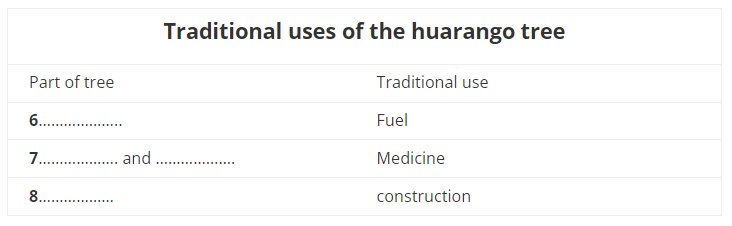
For centuries the huarango tree was vital to the people of the neighbouring Middle Ica Valley too. They grew vegetables under it and ate products made from its seed pods. Its leaves and bark were used for herbal remedies, while its branches were used for charcoal for cooking and heating, and its trunk was used to build houses. But now it is disappearing rapidly. The majority of the huarango forests in the valley have already been cleared for fuel and agriculture – initially, these were smallholdings, but now they’re huge farms producing crops for the international market.
‘Of the forests that were here 1,000 years ago, 99 per cent have already gone,’ says botanist Oliver Whaley from Kew Gardens in London, who, together with ethnobotanist Dr William Milliken, is running a pioneering project to protect and restore the rapidly disappearing habitat. In order to succeed, Whaley needs to get the local people on board, and that has meant overcoming local prejudices. ‘Increasingly aspirational communities think that if you plant food trees in your home or street, it shows you are poor, and still need to grow your own food,’ he says. In order to stop the Middle Ica Valley going the same way as the Lower Ica Valley, Whaley is encouraging locals to love the huarangos again. ‘It’s a process of cultural resuscitation,’ he says. He has already set up a huarango festival to reinstate a sense of pride in their eco-heritage, and has helped local schoolchildren plant thousands of trees.
‘In order to get people interested in habitat restoration, you need to plant a tree that is useful to them,’ says Whaley. So, he has been working with local families to attempt to create a sustainable income from the huarangos by turning their products into foodstuffs. ‘Boil up the beans and you get this thick brown syrup like molasses. You can also use it in drinks, soups or stews.’ The pods can be ground into flour to make cakes, and the seeds roasted into a sweet, chocolatey ‘coffee’. ‘It’s packed full of vitamins and minerals,’ Whaley says.
And some farmers are already planting huarangos. Alberto Benevides, owner of Ica Valley’s only certified organic farm, which Whaley helped set up, has been planting the tree for 13 years. He produces syrup and flour, and sells these products at an organic farmers’ market in Lima. His farm is relatively small and doesn’t yet provide him with enough to live on, but he hopes this will change. ‘The organic market is growing rapidly in Peru,’ Benevides says. ‘I am investing in the future.’
But even if Whaley can convince the local people to fall in love with the huarango again, there is still the threat of the larger farms. Some of these cut across the forests and break up the corridors that allow the essential movement of mammals, birds and pollen up and down the narrow forest strip. In the hope of counteracting this, he’s persuading farmers to let him plant forest corridors on their land. He believes the extra woodland will also benefit the farms by reducing their water usage through a lowering of evaporation and providing a refuge for bio-control insects.
‘If we can record biodiversity and see how it all works, then we’re in a good position to move on from there. Desert habitats can reduce down to very little,’ Whaley explains. ‘It’s not like a rainforest that needs to have this huge expanse. Life has always been confined to corridors and islands here. If you just have a few trees left, the population can grow up quickly because it’s used to exploiting water when it arrives.’ He sees his project as a model that has the potential to be rolled out across other arid areas around the world. ‘If we can do it here, in the most fragile system on Earth, then that’s a real message of hope for lots of places, including Africa, where there is drought and they just can’t afford to wait for rain.’
Questions
1 – 7Complete the notes below. Choose ONE WORD ONLY from the passage for each answer. Write your answer in boxes 1-5 on your answer sheet.
The importance of the huarango tree
Questions
8 – 13Complete the table below. Choose NO MORE THAN TWO WORDS from the passage for each answer. Write your answers in boxes 6-8 on your answer sheet.
Traditional uses of the huarango tree
Do the following statements agree with the information given in Reading Passage 1?
In boxes 9-13 on your answer sheet, write
TRUE if the statement agrees with the information
FALSE if the statement contradicts the information
NOT GIVEN if there is no information on this
- 6
Local families have told Whaley about some traditional uses of huarango products.
- A
True
BFalse
CNot Given
- 7
Farmer Alberto Benevides is now making a good profit from growing huarangos.
- A
True
BFalse
CNot Given
- 8
Whaley needs the co-operation of farmers to help preserve the area’s wildlife.
- A
True
BFalse
CNot Given
- 9
For Whaley’s project to succeed, it needs to be extended over a very large area.
- A
True
BFalse
CNot Given
- 10
Whaley has plans to go to Africa to set up a similar project.
- A
True
BFalse
CNot Given
READING PASSAGE 2
You should spend about 20 minutes on Questions 14-26 which are based on Reading Passage 2 below.
Silbo Gomero – the whistle ‘language’ of the Canary Islands
La Gomera is one of the Canary Islands situated in the Atlantic Ocean off the northwest coast of Africa. This small volcanic island is mountainous, with steep rocky slopes and deep, wooded ravines, rising to 1,487 metres at its highest peak. It is also home to the best known of the world’s whistle ‘languages’, a means of transmitting information over long distances which is perfectly adapted to the extreme terrain of the island.
This ‘language’, known as ‘Silbo’ or ‘Silbo Gomero’ – from the Spanish word for ‘whistle’ – is now shedding light on the language-processing abilities of the human brain, according to scientists. Researchers say that Silbo activates parts of the brain normally associated with spoken language, suggesting that the brain is remarkably flexible in its ability to interpret sounds as language.
‘Science has developed the idea of brain areas that are dedicated to language, and we are starting to understand the scope of signals that can be recognised as language,’ says David Corina, co-author of a recent study and associate professor of psychology at the University of Washington in Seattle.
Silbo is a substitute for Spanish, with individual words recoded into whistles which have high- and low-frequency tones. A whistler – or silbador – puts a finger in his or her mouth to increase the whistle’s pitch, while the other hand can be cupped to adjust the direction of the sound. ‘There is much more ambiguity in the whistled signal than in the spoken signal,’ explains lead researcher Manuel Carreiras, psychology professor at the University of La Laguna on the Canary island of Tenerife. Because whistled ‘words’ can be hard to distinguish, silbadores rely on repetition, as well as awareness of context, to make themselves understood.
The silbadores of Gomera are traditionally shepherds and other isolated mountain folk, and their novel means of staying in touch allows them to communicate over distances of up to 10 kilometres. Carreiras explains that silbadores are able to pass a surprising amount of information via their whistles. ‘In daily life they use whistles to communicate short commands, but any Spanish sentence could be whistled.’ Silbo has proved particularly useful when fires have occurred on the island and rapid communication across large areas has been vital.
The study team used neuroimaging equipment to contrast the brain activity of silbadores while listening to whistled and spoken Spanish. Results showed the left temporal lobe of the brain, which is usually associated with spoken language, was engaged during the processing of Silbo. The researchers found that other key regions in the brain’s frontal lobe also responded to the whistles, including those activated in response to sign language among deaf people. When the experiments were repeated with non-whistlers, however, activation was observed in all areas of the brain.
‘Our results provide more evidence about the flexibility of human capacity for language in a variety of forms,’ Corina says. ‘These data suggest that left-hemisphere language regions are uniquely adapted for communicative purposes, independent of the modality of signal. The non-Silbo speakers were not recognising Silbo as a language. They had nothing to grab onto, so multiple areas of their brains were activated.’
Carreiras says the origins of Silbo Gomero remain obscure, but that indigenous Canary Islanders, who were of North African origin, already had a whistled language when Spain conquered the volcanic islands in the 15th century. Whistled languages survive today in Papua New Guinea, Mexico, Vietnam, Guyana, China, Nepal, Senegal, and a few mountainous pockets in southern Europe. There are thought to be as many as 70 whistled languages still in use, though only 12 have been described and studied scientifically. This form of communication is an adaptation found among cultures where people are often isolated from each other, according to Julien Meyer, a researcher at the Institute of Human Sciences in Lyon, France. ‘They are mostly used in mountains or dense forests,’ he says. ‘Whistled languages are quite clearly defined and represent an original adaptation of the spoken language for the needs of isolated human groups.’
But with modern communication technology now widely available, researchers say whistled languages like Silbo are threatened with extinction. With dwindling numbers of Gomera islanders still fluent in the language, Canaries’ authorities are taking steps to try to ensure its survival. Since 1999, Silbo Gomero has been taught in all of the island’s elementary schools. In addition, locals are seeking assistance from the United Nations Educational, Scientific and Cultural Organization (UNESCO). ‘The local authorities are trying to get an award from the organisation to declare [Silbo Gomero] as something that should be preserved for humanity,’ Carreiras adds.
Questions
14 – 20Do the following statements agree with the information given in Reading Passage 2?
In boxes 14-19 on your answer sheet, write
TRUE if the statement agrees with the information
FALSE if the statement contradicts the information
NOT GIVEN if there is no information on this
- 11
La Gomera is the most mountainous of all the Canary Islands.
- A
True
BFalse
CNot Given
- 12
Silbo is only appropriate for short and simple messages.
- A
True
BFalse
CNot Given
- 13
In the brain-activity study, silbadores and non-whistlers produced different results.
- A
True
BFalse
CNot Given
- 14
The Spanish introduced Silbo to the islands in the 15th century.
- A
True
BFalse
CNot Given
- 15
There is precise data available regarding all of the whistle languages in existence today.
- A
True
BFalse
CNot Given
- 16
The children of Gomera now learn Silbo.
- A
True
BFalse
CNot Given
Questions
21 – 26Complete the notes below. Choose ONE WORD ONLY from the passage for each answer. Write your answers in boxes 20-26 on your answer sheet.
Silbo Gomero
READING PASSAGE 3
You should spend about 20 minutes on Questions 27-40 which are based on Reading Passage 3 below.
Environmental practices of big businesses
The environmental practices of big businesses are shaped by a fundamental fact that for many of us offend our sense of justice. Depending on the circumstances, a business may maximize the amount of money it makes, at least in the short term, by damaging the environment and hurting people. That is still the case today for fishermen in an unmanaged fishery without quotas, and for international logging companies with short-term leases on tropical rainforest land in places with corrupt officials and unsophisticated landowners. When government regulation is effective, and when the public is environmentally aware, environmentally clean big businesses may out-compete dirty ones, but the reverse is likely to be true if government regulation is ineffective and if the public doesn’t care.
It is easy for the rest of us to blame a business for helping itself by hurting other people. But blaming alone is unlikely to produce change. It ignores the fact that businesses are not charities but profit-making companies, and that publicly owned companies with shareholders are under obligation to those shareholders to maximize profits, provided that they do so by legal means. US laws make a company’s directors legally liable for something termed ‘breach of fiduciary responsibility’ if they knowingly manage a company in a way that reduces profits. The car manufacturer Henry Ford was in fact successfully sued by shareholders in 1919 for raising the minimum wage of his workers to $5 per day: the courts declared that, while Ford’s humanitarian sentiments about his employees were nice, his business existed to make profits for its stockholders.
Our blaming of businesses also ignores the ultimate responsibility of the public for creating the condition that let a business profit through destructive environmental policies. In the long run, it is the public, either directly or through its politicians, that has the power to make such destructive policies unprofitable and illegal, and to make sustainable environmental policies profitable.
The public can do that by suing businesses for harming them, as happened after the Exxon Valdez disaster, in which over 40,000m3 of oil were spilled off the coast of Alaska. The public may also make their opinion felt by preferring to buy sustainably harvested products; by making employees of companies with poor track records feel ashamed of their company and complain to their own management; by preferring their governments to award valuable contracts to businesses with a good environmental track record; and by pressing their governments to pass and enforce laws and regulations requiring good environmental practices.
In turn, big businesses can expert powerful pressure on any suppliers that might ignore public or government pressure. For instance, after the US public became concerned about the spread of a disease known as BSE, which was transmitted to humans through infected meat, the US government’s Food and Drug Administration introduced rules demanding that the meat industry abandon practices associated with the risk of the disease spreading. But for five years the meat packers refused to follow these, claiming that they would be too expensive to obey. However, when a major fast-food company then made the same demands after customer purchases of its hamburgers plummeted, the meat industry complied within weeks. The public’s task is therefore to identify which links in the supply chain are sensitive to public pressure: for instance, fast-food chains or jewelry stores, but not meat packers or gold miners.
Some readers may be disappointed or outraged that I place the ultimate responsibility for business practices harming the public on the public itself. I also believe that the public must accept the necessity for higher prices for products to cover the added costs, if any, of sound environmental practices. My views may seem to ignore the belief that businesses should act in accordance with moral principles even if this leads to a reduction in their profits. But I think we have to recognize that, throughout human history, in all politically complex human societies, government regulation has arisen precisely because it was found that not only did moral principles need to be made explicit, they also needed to be enforced.
To me, the conclusion that the public has the ultimate responsibility for the behavior of even the biggest businesses is empowering and hopeful, rather than disappointing. My conclusion is not a moralistic one about who is right or wrong, admirable or selfish, a good guy or a bad guy. In the past, businesses have changed when the public came to expect and require different behavior, to reward businesses for behavior that the public wanted, and to make things difficult for businesses practicing behaviors that the public didn’t want. I predict that in the future, just as in the past, changes in public attitudes will be essential for changes in businesses’ environmental practices.
Questions
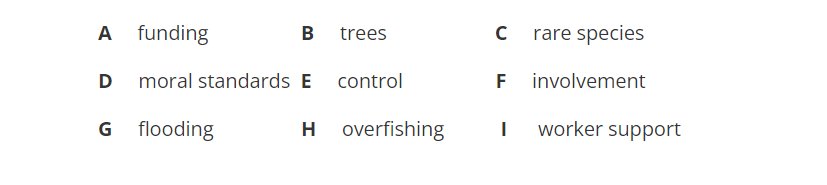
27 – 31Complete the summary using the list of words, A-J, below. Write the correct letter, A-J, in boxes 27-31 on your answer sheet.
Questions
32 – 36Choose the correct letter, A, B, C or D. Write the correct letter in boxes 32-34 on your answer sheet.
- 22
The main idea of the third paragraph is that environmental damage
- A
requires political action if it is to be stopped.
Bis the result of ignorance on the part of the public.
Ccould be prevented by the action of ordinary people.
Dcan only be stopped by educating business leaders.
- 23
In the fourth paragraph, the writer describes ways in which the public can
- A
reduce their own individual impact on the environment.
Blearn more about the impact of business of the environment.
Craise awareness of the effects of specific environmental disasters.
Dinfluence the environmental policies of businesses and governments.
- 24
What pressure was exerted by big business in the case of the disease BSE?
- A
Meat packers stopped supplying hamburgers to fast-food chains.
BA fast-food company forced their meat suppliers to follow the law.
CMeat packers persuaded the government to reduce their expenses.
DA fast-food company encouraged the government to introduce legislation.
Questions
37 – 40Do the following statements agree with the claims of the writer in Reading Passage 3?
In boxes 35-39 on your answer sheet, write
YES if the statement agrees with the claims of the writer
NO if the statement contradicts the claims of the writer
NOT GIVEN if it is impossible to say what the writer thinks about this
- 37
The public should be prepared to fund good environmental practices.
- A
Yes
BNo
CNot Given
- 38
There is a contrast between the moral principles of different businesses.
- A
Yes
BNo
CNot Given
- 39
It is important to make a clear distinction between acceptable and unacceptable behaviour.
- A
Yes
BNo
CNot Given
- 40
The public have successfully influenced businesses in the past.
- A
Yes
BNo
CNot Given
- 25
In the future, businesses will show more concern for the environment.
- A
Yes
BNo
CNot Given
Choose the correct letter, A, B, C or D. Write the correct letter in box 40 on your answer sheet.
- 26
What would be the best subheading for this passage?
- A
Will the world survive the threat caused by big businesses?
BHow can big businesses be encouraged to be less driven by profit?
CWhat environmental dangers are caused by the greed of businesses?
DAre big businesses to blame for the damage they cause the environment?
Questions
1 – 5Complete the notes below. Choose ONE WORD ONLY from the passage for each answer. Write your answer in boxes 1-5 on your answer sheet.
The importance of the huarango tree
Giải thích đáp án
CÂU HỎI 1 – water Chỗ trống cần điền đứng sau danh từ “access” ⇒ cần điền danh từ | |
CÂU HỎI | VÙNG THÔNG TIN |
can access water deep below the surface | They stretch down 50-80 metres and, as well as sucking up water for the tree |
CÂU HỎI 2 – diet Chỗ trống cần điền đứng sau sở hữu cách “inhabitant’s” ⇒ cần điền danh từ | |
CÂU HỎI | VÙNG THÔNG TIN |
was a crucial part of local inhabitants’ diet a long time ago
| He believes the huarango was key to the ancient people’s diet |
CÂU HỎI 3 – drought Chỗ trống cần điền đứng sau giới từ “of” ⇒ cần điền danh từ | |
CÂU HỎI | VÙNG THÔNG TIN |
helped people to survive periods of drought
| it allowed local people to withstand years of drought when their other crops failed |
CÂU HỎI 4 – erosion Chỗ trống cần điền đứng sau động từ “prevents” ⇒ cần điền danh từ | |
CÂU HỎI | VÙNG THÔNG TIN |
prevents erosion of the soil | huarango trees were gradually replaced with crops. Cutting down native woodland leads to erosion, as there is nothing to keep the soil in place. |
CÂU HỎI 5 – desert Chỗ trống cần điền đứng sau mạo từ “a” ⇒ cần điền danh từ | |
CÂU HỎI | VÙNG THÔNG TIN |
prevents land from becoming a desert | So when the huarangos go, the land turns into a desert. |
Questions
6 – 9Complete the table below. Choose NO MORE THAN TWO WORDS from the passage for each answer. Write your answers in boxes 6-8 on your answer sheet.
Traditional uses of the huarango tree
Giải thích đáp án
CÂU HỎI 6 – branches Chú ý tới từ khóa “cooking and heating” để tìm được Paragraph 3 chứa câu trả lời. | |
CÂU HỎI | VÙNG THÔNG TIN |
| Fuel | its branches were used for charcoal for cooking and heating |
DỊCH NGHĨA | |
nhiên liệu | cành của nó được sử dụng làm than để nấu nướng và sưởi ấm |
CÂU HỎI 7 – leaves, bark Chú ý tới từ khóa “herbal remedies” để tìm được Paragraph 3 chứa câu trả lời. | |
CÂU HỎI | VÙNG THÔNG TIN |
| Medicine | Its leaves and bark were used for herbal remedies |
DỊCH NGHĨA | |
thuốc | Lá và vỏ của nó được sử dụng cho thuốc thảo dược |
CÂU HỎI 8 – trunk Chú ý tới từ khóa “build houses” để tìm được Paragraph 3 chứa câu trả lời. | |
CÂU HỎI | VÙNG THÔNG TIN |
Construction | its trunk was used to build houses |
DỊCH NGHĨA | |
xây dựng | thân cây của nó được sử dụng để xây nhà |
Questions
10 – 14Do the following statements agree with the information given in Reading Passage 1?
In boxes 9-13 on your answer sheet, write
TRUE if the statement agrees with the information
FALSE if the statement contradicts the information
NOT GIVEN if there is no information on this
- 10
Local families have told Whaley about some traditional uses of huarango products.
Bạn chưa trả lời câu hỏi này
- A
True
BFalse
CNot Given
Giải thích đáp án
CÂU HỎI 9 – NOT GIVEN Chú ý tới từ khóa “huarango products” để tìm được Paragraph 5 chứa câu trả lời. | |
CÂU HỎI | VÙNG THÔNG TIN |
Local families have told Whaley about some traditional uses of huarango products. | ‘Boil up the beans and you get this thick brown syrup like molasses. You can also use it in drinks, soups or stews.’ The pods can be ground into flour to make cakes, and the seeds roasted into a sweet, chocolatey ‘coffee’. ‘It’s packed full of vitamins and minerals,’ Whaley says. |
DỊCH NGHĨA | |
Các gia đình địa phương đã nói với Whaley về một số công dụng truyền thống của các sản phẩm từ huarango. | ‘Đun sôi đậu và bạn có si-rô màu nâu đặc như mật. Bạn cũng có thể sử dụng nó trong đồ uống, súp hoặc món hầm.’ Vỏ có thể được nghiền thành bột để làm bánh, hạt rang lên trở thành một loại cà phê sô cô la ngọt ngào. Whaley nói: “Nó chứa đầy vitamin và khoáng chất. |
Giải thích: Chỉ có thể khẳng định rằng Whaley đã nói về các công dụng của huarango chứ không có chi tiết đề cập đến việc người địa phương đề cập về chúng ⇒ NOT GIVEN | |
- 11
Farmer Alberto Benevides is now making a good profit from growing huarangos.
Bạn chưa trả lời câu hỏi này
- A
True
BFalse
CNot Given
Giải thích đáp án
CÂU HỎI 10 – FALSE Chú ý tới từ khóa “Alberto Benevides”, “good profit” để tìm được Paragraph 6 chứa câu trả lời. | |
CÂU HỎI | VÙNG THÔNG TIN |
Farmer Alberto Benevides is now making a good profit from growing huarangos | Alberto Benevides, owner of Ica Valley’s only certified organic farm, which Whaley helped set up, has been planting the tree for 13 years. He produces syrup and flour, and sells these products at an organic farmers’ market in Lima. His farm is relatively small and doesn’t yet provide him with enough to live on |
DỊCH NGHĨA | |
Người nông dân Alberto Benevides hiện đang kiếm được lợi nhuận tốt từ việc trồng huarango | Alberto Benevides, chủ sở hữu trang trại hữu cơ được chứng nhận duy nhất của Thung lũng Ica, nơi được Whaley giúp đỡ trong việc thiết lập, đã trồng cây được 13 năm. Anh ấy sản xuất xi-rô và bột mì, đồng thời bán những sản phẩm này tại chợ nông sản hữu cơ ở Lima. Trang trại của anh ấy tương đối nhỏ và chưa cung cấp đủ để anh ấy sống dựa vào |
Giải thích: Nhận định nói rằng Alberto Benevides đang kiếm được lợi nhuận tốt từ việc trồng huarango nhưng thực tế chỉ ra rằng trang trại của anh ấy thậm chí “chưa cung cấp đủ để anh ấy sống dựa vào” ⇒ FALSE | |
- 12
Whaley needs the co-operation of farmers to help preserve the area’s wildlife.
Bạn chưa trả lời câu hỏi này
- A
True
BFalse
CNot Given
Giải thích đáp án
CÂU HỎI 11 – TRUE Chú ý tới từ khóa “co-operation of farmers” để tìm được Paragraph 7 chứa câu trả lời. | |
CÂU HỎI | VÙNG THÔNG TIN |
Whaley needs the co-operation of farmers to help preserve the area’s wildlife. | Some of these cut across the forests and break up the corridors that allow the essential movement of mammals, birds and pollen up and down the narrow forest strip. In the hope of counteracting this, he’s persuading farmers to let him plant forest corridors on their land. |
DỊCH NGHĨA | |
Whaley cần sự hợp tác của nông dân để giúp bảo tồn cuộc sống hoang dã trong khu vực. | Một số trong số này cắt ngang những khu rừng và phá vỡ các hành lang cho phép sự di chuyển thiết yếu của động vật có vú, chim và phấn hoa lên xuống dải rừng hẹp. Với hy vọng chống lại điều này, anh ấy đang thuyết phục nông dân để anh ấy trồng hành lang rừng trên đất của họ. |
Giải thích: Để bảo vệ được khu rừng, Whaley cần sự cho phép của những người nông dân mới có thể trồng cây trên đất của họ ⇒ sự hợp tác của họ là cần thiết ⇒ TRUE | |
- 13
For Whaley’s project to succeed, it needs to be extended over a very large area.
Bạn chưa trả lời câu hỏi này
- A
True
BFalse
CNot Given
Giải thích đáp án
CÂU HỎI 12 – FALSE Chú ý tới từ khóa “large area” để tìm được Paragraph 8 chứa câu trả lời. | |
CÂU HỎI | VÙNG THÔNG TIN |
For Whaley’s project to succeed, it needs to be extended over a very large area.
| It’s not like a rainforest that needs to have this huge expanse. Life has always been confined to corridors and islands here. If you just have a few trees left, the population can grow up quickly because it’s used to exploiting water when it arrives.’ |
DỊCH NGHĨA | |
Để dự án của Whaley thành công, nó cần được mở rộng trên một khu vực rất rộng lớn. | Nó không giống như một khu rừng nhiệt đới cần có khoảng đất rộng lớn. Cuộc sống luôn bị giới hạn trong những hành lang và những hòn đảo ở đây. Nếu bạn chỉ còn lại một vài cây, số lượng có thể phát triển nhanh chóng vì nó đã quen với việc khai thác nước khi đến nơi.” |
Giải thích: Dự án của Whaley không cần một khu vực lớn để thực hiện mới khiến nó trở nên thành công ⇒ FALSE | |
- 14
Whaley has plans to go to Africa to set up a similar project.
Bạn chưa trả lời câu hỏi này
- A
True
BFalse
CNot Given
Giải thích đáp án
CÂU HỎI 13 – NOT GIVEN Chú ý tới từ khóa “Africa” để tìm được Paragraph 8 chứa câu trả lời. | |
CÂU HỎI | VÙNG THÔNG TIN |
Whaley has plans to go to Africa to set up a similar project. | He sees his project as a model that has the potential to be rolled out across other arid areas around the world. ‘If we can do it here, in the most fragile system on Earth, then that’s a real message of hope for lots of places, including Africa, where there is drought and they just can’t afford to wait for rain.’ |
DỊCH NGHĨA | |
Whaley dự định đến châu Phi để thiết lập một dự án tương tự. | Anh ấy coi dự án của mình là một mô hình có tiềm năng được triển khai trên khắp các khu vực khô cằn khác trên thế giới. “Nếu chúng ta có thể làm điều đó ở đây, trong một hệ thống mong manh nhất trên Trái đất, thì đó là một thông điệp thực sự về hy vọng cho nhiều nơi, bao gồm cả Châu Phi, nơi có hạn hán và họ không thể đợi mưa.” |
Giải thích: Whaley chỉ cho rằng nếu dự án của mình khả thi thì nó sẽ là một tin mừng với nhiều vùng khô cằn trên thế giới bao gồm châu Phi chứ chưa nhắc tới dự định thiếp lập dự án tại châu Phi ⇒ chưa đủ dữ liệu chứng minh nhận định ⇒ NOT GIVEN | |
Questions
15 – 20Do the following statements agree with the information given in Reading Passage 2?
In boxes 14-19 on your answer sheet, write
TRUE if the statement agrees with the information
FALSE if the statement contradicts the information
NOT GIVEN if there is no information on this
- 15
La Gomera is the most mountainous of all the Canary Islands.
Bạn chưa trả lời câu hỏi này
- A
True
BFalse
CNot Given
Giải thích đáp án
CÂU HỎI 14 – NOT GIVEN Chú ý tới từ khóa “most mountainous” để tìm được Paragraph 1 chứa câu trả lời. | |
CÂU HỎI | VÙNG THÔNG TIN |
La Gomera is the most mountainous of all the Canary Islands.
| La Gomera is one of the Canary Islands situated in the Atlantic Ocean off the northwest coast of Africa. This small volcanic island is mountainous |
DỊCH NGHĨA | |
La Gomera là hòn đảo nhiều núi nhất trong tất cả các quần đảo Canary. | La Gomera là một trong những quần đảo Canary nằm ở Đại Tây Dương ngoài khơi bờ biển phía tây bắc của Châu Phi. Hòn đảo núi lửa nhỏ này có nhiều núi, với những sườn núi đá dốc và những khe núi sâu, cây cối rậm rạp, cao đến 1.487 mét ở đỉnh cao nhất của nó |
Giải thích: Bài chỉ nhắc đến việc La Gomera là một hòn đảo nhiều núi chứ không nhắc đến thứ tự mật độ núi của nó trong quần đảo Canary ⇒ không thể xác định nó có nhiều núi nhất hay không ⇒ NOT GIVEN | |
- 16
Silbo is only appropriate for short and simple messages.
Bạn chưa trả lời câu hỏi này
- A
True
BFalse
CNot Given
Giải thích đáp án
CÂU HỎI 15 – FALSE Chú ý tới từ khóa “only appropriate”, “short commands” để tìm được Paragraph 5 chứa câu trả lời. | |
CÂU HỎI | VÙNG THÔNG TIN |
Silbo is only appropriate for short and simple messages. | Carreiras explains that silbadores are able to pass a surprising amount of information via their whistles. ‘In daily life they use whistles to communicate short commands, but any Spanish sentence could be whistled.’ |
DỊCH NGHĨA | |
Silbo chỉ thích hợp cho các thông điệp ngắn và đơn giản. | Carreiras giải thích rằng những người sử dụng Silbo có thể truyền một lượng thông tin đáng ngạc nhiên qua tiếng huýt sáo của họ. “Trong cuộc sống hàng ngày, họ sử dụng huýt sáo để giao tiếp các lệnh ngắn, nhưng bất kỳ câu tiếng Tây Ban Nha nào cũng có thể được huýt sáo.” |
Giải thích: Thông tin trong bài chỉ ra rõ ràng rằng tuy Silbo thường được sử dụng để trao đổi các lệnh ngắn nhưng “bất kỳ câu tiếng Tây Ban Nha nào cũng có thể được huýt sáo” ⇒ “chỉ thích hợp cho các thông điệp ngắn và đơn giản” là sai ⇒ FALSE | |
- 17
In the brain-activity study, silbadores and non-whistlers produced different results.
Bạn chưa trả lời câu hỏi này
- A
True
BFalse
CNot Given
Giải thích đáp án
CÂU HỎI 16 – TRUE Chú ý tới từ khóa “different results” để tìm được Paragraph 6 chứa câu trả lời. | |
CÂU HỎI | VÙNG THÔNG TIN |
In the brain-activity study, silbadores and non-whistlers produced different results. | The researchers found that other key regions in the brain’s frontal lobe also responded to the whistles, including those activated in response to sign language among deaf people. When the experiments were repeated with non-whistlers, however, activation was observed in all areas of the brain. |
DỊCH NGHĨA | |
Trong nghiên cứu về hoạt động của não, những người sử dụng silbo và những người không huýt sáo cho ra những kết quả khác biệt. | Các nhà nghiên cứu phát hiện ra rằng các vùng quan trọng khác trong thùy trán của não cũng phản ứng với tiếng huýt sáo, bao gồm cả những vùng được kích hoạt để phản ứng với ngôn ngữ ký hiệu ở người khiếm thính. Tuy nhiên, khi các thí nghiệm được lặp lại với những người không huýt sáo, sự kích hoạt được quan sát thấy ở tất cả các vùng của não. |
Giải thích: Ở những người khiếm thính (non-whistlers), “các vùng quan trọng trong thuỳ trán của não cũng phản ứng” còn ở người sử dụng Silbo thì “sự kích hoạt này được quan sát thấy ở tất cả các vùng của não” ⇒ kết quả đã có sự khác nhau ⇒ TRUE | |
- 18
The Spanish introduced Silbo to the islands in the 15th century.
Bạn chưa trả lời câu hỏi này
- A
True
BFalse
CNot Given
Giải thích đáp án
CÂU HỎI 17 – FALSE Chú ý tới từ khóa “15th century” để tìm được Paragraph 8 chứa câu trả lời. | |
CÂU HỎI | VÙNG THÔNG TIN |
The Spanish introduced Silbo to the islands in the 15th century.
| indigenous Canary Islanders, who were of North African origin, already had a whistled language when Spain conquered the volcanic islands in the 15th century. |
DỊCH NGHĨA | |
Người Tây Ban Nha đã giới thiệu Silbo đến các hòn đảo vào thế kỷ 15. | Người dân bản địa Đảo Canary, có nguồn gốc Bắc Phi đã sở hữu sẵn ngôn ngữ huýt sáo khi Tây Ban Nha xâm lược các đảo núi lửa vào thế kỷ 15. |
Giải thích: Ngôn ngữ huýt sáo đã được sử dụng bởi người bản địa từ trước khi người Tây Ban Nha đến các đảo núi lửa ⇒ người Tây Ban Nha không thể là người giới thiệu ngôn ngữ này cho dân đảo ⇒ FALSE | |
- 19
There is precise data available regarding all of the whistle languages in existence today.
Bạn chưa trả lời câu hỏi này
- A
True
BFalse
CNot Given
Giải thích đáp án
CÂU HỎI 18 – FALSE Chú ý tới từ khóa “precise data” để tìm được Paragraph 8 chứa câu trả lời. | |
CÂU HỎI | VÙNG THÔNG TIN |
There is precise data available regarding all of the whistle languages in existence today.
| There are thought to be as many as 70 whistled languages still in use, though only 12 have been described and studied scientifically. |
DỊCH NGHĨA | |
Có sẵn dữ liệu chính xác về tất cả các ngôn ngữ huýt sáo đang tồn tại ngày nay. | Người ta cho là có tới 70 ngôn ngữ huýt sáo vẫn đang được sử dụng, mặc dù chỉ có 12 ngôn ngữ được miêu tả lại và nghiên cứu khoa học. |
Giải thích: Chỉ có 12/70 ngôn ngữ được nghiên cứu và miêu tả ⇒ không hề có thông tin chính xác cho tất cả các ngôn ngữ huýt sáo ⇒ FALSE | |
- 20
The children of Gomera now learn Silbo.
Bạn chưa trả lời câu hỏi này
- A
True
BFalse
CNot Given
Giải thích đáp án
CÂU HỎI 19 – TRUE Chú ý tới từ khóa “children”, “learn” để tìm được Paragraph 9 chứa câu trả lời. | |
CÂU HỎI | VÙNG THÔNG TIN |
The children of Gomera now learn Silbo.
| Since 1999, Silbo Gomero has been taught in all of the island’s elementary schools. |
DỊCH NGHĨA | |
Trẻ em ở Gomera hiện đang học ngôn ngữ Silbo. | Từ năm 1999, Silbo Gomero đã được giảng dạy ở tất cả các trường tiểu học trên đảo. |
Giải thích: Chương trình học bao gồm Silbo được áp dụng từ 1999 ⇒ trẻ em trên đảo có theo học ngôn ngữ này ⇒ TRUE | |
Questions
21 – 27Complete the notes below. Choose ONE WORD ONLY from the passage for each answer. Write your answers in boxes 20-26 on your answer sheet.
Silbo Gomero
Giải thích đáp án
CÂU HỎI 20 – words Chỗ trống cần điền đứng sau giới từ “in” ⇒ cần điền danh từ | |
CÂU HỎI | VÙNG THÔNG TIN |
high- and low-frequency tones represent different sounds in Spanish words | Silbo is a substitute for Spanish, with individual words recoded into whistles which have high- and low-frequency tones. |
CÂU HỎI 21 – finger Chỗ trống cần điền đứng sau sở hữu cách “silbador’s” ⇒ cần điền danh từ | |
CÂU HỎI | VÙNG THÔNG TIN |
pitch of whistle is controlled using silbador’s finger | A whistler – or silbador – puts a finger in his or her mouth to increase the whistle’s pitch |
CÂU HỎI 22 – direction Chỗ trống cần điền đứng trước động từ to be “is” ⇒ cần điền danh từ | |
CÂU HỎI | VÙNG THÔNG TIN |
direction is changed with a cupped hand
| the other hand can be cupped to adjust the direction of the sound |
CÂU HỎI 23 – commands Chỗ trống cần điền đứng sau tính từ “brief” ⇒ cần điền danh từ | |
CÂU HỎI | VÙNG THÔNG TIN |
in everyday use for the transmission of brief commands | ‘In daily life they use whistles to communicate short commands, but any Spanish sentence could be whistled.’ |
CÂU HỎI 24 – fires Chỗ trống cần điền đứng sau giới từ “about” ⇒ cần điền danh từ | |
CÂU HỎI | VÙNG THÔNG TIN |
can relay essential information quickly, e.g. to inform people about fires
| Silbo has proved particularly useful when fires have occurred on the island and rapid communication across large areas has been vital.
|
CÂU HỎI 25 – technology Chỗ trống cần điền đứng sau tính từ “new” ⇒ cần điền danh từ | |
CÂU HỎI | VÙNG THÔNG TIN |
future under threat because of new technology | But with modern communication technology now widely available, researchers say whistled languages like Silbo are threatened with extinction. |
CÂU HỎI 26 – award Chỗ trống cần điền đứng sau cụm danh từ “a UNESCO”, trước giới từ “to” ⇒ cần điền danh từ | |
CÂU HỎI | VÙNG THÔNG TIN |
Canaries’ authorities hoping to receive a UNESCO award to help preserve it | locals are seeking assistance from the United Nations Educational, Scientific and Cultural Organization (UNESCO). ‘The local authorities are trying to get an award from the organisation to declare [Silbo Gomero] as something that should be preserved for humanity,’ |
Questions
Complete the summary using the list of words, A-J, below. Write the correct letter, A-J, in boxes 27-31 on your answer sheet.
Giải thích đáp án
CÂU HỎI 27 – D | |
CÂU HỎI | VÙNG THÔNG TIN |
any big businesses today are prepared to harm people and the environment in order to make money, and they appear to have no moral standards | The environmental practices of big businesses are shaped by a fundamental fact that for many of us offend our sense of justice. Depending on the circumstances, a business may maximize the amount of money it makes, at least in the short term, by damaging the environment and hurting people. That is still the case today for fishermen in an unmanaged fishery without quotas, and for international logging companies with short-term leases on tropical rainforest land in places with corrupt officials and unsophisticated landowners. |
Giải thích
| |
CÂU HỎI 28 – E | |
CÂU HỎI | VÙNG THÔNG TIN |
Lack of control by governments…can lead to environmental problems | When government regulation is effective, and when the public is environmentally aware, environmentally clean big businesses may out-compete dirty ones, but the reverse is likely to be true if government regulation is ineffective and if the public doesn’t care. |
Giải thích
| |
CÂU HỎI 29 – F | |
CÂU HỎI | VÙNG THÔNG TIN |
lack of public involvement can lead to environmental problems | When government regulation is effective, and when the public is environmentally aware, environmentally clean big businesses may out-compete dirty ones, but the reverse is likely to be true if government regulation is ineffective and if the public doesn’t care. |
Giải thích
| |
CÂU HỎI 30 – H | |
CÂU HỎI | VÙNG THÔNG TIN |
environmental problems such as overfishing | a business may maximize the amount of money it makes, at least in the short term, by damaging the environment and hurting people. That is still the case today for fishermen in an unmanaged fishery without quotas, and for international logging companies with short-term leases on tropical rainforest land in places with corrupt officials and unsophisticated landowners. |
Giải thích
| |
CÂU HỎI 31 – B | |
CÂU HỎI | VÙNG THÔNG TIN |
environmental problems such as ___ or the destruction of trees
| That is still the case today for fishermen in an unmanaged fishery without quotas, and for international logging companies with short-term leases on tropical rainforest land in places with corrupt officials and unsophisticated landowners. |
Giải thích
| |
Questions
33 – 35Choose the correct letter, A, B, C or D. Write the correct letter in boxes 32-34 on your answer sheet.
- 33
The main idea of the third paragraph is that environmental damage
Bạn chưa trả lời câu hỏi này
Giải thích đáp án
CÂU HỎI 32 – C | |
CÂU HỎI | VÙNG THÔNG TIN |
The main idea of the third paragraph is that environmental damage A requires political action if it is to be stopped. B is the result of ignorance on the part of the public. C could be prevented by the action of ordinary people. D can only be stopped by educating business leaders. | In the long run, it is the public, either directly or through its politicians, that has the power to make such destructive policies unprofitable and illegal, and to make sustainable environmental policies profitable. The public can do that by suing businesses for harming them, as happened after the Exxon Valdez disaster, in which over 40,000m3 of oil were spilled off the coast of Alaska. The public may also make their opinion felt by preferring to buy sustainably harvested products; by making employees of companies with poor track records feel ashamed of their company and complain to their own management; by preferring their governments to award valuable contracts to businesses with a good environmental track record; and by pressing their governments to pass and enforce laws and regulations requiring good environmental practices. |
DỊCH NGHĨA | |
Ý chính của đoạn thứ ba là sự hủy hoại môi trường:
A cần tới các động thái chính trị nếu muốn ngăn chặn B là kết quả của sự thiếu hiểu biết từ phía công chúng. C có thể được ngăn chặn bởi hành động của những người bình thường. D chỉ có thể được dừng lại bằng cách giáo dục các nhà lãnh đạo doanh nghiệp.
| Về lâu dài, chính công chúng, trực tiếp hoặc thông qua các chính trị gia của họ, có quyền làm cho các chính sách phá hoại đó trở nên vô ích và bất hợp pháp, đồng thời làm cho các chính sách môi trường bền vững có lợi.
Công chúng có thể làm điều đó bằng cách kiện các doanh nghiệp làm hại họ, như đã xảy ra sau thảm họa Exxon Valdez, trong đó hơn 40.000m3 dầu tràn ra ngoài khơi bờ biển Alaska. Công chúng cũng có thể bày tỏ quan điểm của mình bằng cách thích mua các sản phẩm được khai thác bền vững hơn; bằng cách làm cho nhân viên của các công ty có thành tích kém cảm thấy xấu hổ về công ty của họ và phàn nàn với ban quản lý của chính họ; bằng cách ưu tiên chính phủ của họ trao các hợp đồng có giá trị cho các doanh nghiệp có thành tích tốt về môi trường; và bằng cách thúc ép chính phủ của họ thông qua và thực thi các luật và quy định yêu cầu thực hành tốt về môi trường. |
Đây là 1 câu hỏi khó, cần đọc hiểu đoạn văn trước đó (đoạn 2) để nắm được sự chuyển ý. Đoạn 2 đang nói tới việc mọi người đổ lỗi việc phá hoại môi trường cho các doanh nghiệp, trong khi doanh nghiệp cũng có cái khó của riêng mình (cần phải tối đa hóa lợi nhuận). Dẫn sang đoạn 3, tác giả nói việc đổ lỗi của mọi người cho các doanh nghiệp là đang “ignores the ultimate responsibility of the public for creating the condition that let a business profit through destructive environmental policies – bỏ qua trách nhiệm sau cùng của cộng đồng trong việc tạo điều kiện cho phép doanh nghiệp thu lợi nhuận thông qua các chính sách phá hoại môi trường” => cộng đồng (những người bình thường) thông qua các doanh nghiệp có thể ngăn chặn việc phá hủy môi trường. | |
- 34
In the fourth paragraph, the writer describes ways in which the public can
Bạn chưa trả lời câu hỏi này
Giải thích đáp án
CÂU HỎI 33 – D | |
CÂU HỎI | VÙNG THÔNG TIN |
In the fourth paragraph, the writer describes ways in which the public can A reduce their own individual impact on the environment. B learn more about the impact of business of the environment. C raise awareness of the effects of specific environmental disasters. D influence the environmental policies of businesses and governments. | The public may also make their opinion felt by preferring to buy sustainably harvested products; by making employees of companies with poor track records feel ashamed of their company and complain to their own management; by preferring their governments to award valuable contracts to businesses with a good environmental track record; and by pressing their governments to pass and enforce laws and regulations requiring good environmental practices. |
DỊCH NGHĨA | |
Trong đoạn thứ tư, người viết mô tả những cách mà công chúng có thể
A giảm tác động của cá nhân họ đối với môi trường. B học thêm về tác động của kinh doanh lên môi trường. C nâng cao nhận thức về ảnh hưởng của các thảm họa môi trường cụ thể. D gây ảnh hưởng đến các chính sách môi trường của các doanh nghiệp và chính phủ.
| Công chúng cũng có thể thể hiện quan điểm của mình bằng cách ưu tiên mua các sản phẩm được thu hoạch bền vững; bằng cách làm cho nhân viên của các công ty có thành tích kém cảm thấy xấu hổ về công ty của họ và phàn nàn với chính ban quản lý của họ; bằng cách ưu tiên chính phủ của họ trao những hợp đồng có giá trị cho các doanh nghiệp có thành tích tốt về môi trường; và bằng cách thúc ép chính phủ của họ thông qua và thực thi các luật và quy định yêu cầu thực hành tốt về môi trường. |
=> Những thông tin trong đoạn đều là minh chứng cho đáp án D. Công chúng gây ảnh hưởng đến các chính sách doanh nghiệp (ưu tiên mua các sản phẩm được thu hoạch bền vững, làm cho nhân viên của các công ty có thành tích kém cảm thấy xấu hổ về công ty của họ và phàn nàn với chính ban quản lý) và chính phủ (ưu tiên chính phủ trao những hợp đồng có giá trị cho các doanh nghiệp có thành tích tốt về môi trường, thúc ép chính phủ của họ thông qua và thực thi các luật và quy định yêu cầu thực hành tốt về môi trường). | |
- 35
What pressure was exerted by big business in the case of the disease BSE?
Bạn chưa trả lời câu hỏi này
Giải thích đáp án
CÂU HỎI 34 – B | |
CÂU HỎI | VÙNG THÔNG TIN |
What pressure was exerted by big business in the case of the disease BSE? A Meat packers stopped supplying hamburgers to fast-food chains. B A fast-food company forced their meat suppliers to follow the law. C Meat packers persuaded the government to reduce their expenses. D A fast-food company encouraged the government to introduce legislation.
| For instance, after the US public became concerned about the spread of a disease known as BSE… But for five years the meat packers refused to follow these, claiming that they would be too expensive to obey. However, when a major fast-food company then made the same demands after customer purchases of its hamburgers plummeted, the meat industry complied within weeks. |
DỊCH NGHĨA | |
Áp lực nào của các doanh nghiệp lớn trong trường hợp của căn bệnh BSE?
A nhà chế biến đã ngừng cung cấp bánh mì kẹp thịt cho các chuỗi cửa hàng thức ăn nhanh. B một công ty thức ăn nhanh buộc các nhà cung cấp thịt của họ phải tuân theo luật. C những nhà chế biến thịt đã thuyết phục chính phủ giảm chi phí. D một công ty thức ăn nhanh khuyến khích chính phủ ban hành luật.
| Ví dụ, sau khi công chúng Hoa Kỳ lo ngại về sự lây lan của một căn bệnh được gọi là BSE… Nhưng trong 5 năm, những người đóng gói thịt đã từ chối làm theo những điều này, cho rằng họ sẽ phải trả giá quá đắt để tuân theo. Tuy nhiên, khi một công ty thức ăn nhanh lớn đưa ra yêu cầu tương tự sau khi khách hàng mua hamburger của họ giảm mạnh, ngành công nghiệp thịt đã tuân thủ trong vòng vài tuần. |
| |
Questions
36 – 40Do the following statements agree with the claims of the writer in Reading Passage 3?
In boxes 35-39 on your answer sheet, write
YES if the statement agrees with the claims of the writer
NO if the statement contradicts the claims of the writer
NOT GIVEN if it is impossible to say what the writer thinks about this
- 36
The public should be prepared to fund good environmental practices.
Bạn chưa trả lời câu hỏi này
Giải thích đáp án
CÂU HỎI 35 – YES Chú ý tới từ khóa “environmental practices” để tìm được Paragraph 6 chứa câu trả lời. | |
CÂU HỎI | VÙNG THÔNG TIN |
The public should be prepared to fund good environmental practices. | I also believe that the public must accept the necessity for higher prices for products to cover the added costs, if any, of sound environmental practices. |
DỊCH NGHĨA | |
Công chúng nên chuẩn bị để tài trợ cho các thực tiễn tốt về môi trường.
| Tôi cũng tin rằng công chúng phải chấp nhận sự cần thiết của giá sản phẩm cao hơn để bù đắp các chi phí tăng thêm, nếu có, của các thực tiễn môi trường hợp lý. |
Giải thích: Bài đăng nói rõ rằng công chúng cần nhận thức sự tăng của giá cả hàng hoá tại các thực tiễn môi trường hợp lý = chuẩn bị tài trợ cho các thực tiễn môi trường ⇒ YES | |
- 37
There is a contrast between the moral principles of different businesses.
Bạn chưa trả lời câu hỏi này
Giải thích đáp án
CÂU HỎI 36 – NOT GIVEN Chú ý tới từ khóa “contrast”, “moral principles” để tìm được Paragraph 6 chứa câu trả lời. | |
CÂU HỎI | VÙNG THÔNG TIN |
There is a contrast between the moral principles of different businesses. | My views may seem to ignore the belief that businesses should act in accordance with moral principles even if this leads to a reduction in their profits. But I think we have to recognize that, throughout human history, in all politically complex human societies, government regulation has arisen precisely because it was found that not only did moral principles need to be made explicit, they also needed to be enforced. |
DỊCH NGHĨA | |
Có một sự tương phản trong nguyên tắc đạo đức của các doanh nghiệp khác nhau. | Quan điểm của tôi dường như đang bỏ qua niềm tin rằng các doanh nghiệp nên hành động phù hợp với các nguyên tắc đạo đức ngay cả khi điều này dẫn đến việc giảm lợi nhuận của họ. Nhưng tôi nghĩ chúng ta phải công nhận rằng, trong suốt lịch sử loài người, trong tất cả các xã hội loài người phức tạp về mặt chính trị, sự điều tiết của chính phủ đã xuất hiện một cách chính xác bởi vì người ta thấy rằng không chỉ các nguyên tắc đạo đức cần phải được trình bày rõ ràng mà chúng còn cần phải được thực thi. |
Giải thích: Bài viết có nhắc đến “moral principles” nhưng không đề cập đến hai doanh nghiệp khác nhau, càng không có so sánh về quy tắc đạo đức giữa 2 đối tượng ⇒ không đủ dữ liệu kết luận ⇒ NOT GIVEN | |
- 38
It is important to make a clear distinction between acceptable and unacceptable behaviour.
Bạn chưa trả lời câu hỏi này
Giải thích đáp án
CÂU HỎI 37 – NO Chú ý tới từ khóa “distinction” để tìm được Paragraph 7 chứa câu trả lời. | |
CÂU HỎI | VÙNG THÔNG TIN |
It is important to make a clear distinction between acceptable and unacceptable behaviour. | My conclusion is not a moralistic one about who is right or wrong, admirable or selfish, a good guy or a bad guy. |
DỊCH NGHĨA | |
Điều quan trọng là phải phân biệt rõ ràng giữa hành vi có thể chấp nhận được và không thể chấp nhận được. | Kết luận của tôi không mang tính đạo đức về việc ai đúng hay sai, đáng ngưỡng mộ hay ích kỷ, là người tốt hay kẻ xấu. |
Giải thích: Tác giả nói rằng kết luận của bản thân không phân rõ ra rằng ai làm đúng, ai làm sai, ai là người tốt, ai là kẻ xấu ⇒ không có sự phân biệt rõ ràng giữa những hành vi chấp nhận được và không chấp nhận được ⇒ NO | |
- 39
The public have successfully influenced businesses in the past.
Bạn chưa trả lời câu hỏi này
Giải thích đáp án
CÂU HỎI 38 – YES Chú ý tới từ khóa “influenced business” để tìm được Paragraph 7 chứa câu trả lời. | |
CÂU HỎI | VÙNG THÔNG TIN |
The public have successfully influenced businesses in the past. | In the past, businesses have changed when the public came to expect and require different behavior |
DỊCH NGHĨA | |
Công chúng đã thành công gây ảnh hưởng lên các doanh nghiệp trong quá khứ. | Trước đây, các doanh nghiệp đã thay đổi khi công chúng mong đợi và yêu cầu những hành vi khác biệt |
Giải thích: Đã từng có trường hợp doanh nghiệp thay đổi vì công chúng ⇒ TRUE | |
- 40
In the future, businesses will show more concern for the environment.
Bạn chưa trả lời câu hỏi này
Giải thích đáp án
CÂU HỎI 39 – NOT GIVEN Chú ý tới từ khóa “future” để tìm được Paragraph 7 chứa câu trả lời. | |
CÂU HỎI | VÙNG THÔNG TIN |
In the future, businesses will show more concern for the environment.
| I predict that in the future, just as in the past, changes in public attitudes will be essential for changes in businesses’ environmental practices.
|
DỊCH NGHĨA | |
Trong tương lai, các doanh nghiệp sẽ thể hiện sự quan tâm nhiều hơn đến môi trường. | Tôi dự đoán rằng trong tương lai, cũng như trong quá khứ, những thay đổi trong thái độ của công chúng sẽ rất cần thiết cho những thay đổi trong thực tiễn môi trường của các doanh nghiệp. |
Giải thích: Bài viết chỉ nói rằng thái độ của công chúng sẽ cần thiết để thay đổi hướng hoạt động của doanh nghiệp, không nhắc đến quan điểm của doanh nghiệp ⇒ NOT GIVEN | |
Question
41Choose the correct letter, A, B, C or D. Write the correct letter in box 40 on your answer sheet.
- 41
What would be the best subheading for this passage?
Bạn chưa trả lời câu hỏi này
Giải thích đáp án
CÂU HỎI 40 – D | |
CÂU HỎI | GIẢI THÍCH |
What would be the best subheading for this passage? A Will the world survive the threat caused by big businesses? B How can big businesses be encouraged to be less driven by profit? C What environmental dangers are caused by the greed of businesses? D Are big businesses to blame for the damage they cause the environment? | Bài viết đề cập đến việc doanh nghiệp, chính phủ và công chúng có ảnh hưởng thế nào đến các vấn đề môi trường. Đặc biệt, trách nhiệm của công chúng được nhấn mạnh, như thể để khẳng định rằng doanh nghiệp không phải đối tượng có lỗi duy nhất trong quá trình gây tổn hại môi trường
⇒ Title phù hợp là “Are big businesses to blame for the damage they cause the environment?”
⇒ D |
