
IELTS Handbook 10 – Test 2 – R
09/11/2024 2024-11-09 20:40IELTS Handbook 10 – Test 2 – R
READING PASSAGE 1
You should spend about 20 minutes on Questions 1-13 which are based on Reading Passage 1 below.
Tea and the Industrial Revolution
A Cambridge professor says that a change in drinking habits was the reason for the Industrial Revolution in Britain. Anjana Abuja reports
A
Alan Macfarlane, professor of anthropological science at King’s College, Cambridge has, like other historians, spent decades wrestling with the enigma of the Industrial Revolution. Why did this particular Big Bang – the world-changing birth of industry-happen in Britain? And why did it strike at the end of the 18th century?
B
Macfarlane compares the puzzle to a combination lock. ‘There are about 20 different factors and all of them need to be present before the revolution can happen,’ he says. For industry to take off, there needs to be the technology and power to drive factories, large urban populations to provide cheap labour, easy transport to move goods around, an affluent middle-class willing to buy mass-produced objects, a market-driven economy and a political system that allows this to happen. While this was the case for England, other nations, such as Japan, the Netherlands and France also met some of these criteria but were not industrialising. All these factors must have been necessary. But not sufficient to cause the revolution, says Macfarlane. ‘After all, Holland had everything except coal while China also had many of these factors. Most historians are convinced there are one or two missing factors that you need to open the lock.’
C
The missing factors, he proposes, are to be found in almost even kitchen cupboard. Tea and beer, two of the nation’s favourite drinks, fuelled the revolution. The antiseptic properties of tannin, the active ingredient in tea, and of hops in beer – plus the fact that both are made with boiled water – allowed urban communities to flourish at close quarters without succumbing to water-borne diseases such as dysentery. The theory sounds eccentric but once he starts to explain the detective work that went into his deduction, the scepticism gives way to wary admiration. Macfarlanes case has been strengthened by support from notable quarters – Roy Porter, the distinguished medical historian, recently wrote a favourable appraisal of his research.
D
Macfarlane had wondered for a long time how the Industrial Revolution came about. Historians had alighted on one interesting factor around the mid-18th century that required explanation. Between about 1650 and 1740, the population in Britain was static. But then there was a burst in population growth. Macfarlane says: ‘The infant mortality rate halved in the space of 20 years, and this happened in both rural areas and cities, and across all classes. People suggested four possible causes. Was there a sudden change in the viruses and bacteria around? Unlikely. Was there a revolution in medical science? But this was a century before Lister’s revolution*. Was there a change in environmental conditions? There were improvements in agriculture that wiped out malaria, but these were small gains. Sanitation did not become widespread until the 19th century. The only option left is food. But the height and weight statistics show a decline. So the food must have got worse. Efforts to explain this sudden reduction in child deaths appeared to draw a blank.’
E
This population burst seemed to happen at just the right time to provide labour for the Industrial Revolution. ‘When you start moving towards an industrial revolution, it is economically efficient to have people living close together,’ says Macfarlane. ‘But then you get disease, particularly from human waste.’ Some digging around in historical records revealed that there was a change in the incidence of water-borne disease at that time, especially dysentery. Macfarlane deduced that whatever the British were drinking must have been important in regulating disease. He says, ‘We drank beer. For a long time, the English were protected by the strong antibacterial agent in hops, which were added to help preserve the beer. But in the late 17th century a tax was introduced on malt, the basic ingredient of beer. The poor turned to water and gin and in the 1720s the mortality rate began to rise again. Then it suddenly dropped again. What caused this?’
F
Macfarlane looked to Japan, which was also developing large cities about the same time, and also had no sanitation. Water-borne diseases had a much looser grip on the Japanese population than those in Britain. Could it be the prevalence of tea in their culture? Macfarlane then noted that the history of tea in Britain provided an extraordinary coincidence of dates. Tea was relatively expensive until Britain started a direct clipper trade with China in the early 18th century. By the 1740s, about the time that infant mortality was dipping, the drink was common. Macfarlane guessed that the fact that water had to be boiled, together with the stomach-purifying properties of tea meant that the breast milk provided by mothers was healthier than it had ever been. No other European nation sipped tea like the British, which, by Macfarlanes logic, pushed these other countries out of contention for the revolution.
G
But, if tea is a factor in the combination lock, why didn’t Japan forge ahead in a tea-soaked industrial revolution of its own? Macfarlane notes that even though 17th-century Japan had large cities, high literacy rates, even a futures market, it had turned its back on the essence of any work-based revolution by giving up labour-saving devices such as animals, afraid that they would put people out of work. So, the nation that we now think of as one of the most technologically advanced entered the 19th century having ‘abandoned the wheel’.
——–
* Joseph Lister was the first doctor to use antiseptic techniques during surgical operations to prevent infections.
Questions
1 – 5
Reading Passage 1 has seven paragraphs, A-G. Choose the correct heading for each paragraph from the list of headings below. Match the correct number, i-ix, with questions 1-7.
Questions
6 – 8
Do the following statements agree with the information given in Reading Passage 1?
In boxes 8-13 on your answer sheet, write
TRUE if the statement agrees with the information
FALSE if the statement contradicts the information
NOT GIVEN if there is no information on this
- 8
China’s transport system was not suitable for industry in the 18th century.
- A
True
BFalse
CNot Given
- 9
Tea and beer both helped to prevent dysentery in Britain.
- A
True
BFalse
CNot Given
- 10
Roy Porter disagrees with Professor Macfarlane’s findings.
- A
True
BFalse
CNot Given
- 11
After 1740,there was a reduction in population in Britain.
- A
True
BFalse
CNot Given
- 12
People in Britain used to make beer at home.
- A
True
BFalse
CNot Given
- 13
The tax on malt indirectly caused a rise in the death rate.
- A
True
BFalse
CNot Given
READING PASSAGE 2
You should spend about 20 minutes on Questions 14-26 which are based on Reading Passage 2 below.
Gifted children and learning
A
Internationally, ‘giftedness’ is most frequently determined by a score on a general intelligence test, known as an IQ test, which is above a chosen cutoff point, usually at around the top 2-5%. Children’s educational environment contributes to the IQ score and the way intelligence is used. For example, a very close positive relationship was found when children’s IQ scores were compared with their home educational provision (Freeman, 2010). The higher the children’s IQ scores, especially over IQ 130, the better the quality of their educational backup, measured in terms of reported verbal interactions with parents, number of books and activities in their home etc. Because IQ tests are decidedly influenced by what the child has learned, they are to some extent measures of current achievement based on age-norms; that is, how well the children have learned to manipulate their knowledge and know-how within the terms of the test. The vocabulary aspect, for example, is dependent on having heard those words. But IQ tests can neither identify the processes of learning and thinking nor predict creativity.
B
Excellence does not emerge without appropriate help. To reach an exceptionally high standard in any area very able children need the means to learn, which includes material to work with and focused challenging tuition -and the encouragement to follow their dream. There appears to be a qualitative difference in the way the intellectually highly able think, compared with more average-ability or older pupils, for whom external regulation by the teacher often compensates for lack of internal regulation. To be at their most effective in their self-regulation, all children can be helped to identify their own ways of learning – metacognition – which will include strategies of planning, monitoring, evaluation, and choice of what to learn. Emotional awareness is also part of metacognition, so children should be helped to be aware of their feelings around the area to be learned, feelings of curiosity or confidence, for example.
C
High achievers have been found to use self-regulatory learning strategies more often and more effectively than lower achievers, and are better able to transfer these strategies to deal with unfamiliar tasks. This happens to such a high degree in some children that they appear to be demonstrating talent in particular areas. Overviewing research on the thinking process of highly able children, (Shore and Kanevsky, 1993) put the instructor’s problem succinctly: ‘If they [the gifted] merely think more quickly, then .we need only teach more quickly. If they merely make fewer errors, then we can shorten the practice’. But of course, this is not entirely the case; adjustments have to be made in methods of learning and teaching, to take account of the many ways individuals think.
D
Yet in order to learn by themselves, the gifted do need some support from their teachers. Conversely, teachers who have a tendency to ‘overdirect’ can diminish their gifted pupils’ learning autonomy. Although ‘spoon-feeding’ can produce extremely high examination results, these are not always followed by equally impressive life successes. Too much dependence on the teachers risks loss of autonomy and motivation to discover. However, when teachers o pupils to reflect on their own learning and thinking activities, they increase their pupils’ self-regulation. For a young child, it may be just the simple question ‘What have you learned today?’ which helps them to recognise what they are doing. Given that a fundamental goal of education is to transfer the control of learning from teachers to pupils, improving pupils’ learning to learn techniques should be a major outcome of the school experience, especially for the highly competent. There are quite a number of new methods which can help, such as child- initiated learning, ability-peer tutoring, etc. Such practices have been found to be particularly useful for bright children from deprived areas.
E
But scientific progress is not all theoretical, knowledge is a so vital to outstanding performance: individuals who know a great deal about a specific domain will achieve at a higher level than those who do not (Elshout, 1995). Research with creative scientists by Simonton (1988) brought him to the conclusion that above a certain high level, characteristics such as independence seemed to contribute more to reaching the highest levels of expertise than intellectual skills, due to the great demands of effort and time needed for learning and practice. Creativity in all forms can be seen as expertise se mixed with a high level of motivation (Weisberg, 1993).
F
To sum up, learning is affected by emotions of both the individual and significant others. Positive emotions facilitate the creative aspects of earning and negative emotions inhibit it. Fear, for example, can limit the development of curiosity, which is a strong force in scientific advance, because it motivates problem-solving behaviour. In Boekaerts’ (1991) review of emotion the learning of very high IQ and highly achieving children, she found emotional forces in harness. They were not only curious, but often had a strong desire to control their environment, improve their learning efficiency and increase their own learning resources.
Questions
14 – 21Reading Passage 2 has six paragraphs, A-F. Which paragraph contains the following information? Match the correct letter, A-F, with boxes 14-17. NB You may use any letter more than once.
Questions
22 – 26Look at the following statements (Questions 18-22) and the list of people below. Match each statement with the correct person or people, A-E.
Complete the sentences below. Choose NO MORE THAN THREE WORDS from the passage for each answer. Write your answers in boxes 23-26 on your answer sheet
READING PASSAGE 3
You should spend about 20 minutes on Questions 27-40 which are based on Reading Passage 3 below.
Museums of fine art and their public
The fact that people go to the Louvre museum in Paris to see the original painting Mona Lisa when they can see a reproduction anywhere leads us to question some assumptions about the role of museums of fine art in today’s world
One of the most famous works of art in the world is Leonardo da Vinci’s Mona Lisa. Nearly everyone who goes to see the original will already be familiar with it from reproductions, but they accept that fine art is more rewardingly viewed in its original form.
However, if Mona Lisa was a famous novel, few people would bother to go to a museum to read the writer’s actual manuscript rather than a printed reproduction. This might be explained by the fact that the novel has evolved precisely because of technological developments that made it possible to print out huge numbers of texts, whereas oil paintings have always been produced as unique objects. In addition, it could be argued that the practice of interpreting or ‘reading’ each medium follows different conventions. With novels, the reader attends mainly to the meaning of words rather than the way they are printed on the page, whereas the ‘reader’ of a painting must attend just as closely to the material form of marks and shapes in the picture as to any ideas they may signify.
Yet it has always been possible to make very accurate facsimiles of pretty well any fine art work. The seven surviving versions of Mona Lisa bear witness to the fact that in the 16th century, artists seemed perfectly content to assign the reproduction of their creations to their workshop apprentices as regular ‘bread and butter’ work. And today the task of reproducing pictures is incomparably more simple and reliable, with reprographic techniques that allow the production of high-quality prints made exactly to the original scale, with faithful colour values, and even with duplication of the surface relief of the painting.
But despite an implicit recognition that the spread of good reproductions can be culturally valuable, museums continue to promote the special status of original work.
Unfortunately, this seems to place severe limitations on the kind of experience offered to visitors.
One limitation is related to the way the museum presents its exhibits. As repositories of unique historical objects, art museums are often called ‘treasure houses’. We are reminded of this even before we view a collection by the presence of security guards, attendants, ropes and display cases to keep us away from the exhibits. In many cases, the architectural style of the building further reinforces that notion. In addition, a major collection like that of London’s National Gallery is housed in numerous rooms, each with dozens of works, any one of which is likely to be worth more than all the average visitor possesses. In a society that judges the personal status of the individual so much by their material worth, it is therefore difficult not to be impressed by one’s own relative ‘worthlessness’ in such an environment.
Furthermore, consideration of the ‘value’ of the original work in its treasure house setting impresses upon the viewer that, since these works were originally produced, they have been assigned a huge monetary value by some person or institution more powerful than themselves. Evidently, nothing the viewer thinks about the work is going to alter that value, and so today’s viewer is deterred from trying to extend that spontaneous, immediate, self-reliant kind of reading which would originally have met the work.
The visitor may then be struck by the strangeness of seeing such diverse paintings, drawings and sculptures brought together in an environment for which they were not originally created. This ‘displacement effect’ is further heightened by the sheer volume of exhibits. In the case of a major collection, there are probably more works on display than we could realistically view in weeks or even months.
This is particularly distressing because time seems to be a vital factor in the appreciation of all art forms. A fundamental difference between paintings and other art forms is that there is no prescribed time over which a painting is viewed. By contrast, the audience encourage an opera or a play over a specific time, which is the duration of the performance. Similarly novels and poems are read in a prescribed temporal sequence, whereas a picture has no clear place at which to start viewing, or at which to finish. Thus art works themselves encourage us to view them superficially, without appreciating the richness of detail and labour that is involved.
Consequently, the dominant critical approach becomes that of the art historian, a specialised academic approach devoted to ‘discovering the meaning’ of art within the cultural context of its time. This is in perfect harmony with the museum s function, since the approach is dedicated to seeking out and conserving ‘authentic’, original, readings of the exhibits. Again, this seems to put paid to that spontaneous, participators criticism which can be found in abundance in criticism of classic works of literature, but is absent from most art history.
The displays of art museums serve as a warning of what critical practices can emerge when spontaneous criticism is suppressed. The museum public, like any other audience, experience art more rewardingly when given the confidence to express their views. If appropriate works of fine art could be rendered permanently accessible to the public by means of high-fidelity reproductions, as literature and music already are, the public may feel somewhat less in awe of them. Unfortunately, that may be too much to ask from those who seek to maintain and control the art establishment.
Questions
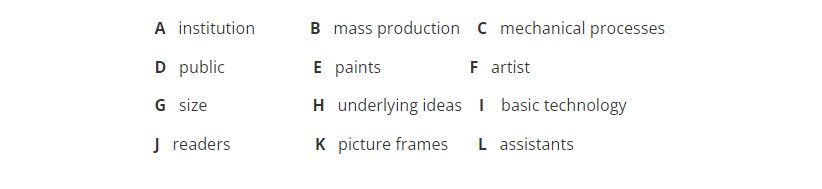
27 – 30Complete the summary using the list of words, A-L, below. Write the correct letter, A-L, in boxes 27-31 on your answer sheet.
The value attached to original works of art
Questions
31 – 35Choose the correct letter, A, B, C or D. Write the correct letter in boxes 32-35 on your answer sheet
- 29
The writer mentions London’s National Gallery to illustrate
- A
the undesirable cost to a nation of maintaining a huge collection of art.
Bthe conflict that may arise in society between financial and artistic values.
Cthe negative effect a museum can have on visitors’ opinions of themselves.
Dthe need to put individual well-being above large-scale artistic schemes.
- 30
The writer says that today, viewers may be unwilling to criticise a because
- A
they lack the knowledge needed to support an opinion.
Bthey fear it may have financial implications.
Cthey have no real concept of the work’s value.
Dthey feel their personal reaction is of no significance.
- 31
According to the writer, the ‘displacement effect’ on the visitor is caused by
- A
the variety of works on display and the way they are arranged.
Bthe impossibility of viewing particular works of art over a long period.
Cthe similar nature of the paintings and the lack of great works.
Dthe inappropriate nature of the individual works selected for exhibition.
- 32
The writer says that unlike other forms of art, a painting does not
- A
involve direct contact with an audience.
Brequire a specific location for a performance.
Cneed the involvement of other professionals.
Dhave a specific beginning or end.
Questions
36 – 40Do the following statements agree with the views of the writer in Reading Passage 3?
In boxes 36-40 on your answer sheet, write
YES if the statement agrees with the views of the writer
NO if the statement contradicts the views of the writer
NOT GIVEN if the is impossible to say what the writer thinks about this
- 36
Art history should focus on discovering the meaning of art using a range of media.
- A
Yes
BNo
CNot Given
- 37
The approach of art historians conflicts with that of art museums.
- A
Yes
BNo
CNot Given
- 38
People should be encouraged to give their opinions openly on works of art.
- A
Yes
BNo
CNot Given
- 39
Reproductions of fine art should only be sold to the public if they are of high quality.
- A
Yes
BNo
CNot Given
- 40
In the future, those with power are likely to encourage more people to enjoy art.
- A
Yes
BNo
CNot Given
Questions
1 – 7Reading Passage 1 has seven paragraphs, A-G. Choose the correct heading for each paragraph from the list of headings below. Match the correct number, i-ix, with questions 1-7.
iv. The time and place of the Industrial Revolution
Bạn chưa trả lời câu hỏi này
viii. Conditions required for industrialisation
Bạn chưa trả lời câu hỏi này
vii. Two keys to Britain’s industrial revolution
Bạn chưa trả lời câu hỏi này
i. The search for the reasons for an increase in population
Bạn chưa trả lời câu hỏi này
vi. Changes in drinking habits in Britain
Bạn chưa trả lời câu hỏi này
ix. Comparisons with Japan lead to the answer
Bạn chưa trả lời câu hỏi này
ii. Industrialisation and the fear of unemployment
Giải thích đáp án
PARAGRAPH A – HEADING iv Chú ý tới từ khóa “time”, “place”, “Industrial Revolution” trong heading. | |
HEADING | VÙNG THÔNG TIN |
The time and place of the Industrial Revolution | Why did this particular Big Bang – the world-changing birth of industry-happen in Britain? And why did it strike at the end of the 18th century? |
DỊCH NGHĨA | |
Thời gian và địa điểm của cuộc cách mạng công nghiệp | |
Giải thích: Trong đoạn văn đề cập đến:
Đoạn văn có đầy đủ dữ liệu về thời gian và địa điểm – “time and place” của cuộc Cách mạng Công nghiệp. ⇒ Heading: iv | |
PARAGRAPH B – HEADING viii Chú ý tới từ khóa “conditions”, “idustrialisation” trong heading. | |
HEADING | VÙNG THÔNG TIN |
Conditions required for industrialisation | For industry to take off, there needs to be the technology and power to drive factories, large urban populations to provide cheap labour, easy transport to move goods around, an affluent middle-class willing to buy mass-produced objects, a market-driven economy and a political system that allows this to happen. |
DỊCH NGHĨA | |
Điều kiện cần cho sự công nghiệp hóa | |
Giải thích: Trong đoạn văn đề cập đến:
Đoạn văn tập trung nhắc đến các điều kiện cần thiết cho cuộc Cách mạng Công nghiệp và trường hợp cụ thể tại một số quốc gia đã/có khả năng xảy ra cuộc Cách mạng Công nghiệp (Japan, Netherlands, France, China). ⇒ Heading: viii | |
PARAGRAPH C – HEADING vii Chú ý tới từ khóa “two keys”, “Britain’s industrial revolution” trong heading. | |
HEADING | VÙNG THÔNG TIN |
Two keys to Britain’s industrial revolution | Tea and beer, two of the nation’s favourite drinks, fuelled the revolution. |
DỊCH NGHĨA | |
Hai yếu tố quan trọng của cuộc cách mạng công nghiệp ở Anh | |
Giải thích: Trong đoạn văn đề cập đến:
Đoạn văn khẳng định rằng chìa khoá thành công của Cách mạng Công nghiệp tại Anh là hai món đồ uống trà và bia. ⇒ Heading: vii | |
PARAGRAPH D – HEADING i Chú ý tới từ khóa “reasons”, “increase in population” trong heading. | |
HEADING | VÙNG THÔNG TIN |
The search for the reasons for an increase in population | Between about 1650 and 1740, the population in Britain was static. But then there was a burst in population growth. Macfarlane says: ‘The infant mortality rate halved in the space of 20 years, and this happened in both rural areas and cities, and across all classes. People suggested four possible causes.” |
DỊCH NGHĨA | |
Việc tìm kiếm các lý do cho sự gia tăng dân số | |
Giải thích: Trong đoạn văn đề cập đến:
Đoạn văn nhắc đến việc người ta đi tìm hiểu về nguyên nhân dẫn đến sự giảm trong tỷ lệ tử vong ở trẻ sơ sinh (yếu tố góp phần gây gia tăng dân số). ⇒ Heading: i | |
PARAGRAPH E – HEADING vi Chú ý tới từ khóa “changes”, “drinking habits”, “Britain” trong heading. | |
HEADING | VÙNG THÔNG TIN |
Changes in drinking habits in Britain | ‘We drank beer. For a long time, the English were protected by the strong antibacterial agent in hops, which were added to help preserve the beer. But in the late 17th century a tax was introduced on malt, the basic ingredient of beer. The poor turned to water and gin and in the 1720s the mortality rate began to rise again. |
DỊCH NGHĨA | |
Những sự thay đổi trong thói quen uống ở Anh | |
Giải thích: Trong đoạn văn đề cập đến:
Đoạn văn nhắc đến thói quen uống bia của người Anh dần chuyển hướng sang nước và rượu gin vào giai đoạn đầu thế kỷ 18. ⇒ Heading: vi | |
PARAGRAPH F – HEADING ix Chú ý tới từ khóa “comparisons”, “Japan” trong heading. | |
HEADING | VÙNG THÔNG TIN |
Comparisons with Japan lead to the answer | Macfarlane looked to Japan, which was also developing large cities about the same time, and also had no sanitation. Water-borne diseases had a much looser grip on the Japanese population than those in Britain. Could it be the prevalence of tea in their culture? |
DỊCH NGHĨA | |
Những sự so sánh với Nhật Bản dẫn đến câu trả lời | |
Giải thích: Trong đoạn văn đề cập đến:
Đoạn văn đưa ra sự so sánh giữa tỷ lệ nhiễm các bệnh lây truyền do nước gây ra tại Nhật Bản và Anh từ đó dẫn đến câu trả lời rằng sự việc này xảy ra là nhờ có thói quen uống trà. ⇒ Heading: ix | |
PARAGRAPH G – HEADING ii Chú ý tới từ khóa “the fear of unemployment” trong heading. | |
HEADING | VÙNG THÔNG TIN |
Industrialisation and the fear of unemployment | But, if tea is a factor in the combination lock, why didn’t Japan forge ahead in a tea-soaked industrial revolution of its own? Macfarlane notes that even though 17th-century Japan had large cities, high literacy rates, even a futures market, it had turned its back on the essence of any work-based revolution by giving up labour-saving devices such as animals, afraid that they would put people out of work. |
DỊCH NGHĨA | |
Công nghiệp hóa và nỗi lo thất nghiệp | |
Giải thích: Trong đoạn văn đề cập đến:
Đoạn văn nhắc đến việc Nhật Bản đã không tiến vào cuộc Cách mạng Công nghiệp vì lo rằng nó có thể làm cho người dân mất việc. ⇒ Heading: ii | |
Questions
8 – 13Do the following statements agree with the information given in Reading Passage 1?
In boxes 8-13 on your answer sheet, write
TRUE if the statement agrees with the information
FALSE if the statement contradicts the information
NOT GIVEN if there is no information on this
- 8
China’s transport system was not suitable for industry in the 18th century.
Bạn chưa trả lời câu hỏi này
- A
True
BFalse
CNot Given
Giải thích đáp án
CÂU HỎI 8 – NOT GIVEN Chú ý tới từ khóa “China’s transport system”, “18th century” để tìm được Paragraph F chứa câu trả lời. | |
CÂU HỎI | VÙNG THÔNG TIN |
China’s transport system was not suitable for industry in the 18th century. | Tea was relatively expensive until Britain started a direct clipper trade with China in the early 18th century. |
DỊCH NGHĨA | |
Hệ thống giao thông của Trung Quốc không phù hợp với ngành công nghiệp trong thế kỷ 18. | Chè tương đối đắt cho đến khi Anh bắt đầu buôn bán trực tiếp với Trung Quốc vào đầu thế kỷ 18. |
Giải thích: Trong bài không có thông tin gì về sự phù hợp của hệ thống giao thông Trung Quốc đối với ngành công nghiệp => không đủ dữ liệu kết luận nhận định ⇒ NOT GIVEN | |
- 9
Tea and beer both helped to prevent dysentery in Britain.
Bạn chưa trả lời câu hỏi này
- A
True
BFalse
CNot Given
Giải thích đáp án
CÂU HỎI 9 – TRUE Chú ý tới từ khóa “dysentery” để tìm được Paragraph C chứa câu trả lời. | |
CÂU HỎI | VÙNG THÔNG TIN |
Tea and beer both helped to prevent dysentery in Britain. | The antiseptic properties of tannin, the active ingredient in tea, and of hops in beer – plus the fact that both are made with boiled water – allowed urban communities to flourish at close quarters without succumbing to water-borne diseases such as dysentery. |
DỊCH NGHĨA | |
Trà và bia đều giúp ngăn ngừa bệnh kiết lỵ ở Anh. | Đặc tính khử trùng của tanin, thành phần hoạt chất trong trà và cây hoa bia có trong bia – cộng với thực tế là cả hai đều được tạo ra bằng nước đun sôi – cho phép các cộng đồng đô thị phát triển ở những khu vực gần nhau mà không bị các bệnh lây truyền qua đường nước như bệnh kiết lỵ. |
Giải thích: Các thành phần trong trà và bia ngăn ngừa được các bệnh lây truyền qua đường nước, trong đó có cả kiết lỵ => nhận định đưa ra là đúng ⇒ TRUE | |
- 10
Roy Porter disagrees with Professor Macfarlane’s findings.
Bạn chưa trả lời câu hỏi này
- A
True
BFalse
CNot Given
Giải thích đáp án
CÂU HỎI 10 – FALSE Chú ý tới từ khóa “Roy Porter”, “Macfarlane” để tìm được Paragraph C chứa câu trả lời. | |
CÂU HỎI | VÙNG THÔNG TIN |
Roy Porter disagrees with Professor Macfarlane’s findings. | Macfarlanes case has been strengthened by support from notable quarters – Roy Porter, the distinguished medical historian, recently wrote a favourable appraisal of his research. |
DỊCH NGHĨA | |
Roy Porter không đồng ý với những phát hiện của Giáo sư Macfarlane. | Quan điểm của Macfarlane đã được củng cố nhờ sự hỗ trợ từ những người có tiếng như Roy Porter, nhà sử học y khoa nổi tiếng, gần đây đã viết một đánh giá tán thành về nghiên cứu của ông. |
Giải thích: Nhà sử học y khoa không hề phản bác lại phát hiện của Giáo sư Macfarlane, ngược lại ông còn ủng hộ và đưa ra đánh giá tán thành về những phát hiện ấy ⇒ nhận định đưa ra là sai => FALSE | |
- 11
After 1740,there was a reduction in population in Britain.
Bạn chưa trả lời câu hỏi này
- A
True
BFalse
CNot Given
Giải thích đáp án
CÂU HỎI 11 – FALSE Chú ý tới từ khóa “1740”, “population in Britain” để tìm được Paragraph D chứa câu trả lời. | |
CÂU HỎI | VÙNG THÔNG TIN |
After 1740,there was a reduction in population in Britain. | Between about 1650 and 1740, the population in Britain was static. But then there was a burst in population growth. |
DỊCH NGHĨA | |
Sau năm 1740, dân số ở Anh giảm. | Giữa khoảng 1650 và 1740, dân số ở Anh không biến động. Nhưng sau đó đã có một sự bùng nổ trong sự gia tăng dân số. |
Giải thích: Sau năm 1740, dân số ở Anh gia tăng một cách bùng nổ chứ không hề giảm ⇒ nhận định đưa ra là sai => FALSE | |
- 12
People in Britain used to make beer at home.
Bạn chưa trả lời câu hỏi này
- A
True
BFalse
CNot Given
Giải thích đáp án
CÂU HỎI 12 – NOT GIVEN Chú ý tới từ khóa “beer” để tìm được Paragraph C chứa câu trả lời. | |
CÂU HỎI | VÙNG THÔNG TIN |
People in Britain used to make beer at home. | The missing factors, he proposes, are to be found in almost even kitchen cupboard. Tea and beer, two of the nation’s favourite drinks, fuelled the revolution. |
DỊCH NGHĨA | |
Mọi người ở Anh thường làm bia tại nhà. | Ông đề xuất rằng những yếu tố còn thiếu sẽ được tìm thấy trong hầu hết các tủ bếp. Trà và bia, hai thức uống yêu thích quốc dân, đã thúc đẩy cuộc cách mạng. |
Giải thích: Bài viết chỉ nói đến việc bia là một trong hai thức uống yêu thích quốc dân chứ không đề cập đến việc người dân có làm bia ở nhà hay không => không đủ dữ liệu kết luận nhận định ⇒ NOT GIVEN | |
- 13
The tax on malt indirectly caused a rise in the death rate.
Bạn chưa trả lời câu hỏi này
- A
True
BFalse
CNot Given
Giải thích đáp án
CÂU HỎI 13 – TRUE Chú ý tới từ khóa “tax on malt”, “rise in the death rate” để tìm được Paragraph E chứa câu trả lời. | |
CÂU HỎI | VÙNG THÔNG TIN |
The tax on malt indirectly caused a rise in the death rate. | But in the late 17th century a tax was introduced on malt, the basic ingredient of beer. The poor turned to water and gin and in the 1720s the mortality rate began to rise again. |
DỊCH NGHĨA | |
Thuế đánh vào mạch nha gián tiếp gây ra sự gia tăng tỷ lệ tử vong. | Nhưng vào cuối thế kỷ 17, một loại thuế đã được áp dụng đối với mạch nha, thành phần cơ bản của bia. Người nghèo chuyển sang uống nước và rượu gin và vào những năm 1720, tỷ lệ tử vong bắt đầu tăng trở lại. |
Giải thích: Trong bài có nhắc đến sự kiện tăng thuế vào cuối thế kỷ 17 lên nguồn nguyên liệu chính sản xuất ra bia là mạch nha, dẫn đến việc người dân thay đổi đồ uống thường ngày thành nước và rượu gin, sau đó có sự gia tăng trong tỷ lệ tử vong ⇒ nhận định đưa ra là đúng => TRUE | |
Questions
14 – 17Reading Passage 2 has six paragraphs, A-F. Which paragraph contains the following information? Match the correct letter, A-F, with boxes 14-17. NB You may use any letter more than once.
Bạn chưa trả lời câu hỏi này
Paragraph A
Bạn chưa trả lời câu hỏi này
Paragraph D
Bạn chưa trả lời câu hỏi này
Paragraph F
Bạn chưa trả lời câu hỏi này
Paragraph D
Giải thích đáp án
CÂU HỎI 14 – PARAGRAPH A Chú ý tới từ khóa “domestic background” để tìm được Paragraph A chứa câu trả lời. | |
CÂU HỎI | VÙNG THÔNG TIN |
a reference to the influence of the domestic background on the gifted child. | a very close positive relationship was found when children’s IQ scores were compared with their home educational provision (Freeman, 2010). The higher the children’s IQ scores, especially over IQ 130, the better the quality of their educational backup, measured in terms of reported verbal interactions with parents, number of books and activities in their home etc. |
DỊCH NGHĨA | |
đề cập đến đến ảnh hưởng của hoàn cảnh gia đình đối với đứa trẻ có năng khiếu. | người ta tìm thấy một mối quan hệ vô cùng mật thiết giữa chỉ số IQ của trẻ em với môi trường giáo dục tại nhà (Freeman, 2010). IQ của trẻ càng cao, đặc biệt là trên 130 thì chất lượng giáo dục của trẻ lại càng tốt, điều này được nhận thấy qua việc tương tác với cha mẹ, qua số lượng sách vở và các hoạt động ở nhà, v.v. |
CÂU HỎI 15 – PARAGRAPH D Chú ý tới từ khóa “too much guidance” để tìm được Paragraph D chứa câu trả lời. | |
CÂU HỎI | VÙNG THÔNG TIN |
reference to what can be lost if learners are given too much guidance. | Too much dependence on the teachers risks loss of autonomy and motivation to discover. |
DỊCH NGHĨA | |
đề cập đến những gì có thể bị mất nếu người học được hướng dẫn quá nhiều. | Phụ thuộc quá nhiều vào giáo viên gây nguy cơ đánh mất quyền tự chủ và động lực để khám phá. |
CÂU HỎI 16 – PARAGRAPH F Chú ý tới từ khóa “damaging effects”, “anxiety” để tìm được Paragraph F chứa câu trả lời. | |
CÂU HỎI | VÙNG THÔNG TIN |
a reference to the damaging effects of anxiety. | Fear, for example, can limit the development of curiosity |
DỊCH NGHĨA | |
đề cập đến tác hại của sự lo lắng. | Ví dụ, nỗi sợ hãi có thể hạn chế sự phát triển của tính ham học hỏi |
CÂU HỎI 17 – PARAGRAPH D Chú ý tới từ khóa “classroom techniques”, “socially-disadvantaged” để tìm được Paragraph D chứa câu trả lời. | |
CÂU HỎI | VÙNG THÔNG TIN |
examples of classroom techniques which favour socially-disadvantaged children. | There are quite a number of new methods which can help, such as child-initiated learning, ability-peer tutoring, etc. Such practices have been found to be particularly useful for bright children from deprived areas. |
DỊCH NGHĨA | |
ví dụ về các kỹ thuật trong lớp học có lợi cho trẻ em có hoàn cảnh khó khăn về mặt xã hội. | Có khá nhiều các phương pháp mới có thể hiệu quả như là phương pháp giáo dục sớm hay việc học từ bạn bè v.v… những hoạt động như vậy đã được chứng minh là đặc biệt hiệu quả cho trẻ thông minh đến từ những vùng khó khăn. |
Questions
18 – 22Look at the following statements (Questions 18-22) and the list of people below. Match each statement with the correct person or people, A-E.
Bạn chưa trả lời câu hỏi này
B. Shore and Kanevsky
Bạn chưa trả lời câu hỏi này
D. Simonton
Bạn chưa trả lời câu hỏi này
E. Boekaerts
Bạn chưa trả lời câu hỏi này
A. Freeman
Bạn chưa trả lời câu hỏi này
C. Elshout
Giải thích đáp án
CÂU HỎI 18 – B Chú ý tới từ khóa “less time”, “exercises” để tìm được Paragraph C chứa câu trả lời. | |
CÂU HỎI | VÙNG THÔNG TIN |
Less time can be spent on exercises with gifted pupils who produce accurate work. A Freeman B Shore and Kanevsky C Elshout D Simonton E Boekaerts | Overviewing research on the thinking process of highly able children, (Shore and Kanevsky, 1993) put the instructor’s problem succinctly: ‘If they [the gifted] merely think more quickly, then we need only teach more quickly. If they merely make fewer errors, then we can shorten the practice’. |
DỊCH NGHĨA | |
Những bạn học sinh giỏi dành ít thời gian để làm bài tập hơn do họ có khả năng làm việc chính xác A Freeman B Shore and Kanevsky C Elshout D Simonton E Boekaerts | Năm 1993, khi nghiên cứu tổng thể về quá trình tư duy ở trẻ có khả năng tư duy cao, hai nhà nghiên cứu Shore và Kanevsky đã phát biểu với các giáo viên ngắn gọn như sau: “Nếu trẻ em tài năng chỉ đơn thuần là suy nghĩ nhanh hơn thì chúng ta chỉ cần dạy nhanh hơn. Nếu chúng ít mắc lỗi hơn thì chúng ta có thể rút ngắn quá trình luyện tập”. |
CÂU HỎI 19 – D Chú ý tới từ khóa “self-reliance” để tìm được Paragraph E chứa câu trả lời. | |
CÂU HỎI | VÙNG THÔNG TIN |
Self-reliance is a valuable tool that helps gifted students reach their goals. A Freeman B Shore and Kanevsky C Elshout D Simonton E Boekaerts | Research with creative scientists by Simonton (1988) brought him to the conclusion that above a certain high level, characteristics such as independence seemed to contribute more to reaching the highest levels of expertise than intellectual skills |
DỊCH NGHĨA | |
Tự lực là một công cụ giá trị giúp học sinh có năng khiếu đạt được mục tiêu của mình. A Freeman B Shore and Kanevsky C Elshout D Simonton E Boekaerts | Nghiên cứu với các nhà khoa học sáng tạo của Simonton (1988) đã đưa ông đến kết luận rằng trên một mức độ cao nhất định, các đặc điểm như tính độc lập dường như đóng góp nhiều hơn so với các kỹ năng trí tuệ để giúp đạt được trình độ chuyên môn cao nhất |
CÂU HỎI 20 – E Chú ý tới từ khóa “channel their feelings”, “assist their learning” để tìm được Paragraph F chứa câu trả lời. | |
CÂU HỎI | VÙNG THÔNG TIN |
Gifted children know how to channel their feelings to assist their learning. A Freeman B Shore and Kanevsky C Elshout D Simonton E Boekaerts | In Boekaerts’ (1991) review of emotion the learning of very high IQ and highly achieving children, she found emotional forces in harness. They were not only curious, but often had a strong desire to control their environment, improve their learning efficiency and increase their own learning resources. |
DỊCH NGHĨA | |
Trẻ có năng khiếu biết cách điều chỉnh cảm xúc của mình để hỗ trợ việc học. A Freeman B Shore and Kanevsky C Elshout D Simonton E Boekaerts | Trong bài đánh giá của Boekaerts (1991) về cảm xúc đối với việc học của những đứa trẻ có chỉ số IQ rất cao và những đứa trẻ đạt thành tích cao, bà đã tìm thấy những sức mạnh cảm xúc đang được khai thác. Chúng không chỉ tò mò mà thường có mong muốn mạnh mẽ để kiểm soát môi trường của mình, cải thiện hiệu quả học tập và tăng nguồn tài nguyên học tập của chính mình. |
CÂU HỎI 21 – A Chú ý tới từ khóa “appropriate support”, “close relatives” để tìm được Paragraph A chứa câu trả lời. | |
CÂU HỎI | VÙNG THÔNG TIN |
The very gifted child benefits from appropriate support from close relatives. A Freeman B Shore and Kanevsky C Elshout D Simonton E Boekaerts | a very close positive relationship was found when children’s IQ scores were compared with their home educational provision (Freeman, 2010). The higher the children’s IQ scores, especially over IQ 130, the better the quality of their educational backup, measured in terms of reported verbal interactions with parents, number of books and activities in their home etc. |
DỊCH NGHĨA | |
Đứa trẻ có năng khiếu được hưởng lợi từ sự hỗ trợ thích hợp từ những người thân. A Freeman B Shore and Kanevsky C Elshout D Simonton E Boekaerts | người ta tìm thấy một mối quan hệ vô cùng mật thiết giữa chỉ số IQ của trẻ em với môi trường giáo dục tại nhà (Freeman, 2010). IQ của trẻ càng cao, đặc biệt là trên 130 thì chất lượng giáo dục của trẻ lại càng tốt, điều này được nhận thấy qua việc tương tác với cha mẹ, qua số lượng sách vở và các hoạt động ở nhà, v.v. |
CÂU HỎI 22 – C Chú ý tới từ khóa “successful students” để tìm được Paragraph E chứa câu trả lời. | |
CÂU HỎI | VÙNG THÔNG TIN |
Really successful students have learnt a considerable amount about their subject. A Freeman B Shore and Kanevsky C Elshout D Simonton E Boekaerts | But scientific progress is not all theoretical, knowledge is so vital to outstanding performance: individuals who know a great deal about a specific domain will achieve at a higher level than those who do not (Elshout, 1995). |
DỊCH NGHĨA | |
Những sinh viên thực sự thành công đã học được một lượng đáng kể về chủ đề của họ. A Freeman B Shore and Kanevsky C Elshout D Simonton E Boekaerts | Nhưng tiến bộ khoa học không phải là tất cả lý thuyết, kiến thức là một yếu tố rất quan trọng để đạt được thành tích xuất sắc: những cá nhân biết nhiều về một lĩnh vực cụ thể sẽ đạt được trình độ cao hơn những người không biết (Elshout, 1995). |
Questions
23 – 27Complete the sentences below. Choose NO MORE THAN THREE WORDS from the passage for each answer. Write your answers in boxes 23-26 on your answer sheet
Giải thích đáp án
CÂU HỎI 23 – books – activities Chỗ trống cần điền thứ nhất đứng sau giới từ “of” ⇒ cần điền danh từ Chỗ trống cần điền thứ hai đứng sau liên từ “and”, đằng trước nó là một danh từ ⇒ khả năng cao là cần điền điền danh từ | |
CÂU HỎI | VÙNG THÔNG TIN |
| One study found a strong connection between children’s IQ and the availability of books and activities at home. | For example, a very close positive relationship was found when children’s IQ scores were compared with their home educational provision (Freeman, 2010). The higher the children’s IQ scores, especially over IQ 130, the better the quality of their educational backup, measured in terms of reported verbal interactions with parents, number of books and activities in their home etc |
CÂU HỎI 24 – internal regulation Chỗ trống cần điền đứng sau động từ “have” ⇒ có thể điền danh từ hoặc danh từ có tính từ bổ nghĩa phía trước | |
CÂU HỎI | VÙNG THÔNG TIN |
Children of average ability seem to need more direction from teachers because they do not have internal regulation | There appears to be a qualitative difference in the way the intellectually highly able think, compared with more average-ability or older pupils, for whom external regulation by the teacher often compensates for lack of internal regulation. |
CÂU HỎI 25 – emotional awareness Chỗ trống cần điền đứng sau động từ “developing” ⇒ có thể điền danh từ hoặc danh từ có tính từ bổ nghĩa phía trước | |
CÂU HỎI | VÙNG THÔNG TIN |
Meta-cognition involves children understanding their own learning strategies, as well as developing emotional awareness | To be at their most effective in their self-regulation, all children can be helped to identify their own ways of learning – metacognition – which will include strategies of planning, monitoring, evaluation, and choice of what to learn. Emotional awareness is also part of metacognition, so children should be helped to be aware of their feelings around the area to be learned, feelings of curiosity or confidence, for example Emotional awareness is also part of metacognition, so children should be helped to be aware of their feelings around the area to be learned, feelings of curiosity or confidence, for example. |
CÂU HỎI 26 – spoon-feeding Chỗ trống cần điền đứng sau cụm từ “know as” ⇒ cần điền danh từ | |
CÂU HỎI | VÙNG THÔNG TIN |
Teachers who rely on what is known as spoon-feeding often produce sets of impressive grades in class tests. | Although ‘spoon-feeding’ can produce extremely high examination results, these are not always followed by equally impressive life successes. |
Questions
Complete the summary using the list of words, A-L, below. Write the correct letter, A-L, in boxes 27-31 on your answer sheet.
The value attached to original works of art
Giải thích đáp án
CÂU HỎI 27 – B. mass production Chỗ trống cần điền đứng sau giới từ “on” ⇒ có thể điền danh từ hoặc danh từ có tính từ bổ nghĩa phía trước | |
CÂU HỎI | VÙNG THÔNG TIN |
But they do not go to museums to read original manuscripts of novels, perhaps because the availability of novels has depended on mass production for so long | However, if Mona Lisa was a famous novel, few people would bother to go to a museum to read the writer’s actual manuscript rather than a printed reproduction. This might be explained by the fact that the novel has evolved precisely because of technological developments that made it possible to print out huge numbers of texts |
CÂU HỎI 28 – H. underlying ideas Chỗ trống cần điền đứng sau mạo từ “the” ⇒ có thể điền danh từ hoặc danh từ có tính từ bổ nghĩa phía trước | |
CÂU HỎI | VÙNG THÔNG TIN |
and also because with novels, the underlying ideas are the most important thing. | With novels, the reader attends mainly to the meaning of words rather than the way they are printed on the page |
CÂU HỎI 29 – L. assistants Chỗ trống cần điền đứng sau động từ “instruct”, trước giới từ “to” ⇒ cần điền danh từ | |
CÂU HỎI | VÙNG THÔNG TIN |
However, in historical times artists such as Leonardo were happy to instruct assistants to produce copies of their work | The seven surviving versions of Mona Lisa bear witness to the fact that in the 16th century, artists seemed perfectly content to assign the reproduction of their creations to their workshop apprentices as regular ‘bread and butter’ work. |
CÂU HỎI 30 – G. size Chỗ trống cần điền đứng sau liên từ “and”, trước liên từ “and” có danh từ “color” ⇒ khả năng cao cần điền danh từ | |
CÂU HỎI | VÙNG THÔNG TIN |
these days new methods of reproduction allow excellent replication of surface relief features as well as colour and size. | And today the task of reproducing pictures is incomparably more simple and reliable, with reprographic techniques that allow the production of high-quality prints made exactly to the original scale, with faithful colour values, and even with duplication of the surface relief of the painting.
|
CÂU HỎI 31 – D. public Chỗ trống cần điền đứng sau mạo từ “the” ⇒ cần điền danh từ | |
CÂU HỎI | VÙNG THÔNG TIN |
It is regrettable that museums still promote the superiority of original works of art, since this may not be in the interests of the public. | But despite an implicit recognition that the spread of good reproductions can be culturally valuable, museums continue to promote the special status of original work. Unfortunately, this seems to place severe limitations on the kind of experience offered to visitors. |
Questions
33 – 36Choose the correct letter, A, B, C or D. Write the correct letter in boxes 32-35 on your answer sheet
- 33
The writer mentions London’s National Gallery to illustrate
Bạn chưa trả lời câu hỏi này
Giải thích đáp án
CÂU HỎI 32 – C | |
CÂU HỎI | VÙNG THÔNG TIN |
The writer mentions London’s National Gallery to illustrate A. the undesirable cost to a nation of maintaining a huge collection of art. B. the conflict that may arise in society between financial and artistic values. C. the negative effect a museum can have on visitors’ opinions of themselves. D. the need to put individual well-being above large-scale artistic schemes. | In addition, a major collection like that of London’s National Gallery is housed in numerous rooms, each with dozens of works, any one of which is likely to be worth more than all the average visitor possesses. In a society that judges the personal status of the individual so much by their material worth, it is therefore difficult not to be impressed by one’s own relative ‘worthlessness’ in such an environment. |
DỊCH NGHĨA | |
Người viết đề cập đến Phòng trưng bày Quốc gia của Luân Đôn để minh họa A. chi phí không mong muốn đối với một quốc gia để duy trì một bộ sưu tập nghệ thuật khổng lồ. B. xung đột có thể nảy sinh trong xã hội giữa các giá trị tài chính và nghệ thuật. C. tác động tiêu cực mà bảo tàng có thể gây ra đối với ý kiến của du khách về chính họ. D. nhu cầu đặt hạnh phúc cá nhân lên trên các kế hoạch nghệ thuật quy mô lớn.
| Ngoài ra, một bộ sưu tập lớn như của Phòng trưng bày Quốc gia Luân Đôn được đặt trong nhiều phòng, mỗi phòng có hàng chục tác phẩm, bất kỳ tác phẩm nào trong số đó đều có khả năng đáng giá hơn tất cả những gì mà một du khách bình thường sở hữu. Trong một xã hội mà người ta đánh giá địa vị cá nhân của quá nhiều thông qua giá trị vật chất của họ, thật khó để không bị ấn tượng bởi sự ‘vô giá trị’ tương đối trong một môi trường như vậy. |
| |
- 34
The writer says that today, viewers may be unwilling to criticise a because
Bạn chưa trả lời câu hỏi này
Giải thích đáp án
CÂU HỎI 33 – D | |
CÂU HỎI | VÙNG THÔNG TIN |
The writer says that today, viewers may be unwilling to criticise because A. they lack the knowledge needed to support an opinion. B. they fear it may have financial implications. C. they have no real concept of the work’s value. D. they feel their personal reaction is of no significance. | Since these works were originally produced, they have been assigned a huge monetary value by some person or institution more powerful than themselves. Evidently, nothing the viewer thinks about the work is going to alter that value, and so today’s viewer is deterred from trying to extend that spontaneous, immediate, self-reliant kind of reading which would originally have met the work. |
DỊCH NGHĨA | |
Người viết cho rằng ngày nay, người xem không thể chỉ trích vì
A Họ thiếu kiến thức cần thiết để hỗ trợ cho ý kiến. B. Họ sợ nó có thể sẽ gây liên luỵ về mặt tài chính. C. Họ không có khái niệm thực sự về giá trị của tác phẩm. D. Họ cảm thấy phản ứng cá nhân của họ không có ý nghĩa gì. | Ngay từ khi những tác phẩm này được tạo ra, chúng đã được định giá bằng một giá trị khổng lồ bởi một vài người hoặc tổ chức có thế lực hơn họ. Rõ ràng, việc đánh giá hay suy nghĩ của người xem về tác phẩm sẽ không làm thay đổi giá trị đó, và vì vậy người xem ngày nay bị cản trở khi cố gắng mở rộng việc thưởng thức một cách tự phát, tức thời, và tự chủ mà ban đầu đã có với tác phẩm. |
| |
- 35
According to the writer, the ‘displacement effect’ on the visitor is caused by
Bạn chưa trả lời câu hỏi này
Giải thích đáp án
CÂU HỎI 34 – A | |
CÂU HỎI | VÙNG THÔNG TIN |
According to the writer, the ‘displacement effect’ on the visitor is caused by A. the variety of works on display and the way they are arranged. B. the impossibility of viewing particular works of art over a long period. C. the similar nature of the paintings and the lack of great works. D. the inappropriate nature of the individual works selected for exhibition. | The visitor may then be struck by the strangeness of seeing such diverse paintings, drawings and sculptures brought together in an environment for which they were not originally created. This ‘displacement effect’ is further heightened by the sheer volume of exhibits. |
DỊCH NGHĨA | |
Theo người viết, ‘hiệu ứng dịch chuyển’ đối với khách tham quan là do A. sự đa dạng của các tác phẩm được trưng bày và cách chúng được sắp xếp. B. không thể xem các tác phẩm nghệ thuật cụ thể trong một thời gian dài. C. bản chất tương tự của các bức tranh và sự thiếu hụt các tác phẩm độc đáo. D. bản chất không phù hợp của các tác phẩm riêng lẻ được chọn để triển lãm. | Sau đó, du khách có thể bị ấn tượng bởi sự kỳ lạ khi nhìn thấy những bức tranh, bản vẽ và tác phẩm điêu khắc đa dạng như vậy được tập hợp lại với nhau trong một môi trường mà chúng không được tạo ra từ đầu. ‘Hiệu ứng chuyển dời’ này còn được tăng thêm bởi khối lượng khổng lồ của các tác phẩm triển lãm. |
| |
- 36
The writer says that unlike other forms of art, a painting does not
Bạn chưa trả lời câu hỏi này
Giải thích đáp án
CÂU HỎI 35 – D | |
CÂU HỎI | VÙNG THÔNG TIN |
The writer says that unlike other forms of art, a painting does not A. involve direct contact with an audience. B. require a specific location for a performance. C. need the involvement of other professionals. D. have a specific beginning or end. | A fundamental difference between paintings and other art forms is that there is no prescribed time over which a painting is viewed. By contrast, the audience encourages an opera or a play over a specific time, which is the duration of the performance. Similarly novels and poems are read in a prescribed temporal sequence, whereas a picture has no clear place at which to start viewing, or at which to finish. |
DỊCH NGHĨA | |
Nhà văn nói rằng không giống như các loại hình nghệ thuật khác, một bức tranh không A. liên quan đến đến việc tiếp xúc trực tiếp với khán giả. B. yêu cầu một địa điểm cụ thể cho một buổi biểu diễn. C. cần sự tham gia của các chuyên gia khác. D. có một sự khởi đầu hoặc kết thúc cụ thể. | Tương tự như vậy, tiểu thuyết và thơ được đọc theo một trình tự thời gian nhất định, trong khi một bức tranh lại không có nơi nào rõ ràng để bắt đầu xem hoặc kết thúc. |
| |
Questions
37 – 41Do the following statements agree with the views of the writer in Reading Passage 3?
In boxes 36-40 on your answer sheet, write
YES if the statement agrees with the views of the writer
NO if the statement contradicts the views of the writer
NOT GIVEN if the is impossible to say what the writer thinks about this
- 37
Art history should focus on discovering the meaning of art using a range of media.
Bạn chưa trả lời câu hỏi này
Giải thích đáp án
CÂU HỎI 36 – NOT GIVEN Chú ý tới từ khóa “art history” để tìm được Paragraph 10 chứa câu trả lời. | |
CÂU HỎI | VÙNG THÔNG TIN |
Art history should focus on discovering the meaning of art using a range of media. | Consequently, the dominant critical approach becomes that of the art historian, a specialised academic approach devoted to ‘discovering the meaning’ of art within the cultural context of its time. |
DỊCH NGHĨA | |
Lịch sử nghệ thuật nên tập trung vào việc khám phá ý nghĩa của nghệ thuật bằng cách sử dụng nhiều phương tiện. | Do đó, cách tiếp cận chủ yếu mà mang tính phê bình trở thành cách tiếp cận của nhà sử học nghệ thuật, một cách tiếp cận học thuật chuyên biệt dành cho việc “khám phá ý nghĩa” của nghệ thuật trong bối cảnh văn hóa của thời đại. |
Giải thích: Đoạn văn chỉ nhắc đến một tiếp cận nghệ thuật chuyên biệt dành cho việc khám phá ý nghĩa của nghệ thuật trong bối cảnh văn hoá thời đại, không nói đến việc sử dụng phương tiện gì => không đủ thông tin kết luận nhận định ⇒ NOT GIVEN | |
- 38
The approach of art historians conflicts with that of art museums.
Bạn chưa trả lời câu hỏi này
Giải thích đáp án
CÂU HỎI 37 – NO Chú ý tới từ khóa “art historians”, “art museums” để tìm được Paragraph 10 chứa câu trả lời. | |
CÂU HỎI | VÙNG THÔNG TIN |
The approach of art historians conflicts with that of art museums. | Consequently, the dominant critical approach becomes that of the art historian, a specialised academic approach devoted to ‘discovering the meaning’ of art within the cultural context of its time. This is in perfect harmony with the museum’s function |
DỊCH NGHĨA | |
Cách tiếp cận của các nhà sử học nghệ thuật mâu thuẫn với cách tiếp cận của các bảo tàng nghệ thuật. | Do đó, cách tiếp cận chủ yếu là mang tính phê bình trở thành cách tiếp cận của nhà sử học nghệ thuật, một cách tiếp cận học thuật chuyên biệt dành cho việc “khám phá ý nghĩa” của nghệ thuật trong bối cảnh văn hóa của thời đại. Điều này hoàn toàn phù hợp với chức năng của bảo tàng |
Giải thích: Bài viết đã nêu rõ rằng cách tiếp cận của nhà sử học nghệ thuật là hoàn toàn hài hoà với chức năng của bảo tàng => nhận định đưa ra sai ⇒ NO | |
- 39
People should be encouraged to give their opinions openly on works of art.
Bạn chưa trả lời câu hỏi này
Giải thích đáp án
CÂU HỎI 38 – YES Chú ý tới từ khóa “opinions” để tìm được Paragraph 11 chứa câu trả lời. | |
CÂU HỎI | VÙNG THÔNG TIN |
People should be encouraged to give their opinions openly on works of art. | The museum public, like any other audience, experience art more rewardingly when given the confidence to express their views. |
DỊCH NGHĨA | |
Mọi người nên được khuyến khích đưa ra ý kiến của mình một cách cởi mở về các tác phẩm nghệ thuật. | Khách tham quan bảo tàng, giống như bất kỳ khán giả nào khác, sẽ trải nghiệm nghệ thuật một cách bổ ích hơn khi được tự tin bày tỏ quan điểm của mình. |
Giải thích: Bài viết chỉ ra rằng người ta sẽ thưởng thức nghệ thuật một cách bổ ích hơn khi được tự tin bày tỏ quan điểm của mình => nêu ra tác dụng để khuyến khích người thưởng thức nghệ thuật trong tương lai => nhận định đưa ra đúng ⇒ YES | |
- 40
Reproductions of fine art should only be sold to the public if they are of high quality.
Bạn chưa trả lời câu hỏi này
Giải thích đáp án
CÂU HỎI 39 – NOT GIVEN Chú ý tới từ khóa “reproductions”, “high quality” để tìm được Paragraph 11 chứa câu trả lời. | |
CÂU HỎI | VÙNG THÔNG TIN |
Reproductions of fine art should only be sold to the public if they are of high quality. | If appropriate works of fine art could be rendered permanently accessible to the public by means of high-fidelity reproductions, as literature and music already are, the public may feel somewhat less in awe of them. |
DỊCH NGHĨA | |
Các bản sao của tác phẩm nghệ thuật chỉ nên được bán cho công chúng nếu chúng có chất lượng cao. | Nếu các tác phẩm mỹ thuật phù hợp có thể được cung cấp vĩnh viễn cho công chúng bằng các bản sao có độ trung thực cao, như văn học và âm nhạc đã làm, thì công chúng có thể cảm thấy bớt kiêng dè hơn phần nào. |
Giải thích: Không có chi tiết nhắc đến việc các tác phẩm tái sản xuất được bán cho công chúng => không đủ dữ liệu kết luận nhận định ⇒ NOT GIVEN | |
- 41
In the future, those with power are likely to encourage more people to enjoy art.
Bạn chưa trả lời câu hỏi này
Giải thích đáp án
CÂU HỎI 40 – NO Chú ý tới từ khóa “those with power” để tìm được Paragraph 11 chứa câu trả lời. | |
CÂU HỎI | VÙNG THÔNG TIN |
In the future, those with power are likely to encourage more people to enjoy art. | If appropriate works of fine art could be rendered permanently accessible to the public by means of high-fidelity reproductions, as literature and music already are, the public may feel somewhat less in awe of them. Unfortunately, that may be too much to ask from those who seek to maintain and control the art establishment. |
DỊCH NGHĨA | |
Trong tương lai, những người có quyền lực có thể sẽ khuyến khích nhiều người thưởng thức nghệ thuật hơn. | Nếu các tác phẩm mỹ thuật phù hợp có thể được cung cấp vĩnh viễn cho công chúng bằng các bản sao có độ trung thực cao, như văn học và âm nhạc đã làm, thì công chúng có thể cảm thấy bớt kiêng dè hơn phần nào. Thật không may, đó có thể là đòi hỏi quá nhiều từ những người tìm cách duy trì và kiểm soát cơ sở nghệ thuật. |
Giải thích: Bài viết nhận xét rằng khó có thể yêu cầu những người duy trì và kiểm soát nghệ thuật khuyến khích nhiều người hơn thưởng thức nghệ thuật => nhận định đưa ra sai ⇒ NO | |
