
Path to Success – Test 5 – R
11/11/2024 2024-11-11 10:03Path to Success – Test 5 – R
Passage 1
READING PASSAGE 1
You should spend about 20 minutes on Questions 1-13, which are based on Reading Passage 1 on the following pages.
Trees in trouble
What is causing the decline of the world’s giant forests?
A
Big trees are incredibly important ecologically. For a start, they sustain countless other species. They provide shelter for many animals, and their trunks and branches can become gardens, hung with green ferns, orchids and bromeliads, coated with mosses and draped with vines. With their tall canopies* basking in the sun, they capture vast amounts of energy. This allows them to produce massive crops of fruit, flowers and foliage that sustain much of the animal life in the forest.
B
Only a small number of tree species have the genetic capacity to grow really big. The mightiest are native to North America, but big trees grow all over the globe, from the tropics to the boreal forests of the high latitudes. To achieve giant stature, a tree needs three things: the right place to establish its seedling, good growing conditions and lots of time with low adult mortality*. Disrupt any of these, and you can lose your biggest trees.
C
In some parts of the world, populations of big trees are dwindling because their seedlings cannot survive or grow. In southern India, for instance, an aggressive non native shrub, Lantana camara, is invading the floor of many forests. Lantana grows so thickly that young trees often fail to take root. With no young trees to replace them, it is only a matter of time before most of the big trees disappear. Across much of northern Australia, gamba grass from Africa is overrunning native savannah woodlands. The grass grows up to four metres tall and burns fiercely, creating super hot fires that cause catastrophic tree mortality.
D
Without the right growing conditions trees cannot get really big, and there is some evidence to suggest tree growth could slow in a warmer world, particularly in environments that are already warm. Having worked for decades at La Selva Biological Station in Puerto Viejo de Sarapiquj, Costa Rica, David and Deborah Clark and colleagues have shown that tree growth there declines markedly in warmer years. “During the day, their photosynthesis* shuts down when it gets too warm, and at night they consume more energy because their metabolic rate increases, much as a reptile’s would when it gets warmer,” explains David Clark. With less energy produced in warmer years and more being consumed just to survive, there is even less energy available for growth.
E
The Clarks’ hypothesis, if correct, means tropical forests would shrink over time. The largest, oldest trees would progressively die off and tend not to be replaced. According to the Clarks, this might trigger a destabilisation of the climate; as older trees die, forests would release some of their stored carbon into the atmosphere, prompting a vicious cycle of further warming, forest shrinkage and carbon emissions.
F
Big trees face threats from elsewhere. The most serious is increasing mortality, especially of mature trees. Across much of the planet, forests of slow-growing ancient trees have been cleared for human use. ln western North America, most have been replaced by monocultures of fast-growing conifers. Siberia’s forests are being logged at an incredible rate. Logging in tropical forests is selective but the timber cutters usually prioritise the biggest and oldest trees. In the Amazon, my colleagues and I found the mortality rate for the biggest trees had tripled in small patches of rainforest surrounded by pasture land. This happens for two reasons. First, as they grow taller, big trees become thicker and less flexible: when winds blow across the surrounding cleared land, there is nothing to stop their acceleration. When they hit the trees, the impact can snap them in half. Second, rainforest fragments dry out when surrounded by dry, hot pastures and the resulting drought can have devastating consequences: one four-year study has shown that death rates will double for smaller trees but will increase 4.5 times for bigger trees.
G
Particular enemies to large trees are insects and disease. Across vast areas of western North America, increasingly mild winters are causing massive outbreaks of bark beetle. These tiny creatures can kill entire forests as they tunnel their way through the inside of trees. In both North America and Europe, fungus-causing diseases such as Dutch elm disease have killed off millions of stately trees that once gave beauty to forests and cities. As a result of human activity, such enemies reach even the remotest corners of the world, threatening to make the ancient giants a thing of the past.
Glossary
|
Questions
1 – 8
Questions 1-7 Reading Passage 1 has seven paragraphs, A-G. Choose the correct heading for each paragraph from the list of headings below.
Questions
9 – 13
Questions 8-13 Complete the sentences below. Choose NO MORE THAN TWO WORDS from the passage for each answer.
The biggest trees in the world can be found in 8
. Some trees in northern Australia die because 9of
made worse by gamba grass. The Clarks believe that the release of 10
from dead trees could lead to the death of more trees. Strong 11
are capable of damaging tall trees in the Amazon. 12
has a worse impact on tall trees than smaller ones. In western Northern America, a species of 13
has destroyed many trees.
Passage 2
READING PASSAGE 2
You should spend about 20 minutes on Questions 14-26, which are based on Readmg Passage 2 below.
Whale Strandings
Why do whales leave the ocean and become stuck on beaches?
When the last stranded whale of a group eventually dies, the story does not end there. A team of researchers begins to investigate, collecting skin samples for instance, recording anything that could help them answer the crucial question: why? Theories abound, some more convincing than others. In recent years, navy sonar has been accused of causing certain whales to strand. ft is known that noise pollution from offshore industry, shipping and sonar can impair underwater communication, but can it really drive whales onto our beaches?
In 1998, researchers at the Pelagos Cetacean Research Institute, a Greek non-profit scientific group, linked whale strandings with low frequency sonar tests being carried out by the North Atlantic Treaty Organisation (NATO). They recorded the stranding of 12 Cuvier’s beaked whales over 38.2 kilometres of coastline. NATO later admitted it had been testing new sonar technology in the same asea at the time as the strandings had occurred. ‘Mass’ whale strandings involve four or more animals. Typically they all wash ashore together, but in mass atypical strandings (such as the one in Greece), the whales don’t strand as a group; they are scattered over a larger area.
For humans, hearing a sudden loud noise might prove frightening, but it does not induce mass fatality. For whales, on the other hand, there is a theory on how sonar can kill. The noise can surprise the animal, causing it to swim too quickly to the surface. The result is decompression sickness, a hazard human divers know all too well. If a diver ascends too quickly from a high-pressure w1derwater environment to a lower-pressure one, gases dissolved in blood and tissue expand and form bubbles. The bubbles block the flow of blood to vital organs, and can ultimately lead to death.
Plausible as this seems, it is still a theory and based on our more comprehensive knowledge of land-based animals. For this reason, some scientists are wary. Whale expert Karen Evans is one such scientist. Another is Rosemary Gales, a leading expert on whale strandings. She says sonar technology cannot always be blamed for mass strand.mgs. “It’s a case-by-case situation. Whales have been stranding for a very long time – pre-sonar:’ And when 80% of all Australian whale strandings occur around Tasmania, Gales and her team must continue in the search for answers.
When animals beach next to each other at the same time, the most common cause has nothing to do with humans at all. “They’re highly social creatures;• says Gales. “When they mass strand – it’s complete panic and chaos. If one of the group strands and sounds the alarm, others will try to swim to its aid, and become stuck themselves.”
Activities such as sonar testing can hint at when a stranding may occur, but if conservationists are to reduce the number of strandings, or improve rescue operations, they need information on where strandings are likely to occur as well. With this in mind, Ralph James, physicist at the University of Western Australia in Perth, thinks he may have discovered why whales turn up only on some beaches. In 1986 he went to Augusta, Western Australia, where more than 100 false killer whales had beached. “I found out from chatting to the locals that whales had been stranding there for decades. So I asked myself, what is it about this beach?” From this question that James pondered over 20 years ago, grew the university’s Whale Stranding Analysis Project.
Data has since revealed that all mass strandings around Australia occur on gently sloping sandy beaches, some with inclines of less than 0.5%. For whale species that depend on an echolocation system to navigate, this kind of beach spells disaster. Usually, as they swim, they make clicking noises, and the resulting sound waves are reflected in an echo and travel back to them. However, these just fade out on shallow beaches, so the whale doesn’t hear an echo and it crashes onto the shore.
But that is not all. Physics, it appears, can help with the when as well as the where. The ocean is full of bubbles. Larger ones rise quickly to the surface and disappear, whilst smaller ones – called microbubbles – can last for days. It is these that absorb whale ‘clicks’. “Rough weather generates more bubbles than usual;’ James adds. So, during and after a storm, echolocating whales are essentially swimming blind. Last year was a bad one for strandings in Australia. Can we predict if this – or any other year – will be any better? Some scientists believe we can. They have found trends which could be used to forecast ‘bad years’ for strandings in the future. In 2005, a survey by Klaus Vanselow and Klaus Ricklefs of sperm whale strandings in the North Sea even found a correlation between these and the sunspot cycle, and suggested that changes in the Earth’s magnetic field might be involved. But others are sceptical. “Their study was interesting … but the analyses they used were flawed on a number of levels,” says Evans. In the same year, she co-authored a study on Australian strandings that uncovered a completely different trend. “We analysed data from 1920 to 2002 … and observed a clear periodicity in the number of whales stranded each year that coincides with a major climatic cycle:’ To put it more simply, he says, in the years when strong westerly and southerly winds bring cool water rich in nutrients closer to the Australia coast, there is an increase in the number of fish. The whales follow.
So what causes mass strandings? “It’s probably many different components;’ says James. And he is probably right. But the point is we now know what many of those components are.
Questions
14 – 17Questions 14-17 Choose NO MORE THAN TWO WORDS from the passage for each answer.
Questions
18 – 21Questions 18-21 Label the diagram below. Choose NO MORE THAN TWO WORDS from the passage for each answer.
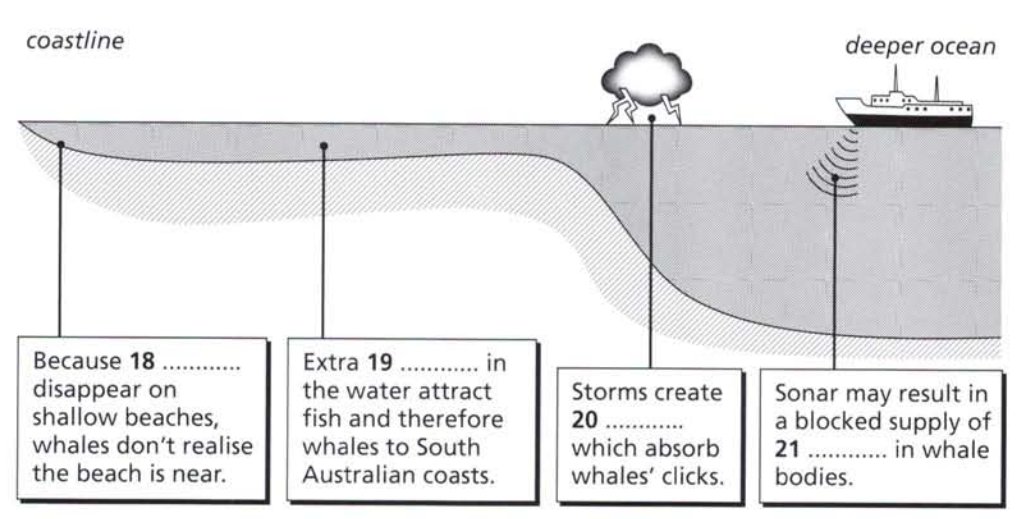
Questions
22 – 26Questions 22-26 Do the following statements agree with the information given in Reading Passage 2?
TRUE if the statement agrees with the information
FALSE if the statement contradicts the information
NOT GIVEN if there is no information on this
- 18
The aim of the research by the Pelagos Institute in 1998 was to prove that navy sonar was responsible for whale strandings.
- A
True
BFalse
CNot Given
- 19
The whales strandedin Greece were found at different points along the coast.
- A
True
BFalse
CNot Given
- 20
Rosemary Gales has questioned the research techniques used by the Greek scientists.
- A
True
BFalse
CNot Given
- 21
Accordingto Gales, whales are likely to try lo help another whale in trouble.
- A
True
BFalse
CNot Given
- 22
There is now agreement amongst scientists that changesin the Earth‘s magnetic fields contribute to whale strandings.
- A
True
BFalse
CNot Given
Passage 3
READING PASSAGE 3
You should spend about 20 minutes on Questions 27-40, which are based on Reading Passage 3 below.
Science in Space
How will NASA transform the International Space Station from a building site into a cutting-edge research laboratory?
A premier, world-class laboratory in low Earth orbit. That was how the National Aeronautics and Space Administration agency (NASA) sold the International Space Station (ISS) to the US Congress in 2001.Today no one can doubt the agency’s technological ambition. The most complex engineering project ever attempted has created an enormous set of interlinked modules that orbits the planet at more than 27,000 kilometres per hour. It might be travelling fast but, say critics, as a lab it is going nowhere. So far, it has gone through $150 billion.
So where should its future priorities lie? This question was addressed at the recent 1st annual ISS research and development conference in Colorado. Among the presenters was Satoshi Iwase of Aichi Medical University in Japan who has spent several years developing an experiment that could help solve one of the key problems that humans will face in space: keeping our bodies healthy in weightlessness. One thing that physiologists have learned is that without gravity our bodies begin to lose strength, leaving astronauts with weakened bones, muscles and cardiovascular systems. To counter these effects on a long-duration mission to, say, Mars, astronauts will almost certainly need to create their own artificial gravity. This is where Iwase comes in. He leads a team designing a centrifuge for humans. In their preliminary design, an astronaut is scrapped into the seat of a machine that resembles an exercise bike. Pedalling provides a workout for the astronaut’s muscles and cardiovascular system, but it also causes the seat to rotate vertically around a central axis so the rider experiences artificial gravity while exercising.
The centrifuge project highlights the station’s potential as a research lab. Similar machines have flown in space aboard NASA’s shuttles, but they couldn’t be tested for long enough to prove whether they were effective. It’s been calculated that co properly assess a centrifuge’s impact on human physiology, astronauts would have co ride it for 30 minutes a day for at least two months. ‘The only way co test this is in weightlessness, and the only time we have to do that is on the space station,’ says Laurence Young, a space medicine expert at the Massachusetts Institute of Technology. There are certainly plenty of ideas for ocher experiments: but many projects have yet to fly. Even if the centrifuge project gets the green light, it will have to wait another five years before the station’s crew can take a spin. Lengthy delays like this are one of the key challenges for NASA. according to an April 2011 report from the US National Academy of Sciences. Its authors said they were ‘deeply concerned’ about the state of NASA’s science research, and made a number of recommendations. Besides suggesting that the agency reduces the time between approving experiments and sending them into space, it also recommended setting clearer research priorities.
NASA has already begun to cake action, hiring management consultants ProOrbis co develop a plan to cut through the bureaucracy. And Congress also directed NASA co hire an independent organisation. the Centre for the Advancement of Science in Space (CASIS}, to help manage the station’s US lab facilities. One of CASIS’s roles is to convince public and private investors that science on the station is worth the spend because judged solely by the number of papers published, the ISS certainly seems poor value: research on the station has generated about 3,100 papers since 1998.The Hubble Space Telescope, meanwhile, has produced more than 11,300 papers in just over 20 years, yet it cost less than one-tench of the price of the space station.
Yet Mark Uhran, assistant associate administrator for the ISS, refutes the criticism that the station hasn’t done any useful research. He points to progress made on a salmonella vaccine, for example. To get the ISS research back on track, CASIS has examined more than 100 previous microgravity experiments to identify promising research themes. From this, it has opted to focus on life science and medical research, and recently called for proposals for experiments on muscle wasting, osteoporosis and the immune system. The organisation also maintains that the ISS should be used to develop products with commercial application and to test those that are either close to or already on the market. Investment from outside organisations is vital, says Uhran, and a balance between academic and commercial research will help attract this.
The station needs to attract cutting-edge research, yet many scientists seem to have little idea what goes on aboard it. Jeanne Di Francesco at ProOrbis conducted more than 200 interviews with people from organisations with potential interests in low gravity studies. Some were aware of the ISS but they didn’t know what’s going on up there, she says. ‘Others know there’s science, but they don’t know what kind.’
According to Alan Stern, planetary scientist, the biggest public relations boost for the ISS may come from the privately funded space flight industry. Companies like SpaceX could help NASA and its partners when it comes to resupplying the ISS, as it suggests it can reduce launch costs by two-thirds. Virgin Atlantic’s SpaceShipTwo or Zero2Infinity’s high altitude balloon could also boost the space station’s fortunes. They might not come close to the ISS’s orbit, yet Stern believes they will revolutionise the way we, the public, see space. Soon everyone will be dreaming of interplanetary travel again, he predicts. More importantly, scientists are already queuing for seats on these low-gravity space-flight services so they can collect data during a few minutes of weightlessness. This demand for low-cost space flight could eventually lead to a service running on a more frequent basis, giving researchers the chance to test their ideas before submitting a proposal for experiments on the ISS. Getting flight experience should help them win a slot on the station, says Stern.
Questions
27 – 32Questions 27-30 Choose the correct letter, A, B, C or D.
- 23
What does the writer state about the ISS in the first paragraph?
- A
Its manufacture has remained within the proposed budget.
BIt is a great example of technological achievement.
CThere are doubts about the speed it has attained.
DNASA should have described its purpose more accurately.
- 24
What are we told about Satoshi Iwase‘s experimental machine?
- A
It is based on conventional exercise equipment.
BIt was originally commissioned by NASA.
CIt is designed only to work in low-gravity environments.
DIt has benefits that Iwase did not anticipate.
- 25
The writer refers to the Hubble Space Telescopein order to
- A
show why investment in space technology has decreased.
Bhighlight the need to promote the ISS in a positive way.
Cexplain which kind of projects are more likely to receive funding.
Djustify the time required for a space project to produce results.
- 26
In the sixth paragraph, we are told that CASIS has
- A
rejected certain applications for experiments on the ISS.
Bexpressed concern about testing products used for profit.
Cquestioned the benefits of some of the projects currently on the ISS.
Dinvited researchers to suggest certain health-based projects.
Questions
33 – 34Questions 31-35 Look at the following opinions (Questions 31-35) and the list of people below. Match each opinion with the correct person, A, B, C or D.
NB You may use any letter more than once.
Questions
35 – 36Questions 36-39 Complete the summary using the lists of words, A-H, below.
A. safe | B. competitive | C. flexible | D. real |
E. rapid | F. regular | G. suitable | H. economical |
Questions
37 – 40Question 40 Choose the correct letter, A, B, C or D.
- 36
The writer‘s purpose in writingthis article is to
- A
promote the advantages of space flight in general.
Billustrate how the ISS could become more effective.
Ccriticise the ISS for its narrow-minded attitude.
Dcontrast useful and worthless space projects.
Questions
1 – 7Questions 1-7 Reading Passage 1 has seven paragraphs, A-G. Choose the correct heading for each paragraph from the list of headings below.
(vi) How wildlife benefits from big trees
Bạn chưa trả lời câu hỏi này
(x) Factors that enable trees to grow to significant heights
Bạn chưa trả lời câu hỏi này
(ii) How other plants can cause harm
Bạn chưa trả lời câu hỏi này
(ix) How higher temperatures slow the rate of tree growth
Bạn chưa trả lời câu hỏi này
(iv) Impact of big tree loss on the wider environment
Bạn chưa trả lời câu hỏi này
(i) How deforestation harms isolated trees
Bạn chưa trả lời câu hỏi này
(vii) Risk from pests and infection
Giải thích đáp án
1. PARAGRAPH A – HEADING vi Chú ý tới từ khóa “wildlife” trong heading. | |
HEADING | VÙNG THÔNG TIN |
How wildlife benefits from big trees | For a start, they sustain countless other species. They provide shelter for many animals, and their trunks and branches can become gardens, hung with green ferns, orchids and bromeliads, coated with mosses and draped with vines. With their tall canopies basking in the sun, they capture vast amounts of energy. This allows them to produce massive crops of fruit, flowers and foliage that sustain much of the animal life in the forest. |
DỊCH NGHĨA | |
Cách mà động vật hoang dã được hưởng lợi từ các cây to | |
Giải thích: Trong đoạn văn đề cập đến:
=> Heading: vi | |
2. PARAGRAPH B – HEADING x Chú ý tới từ khóa “factors, trees, height” trong heading. | |
HEADING | VÙNG THÔNG TIN |
Factors that enable trees to grow to significant heights | To achieve giant stature, a tree needs three things: the right place to establish its seedling, good growing conditions and lots of time with low adult mortality. Disrupt any of these, and you can lose your biggest trees. |
DỊCH NGHĨA | |
Các yếu tố cho phép cây phát triển đến chiều cao đáng kể | |
Giải thích: Trong đoạn văn đề cập đến:
=> Đoạn văn đề cập đến các yếu tố khiến cây đat được chiều cao đáng kể => Heading x | |
3. PARAGRAPH C – HEADING ii Chú ý tới từ khóa “plants, harm” trong heading. | |
HEADING | VÙNG THÔNG TIN |
How other plants can cause harm | In southern India, for instance, an aggressive nonnative shrub, Lantana camara, is invading the floor of many forests. Lantana grows so thickly that young trees often fail to take root. With no young trees to replace them, it is only a matter of time before most of the big trees disappear. Across much of northern Australia, gamba grass from Africa is overrunning native savannah woodlands. The grass grows up to four metres tall and burns fiercely, creating super hot fires that cause catastrophic tree mortality. |
DỊCH NGHĨA | |
Cách mà các loại cây khác có thể gây hại (cho cây to) | |
Giải thích: Trong đoạn văn đề cập đến:
=> Đoạn văn đề cập đến việc 2 loài thực vật đang gây ra tổn hại cho các cây to theo những cách khác nhau => Heading: ii | |
4. PARAGRAPH D – HEADING ix Chú ý tới từ khóa “high temperatures” trong heading. | |
HEADING | VÙNG THÔNG TIN |
How higher temperatures slow the rate of tree growth | “During the day, their photosynthesis* shuts down when it gets too warm, and at night they consume more energy because their metabolic rate increases, much as a reptile’s would when it gets warmer,” explains David Clark. With less energy produced in warmer years and more being consumed just to survive, there is even less energy available for growth. |
DỊCH NGHĨA | |
Cách mà mức nhiệt cao hơn làm chậm tốc độ tăng trưởng của cây | |
Giải thích: Trong đoạn văn đề cập đến:
=> Đoạn văn nói tới việc khí hậu ấm áp ngăn cản sự phát triển của cây => Heading: ix | |
5. PARAGRAPH E – HEADING iv Chú ý tới từ khóa “loss”, “wider environment” trong heading. | |
HEADING | VÙNG THÔNG TIN |
Impact of big tree loss on the wider environment | According to the Clarks, this might trigger a destabilisation of the climate; as older trees die, forests would release some of their stored carbon into the atmosphere, prompting a vicious cycle of further warming, forest shrinkage and carbon emissions. |
DỊCH NGHĨA | |
Tác động của việc mất đi các cây to đối với môi trường quy mô lớn hơn | |
Giải thích: Trong đoạn văn đề cập đến:
=> Đoạn văn nói về ảnh hưởng của các cây lớn lên môi trường và khí hậu => Heading: iv | |
6. PARAGRAPH F – HEADING i Chú ý tới từ khóa “deforestation”, “isolated trees” trong heading. | |
HEADING | VÙNG THÔNG TIN |
How deforestation harms isolated trees | Logging in tropical forests is selective but the timber cutters usually prioritise the biggest and oldest trees. In the Amazon, my colleagues and I found the mortality rate for the biggest trees had tripled in small patches of rainforest surrounded by pasture land. |
DỊCH NGHĨA | |
Phá rừng gây hại cho cây bị cô lập như thế nào | |
Giải thích: Trong đoạn văn đề cập đến:
=> Đoạn văn nói về việc một số các cây lớn bị tổn hại bởi nạn phá rừng => Heading: i | |
7. PARAGRAPH G – HEADING vii Chú ý tới từ khóa “pests, infection” trong heading. | |
HEADING | VÙNG THÔNG TIN |
Risk from pests and infection | Particular enemies to large trees are insects and disease. Across vast areas of western North America, increasingly mild winters are causing massive outbreaks of bark beetle. These tiny creatures can kill entire forests as they tunnel their way through the inside of trees. |
DỊCH NGHĨA | |
Rủi ro từ sâu bệnh và nhiễm trùng | |
Giải thích: Trong đoạn văn đề cập đến:
=> Đoạn văn nói về những rủi ro đến từ sâu bệnh và bệnh truyền nhiễm => Heading: vii | |
Questions
8 – 13Questions 8-13 Complete the sentences below. Choose NO MORE THAN TWO WORDS from the passage for each answer.
Giải thích đáp án
CÂU HỎI 8 – North America Chỗ trống cần điền đứng sau giới từ “in” ⇒ cần điền danh từ | |
CÂU HỎI | VÙNG THÔNG TIN |
The biggest trees in the world can be found in North America. | The mightiest are native to North America, but big trees grow all over the globe, from the tropics to the boreal forests of the high latitudes. |
CÂU HỎI 9 – (super-hot) fires Chỗ trống cần điền đứng sau giới từ “of” ⇒ cần điền danh từ/cụm danh từ | |
CÂU HỎI | VÙNG THÔNG TIN |
Some trees in northern Australia die because of (super hot) fires made worse by gamba grass. | Across much of northern Australia, gamba grass from Africa is overrunning native savannah woodlands. The grass grows up to four metres tall and burns fiercely, creating (super hot) fires that cause catastrophic tree mortality. |
CÂU HỎI 10 – (stored) carbon Chỗ trống cần điền đứng sau giới từ “of” ⇒ cần điền danh từ/cụm danh từ | |
CÂU HỎI | VÙNG THÔNG TIN |
The Clarks believe that the release of (stored) carbon from dead trees could lead to the death of more trees. | According to the Clarks, this might trigger a destabilisation of the climate; as older trees die, forests would release some of their (stored) carbon into the atmosphere, prompting a vicious cycle of further warming, forest shrinkage and carbon emissions. |
CÂU HỎI 11 – winds Chỗ trống cần điền đứng sau tính từ “strong” ⇒ cần điền danh từ | |
CÂU HỎI | VÙNG THÔNG TIN |
Strong winds are capable of damaging tall trees in the Amazon.
| In the Amazon, my colleagues and I found the mortality rate for the biggest trees had tripled in small patches of rainforest surrounded by pasture land. This happens for two reasons. First, as they grow taller, big trees become thicker and less flexible: when winds blow across the surrounding cleared land, there is nothing to stop their acceleration. When they hit the trees, the impact can snap them in half. |
CÂU HỎI 12 – drought Chỗ trống cần điền đứng trước động từ “has” làm chủ ngữ ⇒ cần điền danh từ hoặc động từ đuôi “ing” | |
CÂU HỎI | VÙNG THÔNG TIN |
Drought has a worse impact on tall trees than smaller ones. | Second, rainforest fragments dry out when surrounded by dry, hot pastures and the resulting drought can have devastating consequences: one four year study has shown that death rates will double for smaller trees but will increase 4.5 times for bigger trees. |
CÂU HỎI 13 – (bark) beetle Chỗ trống cần điền đứng sau giới từ “of” ⇒ cần điền danh từ/cụm danh từ | |
CÂU HỎI | VÙNG THÔNG TIN |
In western Northern America, a species of (bark) beetle has destroyed many trees. | Across vast areas of western North America, increasingly mild winters are causing massive outbreaks of (bark) beetle. These tiny creatures can kill entire forests as they tunnel their way through the inside of trees. |
Questions
14 – 17Questions 14-17 Choose NO MORE THAN TWO WORDS from the passage for each answer.
Giải thích đáp án
CÂU HỎI 14 – skin/skin samples Chỗ trống cần điền đứng sau động từ “collecting” ⇒ cần điền danh từ/cụm danh từ | |
CÂU HỎI | VÙNG THÔNG TIN |
What do researchers often take from the bodies of whales? | When the last stranded whale of a group eventually dies, the story does not end there. A team of researchers begins to investigate, collecting skin (samples) for instance, recording anything that could help them answer the crucial question: why? |
CÂU HỎI 15 – noise/noise pollution Chỗ trống cần điền đứng trước giới từ “from” trong cụm danh từ để làm chủ ngữ ⇒ có thể điền danh từ/cụm danh từ | |
CÂU HỎI | VÙNG THÔNG TIN |
What do some industries and shipping create that is harmful to whales? | It is known that noise (pollution) from offshore industry, shipping and sonar can impair underwater communication, but can it really drive whales onto our beaches? |
CÂU HỎI 16 – (around) Tasmania Chỗ trống cần điền đứng sau động từ “occur” chỉ địa điểm ⇒ có thể điền danh từ/cụm danh từ | |
CÂU HỎI | VÙNG THÔNG TIN |
In which geographical region do most whale strandings in Australia happen? | And when 80% of all Australian whale strandings occur (around) Tasmania, Gales and her team must continue in the search for answers. |
CÂU HỎI 17 – sperm/sperm whale(s) Chỗ trống cần điền đứng sau giới từ “of” ⇒ có thể điền danh từ/cụm danh từ | |
CÂU HỎI | VÙNG THÔNG TIN |
Which kind of whale was the subject of a study in the North Sea? | In 2005, a survey by Klaus Vanselow and Klaus Ricklefs of sperm (whale) strandings in the North Sea even found a correlation between these and the sunspot cycle, and suggested that changes in the Earth’s magnetic field might be involved. |
Questions
18 – 21Questions 18-21 Label the diagram below. Choose NO MORE THAN TWO WORDS from the passage for each answer.
Giải thích đáp án
CÂU HỎI 18 – sound waves Chỗ trống cần điền đứng trước động từ “disappear” sau giới từ “because” ⇒ có thể điền danh từ/cụm danh từ | |
CÂU HỎI | VÙNG THÔNG TIN |
Because sound waves disappear on shallow beaches, whales don’t realise the beach is near. | Usually, as they swim, they make clicking noises, and the resulting sound waves are reflected in an echo and travel back to them. However, these just fade out on shallow beaches, so the whale doesn’t hear an echo and it crashes onto the shore. |
CÂU HỎI 19 – nutrients Chỗ trống cần điền đứng sau tính từ “extra” ⇒ cần điền danh từ | |
CÂU HỎI | VÙNG THÔNG TIN |
Extra nutrients in the water attract fish and therefore whales to South Australian coasts. | To put it more simply, she says, in the years when strong westerly and southerly winds bring cool water rich in nutrients closer to the Australia coast, there is an increase in the number of fish. |
CÂU HỎI 20 – microbubbles Chỗ trống cần điền đứng sau động từ “create” ⇒ cần điền danh từ | |
CÂU HỎI | VÙNG THÔNG TIN |
Storms create microbubbles which absorb whales’ clicks. | Larger ones rise quickly to the surface and disappear, whilst smaller ones called microbubbles can last for days. It is these that absorb whale ‘clicks! “Rough weather generates more bubbles than usual,” James adds. So, during and after a storm, echolocating whales are essentially swimming blind. |
CÂU HỎI 21 – blood Chỗ trống cần điền đứng sau giới từ “in” ⇒ cần điền danh từ | |
CÂU HỎI | VÙNG THÔNG TIN |
Sonar may result in a blocked supply of blood in whale bodies. | For whales, on the other hand, there is a theory on how sonar can kill. The noise can surprise the animal, causing it to swim too quickly to the surface. The result is decompression sickness, a hazard human divers know all too well. If a diver ascends too quickly from a high pressure underwater environment to a lower pressure one, gases dissolved in blood and tissue expand and form bubbles. The bubbles block the flow of blood to vital organs, and can ultimately lead to death. |
Questions
22 – 26Questions 22-26 Do the following statements agree with the information given in Reading Passage 2?
TRUE if the statement agrees with the information
FALSE if the statement contradicts the information
NOT GIVEN if there is no information on this
- 22
The aim of the research by the Pelagos Institute in 1998 was to prove that navy sonar was responsible for whale strandings.
Bạn chưa trả lời câu hỏi này
- A
True
BFalse
CNot Given
Giải thích đáp án
CÂU HỎI 22 – NOT GIVEN Chú ý tới từ khóa “Pelagos Institute, 1998” để tìm được Paragraph 2 chứa câu trả lời. | |
|---|---|
CÂU HỎI | VÙNG THÔNG TIN |
The aim of the research by the Pelagos Institute in 1998 was to prove that navy sonar was responsible for whale strandings. | In 1998, researchers at the Pelagos Cetacean Research Institute, a Greek nonprofit scientific group, linked whale strandings with low frequency sonar tests being carried out by the North Atlantic Treaty Organisation (NATO). |
DỊCH NGHĨA | |
Mục đích nghiên cứu của Viện Pelagos vào năm 1998 là để chứng minh rằng sonar hải quân chịu trách nhiệm cho việc cá voi mắc cạn.
*sonar: thiết bị phát hiện tàu ngầm | Năm 1998, các nhà nghiên cứu tại Viện Nghiên cứu Cá voi Pelagos, một nhóm khoa học phi lợi nhuận của Hy Lạp, đã liên kết việc cá voi mắc cạn với các cuộc thử nghiệm sonar tần số thấp do Tổ chức Hiệp ước Bắc Đại Tây Dương (NATO) thực hiện. |
Giải thích: Bài viết đưa ra thông tin rằng trong quá trình nghiên cứu, các nhà nghiên cứu tại Viện Nghiên cứu Cá voi Pelagos đã tìm ra sự liên kết của việc cá voi mắc cạn với các cuộc thử nghiệm sonar chứ không nói rằng mục đích ban đầu khi thực hiện cuộc nghiên cứu này là gì => không đủ thông tin kết luận nhận định ⇒ NOT GIVEN | |
- 23
The whales strandedin Greece were found at different points along the coast.
Bạn chưa trả lời câu hỏi này
- A
True
BFalse
CNot Given
Giải thích đáp án
CÂU HỎI 23 – TRUE Chú ý tới từ khóa “Greece” để tìm được Paragraph 2 chứa câu trả lời. | |
|---|---|
CÂU HỎI | VÙNG THÔNG TIN |
The whales stranded in Greece were found at different points along the coast. | Typically they all wash ashore together, but in mass atypical strandings (such as the one in Greece), the whales don’t strand as a group; they are scattered over a larger area.
|
DỊCH NGHĨA | |
Những con cá voi mắc cạn ở Hy Lạp được tìm thấy ở những địa điểm khác nhau dọc theo bờ biển. | Thông thường, tất cả chúng đều dạt vào bờ cùng nhau, nhưng trong những trường hợp mắc cạn hàng loạt không điển hình (chẳng hạn như ở Hy Lạp), cá voi không mắc cạn theo nhóm; chúng nằm rải rác trên một khu vực rộng lớn hơn. |
Giải thích: Bài viết nêu rõ rằng cá voi mắc cạn nằm rải rác chứ không tụ lại thành nhóm => chúng được tìm thấy ở những địa điểm khác nhau => nhận định đưa ra đúng ⇒ TRUE | |
- 24
Rosemary Gales has questioned the research techniques used by the Greek scientists.
Bạn chưa trả lời câu hỏi này
- A
True
BFalse
CNot Given
Giải thích đáp án
CÂU HỎI 24 – NOT GIVEN Chú ý tới từ khóa “Rosemary Gales” để tìm được Paragraph 4 chứa câu trả lời. | |
|---|---|
CÂU HỎI | VÙNG THÔNG TIN |
Rosemary Gales has questioned the research techniques used by the Greek scientists. | Another is Rosemary Gales, a leading expert on whale strandings. She says sonar technology cannot always be blamed for mass strandings. |
DỊCH NGHĨA | |
Rosemary Gales đã đặt câu hỏi về các kỹ thuật nghiên cứu được sử dụng bởi các nhà khoa học Hy Lạp. | Một người khác là Rosemary Gales, chuyên gia hàng đầu về tình trạng mắc cạn của cá voi. Bà nói rằng không phải lúc nào công nghệ sonar cũng có lỗi trong các vụ mắc cạn hàng loạt. |
Giải thích: Rosemary Gales có ý kiến rằng công nghệ sonar không hoàn toàn chịu trách nhiệm cho các vụ cá voi mắc cạn => bà đưa ra quan điểm khác so với kết quả nghiên cứu của các nhà khoa học Hy Lạp chứ không có thông tin khẳng định việc bà có nghi ngờ kỹ thuật nghiên cứu của họ => không đủ dữ liệu kết luận nhận định⇒ FALSE | |
- 25
Accordingto Gales, whales are likely to try lo help another whale in trouble.
Bạn chưa trả lời câu hỏi này
- A
True
BFalse
CNot Given
Giải thích đáp án
CÂU HỎI 25 – TRUE Chú ý tới từ khóa “whale in trouble” để tìm được Paragraph 5 chứa câu trả lời. | |
|---|---|
CÂU HỎI | VÙNG THÔNG TIN |
According to Gales, whales are likely to try to help another whale in trouble. | “They’re highly social creatures,” says Gales. “When they mass strand it’s complete panic and chaos. If one of the group strands and sounds the alarm, others will try to swim to its aid, and become stuck themselves.” |
DỊCH NGHĨA | |
Theo Gales, cá voi có xu hướng cố gắng giúp đỡ cá voi khác đang gặp khó khăn. | “Chúng là những sinh vật có tính xã hội cao,” Gales nói. “Khi chúng mắc cạn hàng loạt thì chúng sẽ hoảng loạn và rơi vào hỗn loạn hoàn toàn. Nếu một cá thể trong nhóm mắc cạn và phát ra âm thanh báo động, những cá voi khác sẽ cố gắng bơi đến trợ giúp và tự chúng mắc kẹt.” |
Giải thích: Bài viết chỉ ra rằng khi một chú cá voi bị mắc cạn, cá voi khác sẽ đến giải cứu => cá voi có xu hướng giúp đỡ cá voi khác đang gặp nạn => nhận định đưa ra đúng ⇒ TRUE | |
- 26
There is now agreement amongst scientists that changesin the Earth‘s magnetic fields contribute to whale strandings.
Bạn chưa trả lời câu hỏi này
- A
True
BFalse
CNot Given
Giải thích đáp án
CÂU HỎI 26 – FALSE Chú ý tới từ khóa “Earth’s magnetic fields” để tìm được Paragraph 9 chứa câu trả lời. | |
|---|---|
CÂU HỎI | VÙNG THÔNG TIN |
There is now agreement amongst scientists that changes in the Earth’s magnetic fields contribute to whale strandings. | In 2005, a survey by Klaus Vanselow and Klaus Ricklefs of sperm whale strandings in the North Sea even found a correlation between these and the sunspot cycle, and suggested that changes in the Earth’s magnetic field might be involved. But others are skeptical. |
DỊCH NGHĨA | |
Hiện nay, các nhà khoa học đã nhất trí rằng những thay đổi trong từ trường của Trái đất góp phần vào việc cá voi mắc cạn. | Vào năm 2005, một cuộc khảo sát của Klaus Vanselow và Klaus Ricklefs về các vụ mắc cạn của cá nhà táng ở Biển Bắc thậm chí còn tìm thấy mối tương quan giữa những điều này với chu kỳ vết đen Mặt trời, đồng thời cho rằng có thể liên quan đến những thay đổi trong từ trường của Trái đất. Nhưng những nhà khoa học khác thì hoài nghi. |
Giải thích: Bài viết chỉ ra rằng có hai nhà khoa học đã đưa ra quan điểm rằng việc cá voi mắc cạn có liên quan đến sự thay đổi trong từ trường Trái Đất, tuy nhiên những nhà khoa học khác thì đang hoài nghi vấn đề này ⇒ không có sự nhất trí => nhận định đưa ra sai => FALSE | |
Questions
Questions 27-30 Choose the correct letter, A, B, C or D.
- 27
What does the writer state about the ISS in the first paragraph?
Bạn chưa trả lời câu hỏi này
Giải thích đáp án
CÂU HỎI 27 – B | |
CÂU HỎI | VÙNG THÔNG TIN |
What does the writer state about the ISS in the first paragraph? A. Its manufacture has remained within the proposed budget. B. It is a great example of technological achievement. C. There are doubts about the speed it has attained. D. NASA should have described its purpose more accurately.
| A premier, world class laboratory in low Earth orbit. That was how the National Aeronautics and Space Administration agency (NASA) sold the International Space Station (ISS) to the US Congress in 2001. Today no one can doubt the agency’s technological ambition. The most complex engineering project ever attempted has created an enormous set of interlinked modules that orbits the planet at more than 27,000 kilometres per hour. It might be travelling fast but, say critics, as a lab it is going nowhere. So far, it has gone through $150 billion. |
DỊCH NGHĨA | |
Nhà văn nói gì về ISS trong đoạn đầu tiên? A. Sản xuất của nó vẫn nằm trong ngân sách đề xuất. B. Đó là một ví dụ tuyệt vời về thành tựu công nghệ. C. Có nghi ngờ về tốc độ mà nó đã đạt được. D. NASA nên mô tả mục đích của nó chính xác hơn. | Một phòng thí nghiệm hàng đầu, đẳng cấp thế giới ở quỹ đạo thấp của Trái đất. Đó là cách mà Cơ quan Quản lý Hàng không và Vũ trụ Quốc gia (NASA) đã bán Trạm Vũ trụ Quốc tế (ISS) cho Quốc hội Hoa Kỳ vào năm 2001. Ngày nay, không ai có thể nghi ngờ tham vọng công nghệ của cơ quan này. Dự án kỹ thuật phức tạp nhất từng được thực hiện đã tạo ra một tập hợp khổng lồ các mô-đun liên kết với nhau quay quanh hành tinh với tốc độ hơn 27.000 km/h. Các nhà phê bình nói rằng nó có thể đang phát triển nhanh chóng, nhưng với tư cách là một phòng thí nghiệm, nó sẽ chẳng đi đến đâu. Cho đến nay, nó đã vượt qua 150 tỷ đô la. |
| |
- 28
What are we told about Satoshi Iwase‘s experimental machine?
Bạn chưa trả lời câu hỏi này
Giải thích đáp án
CÂU HỎI 28 – A | |
CÂU HỎI | VÙNG THÔNG TIN |
What are we told about Satoshi Iwase’s experimental machine? A. It is based on conventional exercise equipment. B. It was originally commissioned by NASA. C. It is designed only to work in low-gravity environments. D. It has benefits that Iwase did not anticipate. | This is where Iwase comes in. He leads a team designing a centrifuge for humans. In their preliminary design, an astronaut is strapped into the seat of a machine that resembles an exercise bike. Pedalling provides a workout for the astronaut’s muscles and cardiovascular system, but it also causes the seat to rotate vertically around a central axis so the rider experiences artificial gravity while exercising. |
DỊCH NGHĨA | |
Chúng ta đã cho biết gì về cỗ máy thử nghiệm của Satoshi Iwase? A. Nó dựa trên thiết bị tập thể dục thông thường. B. Ban đầu nó được ủy quyền bởi NASA. C. Nó được thiết kế chỉ để hoạt động trong môi trường trọng lực thấp. D. Nó có những lợi ích mà Iwase không lường trước được. | Đây là nơi Iwase nhập cuộc. Anh ấy lãnh đạo một nhóm thiết kế máy ly tâm cho con người. Trong thiết kế sơ bộ của họ, một phi hành gia được buộc vào ghế của một cỗ máy giống như một chiếc xe đạp tập thể dục. Đạp xe cung cấp một bài tập luyện cho cơ bắp và hệ thống tim mạch của phi hành gia, nhưng nó cũng làm cho ghế xoay theo chiều dọc quanh trục trung tâm để người lái trải nghiệm trọng lực nhân tạo trong khi tập luyện. |
| |
- 29
The writer refers to the Hubble Space Telescopein order to
Bạn chưa trả lời câu hỏi này
Giải thích đáp án
CÂU HỎI 29 – B | |
CÂU HỎI | VÙNG THÔNG TIN |
The writer refers to the Hubble Space Telescope in order to A. show why investment in space technology has decreased. B. highlight the need to promote the ISS in a positive way. C. explain which kind of projects are more likely to receive funding. D. justify the time required for a space project to produce results.
| One of CASIS’s roles is to convince public and private investors that science on the station is worth the spend because judged solely by the number of papers published, the ISS certainly seems poor value: research on the station has generated about 3,100 papers since 1998. The Hubble Space Telescope, meanwhile, has produced more than 1,300 papers in just over 20 years, yet it cost less than one tenth of the price of the space station. |
DỊCH NGHĨA | |
Người viết đề cập đến Kính viễn vọng Không gian Hubble để A. chỉ ra lý do tại sao tiền đầu tư vào công nghệ vũ trụ đã giảm. B. nhấn mạnh sự cần thiết phải thúc đẩy ISS theo hướng tích cực. C. giải thích loại dự án nào có nhiều khả năng nhận được tài trợ hơn. D. chứng minh thời gian cần thiết để một dự án không gian tạo ra kết quả. | Một trong những vai trò của CASIS là thuyết phục các nhà đầu tư công và tư nhân rằng khoa học trên trạm đáng để chi tiêu vì nếu chỉ xét theo số lượng bài báo được xuất bản, ISS chắc chắn có vẻ kém giá trị: nghiên cứu về trạm đã tạo ra khoảng 3,100 bài báo kể từ năm 1998. Trong khi đó, Kính viễn vọng Không gian Hubble đã tạo ra hơn 11,300 bài báo chỉ trong hơn 20 năm, nhưng nó có giá chưa bằng một phần mười giá của trạm vũ trụ. |
| |
- 30
In the sixth paragraph, we are told that CASIS has
Bạn chưa trả lời câu hỏi này
Giải thích đáp án
CÂU HỎI 30 – D | |
CÂU HỎI | VÙNG THÔNG TIN |
In the sixth paragraph, we are told that CASIS has A. rejected certain applications for experiments on the ISS. B. expressed concern about testing products used for profit. C. questioned the benefits of some of the projects currently on the ISS. D. invited researchers to suggest certain health-based projects. | To get the ISS research back on track, CASIS has examined more than 100 previous microgravity experiments to identify promising research themes. From this, it has opted to focus on life science and medical research, and recently called for proposals for experiments on muscle wasting, osteoporosis and the immune system. The organisation also maintains that the ISS should be used to develop products with commercial application and to test those that are either close to or already on the market. Investment from outside organisations is vital, says Uhran, and a balance between academic and commercial research will help attract this. |
DỊCH NGHĨA | |
Trong đoạn thứ sáu, chúng ta được biết rằng CASIS đã A. từ chối một số ứng dụng cho các thí nghiệm trên ISS. B. bày tỏ lo ngại về việc thử nghiệm các sản phẩm được sử dụng vì lợi nhuận. C. đặt câu hỏi về lợi ích của một số dự án hiện có trên ISS. D. mời các nhà nghiên cứu đề xuất một số dự án dựa về sức khỏe. | Tuy nhiên, Mark Uhran, trợ lý quản trị viên của ISS, bác bỏ những lời chỉ trích rằng trạm đã không thực hiện bất kỳ nghiên cứu hữu ích nào. Ví dụ, ông chỉ ra những tiến bộ đạt được đối với vắc-xin salmonella. Để đưa nghiên cứu ISS trở lại đúng hướng, CASIS đã kiểm tra hơn 100 thí nghiệm vi trọng lực trước đó để xác định các chủ đề nghiên cứu đầy triển vọng. Từ đó, nó đã chọn tập trung vào khoa học đời sống và nghiên cứu y học, và gần đây đã kêu gọi đề xuất các thí nghiệm về teo cơ, loãng xương và hệ thống miễn dịch. Tổ chức cũng khẳng định rằng ISS nên được sử dụng để phát triển các sản phẩm có ứng dụng thương mại và để thử nghiệm những sản phẩm gần hoặc đã có trên thị trường. Đầu tư từ các tổ chức bên ngoài là rất quan trọng, Uhran nói, và sự cân bằng giữa nghiên cứu học thuật và thương mại sẽ giúp thu hút điều này. |
| |
Questions
31 – 35Questions 31-35 Look at the following opinions (Questions 31-35) and the list of people below. Match each opinion with the correct person, A, B, C or D.
NB You may use any letter more than once.
Bạn chưa trả lời câu hỏi này
(C) Mark Uhran
Bạn chưa trả lời câu hỏi này
(D) Jeanne DiFrancesco
Bạn chưa trả lời câu hỏi này
(B) Authors of the US National Academy of Sciences report
Bạn chưa trả lời câu hỏi này
(C) Mark Uhran
Bạn chưa trả lời câu hỏi này
(A) Laurence Young
Giải thích đáp án
CÂU HỎI 31 – C Chú ý tới từ khóa “business-related venture” để tìm được Paragraph 6 chứa câu trả lời. | |
CÂU HỎI | VÙNG THÔNG TIN |
The ISS should be available for business-related ventures. A. Laurence Young B. Authors of the US National Academy of Sciences report C. Mark Uhran D. Jeanne DiFrancesco | The organisation also maintains that the ISS should be used to develop products with commercial application and to test those that are either close to or already on the market. Investment from outside organisations is vital, says Uhran, and a balance between academic and commercial research will help attract this. |
DỊCH NGHĨA | |
ISS nên có sẵn cho các dự án liên quan đến kinh doanh. A. Laurence Young B. Báo cáo của các tác giả Viện Hàn lâm Khoa học Quốc gia Hoa Kỳ C. Mark Uhran D. Jeanne Di Francesco | Tổ chức cũng khẳng định rằng ISS nên được sử dụng để phát triển các sản phẩm có ứng dụng thương mại và để thử nghiệm những sản phẩm gần hoặc đã có trên thị trường. Đầu tư từ các tổ chức bên ngoài là rất quan trọng, Uhran nói, và sự cân bằng giữa nghiên cứu học thuật và thương mại sẽ giúp thu hút điều này. |
CÂU HỎI 32 – D Chú ý tới từ khóa “general ignorance” để tìm được Paragraph 7 chứa câu trả lời. | |
CÂU HỎI | VÙNG THÔNG TIN |
There is general ignorance about what kinds of projects are possible on the ISS. A. Laurence Young B. Authors of the US National Academy of Sciences report C. Mark Uhran D. Jeanne DiFrancesco | Jeanne DiFrancesco at ProOrbis conducted more than 200 interviews with people from organisations with potential interests in low gravity studies. Some were aware of the ISS but they didn’t know what’s going on up there, she says. ‘Others know there’s science, but they don’t know what kind.’ |
DỊCH NGHĨA | |
Có một sự thiếu hiểu biết chung về các loại dự án có thể thực hiện được trên ISS. A. Laurence Young B. Báo cáo của các tác giả Viện Hàn lâm Khoa học Quốc gia Hoa Kỳ C. Mark Uhran D. Jeanne Di Francesco | Jeanne DiFrancesco tại ProOrbis đã thực hiện hơn 200 cuộc phỏng vấn với những người từ các tổ chức có tiềm năng quan tâm đến các nghiên cứu về trọng lực thấp. Cô ấy nói, một số người đã biết về ISS nhưng họ không biết chuyện gì đang xảy ra trên đó. ‘Những người khác biết về khoa học, nhưng họ không biết loại nào.’ |
CÂU HỎI 33 – B Chú ý tới từ khóa “accepted projects” để tìm được Paragraph 4 chứa câu trả lời. | |
CÂU HỎI | VÙNG THÔNG TIN |
The process of getting accepted projects onto the ISS should be speeded up. A. Laurence Young B. Authors of the US National Academy of Sciences report C. Mark Uhran D. Jeanne DiFrancesco | Lengthy delays like this are one of the key challenges for NASA, according to an April 2011 report from the US National Academy of Sciences. Its authors said they were ‘deeply concerned’ about the state of NASA’s science research, and made a number of recommendations. Besides suggesting that the agency reduces the time between approving experiments and sending them into space, it also recommended setting clearer research priorities. |
DỊCH NGHĨA | |
Quá trình đưa các dự án được chấp nhận lên ISS cần được đẩy nhanh. A. Laurence Young B. Báo cáo của các tác giả Viện Hàn lâm Khoa học Quốc gia Hoa Kỳ C. Mark Uhran D. Jeanne Di Francesco | Theo một báo cáo tháng 4 năm 2011 của Viện Hàn lâm Khoa học Quốc gia Hoa Kỳ, sự chậm trễ kéo dài như thế này là một trong những thách thức chính đối với NASA. Các tác giả của nó cho biết họ ‘quan ngại sâu sắc’ về tình trạng nghiên cứu khoa học của NASA và đưa ra một số khuyến nghị. Bên cạnh việc đề xuất cơ quan giảm thời gian giữa việc phê duyệt các thí nghiệm và gửi chúng vào không gian, cơ quan này cũng khuyến nghị đặt ra các ưu tiên nghiên cứu rõ ràng hơn. |
CÂU HỎI 34 – C Chú ý tới từ khóa “achievements of the ISS” để tìm được Paragraph 6 chứa câu trả lời. | |
CÂU HỎI | VÙNG THÔNG TIN |
Some achievements of the ISS are underrated. A. Laurence Young B. Authors of the US National Academy of Sciences report C. Mark Uhran D. Jeanne DiFrancesco | Yet Mark Uhran, assistant associate administrator for the ISS, refutes the criticism that the station hasn’t done any useful research. He points to progress made on a salmonella vaccine, for example. |
DỊCH NGHĨA | |
Một số thành tựu của ISS bị đánh giá thấp. A. Laurence Young B. Báo cáo của các tác giả Viện Hàn lâm Khoa học Quốc gia Hoa Kỳ C. Mark Uhran D. Jeanne Di Francesco | Tuy nhiên, Mark Uhran, trợ lý quản trị viên của ISS, bác bỏ những lời chỉ trích rằng trạm đã không thực hiện bất kỳ nghiên cứu hữu ích nào. Ví dụ, ông chỉ ra những tiến bộ đạt được đối với vắc-xin salmonella. |
CÂU HỎI 35 – A Chú ý tới từ khóa “absence of gravity” để tìm được Paragraph 3 chứa câu trả lời. | |
CÂU HỎI | VÙNG THÔNG TIN |
To properly assess new space technology, there has to be an absence of gravity. A. Laurence Young B. Authors of the US National Academy of Sciences report C. Mark Uhran D. Jeanne DiFrancesco | The only way to test this is in weightlessness, and the only time we have to do that is on the space station,’ says Laurence Young, a space medicine expert at the Massachusetts Institute of Technology. |
DỊCH NGHĨA | |
Để đánh giá đúng công nghệ vũ trụ mới, cần phải có sự vắng mặt của lực hấp dẫn. A. Laurence Young B. Báo cáo của các tác giả Viện Hàn lâm Khoa học Quốc gia Hoa Kỳ C. Mark Uhran D. Jeanne Di Francesco | Laurence Young, một chuyên gia y học vũ trụ tại Viện Công nghệ Massachusetts, cho biết cách duy nhất để kiểm tra điều này là trong tình trạng không trọng lượng, và lần duy nhất chúng ta phải làm điều đó là trên trạm vũ trụ. |
Questions
36 – 39Questions 36-39 Complete the summary using the lists of words, A-H, below.
A. safe
B. competitive
C. flexible
D. real
E. rapid
F. regular
G. suitable
H. economical
Giải thích đáp án
CÂU HỎI 36 – H Chỗ trống cần điền đứng sau tính từ “more” ⇒ có thể điền tính từ | |
CÂU HỎI | VÙNG THÔNG TIN |
According to Alan Stern, private space companies could affect the future of the ISS. He believes they could change its image; firstly because sending food and equipment there would be more economical if a commercial craft were used, and secondly | According to Alan Stern, planetary scientist, the biggest public relations boost for the ISS may come from the privately funded space flight industry. Companies like SpaceX could help NASA and its partners when it comes to resupplying the ISS, as it suggests it can reduce launch costs by two-thirds. |
CÂU HỎI 37 – D Chỗ trống cần điền đứng sau động từ nối “seem” ⇒ cần điền tính từ | |
CÂU HỎI | VÙNG THÔNG TIN |
because commercial flights might make the whole idea of space exploration seem real to ordinary people. | They might not come close to the ISS’s orbit, yet Stern believes they will revolutionise the way we, the public, see space. Soon everyone will be dreaming of interplanetary travel again, he predicts. |
CÂU HỎI 38 – F Chỗ trống cần điền đứng sau tính từ “more” ⇒ có thể điền tính từ | |
CÂU HỎI | VÙNG THÔNG TIN |
Another point is that as the demand for space flights increases, there is a chance of them becoming more regular. | More importantly, scientists are already queuing for seats on these low gravity spaceflight services so they can collect data during a few minutes of weightlessness. This demand for low-cost space flight could eventually lead to a service running on a more frequent basis |
CÂU HỎI 39 – G Chỗ trống cần điền đứng sau tính từ “more” ⇒ có thể điền tính từ | |
CÂU HỎI | VÙNG THÔNG TIN |
And by working on a commercial flight first, scientists would be more suitable if an ISS position came up. | This demand for low-cost space flight could eventually lead to a service running on a more frequent basis, giving researchers the chance to test their ideas before submitting a proposal for experiments on the ISS. Getting flight experience should help them win a slot on the station, says Stern. |
Question
40Question 40 Choose the correct letter, A, B, C or D.
- 40
The writer‘s purpose in writingthis article is to
Bạn chưa trả lời câu hỏi này
Giải thích đáp án
CÂU HỎI 40 – B | |
CÂU HỎI | DỊCH NGHĨA |
The writer’s purpose in writing this article is to A. promote the advantages of space flight in general. B. illustrate how the ISS could become more effective. C. criticise the ISS for its narrow-minded attitude. D. contrast useful and worthless space projects. | Mục đích của người viết khi viết bài này là để A. phát huy ưu điểm của chuyến bay vào vũ trụ nói chung. B. minh họa cách ISS có thể trở nên hiệu quả hơn. C. chỉ trích ISS vì thái độ hẹp hòi. D. đối chiếu các dự án không gian hữu ích và vô giá trị. |
Giải thích
| |
