
ELTS Handbook 11 – Test 4
20/10/2024 2024-10-20 2:40ELTS Handbook 11 – Test 4
SECTION 1
Questions
1 – 6
Complete the table below. Write ONE WORD AND/OR A NUMBER for each answer
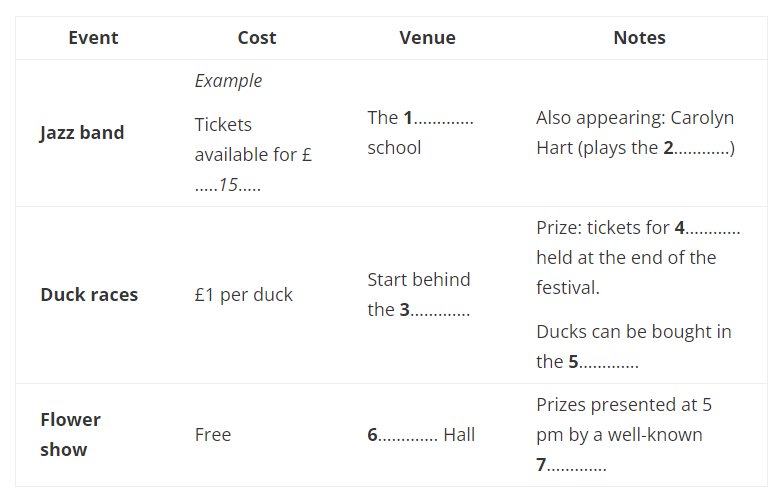
1. 1
2. 2
3. 3
4. 4
5. 5
6. 6
7. 7
Questions
7 – 10
Who is each play suitable for? Choose the correct letter, A, B or C.
SECTION 2
Questions
11 – 15
What does the speaker say about each of the following collections? Choose SIX answers from the box and match the correct letter, A-G.
Questions
16 – 20
Label the plan below. Write the correct letter, A-H.

Facilities railway station car park: 16
cinema: 17
indoor market: 18
library: 19
nature reserve: 20
SECTION 3
Questions
21 – 26
Choose TWO letters, A-E. Which TWO characteristics were shared by the subjects of Joanna’s psychology study?
- 1718
- AThey had all won prizes for their music.BThey had all made music recordings.CThey were all under 27 years old.DThey had all toured internationally.EThey all played a string instrument.
Questions
27 – 30
Choose TWO letters, A-E. Which TWO points does Joanna make about her use of telephone interviews?
- 1920
- AIt meant rich data could be collected.BIt allowed the involvement of top performers.CIt led to a stressful atmosphere at times.DIt meant interview times had to be limited.EIt caused some technical problems.
Choose TWO letters, A-E. Which TWO topics did Joanna originally intend to investigate in her research?
- 2122
- Aregulations concerning concert dressBaudience reactions to the dress of performersCchanges in performer attitudes to concert dressDhow choice of dress relates to performer rolesElinks between musical instrument and dress choice
Choose the correct letter, A, B or C.
- 23
Joanna concentrated on women performers because
- A
women are more influenced by fashion.
Bwomen’s dress has led to more controversy.
Cwomen’s code of dress is less strict than men’s.
- 24
Mike Frost’s article suggests that in popular music, women’s dress is affected by
- A
their wish to be taken seriously.
Btheir tendency to copy each other.
Ctheir reaction to the masculine nature of the music.
- 25
What did Joanna’s subjects say about the audience at a performance?
- A
The musicians’ choice of clothing is linked to respect for the audience.
BThe clothing should not distract the audience from the music.
CThe audience should make the effort to dress appropriately.
- 26
According to the speakers, musicians could learn from sports scientists about
- A
the importance of clothing for physical freedom.
Bthe part played by clothing in improving performance.
Cthe way clothing may protect against physical injury.
SECTION 4
Questions
31 – 40
Complete the notes below. Write ONE WORD ONLY for each answer.
ETHNOGRAPHY IN BUSINESS Ethnography: research which explores human cultures It can be used in business: ● to investigate customer needs and 31
● to help companies develop new designs Examples of ethnographic research in business Kitchen equipment ● Researchers found that cooks could not easily see the 32
in measuring cups. Cell phones ● In Uganda, customers paid to use the cell phones of entrepreneurs. ● These customers wanted to check the 33
used. Computer companies ● There was a need to develop 34
to improve communication between system administrators and colleagues. Hospitals ● Nurses needed to access information about 35
in different parts of the hospital. Airlines ● Respondents recorded information about their 36
while travelling. Principles of ethnographic research in business ● The researcher does not start off with a hypothesis. ● Participants may be selected by criteria such as age, 37
or product used. ● The participants must feel 38
about taking part in the research. ● There is usually direct 39
of the participants. ● The interview is guided by the participant. ● A lot of time is needed for the 40
of the data. ● Researchers look for a meaningful pattern in the data.
SECTION 1
Questions
1 – 7Complete the table below. Write ONE WORD AND/OR A NUMBER for each answer
Giải thích đáp án
ROB: Good morning. Stretton Festival box office. How can I help you?
MELANIE: Oh, hello. My family and I are on holiday on the area, and we’ve seen some posters about the festival this week. Could you tell me about some of the events, please?
ROB: Of course.
MELANIE: First of all, are there still tickets available for the jazz band on Saturday?
ROB: There are, but only (Example) £18 . The £12 seats have all been sold.
MELANIE: OK. And the venue is the school, isn’t it?
ROB: Yes, that’s right, (Q1) the secondary school (trường cấp hai). Make sure you don’t go to the primary school by mistake! And there’s an additional performer who isn’t mentioned on the posters – Carolyn Hart is going to play with the band.
MELANIE: Oh, I think I’ve heard her on the radio. Doesn’t she play the oboe, or flute or something?
ROB: (Q2) Yes the flute (Đúng là sáo). She usually plays with symphony orchestras, and apparently this is her first time with a jazz band.
MELANIE: Well, I’d certainly like to hear her. Then the next thing I want to ask about is the duck races – I saw a poster beside a river. What are they, exactly?
ROB: Well, you buy a yellow plastic duck – or as many as you like – they’re a pound each. And you write your name on each one. There’ll be several races, depending on the number of ducks taking part. And John Stevens, a champion swimmer who lives locally, is going to start the races. (Q3) All the ducks will be launched into the river at the back of (= behind) the cinema (Tất cả vịt sẽ được thả xuống sông ở phía sau rạp chiếu phim), then they’ll float along the river for 500 metres, as far as the railway bridge.
MELANIE: And are there any prizes?
ROB: Yes, (Q4) the first duck in each race to arrive at the finishing line wins its owner free tickets for the concert on the last night of the festival. (trong mỗi cuộc đua, chú vịt đầu tiên về đích sẽ giành được vé miễn phí cho chủ nhân của nó đến buổi hòa nhạc vào đêm cuối cùng của lễ hội.)
MELANIE: You said you can buy a duck (= ducks can be bought)? I’m sure my children will both want one.
ROB: (Q5) They’re on sale at a stall in the market (Chúng đang được bán tại một quầy hàng trong chợ). You can’t miss it – it’s got an enormous sign showing a couple of ducks.
MELANIE: OK. I’ll go there this afternoon. I remember walking past there yesterday. Now could you tell me something about the flower show, please?
ROB: Well, admission is free, and the show is being held in Bythwaite Hall. (chương trình được tổ chức ở Bythwaite Hall)
MELANIE: Sorry, how do you spell that?
ROB: (Q6) B-Y-T-H-W-A-I-T-E. Bythwaite.
MELANIE: Is it easy to find? I’m no very familiar with the town yet.
ROB: Oh, you won’t have any problem. It’s right in the centre of Stretton. It’s the only old building in the town, so it’s easy to recognise.
MELANIE: I know it. I presume it’s open all day.
ROB: Yes, but if you’d like to see the prizes being awarded for the best flowers, you’ll need to be there at 5 o’clock. (Q7) The prizes are being given by a famous (=well-known) actor, Kevin Shapless (Các giải thưởng đang được trao bởi một diễn viên nổi tiếng, Kevin Shapless). He lives nearby and gets involved in a lot of community events.
MELANIE: Gosh, I’ve seen him on TV. I’ll definitely go to the prize-giving.
ROB: Right.
Questions
8 – 10Who is each play suitable for? Choose the correct letter, A, B or C.
Bạn chưa trả lời câu hỏi này
A The Mystery of Muldoon
Bạn chưa trả lời câu hỏi này
B Fire and Flood
Bạn chưa trả lời câu hỏi này
C Silly Sailor
Giải thích đáp án
MELANIE: I’ve seen a list of plays that are being performed this week, and I’d like to know which are suitable for my children, and which ones my husband and I might go to.
ROB: How old are your children?
MELANIE: Five and seven. What about ‘The Mystery of Muldoon’?
ROB: (Q8) That’s aimed at five to ten-year-olds (= mainly for children). (Chương trình hướng đến trẻ từ 5 đến 10 tuổi)
MELANIE: So if I take my children, I can expect them to enjoy it more than I do?
ROB: I think so. (Q9) If you’d like something for yourself and your husband and leave your children with a babysitter (= mainly for adults), you might like to see ‘Fire and Flood’ (Nếu bạn muốn thứ gì đó cho bản thân và chồng mình và để con cái cho người trông trẻ, bạn có thể xem ‘Lửa và máu’) – it’s about events that really happened in Stretton two hundred years ago, and children might find it rather frightening.
MELANIE: Oh, thanks for the warning. And finally, what about ‘Silly Sailor’?
ROB: That’s a comedy, and (Q10) it’s for young and old (= for people of all ages) (nó dành cho cả trẻ lẫn già). In fact, it won an award in the Stretton Drama Festival a couple of months ago.
MELANIE: OK. Well, goodbye, and thanks for all the information. I’m looking forward to the festival!
ROB: Goodbye.
SECTION 2
Questions
11 – 16What does the speaker say about each of the following collections? Choose SIX answers from the box and match the correct letter, A-G.
Bạn chưa trả lời câu hỏi này
E includes the most popular exhibits in the museum
Bạn chưa trả lời câu hỏi này
D includes some items given by the artists
Bạn chưa trả lời câu hỏi này
G has had some of its contents relocated
Bạn chưa trả lời câu hỏi này
B was recently publicised in the media
Bạn chưa trả lời câu hỏi này
C includes some items given by members of the public
Bạn chưa trả lời câu hỏi này
A was given by one person
Giải thích đáp án
Good morning, and welcome to the museum – one with a remarkable range of exhibits, which I’m sure you’ll enjoy. My name’s Greg, and I’ll tell you about the various collections as we go round. But before we go, let me just give you a taste of what we have here.
Well, for one thing, we have a fine collection of twentieth and twenty-first century paintings, many by very well-known artists. I’m sure you’ll recognise several of the paintings. (Q11) This is the gallery that attracts the largest number of visitors (= the most popular exhibits) (Đây là triển lãm hút khách nhất), so it’s best to go in early in the day, before the crowds arrive.
There are nineteenth-century paintings. The museum was opened in the middle of that century, and (Q12) several of the artists each donated one work (= given by the artists) (có vài nghệ sĩ đã đóng góp vào đó mỗi người một tác phẩm) – to get the museum started, as it were. So they’re of special interest to us – we feel closer to them than to other works.
The sculpture gallery has a number of fine exhibits, but I’m afraid it’s currently closed for refurbishment. You’ll need to come back next year to see it properly, but (Q13) a number of the sculptures have been moved to other parts of the museum (= relocated). (một số lượng tác phẩm điêu khắc đã được chuyển đến nơi khác trong bảo tàng). (Q14) ‘Around the world’ is a temporary exhibition – you’ve probably seen something about it on TV or in the newspapers (= publicised in the media) (‘Vòng quanh thế giới’ là một cuộc triển lãm tạm thời – bạn có thể đã thấy điều gì đó về nó trên TV hoặc trên báo) . It’s created a great deal of interest, because it presents objects from every continent and many countries, and provides information about their social context – why they were made, who for, and so on.
Then there’s the collection of coins. This is what you might call a focused, specialist collection, because all the coins come from this country, and were produced between two thousand and a thousand years ago. (Q15) And many of them were discovered by ordinary people (= members of the public) digging their gardens and donated to the museum! (Và phần lớn được phát hiện bởi những người dân bình thường khi họ đào vườn và tặng chúng cho bảo tàng!) (Q16) All our porcelain and glass were left to the museum by its founder (= given by one person) (Tất cả đồ sứ và thủy tinh của chúng tôi đã được người sáng chế để lại cho bảo tàng), when he died in 1878. And in the terms of his will, we’re not allowed to add anything to that collection: he believed it was perfect in itself, and we don’t see any reason to disagree!
Questions
17 – 20Label the plan below. Write the correct letter, A-H.
Giải thích đáp án
OK, that was something about the collections, and now here’s some more practical information, in case you need it. Most of the museum facilities are downstairs, in the basement, so you go down the stairs here. When you reach the bottom of the stairs, you’ll find yourself in a sitting area, with comfortable chairs and sofas where you can have a rest before continuing your exploration of the museum.
We have a very good restaurant, which serves excellent food all day, in a relaxing atmosphere. (Q17) To reach it, when you get to the bottom of the stairs, go straight ahead to the far side of the sitting area, then turn right into the corridor. You’ll see the door on the restaurant facing you (Để đến được đó, khi bạn đến chân cầu thang, hãy đi thẳng tới phía bên kia của khu vực chỗ ngồi, sau đó rẽ phải vào hành lang. Bạn sẽ thấy cánh cửa nhà hàng phía đối diện bạn).
If you just want a snack, or if you’d like to eat somewhere with facilities for children, we also have a café. (Q18) When you reach the bottom of the stairs, you’ll need to go straight ahead, turn right into the corridor, and the café is immediately on the right. (Khi đến chân cầu thang, bạn cần đi thẳng về phía trước, rẽ phải vào hành lang và quán cà phê nằm ngay bên phải.)
And talking about children, (Q19) there are baby-changing facilities downstairs: cross the sitting area, continue straight ahead along the corridor on the left and you and your body will find the facilities on the left-hand side. (có một phòng thay đồ cho em bé với đầy đủ tiện nghi ở tầng dưới: băng qua khu vực ngồi, tiếp tục đi thẳng dọc theo hành lang phía bên trái và bạn sẽ tìm thấy nó ở bên tay trái)
(Q20) The cloakroom where you should leave coats, umbrellas and any large bags, is on the left hand side of the sitting area. It’s through the last door before you come to the corridor. (Phòng thay đồ là nơi bạn để áo khoác, ô và bất kỳ chiếc túi to nào, nằm ở phía bên trái của khu vực tiếp khách. Đó là cánh cửa cuối cùng trước khi bạn đến hành lang.)
There are toilets on every floor, but in the basement they’re the first rooms on the left when you get down there.
OK, now if you’ve got anything to leave in the cloakroom, please do that now, and then we’ll start our tour.
SECTION 3
Questions
21 – 22Choose TWO letters, A-E. Which TWO characteristics were shared by the subjects of Joanna’s psychology study?
- 2122
- AThey had all won prizes for their music.
Bạn chọn thiếu đáp án này
BThey had all made music recordings.CThey were all under 27 years old.Bạn chọn thiếu đáp án này
DThey had all toured internationally.EThey all played a string instrument.
Giải thích đáp án
CÂU HỎI | TRANSCRIPT & GIẢI THÍCH |
Q21 – 22. Which TWO characteristics were shared by the subjects of Joanna’s psychology study? A. They had all won prizes for their music. B. They had all made music recordings. C. They were all under 27 years old. D. They had all toured internationally. E. They all played a string instrument. | JOANNA nói rằng: “They were all very highly regarded in the music world and they’d done quite extensive tours in different continents (họ đã đi lưu diễn khá nhiều nơi ở các lục địa khác nhau), and quite a few had won prizes and competitions as well.”
“Yes, between 25 and 29 – the mean was 27.8. I wasn’t specifically looking for artists who’d produced recordings, but this is something that’s just taken for granted these days, and they all had.” (Tôi không đặc biệt tìm kiếm những nghệ sĩ đã sản xuất các bản thu âm, nhưng ngày nay, đó là một điều hiển nhiên và tất cả họ đều sở hữu) |
DỊCH NGHĨA | |
Q21 – 22. Các đối tượng của nghiên cứu tâm lý học Joanna có chung HAI đặc điểm nào? A. Họ đều đã giành được giải thưởng cho âm nhạc B. Họ đều đã có những bản thu âm nhạc. C. Họ đều dưới 27 tuổi. D. Họ đều đã đi lưu diễn quốc tế. E. Họ đều chơi một nhạc cụ dây. |
Questions
23 – 24Choose TWO letters, A-E. Which TWO points does Joanna make about her use of telephone interviews?
- 2324
Bạn chọn thiếu đáp án này
AIt meant rich data could be collected.Bạn chọn thiếu đáp án này
BIt allowed the involvement of top performers.CIt led to a stressful atmosphere at times.DIt meant interview times had to be limited.EIt caused some technical problems.
Giải thích đáp án
CÂU HỎI | TRANSCRIPT & GIẢI THÍCH |
Q23 – 24. Which TWO points does Joanna make about her use of telephone interviews? A. It meant rich data could be collected. B. It allowed the involvement of top performers. C. It led to a stressful atmosphere at times. D. It meant interview times had to be limited. E. It caused some technical problems. | JOANNA: Yes. I realised if I was going to interview leading musicians it’s only be possible over the phone because they’re so busy. (Tôi nhận ra rằng nếu tôi định phỏng vấn các nhạc sĩ hàng đầu thì chỉ có thể qua điện thoại vì họ rất bận) I recorded them using a telephone recording adaptor. I’d been worried about the quality, but it worked out all right. I managed at least a 30-minute interview with each subject, sometimes longer.
SUPERVISOR: Did doing it on the phone make it more stressful?
JOANNA: I’d thought it might … it was all quite informal though and in fact they seemed very keen to talk. And I don’t think using the phone meant I got less rich data rather the opposite in fact. (Và tôi không nghĩ rằng sử dụng điện thoại có nghĩa là tôi nhận được ít dữ liệu hơn, thực tế lại là ngược lại)
|
DỊCH NGHĨA | |
Q23 – 24. Joanna đưa ra HAI điểm nào về việc sử dụng các cuộc phỏng vấn qua điện thoại? A. Nó có nghĩa là ta có thể thu thập được nguồn dữ liệu phong phú, dồi dào B. Nó cho phép sự tham gia của những người biểu diễn hàng đầu C. Đôi khi nó đã dẫn đến một bầu không khí căng thẳng. D. Nó có nghĩa là thời gian phỏng vấn phải được giới hạn. E. Nó gây ra một số vấn đề kỹ thuật. |
Questions
25 – 26Choose TWO letters, A-E. Which TWO topics did Joanna originally intend to investigate in her research?
- 2526
- Aregulations concerning concert dress
Bạn chọn thiếu đáp án này
Baudience reactions to the dress of performersCchanges in performer attitudes to concert dressDhow choice of dress relates to performer rolesBạn chọn thiếu đáp án này
Elinks between musical instrument and dress choice
Giải thích đáp án
CÂU HỎI | TRANSCRIPT & GIẢI THÍCH |
Q25 – 26. Which TWO topics did Joanna originally intend to investigate in her research? A. regulations concerning concert dress B. audience reactions to the dress of performers C. changes in performer attitudes to concert dress D. how choice of dress relates to performer roles E. links between musical instrument and dress choice | JOANNA: That’s right. My research investigated the way players see their role as a musician and how this is linked to the type of clothing they decide to wear. But that focus didn’t emerge immediately. When I started I was more interested in trying to investigate the impact of what was worn on those listening (Khi tôi bắt đầu, tôi quan tâm nhiều hơn đến việc cố gắng tìm ra tác động của trang phục đến người nghe), and also whether someone like a violinist might adopt a different style of clothing from, say, someone playing the flute or the trumpet. (liệu một người như nghệ sĩ vĩ cầm có thể chọn một kiểu quần áo khác với ai đó thổi sáo hay kèn hay không.)
|
DỊCH NGHĨA | |
Q25 – 26. Ban đầu Joanna dự định khảo sát HAI chủ đề nào trong nghiên cứu của mình? A. quy định liên quan đến trang phục buổi hòa nhạc B. phản ứng của khán giả với trang phục của người biểu diễn C. sự thay đổi trong thái độ của người biểu diễn đối với trang phục buổi hòa nhạc D. cách lựa chọn trang phục liên quan đến vai trò của người biểu diễn E. liên kết giữa nhạc cụ và sự lựa chọn trang phục |
Questions
27 – 30Choose the correct letter, A, B or C.
- 27
Joanna concentrated on women performers because
Bạn chưa trả lời câu hỏi này
- A
women are more influenced by fashion.
Bwomen’s dress has led to more controversy.
Cwomen’s code of dress is less strict than men’s.
Giải thích đáp án
CÂU HỎI | TRANSCRIPT & GIẢI THÍCH |
27. Joanna concentrated on women performers because A. women are more influenced by fashion. B. women’s dress has led to more controversy. C. women’s code of dress is less strict than men’s. | I think a lot of the men are very much influenced by fashion, but in social terms the choices they have are more limited … they’d really upset audiences if they strayed away from quite narrow boundaries. (về mặt xã hội, sự lựa chọn của họ bị hạn chế hơn… họ sẽ thực sự làm khán giả khó chịu nếu họ đi lạc ra khỏi những ranh giới hạn hẹp)
|
DỊCH NGHĨA | |
27. Joanna tập trung vào những người biểu diễn là nữ bởi vì A. Phụ nữ bị ảnh hưởng nhiều hơn bởi thời trang. B. Trang phục của phụ nữ dẫn đến nhiều tranh cãi hơn. C. Quy tắc ăn mặc của phụ nữ ít khắt khe hơn so với nam giới. |
- 28
Mike Frost’s article suggests that in popular music, women’s dress is affected by
Bạn chưa trả lời câu hỏi này
- A
their wish to be taken seriously.
Btheir tendency to copy each other.
Ctheir reaction to the masculine nature of the music.
Giải thích đáp án
CÂU HỎI | TRANSCRIPT & GIẢI THÍCH |
28. Mike Frost’s article suggests that in popular music, women’s dress is affected by A. their wish to be taken seriously. B. their tendency to copy each other. C. their reaction to the masculine nature of the music. | He points out that a lot of female singers and musicians in popular music tend to dress down in performances, and wear less feminine clothes, like jeans instead of skirts, and he suggests this is because otherwise they’d just be discounted as trivial. (anh ấy gợi ý điều này bởi vì nếu không thì chúng sẽ chỉ được coi như một thứ tầm thường.)
|
DỊCH NGHĨA | |
28. Bài báo của Mike Frost cho rằng trong các loại nhạc phổ biến, cách ăn mặc của phụ nữ bị ảnh hưởng bởi A. mong muốn là được xem trọng B. xu hướng sao chép lẫn nhau C. phản ứng của họ đối với bản chất nam tính của âm nhạc |
- 29
What did Joanna’s subjects say about the audience at a performance?
Bạn chưa trả lời câu hỏi này
- A
The musicians’ choice of clothing is linked to respect for the audience.
BThe clothing should not distract the audience from the music.
CThe audience should make the effort to dress appropriately.
Giải thích đáp án
CÂU HỎI | TRANSCRIPT & GIẢI THÍCH |
29. What did Joanna’s subjects say about the audience at a performance? A. The musicians’ choice of clothing is linked to respect for the audience. B. The clothing should not distract the audience from the music. C. The audience should make the effort to dress appropriately. | The subjects I interviewed felt this was really important. It’s all to do with what we understand by performance as a public event. They believed the audience had certain expectations and it was up to them as performers to fulfill these expectations to show a kind of esteem … (Họ tin rằng khán giả có những kỳ vọng nhất định và việc thực hiện những kỳ vọng này là tùy thuộc vào cách mà người biểu diễn thể hiện sự quý trọng…)
|
DỊCH NGHĨA | |
29. Đối tượng của Joanna nói gì về khán giả tại một buổi biểu diễn? A. Lựa chọn trang phục của các nhạc sĩ có liên quan đến sự tôn trọng khán giả B. Trang phục không nên làm khán giả phân tâm khỏi âm nhạc C. Khán giả nên cố gắng ăn mặc sao cho phù hợp |
- 30
According to the speakers, musicians could learn from sports scientists about
Bạn chưa trả lời câu hỏi này
- A
the importance of clothing for physical freedom.
Bthe part played by clothing in improving performance.
Cthe way clothing may protect against physical injury.
Giải thích đáp án
CÂU HỎI | TRANSCRIPT & GIẢI THÍCH |
30. According to the speakers, musicians could learn from sports scientists about A. the importance of clothing for physical freedom. B. the part played by clothing in improving performance. C. the way clothing may protect against physical injury. | Musicians are quite vulnerable physically, aren’t they, because the movements they carry out are very intensive and repetitive, so I’d imagine some features of sports clothing could safeguard the players from the potentially dangerous effects of this sort of thing. (Tôi tưởng tượng một số tính năng của quần áo thể thao có thể bảo vệ người chơi khỏi những tác động nguy hiểm tiềm ẩn.)
|
DỊCH NGHĨA | |
30. Theo các diễn giả, các nhạc sĩ có thể học hỏi từ các nhà khoa học thể thao về A. tầm quan trọng của quần áo đối với sự tự do về thể chất. B. vai trò của quần áo trong việc cải thiện phần trình diễn. C. cách mà quần áo bảo vệ để tránh khỏi chấn thương thể chất. |
SECTION 4
Questions
31 – 40Complete the notes below. Write ONE WORD ONLY for each answer.
Giải thích đáp án
As we saw in the last lecture, a major cause of climate change is the rapid rise in the level of carbon dioxide in the atmosphere over the last century. If we could reduce the amount of CO2, perhaps the rate of climate change could also be slowed down. One potential method involves enhancing the role of the soil that plants grow in, with regard to absorbing CO2. Rattan Lal, a soil scientist from Ohio Stage University, in the USA, claims that the world’s agricultural soils could potentially absorb 13 per cent of the carbon dioxide in the atmosphere – the equivalent of the amount released in the last 3o years. And research is going on into how this might be achieved.
Lal first came to the idea that soil might be valuable in this way not through an interest in climate change, but rather out of concern for the land itself and the people dependent on it. Carbon-rich soil is dark, crumbly and fertile, and retains some water. But (Q31) erosion can occur if soil is dry (có thể xảy ra xói mòn nếu đất khô hạn), which is a likely effect if it contains inadequate amounts of carbon. Erosion is of course bad for people trying to grow crops or breed animals on that terrain. In the 1970s and ‘80s, (Q32) Lal was studying soils in Africa so devoid of organic matter that the ground had become extremely hard, like cement (Lal đã nghiên cứu thấy rằng đất ở châu Phi thiếu chất hữu cơ đến nỗi mặt đất trở nên cực kỳ cứng, như xi măng vậy). There he met a pioneer in the study of global warming, who suggested that carbon from the soil had moved into the atmosphere. This is now looking increasingly likely.
Let me explain. For millions of years, carbon dioxide levels in the atmosphere have been regulated, in part, by a natural partnership between plants and microbes – tiny organisms in the soil. (Q33) Plants absorb CO2 from the air and transform it into (= plants turn CO2 from the air into) sugars and other carbon-based substances (Thực vật hấp thụ CO2 từ không khí và chuyển nó thành đường và các chất có nguồn gốc cacbon khác). While a proportion of these carbon products remain in the plant, (Q34) some transfer from (= some CO2 moves from) the roots to fungi and soil microbes (= microbes in the soil) (một số chuyển từ rễ cây sang nấm và vi khuẩn trong đất), which store the carbon in the soil.
The invention of agriculture some 10,000 years ago disrupted these ancient soil-building processes and led to the loss of carbon from the soil. When humans started draining the natural topsoil, and ploughing it up for planting, they exposed the buried carbon to oxygen. This created carbon dioxide and released it into the air. And in some places, grazing by domesticated animals has removed all vegetation, releasing carbon into the air. Tons of carbon have been stripped from the world’s soils – where it’s needed – and pumped into the atmosphere.
So what can be done? Researchers are now coming up with evidence that even modest changes to farming can significantly help to reduce the amount of carbon in the atmosphere.
Some growers have already started using an approach known as regenerative agriculture. (Q35) This aims to boost the fertility of soil (= soil remains fertile) and keep it moist through established practices (Điều này nhằm mục đích tăng cường độ phì nhiêu của đất và giữ ẩm thông qua các hoạt động đã được thiết lập). These include keeping fields planted all year round, (Q36) and increasing the variety of plants being grown (và tăng số lượng cây trồng). Strategies like these can significantly increase the amount of carbon stored in the soil, so agricultural researchers are now building a case for their use in combating climate change.
One American investigation into the potential for storing CO2 on agricultural lands is taking place in California. Soil scientist Whendee Silver of the University of California, Berkeley, is conducting (= taking place) (Q37) a first-of-its-kind study on a large cattle farm in the state (nghiên cứu đầu tiên về loại hình này trên một trang trại gia súc lớn ở bang). She and her students are testing the effects on carbon storage of the compost that is created from waste – both agricultural (= waste from agriculture), including manure and cornstalks, and (Q38) waste produced in gardens (chất thải trong vườn), such as leaves, branches, and lawn trimmings.
In Australia, soil ecologist Christine Jones is testing another promising soil-enrichment strategy. Jones and 12 farmers are (Q39) working to build up soil carbon (= to increase soil carbon) by cultivating grasses that stay green (= are always green) all year round (tích lũy carbon trong đất bằng cách trồng những loại cỏ xanh quanh năm). Like composting, the approach has already been proved experimentally; Jones now hopes to show that it can be applied on working farms and that the resulting carbon capture can be accurately measured.
It’s hoped in the future that projects such as these will demonstrate the role that farmers and other land managers can play in reducing the harmful effects of greenhouse gases. For example, in countries like the United States, where most farming operations use large applications of fertiliser, changing such long-standing habits will require a change of system. Rattan Lal argues that (Q40) farmers should receive payment not just for the corn or beef they produce but also for the carbon they can store (= for carbon storage, as well as their produce) in their soil. (người nông dân phải nhận được khoản tiền không chỉ từ các sản phẩm ngô hay thịt bò mà còn từ lượng carbon mà họ có thể lưu trữ trong đất)
