
IELTS Handbook 11 – Test 3
20/10/2024 2024-10-20 1:37IELTS Handbook 11 – Test 3
SECTION 1
Questions
1 – 6
Choose the correct letter, A, B or C.
Choose the correct letter, A, B or C.
- 1
The ‘Family Welcome’ event in the art gallery begins at
- A
10 am.
B10.30 am.
C2 pm.
- 2
The film that is now shown in the ‘Family Welcome’ event is about
- A
sculpture.
Bpainting.
Cceramics.
- 3
When do most of the free concerts take place?
- A
in the morning
Bat lunchtime
Cin the evening
- 4
Where will the 4 pm concert of Latin American music take place?
- A
in a museum
Bin a theatre
Cin a library
- 5
The boat race begins at
- A
Summer Pool.
BCharlesworth Bridge.
COfford Marina.
- 6
One of the boat race teams
- A
won a regional competition earlier this year.
Bhas represented the region in a national competition.
Chas won several regional competitions.
Questions
7 – 10
Complete the sentences below. Write ONE WORD ONLY for each answer.
Paxton Nature Reserve Paxton is a good place for seeing rare 7
all year round. This is a particularly good time for seeing certain unusual 8
. Visitors will be able to learn about 9
and then collect some. Part of the 10
has been made suitable for swimming.
SECTION 2
Questions
11 – 15
Choose the correct letter, A, B or C.
Changes in Barford over the last 50 years
- 11
In Shona’s opinion, why do fewer people use buses in Barford these days?
- A
The buses are old and uncomfortable.
BFares have gone up too much.
CThere are not so many bus routes.
- 12
What change in the road network is known to have benefited the town most?
- A
the construction of a bypass
Bthe development of cycle paths
Cthe banning of cars from certain streets
- 13
What is the problem affecting shopping in the town centre?
- A
lack of parking spaces
Black of major retailers
Clack of restaurants and cafés
- 14
What does Shona say about medical facilities in Barford?
- A
There is no hospital.
BNew medical practices are planned.
CThe number of dentists is too low.
- 15
The largest number of people are employed in
- A
manufacturing.
Bservices.
Ceducation.
Questions
16 – 20
What is planned for each of the following facilities? Choose FIVE answers from the box and write the correct letter, A-G.
Plans
A It will move to a new location.
B It will have its opening hours extended.
C It will be refurbished.
D It will be used for a different purpose.
E It will have its opening hours reduced.
F It will have new management.
G It will be expanded.
Facilities railway station car park: 16
cinema: 17
indoor market: 18
library: 19
nature reserve: 20
SECTION 3
Questions
21 – 26
Complete the table below. Write ONE WORD ONLY for each answer.
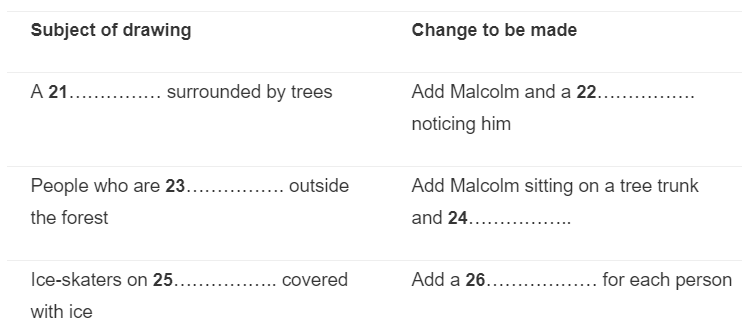
21. 21
22. 22
23. 23
24. 24
25. 25
26. 26
Questions
27 – 30
Who is going to write each of the following parts of the report? Choose the correct letter, A-D.
SECTION 4
Questions
31 – 40
Complete the notes below. Write ONE WORD ONLY for each answer.
ETHNOGRAPHY IN BUSINESS Ethnography: research which explores human cultures It can be used in business: ● to investigate customer needs and 31
● to help companies develop new designs Examples of ethnographic research in business Kitchen equipment ● Researchers found that cooks could not easily see the 32
in measuring cups. Cell phones ● In Uganda, customers paid to use the cell phones of entrepreneurs. ● These customers wanted to check the 33
used. Computer companies ● There was a need to develop 34
to improve communication between system administrators and colleagues. Hospitals ● Nurses needed to access information about 35
in different parts of the hospital. Airlines ● Respondents recorded information about their 36
while travelling. Principles of ethnographic research in business ● The researcher does not start off with a hypothesis. ● Participants may be selected by criteria such as age, 37
or product used. ● The participants must feel 38
about taking part in the research. ● There is usually direct 39
of the participants. ● The interview is guided by the participant. ● A lot of time is needed for the 40
of the data. ● Researchers look for a meaningful pattern in the data.
SECTION 1
Questions
1 – 6Choose the correct letter, A, B or C.
Choose the correct letter, A, B or C.
- 1
The ‘Family Welcome’ event in the art gallery begins at
- A
10 am.
B10.30 am.
C2 pm.
Giải thích đáp án
CÂU HỎI | TRANSCRIPT & GIẢI THÍCH |
1. The ‘Family Welcome’ event in the art gallery begins at A. 10 am. B. 10.30 am. C. 2 pm. | The gallery opens at 10, and the ‘Family Welcome’ event runs from 10.30 until 2 o’clock (sự kiện ‘Chào đón gia đình’ diễn ra từ 10:30 sáng đến 2 giờ chiều) |
DỊCH NGHĨA | |
1. Sự kiện ‘Chào đón gia đình’ tại triển lãm nghệ thuật bắt đầu lúc A. 10 giờ sáng. B. 10:30 sáng. C. 2 giờ chiều. |
- 2
The film that is now shown in the ‘Family Welcome’ event is about
Bạn chưa trả lời câu hỏi này
- A
sculpture.
Bpainting.
Cceramics.
Giải thích đáp án
CÂU HỎI | TRANSCRIPT & GIẢI THÍCH |
2. The film that is now shown in the ‘Family Welcome’ event is about A. sculpture. B. painting. C. ceramics. | And several times during the day, they’re going to show a short film that the gallery has produced. It demonstrates how ceramics are made (họ sẽ chiếu một đoạn phim ngắn của triển lãm. Nó cho thấy cách người ta làm gốm sứ), and there’ll be equipment and materials for children to have a go themselves. |
DỊCH NGHĨA | |
2. Bộ phim hiện được chiếu trong sự kiện ‘Chào đón gia đình’ nói về A. tác phẩm điêu khắc. B. bức tranh C. gốm sứ |
- 3
When do most of the free concerts take place?
Bạn chưa trả lời câu hỏi này
- A
in the morning
Bat lunchtime
Cin the evening
Giải thích đáp án
CÂU HỎI | TRANSCRIPT & GIẢI THÍCH |
3. When do most of the free concerts take place? A. in the morning B. at lunchtime C. in the evening | Well there are several free concerts taking place at different times – one or two in the morning, the majority at lunchtime (đa số vào giờ ăn trưa), and a couple in the evening. |
DỊCH NGHĨA | |
3. Hầu hết các buổi hòa nhạc miễn phí diễn ra khi nào? A. vào buổi sáng B. vào giờ ăn trưa C. vào buổi tối |
- 4
Where will the 4 pm concert of Latin American music take place?
Bạn chưa trả lời câu hỏi này
- A
in a museum
Bin a theatre
Cin a library
Giải thích đáp án
CÂU HỎI | TRANSCRIPT & GIẢI THÍCH |
4. Where will the 4 pm concert of Latin American music take place? A. in a museum B. in a theatre C. in a library | They’re performing in the central library at 1 o’clock, then at 4 it’s in the City Museum (sau đó lúc 4 giờ ở Bảo tàng Thành phố), and in the evening, at 7.30, there’s a longer concert, in the theatre.
|
DỊCH NGHĨA | |
4. Buổi hòa nhạc Mỹ La Tinh vào lúc 4 giờ chiều sẽ diễn ra ở đâu? A. trong viện bảo tàng B. trong một nhà hát C. trong một thư viện |
- 5
The boat race begins at
Bạn chưa trả lời câu hỏi này
- A
Summer Pool.
BCharlesworth Bridge.
COfford Marina.
Giải thích đáp án
CÂU HỎI | TRANSCRIPT & GIẢI THÍCH |
5. The boat race begins at A. Summer Pool. B. Charlesworth Bridge. C. Offord Marina. | The race starts at Offord Marina (Cuộc đua xuất phát từ bến du thuyền Offord), to the north of Burnham, and goes as far as Summer Pool. |
DỊCH NGHĨA | |
5. Cuộc đua thuyền xuất phát từ A. Bể bơi mùa hè. B. Cầu Charlesworth C. Bến du thuyền Offord.
|
- 6
One of the boat race teams
Bạn chưa trả lời câu hỏi này
- A
won a regional competition earlier this year.
Bhas represented the region in a national competition.
Chas won several regional competitions.
Giải thích đáp án
CÂU HỎI | TRANSCRIPT & GIẢI THÍCH |
6. One of the boat race teams A. won a regional competition earlier this year. B. has represented the region in a national competition. C. has won several regional competitions. | One of them came first in the West of England regional championship in May this year (Một trong số họ đã về nhất ở giải vô địch khu vực miền Tây nước Anh vào tháng 5 năm nay) – it was the first time a team from Burnham has won. |
DỊCH NGHĨA | |
6. Một trong những đội đua thuyền A. đã giành chiến thắng trong một cuộc thi khu vực vào đầu năm nay. B. đã đại diện cho khu vực trong một cuộc thi cấp quốc gia. C. đã giành chiến thắng trong một số cuộc thi khu vực. |
Questions
7 – 10Complete the sentences below. Write ONE WORD ONLY for each answer.
Giải thích đáp án
SUE: Now I’ve heard something about Paxton Nature Reserve. (Q7) It’s a good place for spotting unusual birds, isn’t it? (Đó có phải là một nơi lý tưởng để ngắm những loài chim hiếm không?)
MARTIN: That’s right – throughout the year (Đúng vậy – trong suốt cả năm) There is a lake there, as well as a river, and they provide a very attractive habitat. So it’s a good idea to bring binoculars if you have them. (Q8) And just at the moment you can see various flowers that are pretty unusual (Và ngay tại thời điểm này, bạn có thể nhìn thấy nhiều loài hoa khác nhau, chúng đều khá hiếm) – the soil at Paxton isn’t very common. They’re looking good right now.
SUE: Right. My husband will be particularly interested in that.
MARTIN: (Q9) And there’s going to be a talk and slide show about (= learn about) mushrooms – and you’ll be able to go out and pick some afterwards and study the different varieties. (Và sẽ có một cuộc thảo luận và trình chiếu hình ảnh về nấm – và bạn sẽ có thể ra ngoài sau đó hái một ít và nghiên cứu các loại nấm khác nhau)
SUE: Uhuh. And is it possible for children to swim in the river? (Và liệu trẻ em có thể bơi ở sông không?)
MARTIN: (Q10) Yes. Part of it has been fenced off to make it safe for children to swim in (Có. Một phần sông đã được rào lại để tạo sự an toàn cho trẻ em khi bơi) . It’s very shallow, and there’s a lifeguard on duty whenever it’s open. The lake is too deep, so swimming isn’t allowed there.
SUE: OK, we must remember to bring their swimming things, in case we go to Paxton. How long does it take to get there by car from Burnham?
MARTIN: About 20 minutes, but parking is very limited, so it’s usually much easier to go by bus – and it takes about the same time.
SUE: Right. Well. I’ll discuss the options with the rest of the family. Thanks very much for all your help.
MARTIN: You’re welcome.
SUE: Goodbye.
MARTIN: Bye.
SECTION 2
Questions
11 – 15Choose the correct letter, A, B or C.
Changes in Barford over the last 50 years
- 11
In Shona’s opinion, why do fewer people use buses in Barford these days?
Bạn chưa trả lời câu hỏi này
- A
The buses are old and uncomfortable.
BFares have gone up too much.
CThere are not so many bus routes.
Giải thích đáp án
CÂU HỎI | TRANSCRIPT & GIẢI THÍCH |
11. In Shona’s opinion, why do fewer people use buses in Barford these days? A. The buses are old and uncomfortable. B. Fares have gone up too much. C. There are not so many bus routes. | Most people used them frequently, but not now because the bus companies concentrate on just the routes that attract most passengers. So parts of the town are no longer served by buses (Hầu hết mọi người đều đi xe buýt thường xuyên, nhưng giờ thì không, bởi các công ty xe buýt chỉ tập trung vào các tuyến thu hút nhiều hành khách nhất. Vì vậy, nhiều khu vực của thị trấn không còn được xe buýt phục vụ) |
DỊCH NGHĨA | |
11. Theo ý kiến của Shona, tại sao ngày nay ở Barford có ít người sử dụng xe buýt hơn? A. Những chiếc xe buýt đã cũ và không thoải mái. B. Tiền vé xe đã tăng lên quá cao C. Không có quá nhiều tuyến xe buýt.
|
- 12
What change in the road network is known to have benefited the town most?
Bạn chưa trả lời câu hỏi này
- A
the construction of a bypass
Bthe development of cycle paths
Cthe banning of cars from certain streets
Giải thích đáp án
CÂU HỎI | TRANSCRIPT & GIẢI THÍCH |
12. What change in the road network is known to have benefited the town most? A. the construction of a bypass B. the development of cycle paths C. the banning of cars from certain streets | The new cycle paths separating bikes from cars in most main roads, are being used far more than was expected reducing traffic and improving air quality (Những tuyến đường dành cho xe đạp mới giúp tách xe đạp ra khỏi ô tô ở hầu hết các tuyến đường chính, hiện đang được sử dụng nhiều hơn mong đợi, giúp làm giảm lưu lượng và cải thiện chất lượng không khí) |
DỊCH NGHĨA | |
12. Thay đổi nào trong mạng lưới đường bộ được cho là mang lại lợi ích nhiều nhất cho thị trấn? A. việc xây dựng một đường vòng B. sự phát triển của đường dành cho xe đạp C. cấm ô tô vào một số con phố |
- 13
What is the problem affecting shopping in the town centre?
Bạn chưa trả lời câu hỏi này
- A
lack of parking spaces
Black of major retailers
Clack of restaurants and cafés
Giải thích đáp án
CÂU HỎI | TRANSCRIPT & GIẢI THÍCH |
13. What is the problem affecting shopping in the town centre? A. lack of parking spaces B. lack of major retailers C. lack of restaurants and cafés | Most shops are small independent stores, which is good, but many people prefer to use supermarkets and department stores in nearby large towns, as there are so few well-known chain stores here (nhiều người thích siêu thị và cửa hàng bách hóa ở các thị trấn lớn gần đó, sở dĩ là bởi có quá ít chuỗi cửa hàng nổi tiếng ở đây) |
DỊCH NGHĨA | |
13. Vấn đề ảnh hưởng đến việc mua sắm ở trung tâm thị trấn là gì? A. thiếu chỗ đỗ xe B. thiếu các cửa hàng bán lẻ lớn C. thiếu các nhà hàng và quán cà phê |
- 14
What does Shona say about medical facilities in Barford?
Bạn chưa trả lời câu hỏi này
- A
There is no hospital.
BNew medical practices are planned.
CThe number of dentists is too low.
Giải thích đáp án
CÂU HỎI | TRANSCRIPT & GIẢI THÍCH |
14. What does Shona say about medical facilities in Barford? A. There is no hospital. B. New medical practices are planned. C. The number of dentists is too low. | Our hospital closed 15 years ago (Bệnh viện của chúng tôi đã đóng cửa 15 năm trước), which means journeys to other towns are unavoidable. |
DỊCH NGHĨA | |
14. Shona nói gì về các cơ sở y tế ở Barford? A. Không có bệnh viện. B. Hệ thống phòng khám mới được hoạch định. C. Số lượng nha sĩ quá thấp. |
- 15
The largest number of people are employed in
Bạn chưa trả lời câu hỏi này
- A
manufacturing.
Bservices.
Ceducation.
Giải thích đáp án
CÂU HỎI | TRANSCRIPT & GIẢI THÍCH |
15. The largest number of people are employed in A. manufacturing. B. services. C. education. | The number of schools and colleges has increased making that the main employment sector (Số lượng các trường học và cao đẳng đã tăng lên, trở thành lĩnh vực việc làm chính) |
DỊCH NGHĨA | |
15. Phần lớn người dân ở đây là làm việc trong lĩnh vực A. sản xuất. B. dịch vụ. C. học vấn. |
Questions
16 – 20What is planned for each of the following facilities? Choose FIVE answers from the box and write the correct letter, A-G.
Plans
A It will move to a new location.
B It will have its opening hours extended.
C It will be refurbished.
D It will be used for a different purpose.
E It will have its opening hours reduced.
F It will have new management.
G It will be expanded.
Giải thích đáp án
Now I’ll very quickly outline current plans for some of the town’s facilities, before asking for your comments.
As you’ll know if you regularly use the car park at the railway station, it’s usually full. The railway company applied for permission to replace it with a multi-storey car park, but that was refused. (Q16) Instead, the company has bought some adjoining land, and this will be used to increase the number of parking spaces (= expanded) (Thay vào đó, công ty đã mua một số khu đất liền kề, và sử dụng nó để tăng số lượng chỗ đậu xe)
(Q17) The Grand, the old cinema in the high street will close at the end of the year, and reopen on a different site (= move to a new location) (The Grand, rạp chiếu phim cũ trên phố sẽ đóng cửa vào cuối năm nay và mở cửa trở lại ở một địa điểm khác). You’ve probably seen the building under construction. The plan is to have three screens with fewer seats, rather than just the one large auditorium in the old cinema.
I expect many of you to shop in the indoor market. It’s become more and more shabby-looking, and because of fears about safety, it was threatened with demolition. (Q18) The good news is that it will close for six weeks to be made safe and redecorated (= refurbished), and the improved building will open in July. (Tin tốt là nó sẽ đóng cửa trong sáu tuần để đảm bảo an toàn và sẽ được trang trí lại, và tòa nhà sau khi cải tiến sẽ mở cửa vào tháng Bảy) Lots of people use the library, including school and college students who go there to study. (Q19) The council has managed to secure funding to keep the library open later into the evening, twice a week (= have its opening hours extended) (Hội đồng đã đảm bảo được kinh phí cho thư viện mở cửa muộn hơn vào buổi tối, hai lần một tuần). We would like to enlarge the building in the not-too-distant future, but this is by no means definite.
There’s no limit on access to the nature reserve on the edge of town, and this will continue to be the case. What will change, though, is that (Q20) the council will no longer be in charge of the area. Instead it will become the responsibility of a national body (= have new management) that administers most nature reserves in the country. (Thay vào đó, cơ quan quốc gia sẽ có trách nhiệm quản lý hầu hết các khu bảo tồn thiên nhiên trong nước)
OK, now let me ask you …
SECTION 3
Questions
21 – 26Complete the table below. Write ONE WORD ONLY for each answer.
Giải thích đáp án
JEREMY: Hello, Helen. Sorry I’m late.
HELEN: Hi, Jeremy, no problem. Well we’d better work out where we are on our project, I suppose.
JEREMY: Yeah. I’ve looked at the drawings you’ve done for my story, ‘The Forest’, and I think they’re brilliant – they really create the atmosphere I had in mind when I was writing it.
HELEN: I’m glad you like them.
JEREMY: There are just a few suggestions I’d like to make.
HELEN: Go ahead.
JEREMY: Now, I’m not sure about (Q21) the drawing of the cave – it’s got trees all around it (= surrounded by trees) (bản vẽ của hang động – xung quanh nó có cây cối), which is great, but the drawing’s a bit too static, isn’t it? I think it needs some action.
HELEN: Yes, there’s nothing happening. Perhaps I should add the boy – Malcolm, isn’t it? He would be walking up to it.
JEREMY: (Q22) Yes, let’s have Malcolm in the drawing. And what about putting in a tiger (Đúng vậy, hãy thêm Malcolm vào trong bản vẽ. Thêm một con hổ thì sao nhỉ?) – the one that he makes friends with a bit later? Maybe it could be sitting under a tree washing itself.
HELEN: And the tiger stops in the middle of what it’s doing when it sees Malcolm walking past (= noticing him).
JEREMY: That’s a good idea.
HELEN: OK, I’ll have a go at that.
JEREMY: Then there’s (Q23) the drawing of the crowd of men and women dancing. They’re just outside the forest (bức vẽ một đám đông cả nam và nữ đang khiêu vũ. Họ ở ngay bên ngoài khu rừng), and there’s a lot going on.
HELEN: That’s right, you wanted them to be watching a carnival procession, but I thought it would be too crowded. Do you think it works like this?
JEREMY: Yes, I like what you’ve done. The only thing is, could you add Malcolm to it, without changing what’s already there.
HELEN: What about having him sitting on the tree trunk on the right of the picture?
JEREMY: Yes, that would be fine.
HELEN: And do you want him watching the other people?
JEREMY: No, he’s been left out of all the fun, so (Q24) I’d like him to be crying (Tôi muốn anh ấy đang khóc) – that’ll contrast nicely with the next picture, where he’s laughing at the clowns in the carnival.
HELEN: Right, I’ll do that.
JEREMY: And then the drawing of the people ice skating in the forest.
HELEN: I wasn’t too happy with that one. (Q25) Because they’re supposed to be skating on grass aren’t they? (Bởi vì họ có vẻ đang trượt trên cỏ phải không?)
JEREMY: That’s right, and it’s frozen over (= covered with ice). At the moment it doesn’t look quite right.
HELEN: Mm, I see what you mean. I’ll have another go at that.
JEREMY: And I like the wool hats they’re wearing. (Q26) Maybe you could give each of them (= each person) a scarf as well (Bạn có thể tặng cho mỗi người một chiếc khăn quàng cổ)
HELEN: Yeah, that’s easy enough. They can be streaming out behind the people to suggest they’re skating really fast.
JEREMY: Mm, great. Well that’s all on the drawings.
HELEN: Right. So you’ve finished writing your story and I just need to finish illustrating it, and my story and your drawings are done.
Questions
27 – 30Who is going to write each of the following parts of the report? Choose the correct letter, A-D.
Bạn chưa trả lời câu hỏi này
A Helen only
Bạn chưa trả lời câu hỏi này
C both Helen and Jeremy
Bạn chưa trả lời câu hỏi này
D neither Helen nor Jeremy
Bạn chưa trả lời câu hỏi này
B Jeremy only
Giải thích đáp án
HELEN: So the next thing is to decide what exactly we need to write about in the report that goes with the stories, and how we’re going to divide the work.
JEREMY: Right, Helen.
HELEN: What do you think about including a section on how we planned the project as a whole, Jeremy? That’s probably quite important.
JEREMY: Yeah. Well, (Q27) you’ve had most of the good ideas so far. How do you feel about drafting (= plan) something, then we can go through it together and discuss it? (đến bây giờ bạn đã có hầu hết các ý tưởng hay rồi. Bạn thấy sao về việc tự mình phác thảo rồi chúng ta cùng nhau thảo luận về nó?)
HELEN: OK, that seems reasonable. And I could include something on how we came up with the ideas for our two stories (thêm vào đó cả cách làm thế nào mà chúng ta nghĩ ra ý tưởng cho hai câu chuyện), couldn’t I?
JEREMY: (Q28) Well, I’ve started writing something about that, so why don’t you do the same and we can include the two things. (Chà, tôi đã bắt đầu viết về nó, vậy tại sao bạn không cùng làm như vậy và chúng ta có thể gộp cả hai thứ lại với nhau)
HELEN: Right. So what about our interpretation of the stories? Do we need to write about what we think they show, like the value of helping other people, all that sort of thing?
JEREMY: (Q29) That’s going to come up later, isn’t it? I think everyone in the class is going to read each other’s stories and come up with their own interpretations which we’re going to discuss. (Điều đó sẽ được đưa ra sau, phải không nhỉ? Tôi nghĩ mọi người trong lớp sẽ đọc câu chuyện của nhau và đưa ra cách giải thích của riêng họ về cái mà chúng ta sẽ thảo luận)
HELEN: Oh, I missed that. So it isn’t going to be part of the report at all?
JEREMY: No. But we need to write about the illustrations (= comments on the illustrations), because they’re an essential element of children’s experience of reading the stories. It’s probably easiest for you to write that section, as you know more about drawing than I do.
HELEN: (Q30) Maybe, but I find it quite hard to write about. I’d be happier if you did it. (Sẽ thật tuyệt nếu bạn phụ trách phần này)
JEREMY: OK. So when do you think …
SECTION 4
Questions
31 – 40Complete the notes below. Write ONE WORD ONLY for each answer.
Giải thích đáp án
So what I’m going to talk about to you today is something called Ethnography. This is a type of research aimed at exploring the way human cultures work. It was first developed for use in anthropology, and it’s also been used in sociology and communication studies. So what’s it got to do with business, you may ask. Well, businesses are finding that (Q31) ethnography can offer them deeper insight into the possible needs of customers (= customer needs), either present or future, as well as providing valuable information about their attitudes towards existing products (dân tộc học có thể cho họ cái nhìn sâu sắc hơn về các nhu cầu có thể có của khách hàng, dù ở hiện tại hay tương lai, cũng như cung cấp thông tin có giá trị về thái độ của họ đối với các sản phẩm hiện có) . And ethnography can also help companies to design new products or services that customers really want.
Let’s look at some examples of how ethnographic research works in business. One team of researchers did a project for a company manufacturing kitchen equipment. They watched how cooks used measuring cups to measure out things like sugar and flour. They saw that the cooks had to check and recheck the contents, because (Q32) although the measuring cups had numbers inside them, the cooks couldn’t see these easily (mặc dù các cốc đo lường có những con số bên trong, nhưng người nấu không thể nhìn thấy chúng một cách dễ dàng) . So a new design of cup was developed to overcome this problem, and it was a top seller.
Another team of ethnographic researchers looked at how cell phones were used in Uganda, in Africa. They found that people who didn’t have their own phones could pay to use the phones of local entrepreneurs. Because these customers paid in advance for their calls, (Q33) they were eager to know how much time they’d spent on (= used) the call so far (họ háo hức muốn biết xem mình đã dành bao nhiêu thời gian gọi điện từ trước đến nay) So the phone company designed phones for use globally with this added feature.
Ethnographic research has also been carried out in computer companies. In one company, IT systems administrators were observed for several weeks. It was found that a large amount of their work involved communicating with colleagues (= communication between system administrators and colleagues) in order to solve problems, but that (Q34) they didn’t have a standard way of exchanging information from spreadsheets and so on. So the team came up with an idea (= a need to develop) for software that would help them to do this. (họ không có cách trao đổi thông tin chuẩn từ bảng tính. Vì vậy, nhóm đã nảy ra ý tưởng về phần mềm có thể giúp họ thực hiện điều này)
In another piece of research, a team observed and talked to nurses working in hospitals. (Q35) This led to the recognition that the nurses needed to access the computer records (= nurses needed to access information) of their patients, no matter where they were (Điều này dẫn đến một sự công nhận rằng các y tá cần truy cập vào hồ sơ của bệnh nhân trên máy tính cho dù là họ đang ở đâu.) This led to the development of a portable computer tablet that allowed the nurses to check records in locations throughout the hospital.
Occasionally, research can be done even in environments where the researchers can’t be present. For example, in one project done for an airline, (Q36) respondents used their smartphones to record information during airline trips (= while travelling), in a study aiming at tracking the emotions of passengers during a flight. (người trả lời sử dụng điện thoại thông minh của họ để ghi lại thông tin trong các chuyến đi bằng máy bay, trong một nghiên cứu nhằm theo dõi cảm xúc của hành khách trong suốt chuyến bay.)
So what makes studies like these different from ordinary research? Let’s look at some of the general principles behind ethnographic research in business. First of all, the researcher has to be completely open-minded – he or she hasn’t thought up a hypothesis to be tested, as is the case in other types of research. Instead they wait for the participants in the research to inform them. As far as choosing the participants themselves is concerned, that’s not really all that different from ordinary research – the criteria according to which the participants are chosen may be something as simple as the age bracket they fall into, (Q37) or the researchers may select them according to their income (hoặc các nhà nghiên cứu có thể lựa chọn chúng theo thu nhập của họ), or they might try to find a set of people who all use a particular product, for example. But it’s absolutely crucial to recruit the right people as participants. As well as the criteria I’ve mentioned, (Q38) they have to be comfortable talking about themselves and being watched as they go about their activities (= taking part in the research) (họ phải thoải mái khi nói về bản thân và được giám sát trong các hoạt động của họ) . Actually, most researchers say that people open up pretty easily, maybe because they’re often in their own home or workplace.
So what makes this type of research special is that it’s not just a matter of sending a questionnaire to the participants, instead (Q39) the research is usually based on first-hand (= direct) observation of what they are doing at the time (nghiên cứu thường dựa trên quan sát trực tiếp về những gì họ đang làm vào thời điểm đó). But that doesn’t mean that the researcher never talks to the participants. However, unlike in traditional research, in this case it’s the participant rather than the researchers who decides what direction the interview will follow. This means that there’s less likelihood of the researcher imposing his or her own ideas on the participant.
But after they’ve said goodbye to their participants and got back to their office, the researchers’ work isn’t finished. (Q40) Most researchers estimate that 70 to 80 percent of their time is spent not on the collecting of data but on its analysis – looking at photos, listening to recording and transcribing them and so on (Hầu hết các nhà nghiên cứu ước tính rằng 70 đến 80% thời gian của họ không phải dành cho việc thu thập dữ liệu mà dành cho việc phân tích chúng – xem ảnh, nghe ghi âm và chép lại, v.v.). The researchers may end up with hundreds of pages of notes. And to determine what’s significant, they don’t focus on the sensational things or the unusual things, instead they try to identify a pattern of some sort in all this data, and to discern the meaning behind it. This can result in some compelling insights that can in turn feed back to the whole design process.
