IELTS Handbook 13 – Test 1

Questions

– 7

Complete the table below. Write ONE WORD AND/OR A NUMBER for each answer.

COOKERY CLASSES
Example Andrew is the ……Events…… Manager Rooms Adelphi Room number of people who can sit down to eat: 1


has a gallery suitable for musicians can go out and see the 2


in pots on the terrace terrace has a view of a group of 3


Carlton Room number of people who can sit down to eat: 110 has a 4


View of the lake Options Master of Ceremonies: can give a 5


while people are eating will provide 6


if there are any problems Accommodation: in the hotel rooms or 7


Questions

11 – 16


Choose the correct letter, A, B or C.

Traffic Changes in Granford

  • 1

    Why are changes needed to traffic systems in Granford?

     
  • A

    The number of traffic accidents has risen.

    B

    The amount of traffic on the roads has increased.

    C

    The types of vehicles on the roads have changed.

  • 2

    In a survey, local residents particularly complained about

     
  • A

    dangerous driving by parents.

    B

    pollution from trucks and lorries.

    C

    inconvenience from parked cars.

  • 3

    According to the speaker, one problem with the new regulations will be

     
  • A

    raising money to pay for them.

    B

    finding a way to make people follow them.

    C

    getting the support of the police.

Questions

17 – 18

Label the map below. Match the correct letter, A-I, with Questions 14-20

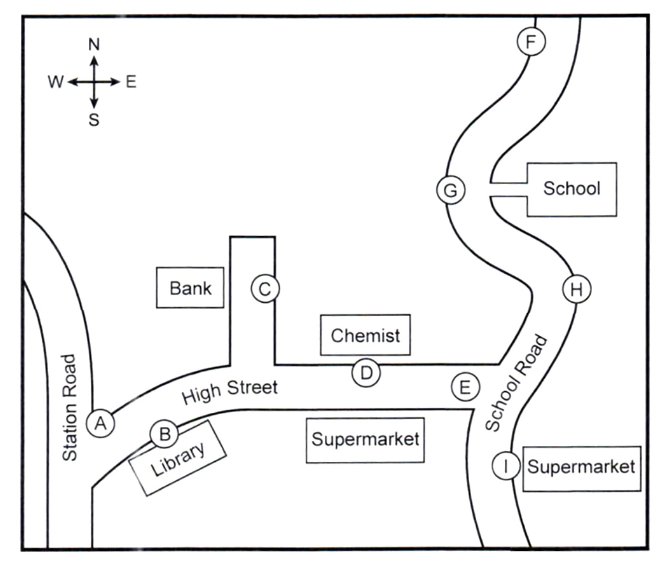
Proposed traffic changes in Granford
4
New traffic lights
Chọn đáp án
5
Pedestrian crossing
Chọn đáp án
6
Parking allowed
Chọn đáp án
7
New ‘No Parking’ sign
Chọn đáp án
8
New disabled parking spaces
Chọn đáp án
9
Widened pavement
Chọn đáp án
10
Lorry loading/unloading restrictions
Chọn đáp án

Questions

21 – 25


Choose the correct letter, A, B or C.

  • 21

    Why is Jack interested in investigating seed germination?

     
  • A

    He may do a module on a related topic later on.

    B

    He wants to have a career in plant science.

    C

    He is thinking of choosing this topic for his dissertation.

  • 22

    Jack and Emma agree the main advantage of their present experiment is that it can be

     
  • A

    described very easily.

    B

    carried out inside the laboratory.

    C

    completed in the time available.

  • 23

    What do they decide to check with their tutor?

     
  • A

    whether their aim is appropriate

    B

    whether anyone else has chosen this topic

    C

    whether the assignment contributes to their final grade

  • 24

    They agree that Graves’ book on seed germination is disappointing because

     
  • A

    it fails to cover recent advances in seed science.

    B

    the content is irrelevant for them.

    C

    its focus is very theoretical.

  • 25

    What does Jack say about the article on seed germination by Lee Hall?

     
  • A

    The diagrams of plant development are useful.

    B

    The analysis of seed germination statistics is thorough.

    C

    The findings on seed germination after fires are surprising.

Questions

26 – 30

Complete the flow-chart below. Choose FIVE answers from the box and write the correct letter, A-H, next to Questions 26-30

Stage in the experiment

Select seeds of different 11


and sizes. ↓ Measure and record the 12


and size of each one. ↓ Decide on the 13


to be used. ↓ Use a different 14


for each seed and label it. ↓ After about 3 weeks, record the plant’s 15


. ↓ Investigate the findings.


Questions

31 – 40


Complete the notes below. Write ONE WORD ONLY for each answer.

Effects of urban environments on animals

ATLIT-YAM – was a village on coast of eastern Mediterranean – thrived until about 7,000 BC – stones homes had a courtyard – had a semicircle of large stones round a 31


– cause of destruction unknown – now under the sea – biggest settlement from the prehistoric period found on the seabed – research carried out into structures, 32


and human remains TRADITIOINAL AUTONOMOUS UNDERWATER VEHICLES (AUVs) – used in the oil industry, e.g. to make 33


– problems: they were expensive and 34


LATEST AUVs – much easier to use, relatively cheap, sophisticated Tests: – Marzamemi, Sicily: found ancient Roman ships carrying architectural elements made of 35


Underwater internet: – 36


is used for short distance communication, acoustic waves for long distance – plans for communication with researchers by satellite – AUV can send data to another AUV that has better 37


, for example Planned research in Gulf of Baratti: – to find out more about wrecks of ancient Roman ships, including . one carrying 38


supplies; tables may have been used for cleaning the 39


. others carrying containers of olive oil or 40


Section 1


Questions

– 10

Complete the table below. Write ONE WORD AND/OR A NUMBER for each answer.

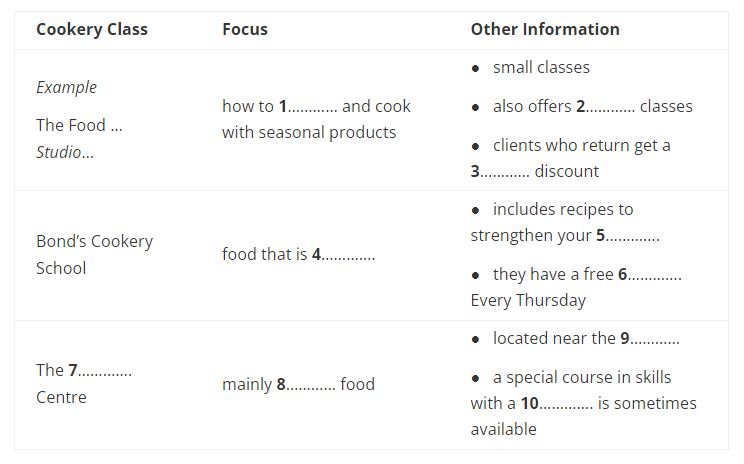
COOKERY CLASSES

Chỗ trống 1: 1
choose
Chỗ trống 2: 2
private
Chỗ trống 3: 3
Chỗ trống 4: 4
healthy
Chỗ trống 5: 5
bones
Chỗ trống 6: 6
lecture
Chỗ trống 7: 7
Arretsa
Chỗ trống 8: 8
vegetarian
Chỗ trống 9: 9
market
Chỗ trống 10: 10
knife

Giải thích đáp án


OFFICIAL:        Hello, Tourist Information Centre, Mike speaking, how can I help you?

WOMAN:         Oh, hi. I wanted to find out about cookery classes. I believe there are some one-day classes for tourists?

OFFICIAL:        Well, they’re open to everyone, but tourists are always welcome. OK, let me give you some details of what’s available. There are several classes. One very popular one is at the Food Studio. 

WOMAN:         OK

OFFICIAL:        (Q1) They focus on seasonal products, and as well as teaching you how to cook them, they also show you how to choose them [Họ tập trung vào các sản phẩm theo mùa cũng như dạy bạn cách nấu, ngoài ra họ cũng chỉ cho bạn cách chọn các sản phẩm đó].

WOMAN:         Right, that sounds good. How big are the classes?

OFFICIAL:        I’m not sure exactly, but they’ll be quite small.

WOMAN:         (Q2) And could I get a private lesson there [Và tôi có thể có một buổi học riêng ở đó không]?

OFFICIAL:        I think so … let me check, yes, they do offer those (= offer private classes). Though in fact most of the people who attend the classes find it’s a nice way of getting to know one another.

WOMAN:         I suppose it must be, yes.

OFFICIAL:        And this company has a special deal for clients where (Q3) they offer a discount of 20% if you return for a further class [họ giảm giá 20% nếu bạn quay lại để học lớp tiếp theo].

WOMAN:         OK. But you said there were several classes?

OFFICIAL:        That’s right. Another one you might be interested in is Bond’s Cookery School. They’re quite new, they just opened six months ago, but I’ve heard good things about them. (Q4) They concentrate on (= focus on) teaching you to prepare healthy food [Họ tập trung vào dạy bạn chuẩn bị đồ ăn lành mạnh], and they have quite a lot of specialist staff.

WOMAN:         So is that food for people on a diet and things like that? I don’t know if I’d be interested in that.

OFFICIAL:        Well, I don’t think they particularly focus on low calorie diets or weight loss. (Q5) It’s more to do with recipes that look at specific needs, like including ingredients that will help build up your bones and make them stronger (= strengthen) [Nó liên quan nhiều hơn đến các công thức nấu ăn mà hướng tới  các nhu cầu cụ thể, chẳng hạn như bao gồm các thành phần giúp xây dựng xương của bạn và làm cho chúng chắc khỏe hơn]that sort of thing.

WOMAN:         I see. Well, I might be interested, I’m not sure. Do they have a website I could check?

OFFICIAL:        Yes, just key in the name of the school – it’ll come up. And if you want to know more about them, (Q6) every Thursday evening they have a lecture at the school. It’s free [mỗi tối thứ năm họ có một bài giảng tại trường. Nó miễn phí] and you don’t need to book or anything, just turn up at 7.30. And that might give you an idea of whether you want to go to an actual class.

—————————

OFFICIAL:        OK, there’s one more place you might be interested in. That’s got a rather strange name, (Q7) it’s called The Arretsa Centre – that’s spelled A-R-R-E-T-S-A [nó được gọi là Trung tâm Arretsa – đánh vần là A-R-R-E-T-S-A].

WOMAN:         OK.

OFFICIAL:        They’ve got a very good reputation. They do a bit of meat and fish cookery but (Q8) they mostly (= mainly) specialise in vegetarian dishes [họ chủ yếu chuyên các món chay].

WOMAN:         Right. That’s certainly an area I’d like to learn more about. I’ve got lots of friends who don’t eat meat. In fact, I think I might have seen that school today. (Q9) Is it just by (= near) the market? [Có phải nó ngay gần chợ không?]

OFFICIAL:        That’s right. So they don’t have any problem getting their ingredients. They’re right next door. And (Q10) they also offer a special two-hour course in how to use a knife. They cover all the different skills [họ cũng cung cấp một khóa học đặc biệt kéo dài hai giờ về cách sử dụng dao, trong đó bao gồm tất cả các kỹ năng khác nhau] – buying them, sharpening, chopping techniques. It gets booked up quickly though so you’d need to check it was available.

WOMAN:         Right, well thank you very much. I’ll go and …


Section 2


Questions

11 – 13
 

Choose the correct letter, A, B or C.

Traffic Changes in Granford

  • 11

    Why are changes needed to traffic systems in Granford?

     
  • Bạn chưa trả lời câu hỏi này

  • A

    The number of traffic accidents has risen.

    B

    The amount of traffic on the roads has increased.

    C

    The types of vehicles on the roads have changed.

Giải thích đáp án


CÂU HỎI 11

TRANSCRIPT & GIẢI THÍCH

Why are changes needed to traffic systems in Granford?

A. The number of traffic accidents has risen.

B.   The amount of traffic on the roads has increased.

C.   The types of vehicles on the roads have changed.

But it’s the overall rise in the volume of traffic of all kinds that’s concerning us [Nhưng chính sự gia tăng tổng thể về lượng tham gia giao thông của mọi loại phương tiện mới là điều khiến chúng tôi lo lắng]

DỊCH NGHĨA

Tại sao cần thay đổi hệ thống giao thông ở Granford?


A. Số vụ tai nạn giao thông đã tăng lên.

B. Lưu lượng giao thông trên các tuyến đường tăng lên.

C. Các loại phương tiện trên đường đã thay đổi.

  • 12

    In a survey, local residents particularly complained about

     
  • Bạn chưa trả lời câu hỏi này

  • A

    dangerous driving by parents.

    B

    pollution from trucks and lorries.

    C

    inconvenience from parked cars.

Giải thích đáp án


CÂU HỎI 12

TRANSCRIPT & GIẢI THÍCH

In a survey, local residents particularly complained about

A.   dangerous driving by parents.

B.   pollution from trucks and lorries.

C.   inconvenience from parked cars.

People were very concerned about the lack of visibility on some roads due to cars parked along the sides of the roads [Người dân rất bức xúc trước tình trạng một số tuyến đường bị che khuất tầm nhìn do ô tô đậu dọc hai bên đường] 

DỊCH NGHĨA

Trong một cuộc khảo sát, cư dân địa phương đặc biệt phàn nàn về


A. cha mẹ lái xe nguy hiểm.

B. ô nhiễm từ các loại xe tải.

C. sự bất tiện từ ô tô dừng đỗ.

  • 13

    According to the speaker, one problem with the new regulations will be

     
  • Bạn chưa trả lời câu hỏi này

  • A

    raising money to pay for them.

    B

    finding a way to make people follow them.

    C

    getting the support of the police.

Giải thích đáp án


CÂU HỎI 13

TRANSCRIPT & GIẢI THÍCH

According to the speaker, one problem with the new regulations will be

A.   raising money to pay for them.

B.   finding a way to make people follow them.

C.   getting the support of the police.

But, of course, it’s no good introducing new regulations if we don’t have a way of making sure that everyone obeys them [Nhưng tất nhiên sẽ không tốt khi đưa ra các quy định mới nếu chúng ta không có cách đảm bảo rằng mọi người đều tuân theo chúng]

DỊCH NGHĨA

Theo diễn giả, một vấn đề về quy định mới sẽ là


A. huy động tiền để chi trả cho chúng. .

B. tìm cách khiến mọi người làm theo chúng. 

C. nhận được sự hỗ trợ của cảnh sát.

Questions

14 – 20

Label the map below. Match the correct letter, A-I, with Questions 14-20

Proposed traffic changes in Granford

14
New traffic lights

Bạn chưa trả lời câu hỏi này

Position E

15
Pedestrian crossing

Bạn chưa trả lời câu hỏi này

Position D

16
Parking allowed

Bạn chưa trả lời câu hỏi này

Position B

17
New ‘No Parking’ sign

Bạn chưa trả lời câu hỏi này

Position G

18
New disabled parking spaces

Bạn chưa trả lời câu hỏi này

Position C

19
Widened pavement

Bạn chưa trả lời câu hỏi này

Position H

20
Lorry loading/unloading restrictions

Bạn chưa trả lời câu hỏi này

Position I

Giải thích đáp án


OK, so this slide shows a map of the central area of Granford, with the High Street in the middle and School Road on the right. Now, we already have a set of traffic lights in the High Street at the junction with Station Road, (Q14) but we’re planning to have another set at the other end, at the School Road junction (=> E[nhưng chúng tôi đang lên kế hoạch để có một dàn cột đèn khác ở đầu bên kia, tại ngã ba Đường School], to regulate the flow or traffic along the High Street.

We’re decided we definitely need a pedestrian crossing. We considered putting this on School Road, just outside the school, but in the end we decided that could lead to a lot of traffic congestion (Q15) so we decided to locate it on the High Street, crossing the road in front of the supermarket (=> D) [chúng tôi quyết định đặt  nó trên Phố High, băng qua con đường đằng trước siêu thị]. That’s a very busy area, so it should help things there.

We’re proposing some changes to parking. (Q16) At present, parking isn’t allowed on the High Street outside the library, but we’re going to change that, and allow parking there (=> B[Hiện tại đỗ xe bị cấm trên Phố High bên ngoài thư viện, nhưng chúng tôi sẽ thay đổi điều này và cho phép đỗ xe ở đó], but not at the other end of the High Street near School Road.

(Q17) There’ll be a new ‘No Parking’ sign on School Road, just by the entrance to the school (=> G[Sẽ có biển báo ‘Cấm đậu xe’ mới trên Đường School, ngay lối vào trường], forbidding parking for 25 metres. This should improve visibility for drivers and pedestrians, especially on the bend just to the north of the school.

As far as disabled drivers are concerned, at present they have parking outside the supermarket, but lorries also use those spaces, (Q18) so we’ve got two new disabled parking spaces on the side road up towards the bank (=> C[chúng tôi có hai chỗ đậu xe dành cho người khuyết tật mới trên con đường phụ hướng về phía ngân hàng]. It’s not ideal, but probably better than the present arrangement.

We also plan to widen the pavement on School Road. (Q19) We think we can manage to get an extra half-metre on the bend just before you get to the school, on the same side of the road (=> H[Chúng tôi nghĩ rằng có thể lấn thêm nửa mét ở khúc cua ngay trước khi bạn đến trường, ở cùng một bên đường].

Finally, we’ve introduced new restrictions on loading and unloading for the supermarket, (Q20) so lorries will only be allowed to stop there before 8 am. That’s the supermarket on School Road (=> I) [vì vậy xe tải sẽ chỉ được phép dừng ở đó trước 8 giờ sáng. Đó là siêu thị trên đường School] – we kept to the existing arrangements with the High Street supermarket.

OK. So that’s about it. Now, would anyone …

Section 3


Questions

21 – 25
 

Choose the correct letter, A, B or C.

  • 21

    Why is Jack interested in investigating seed germination?

     
  • Bạn chưa trả lời câu hỏi này

  • A

    He may do a module on a related topic later on.

    B

    He wants to have a career in plant science.

    C

    He is thinking of choosing this topic for his dissertation.

Giải thích đáp án


CÂU HỎI 21

TRANSCRIPT & GIẢI THÍCH

Why is Jack interested in investigating seed germination?

A   He may do a module on a related topic later on.

B.   He wants to have a career in plant science.

C.   He is thinking of choosing this topic for his dissertation.

No, there’s an optional module on seed structure and function in the third year that I might do, so I thought it might be useful for that [Không, có một chương trình tùy chọn về cấu trúc và chức năng của hạt giống mà tôi có thể làm vào năm thứ ba, vì vậy tôi nghĩ nó có thể hữu ích cho việc đó]

DỊCH NGHĨA

Tại sao Jack quan tâm đến việc điều tra sự nảy mầm của hạt giống?


A Anh ấy có thể thực hiện một học phần về chủ đề liên quan sau này.

B. Anh ấy muốn có một sự nghiệp trong khoa học thực vật.

C. Anh ấy đang nghĩ đến việc chọn chủ đề này cho luận văn của mình.

  • 22

    Jack and Emma agree the main advantage of their present experiment is that it can be

     
  • Bạn chưa trả lời câu hỏi này

  • A

    described very easily.

    B

    carried out inside the laboratory.

    C

    completed in the time available.

Giải thích đáp án


CÂU HỎI 22

TRANSCRIPT & GIẢI THÍCH

Jack and Emma agree the main advantage of their present experiment is that it can be

A.   described very easily.

B.   carried out inside the laboratory.

C.   completed in the time available.

EMMA: OK. We’d need to allow time for the seeds to come up.

JACK: That should be fine if we start now. A lot of the other possible experiments need quite a bit longer 

[Emma: Chúng ta cần có thời gian để hạt giống nảy mầm.

Jack: Sẽ được  thôi nếu chúng ta bắt đầu ngay bây giờ. Rất nhiều thử nghiệm khả thi khác cần nhiều thời gian hơn]


DỊCH NGHĨA

Jack và Emma đồng ý rằng ưu điểm chính của thí nghiệm hiện tại của họ là nó có thể


A. được mô tả rất dễ dàng.

B. tiến hành trong phòng thí nghiệm.

C. hoàn thành trong thời gian cho sẵn.

  • 23

    What do they decide to check with their tutor?

     
  • Bạn chưa trả lời câu hỏi này

  • A

    whether their aim is appropriate

    B

    whether anyone else has chosen this topic

    C

    whether the assignment contributes to their final grade

Giải thích đáp án


CÂU HỎI 23

TRANSCRIPT & GIẢI THÍCH

What do they decide to check with their tutor?

A.   whether their aim is appropriate

B.   whether anyone else has chosen this topic

C.   whether the assignment contributes to their final grade

Yeah. We need to have a word with the tutor if we’re going to go ahead with it though. [Mặc dù vậy, chúng ta cần phải nói chuyện với thầy phụ đạo nếu tiếp tục với việc này.] I’m sure our aim’s OK. It’s not very ambitious but the assignment’s only ten percent of our final mark, isn’t it? But we need to be sure we’re the only ones doing it [chúng ta cần phải chắc chắn rằng chúng ta là những người duy nhất chọn chủ đề  này]

DỊCH NGHĨA

Họ quyết định kiểm tra điều gì với gia sư của họ?


A. liệu mục tiêu của họ có phù hợp không

B. liệu có ai khác đã chọn chủ đề này hay chưa

C. bài tập có đóng góp vào điểm cuối kỳ của họ không

  • 24

    They agree that Graves’ book on seed germination is disappointing because

     
  • Bạn chưa trả lời câu hỏi này

  • A

    it fails to cover recent advances in seed science.

    B

    the content is irrelevant for them.

    C

    its focus is very theoretical.

Giải thích đáp án


CÂU HỎI 24

TRANSCRIPT & GIẢI THÍCH

They agree that Graves’ book on seed germination is disappointing because

A.   it fails to cover recent advances in seed science.

B.   the content is irrelevant for them.

C.   its focus is very theoretical.

I found it quite hard to follow – lots about the theory, which I hadn’t expected [Tôi thấy khá khó để làm theo nó – rất nhiều lý thuyết, đây là điều mà tôi không mong đợi].

DỊCH NGHĨA

Họ đồng ý rằng cuốn sách về hạt nảy mầm của Graves gây thất vọng vì


A. nó không bao gồm những tiến bộ gần đây trong khoa học hạt giống.

B. nội dung không liên quan đến họ.

C. trọng tâm của nó là rất lý thuyết.

  • 25

    What does Jack say about the article on seed germination by Lee Hall?

     
  • Bạn chưa trả lời câu hỏi này

  • A

    The diagrams of plant development are useful.

    B

    The analysis of seed germination statistics is thorough.

    C

    The findings on seed germination after fires are surprising.

Giải thích đáp án


CÂU HỎI 25

TRANSCRIPT & GIẢI THÍCH

What does Jack say about the article on seed germination by Lee Hall?

A.   The diagrams of plant development are useful.

B.   The analysis of seed germination statistics is thorough.

C.   The findings on seed germination after fires are surprising.

JACK: I read an article about seed germination by Lee Hall.


EMMA: About seeds that lie in the ground for ages and only germinate after a fire?


JACK: That’s the one. I knew a bit about it already, but not about this research. His analysis of figures comparing the times of the fires and the proportion of seeds that germinated was done in a lot of detail – very impressive [Phân tích của ông ấy về các số liệu so sánh thời gian xảy ra các vụ cháy và tỷ lệ hạt nảy mầm được thực hiện rất chi tiết – rất ấn tượng].

DỊCH NGHĨA

Jack nói gì về bài báo về sự nảy mầm của hạt giống của Lee Hall?


A. Các sơ đồ phát triển của cây rất hữu ích.

B. Việc phân tích số liệu thống kê nảy mầm của hạt rất  kỹ lưỡng.

C. Những phát hiện về sự nảy mầm của hạt giống sau các vụ cháy rất đáng ngạc nhiên.

Questions

26 – 30

Complete the flow-chart below. Choose FIVE answers from the box and write the correct letter, A-H, next to Questions 26-30

Stage in the experiment

Select seeds of different 26
G
and sizes. ↓ Measure and record the 27
C
and size of each one. ↓ Decide on the 28
H
to be used. ↓ Use a different 29
A
for each seed and label it. ↓ After about 3 weeks, record the plant’s 30
E
. ↓ Investigate the findings.

Giải thích đáp án


EMMA:             Anyway, shall we have a look at the procedure for our experiment? We’ll need to get going with it quite soon.

JACK:                Right. So the first thing we have to do is find our seeds. I think vegetable seeds would be best. And obviously they mustn’t all be the same size.  (Q26) So, how many sorts (= types) do we need? About four different ones [Vậy chúng ta cần bao nhiêu loại? Khoảng bốn cái khác nhau được không]?

EMMA:             I think that would be enough. There’ll be quite a large number of seeds for each one.

JACK:                    (Q27) Then, for each seed we need to find out how much it weighs (= record the weight) [Sau đó, đối với mỗi hạt chúng ta cần tìm hiểu xem nó nặng bao nhiêu] and also measure its dimensions, and we need to keep a careful record of all that.

EMMA:             That’ll be quite time-consuming. (Q28) And we also need to decide how deep (= decide on the depth) we’re going to plant the seeds [Và chúng ta cũng cần quyết định độ sâu sẽ gieo hạt] – right on the surface, a few millimetres down, or several centimetres.

JACK:                OK. So then we get planting. (Q29) Do you think we can plant several seeds together in the same plant pot [Cậu có nghĩ rằng chúng ta có thể gieo nhiều hạt giống cùng nhau trong cùng một chậu cây không]

EMMA:                 No, I think we need a different one (one = potfor each seed [Không, tớ nghĩ mỗi hạt giống cần một chậu  riêng].

JACK:                Right. And we’ll need to label them – we can use different coloured labels. Then we wait for the seeds to germinate – I reckon that’ll be about three weeks, depending on what the weather’s like. (Q30) Then we see if our plants have come up, and write down how tall they’ve grown (record the plant’s height[Sau đó chúng ta sẽ kiểm tra xem cây đã mọc lên chưa và ghi lại chiều cao của chúng]

EMMA:             Then all we have to do is look at our numbers, and see if there’s any relation between them.

JACK:                That’s right. So … 


Section 4

Questions

31 – 40

Complete the notes below. Write ONE WORD ONLY for each answer.

Effects of urban environments on animals

IntroductionRecent urban developments represent massive environmental changes. It was previously thought that only a few animals were suitable for city life, e.g.● the 31
crow
– because of its general adaptability● the pigeon – because walls of city buildings are similar to 32
cliffs
In fact, many urban animals are adapting with unusual 33
speed
Recent research● Emilie Snell-Rood studied small urbanised mammal specimens from museums in Minnesota.– She found the size of their 34
had increased.– She suggests this may be due to the need to locate new sources of 35
food
and to deal with new dangers.● Catarina Miranda focused on the 36
of urban and rural blackbirds.– She found urban birds were often braver, but were afraid of situations that were 37
new
● Jonathan Atwell studies how animals respond to urban environments.– He found that some animals respond to 38
stress
by producing lower levels of hormones.● Sarah Partan’s team found urban squirrels use their 39
to help them communicate.Long-term possibilitiesSpecies of animals may develop which are unique to cities. However, some changes may not be 40
permanent
.

Giải thích đáp án

Hi. Today we’re going to be looking at animals in urban environments and I’m going to be telling you about some research on how they’re affected by these environments.

Now, in evolutionary terms, urban environments represent huge upheavals, the sorts of massive changes that usually happen over millions of years. And we used to think that only a few species could adapt to this new environment. (Q31) One species which is well known as being highly adaptable is the crow, and there’ve been various studies about how they manage to learn new skills [Một loài nổi tiếng về việc có khả năng thích nghi cao là quạ, và đã có nhiều nghiên cứu khác nhau về khả năng của chúng trong việc học kỹ năng mới]. Another successful species is the pigeon(Q32) because they’re able to perch on ledges on the walls of city buildings, just like they once perched on cliffs by the sea [bởi vì chúng có thể đậu trên gờ tường của các tòa nhà trong thành phố, giống như chúng đã từng đậu trên vách đá bên bờ biển]


But in fact, we’re now finding that these early immigrants were just the start of a more general movement of animals into cities, and of adaptation by these animals to city life. (Q33) And one thing that researchers are finding especially interesting is the speed with which they’re doing this – we’re not talking about gradual evolution here – these animals are changing (= adapting) fast [Một điều mà các nhà nghiên cứu đang thấy đặc biệt thú vị là tốc độ mà chúng đang làm điều này – chúng ta không hề nói về quá trình tiến hóa dần dần ở đây – những loài động vật này đang thật sự thay đổi nhanh chóng]

Giải thích: Nhiều loài động vật đang thích nghi rất nhanh – không phải theo cách phát triển từ từ (thường thấy => usual) => thích nghi với một tốc độ khác thường (unusual speed).


Let me tell you about some of the studies that have been carried out in this area. So, in the University of Minnesota, a biologist called Emilie Snell-Rood and her colleagues looked at specimens of urbanised small mammals such as mice and gophers that had been collected in Minnesota, and that are now kept in museums there. And she looked at specimens that had been collected over the last hundred years, which is a very short time in evolutionary terms. (Q34) And she found that during that time, these small mammals had experienced a jump in brain size [Và cô ấy phát hiện ra rằng trong thời gian đó, những động vật có vú cỡ nhỏ này đã có một bước nhảy vọt về kích thước não] when compared to rural mammals. Now, we can’t be sure this means they’re more intelligent, but since the sizes of other parts of the body didn’t change, it does suggest that something cognitive was going on. And Snell-Rood thinks that (Q35) this change might reflect the cognitive demands of adjusting to city life – having to look in different places to find (= need to locate new sources of) food [sự thay đổi này có thể phản ánh nhu cầu nhận thức của việc thích nghi với cuộc sống thành phố – phải tìm ở những nơi khác nhau để tìm đồ ăn], for example, and coping with a whole new set of dangers. 

Then over in Germany at the Max Planck Institute, there’s another biologist called Catarina Miranda who’s done some experiments with blackbirds living in urban and rural areas. (Q36) And she’s been looking not at their anatomy but at their behaviour [Và cô ấy không tập trung vào sự giải phẫu chúng, cô ấy tập trung vào các hành vi]. So as you might expect, she’s found that the urban blackbirds tend to be quite bold – they’re prepared to face up to a lot of threats that would frighten away their country counterparts. But (Q37) there’s one type of situation that does seem to frighten the urban blackbirds, and that’s anything new [có một loại tình huống dường như khiến những con chim hoét đen ở thành thị sợ hãi, và đó là một điều mới mẻ] – anything they haven’t experienced before. And if you think about it, that’s quite sensible for a bird living in the city.

——————

Jonathan Atwell, in Indiana University, is looking at how a range of animals respond to urban environments. (Q38) He’s found that when they’re under stress, their endocrine systems react by reducing the amount of hormones (by producing lower levels of hormones) [Ông phát hiện ra rằng khi chúng bị căng thẳng, hệ thống nội tiết của chúng sẽ phản ứng bằng cách giảm lượng hormone] such as corticosterone into their blood. It’s a sensible-seeming adaptation. A rat that gets scared every time a subway train rolls past won’t be very successful.

There’s just one more study I’d like to mention which is by Sarah Partan and her team, and (Q39) they’ve been looking at how squirrels communicate in an urban environment, and they’ve found that a routine part of their communication is carried out (= help them communicate) by waving their tails [họ đã xem xét cách sóc giao tiếp trong môi trường đô thị và họ đã phát hiện ra rằng một phần thông thường trong giao tiếp của chúng được thực hiện bằng cách vẫy đuôi]. You do also see this in the country, but it’s much more prevalent in cities, possibly because it’s effective in a noisy environment.

So what are the long-term implications of this? One possibility is that we may see completely new species developing in cities. But on the other hand, (Q40) it’s possible that not all of these adaptations will be (= some changes will not be) permanent [có thể không phải tất cả những sự thích ứng  này sẽ là vĩnh viễn]. Once the animal’s got accustomed to its new environment, it may no longer need the features it’s developed.

So, now we’ve had a look…

Select the fields to be shown. Others will be hidden. Drag and drop to rearrange the order.
  • Image
  • SKU
  • Rating
  • Price
  • Stock
  • Availability
  • Add to cart
  • Description
  • Content
  • Weight
  • Dimensions
  • Additional information
Click outside to hide the comparison bar
Compare