
IELTS Handbook 14 – Test 2
17/10/2024 2024-10-17 1:26IELTS Handbook 14 – Test 2
Section 1
Questions
1 – 10
Complete the notes below. Write ONE WORD AND/OR A NUMBER for each answer.
TOTAL HEALTH CLINIC
Type of crime: theft Personal information Example Name Louise …Taylor… Nationality 1
Date of birth 14 December 1977 Occupation interior designer Reason for visit business (to buy antique 2
) Length of stay two months Current address 3
Apartments (No 15) Details of theft Items stolen – a wallet containing approximately 4£
– a 5
Date of theft 6
Possible time and place of theft Location outside the 7
at about 4 pm Details of suspect – some boys asked for the 8
then ran off – one had a T-shirt with a picture of a tiger – he was about 12, slim build with 9
hair Crime reference number allocated 10
Section 2
Questions
11 – 12
Choose the correct letter, A, B or C.
Visit to Branley Castle
- 1
Before Queen Elizabeth I visited the castle in 1576,
- A
repairs were carried out to the quest rooms.
Ba new building was constructed for her.
Ca fire damaged part of the main hall.
- 2
In 1982, the castle was sold to
- A
the government
Bthe Fenys family.
Can entertainment company.
- 3
In some of the rooms, visitors can
- A
speak to experts on the history of the castle.
Binteract with actors dressed as famous characters.
Csee models of historical figures moving and talking.
- 4
In the castle park, visitors can
- A
see an 800-year-old tree.
Bgo to an art exhibition.
Cvisit a small zoo.
- 5
At the end of the visit, the group will have
- A
afternoon tea in the conservatory.
Bthe chance to meet the castle’s owners.
Ca photograph together on the Great Staircase.
Questions
13 – 14
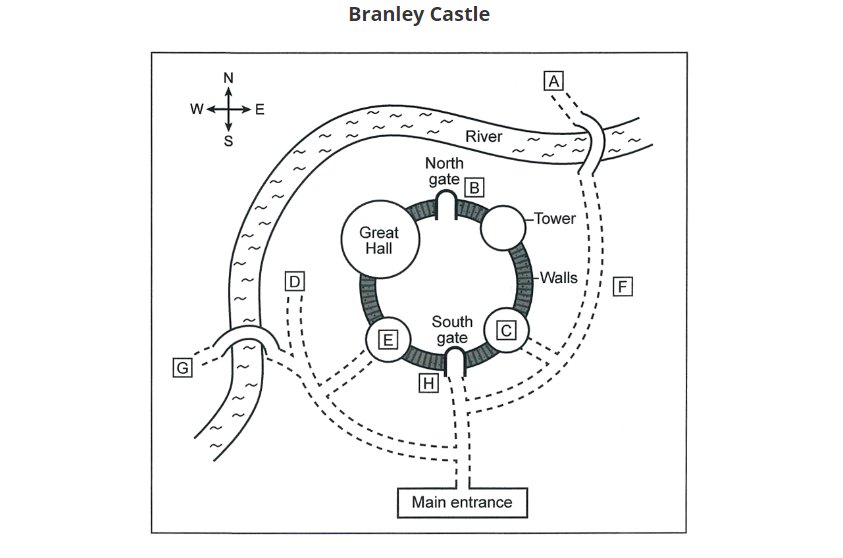
Label the plan below. Write the correct letter, A-H, next to Questions 16-20
Section 3
Questions
21 – 25
Choose the correct letter, A, B or C.
Woolly mammoths on St Paul’s Island
- 21
How will Rosie and Martin introduce their presentation?
- A
with a drawing of woolly mammoths in their natural habit
Bwith a timeline showing when woolly mammoths lived
Cwith a video clip about woolly mammoths
- 22
What was surprising about the mammoth tooth found by Russell Graham?
- A
It was still embedded in the mammoth’s jawbone.
BIt was from an unknown species of mammoth.
CIt was not as old as mammoth remains from elsewhere.
- 23
The students will use an animated diagram to demonstrate how the mammoths
- A
became isolated on the island.
Bspread from the island to other areas.
Ccoexisted with other animals on the island.
- 24
According to Martin, what is unusual about the date of the mammoths’ extinction on the island?
- A
how exact it is
Bhow early it is
Chow it was established
Questions
26 – 30
What action will the students take for each of the following sections of their presentation? Choose SIX answers from the box and match the correct letter, A-H, with Questions 25-30.
Section 4
Questions
31 – 40
Complete the notes below. Write ONE WORD ONLY for each answer.
The history of weather forecasting
Introduction More energy required because of growth in population and 31
What’s needed: ● renewable energy sources ● methods that won’t create pollution Wave energy Advantage: waves provide a 32
source of renewable energy Electricity can be generated using offshore or onshore systems Onshore systems may use a reservoir Problems: ● waves can move in any 33
● movement of sand, etc. on the 34
of the ocean may be affected Tidal energy Tides are more 35
than waves Planned tidal lagoon in Wales: ● will be created in a 36
at Swansea ● breakwater (dam) containing 16 turbines ● rising tide forces water through turbines, generating electricity ● stored water is released through 37
, driving the turbines in the reverse direction Advantages: ● not dependent on weather ● no 38
is required to make it work ● likely to create a number of 39
Problem: ● may ham fish and birds, e.g. by affecting 40
and building up silt Ocean thermal energy conversion Uses a difference in temperature between the surface and lower levels Water brought to the surface in a pipe
Section 1
Questions
1 – 10Complete the notes below. Write ONE WORD AND/OR A NUMBER for each answer.
TOTAL HEALTH CLINIC
Giải thích đáp án
CARL: Hi, come and take a seat.
JULIE: Thank you.
CARL: My name’s Carl Rogers and I’m one of the doctors here at the Total Health Clinic. So I understand this is your first visit to the clinic?
JULIE: Yes, it is.
CARL: OK, well I hope you’ll be very happy with the service you receive here. So if it’s alright with you I’ll take a few details to help me give you the best possible service.
JULIE: Sure.
CARL: So can I check first of all that we have the correct personal details for you? So your full name is Julie Anne (Example) Garcia?
JULIE: That’s correct.
CARL: Perfect. And can I have a contact phone number? (
Hoàn hảo. Và cho tôi xin số điện thoại liên lạc được không?)
JULIE: It’s (Q1) 219 442 9785.
CARL: OK, and then can I just check that we have the correct date of birth? (Được rồi, và sau đó tôi có thể kiểm tra xem chúng tôi có đúng ngày sinh không?)
JULIE: (Q2) October tenth, 1992.
CARL: Oh, I actually have 1991, I’ll just correct that now. Right, so that’s all good. Now I just need just a few more personal details … do you have an occupation, either full-time or part-time?
JULIE: Yes, I work full-time (= Occupation) in Esterhazy’s – you know, the restaurant chain. I started off as a waitress there a few years ago and I’m a (Q3) manager now.(Tôi bắt đầu làm nhân viên phục vụ ở đó vài năm trước và hiện tại tôi là quản lý)
CARL: Oh I know them, yeah, they’re down on 114th Street, aren’t they?
JULIE: That’s right.
CARL: Yeah, I’ve been there a few times. I just love their salads.
JULIE: That’s good to hear.
CARL: Right, so one more thing I need to know before we talk about why you’re here, Julie, and that’s the name of your insurance company.
JULIE: It’s (Q4) Cawley Life Insurance, that’s C-A-W-L-E-Y. (là công ty bảo hiểm Cawley)
CARL: Excellent, thank you so much.
——————————-
JULIE: Now Julie, let’s look at how we can help you. So tell me a little about what brought you here today.
CARL: Well, I’ve been getting a pain in my (Q5) knee, the left one. (Chà, tôi đang bị đau ở đầu gối, cái bên trái.)Not very serious at first, but it’s gotten worse, so I thought I ought to see someone about it.
JULIE: That’s certainly the right decision. So how long have you been aware of this pain? Is it just a few days, or is it longer than that?
CARL: Longer. It’s been worse for the last couple of days, but it’s (Q6) three weeks since (= began) I first noticed it. (Lâu hơn. Tình hình tồi tệ hơn trong vài ngày qua, nhưng đã là ba tuần kể từ lần đầu tiên tôi nhận thấy nó.)It came on quite gradually though, so I kind of ignored it at first.
JULIE: And have you taken any medication yourself, or treated it in any way?
CARL: Yeah, I’ve been taking medication to deal with the pain. Tylenol, and that works OK for a few hours. But I don’t like to keep taking it.
CARL: I am, yes.
JULIE: So do you do any sport on a regular basis?
CARL: Yes, I play a lot of (Q7) tennis. I belong to a club so I go there a lot. (Có, tôi chơi rất nhiều quần vợt. Tôi thuộc về một câu lạc bộ nên tôi đến đó rất nhiều.)I’m quite competitive so I enjoy that side of it as well as the exercise. But I haven’t gone since this started.
JULIE: Sure. And do you do any other types of exercise?
CARL: Yeah, I sometimes do a little swimming, but usually just when I’m on vacation. But normally I go (Q8) runninga few times a week (=regularly) maybe three or four times.(Nhưng bình thường tôi đi chạy một vài lần một tuần, có thể là ba hoặc bốn lần.)
JULIE: Hmm. So your legs are getting quite a pounding. But you haven’t had any problems up to now?
CARL: No, not with my legs. I did have an accident last year when I slipped and hurt (= injured) my (Q9) shoulder, but that’s better now.(
Không, không phải bằng chân của tôi. Tôi đã bị tai nạn vào năm ngoái khi trượt chân và bị thương ở vai, nhưng bây giờ thì tốt hơn rồi.)
JULIE: Excellent. And do you have any allergies?
CARL: No, none that I’m aware of.
JULIE: And do you take any medication on a regular basis?
CARL: Well, I take (Q10) vitamins but that’s all. I’m generally very healthy. (Tôi uống vitamin nhưng chỉ có vậy thôi. Tôi nói chung là rất khỏe mạnh.)
JULIE: OK, well let’s have a closer look and see what might be causing this problem. If you can just get up …
Section 1
Questions
1 – 10Complete the notes below. Write ONE WORD AND/OR A NUMBER for each answer.
TOTAL HEALTH CLINIC
Giải thích đáp án
CARL: Hi, come and take a seat.
JULIE: Thank you.
CARL: My name’s Carl Rogers and I’m one of the doctors here at the Total Health Clinic. So I understand this is your first visit to the clinic?
JULIE: Yes, it is.
CARL: OK, well I hope you’ll be very happy with the service you receive here. So if it’s alright with you I’ll take a few details to help me give you the best possible service.
JULIE: Sure.
CARL: So can I check first of all that we have the correct personal details for you? So your full name is Julie Anne (Example) Garcia?
JULIE: That’s correct.
CARL: Perfect. And can I have a contact phone number? (
Hoàn hảo. Và cho tôi xin số điện thoại liên lạc được không?)
JULIE: It’s (Q1) 219 442 9785.
CARL: OK, and then can I just check that we have the correct date of birth? (Được rồi, và sau đó tôi có thể kiểm tra xem chúng tôi có đúng ngày sinh không?)
JULIE: (Q2) October tenth, 1992.
CARL: Oh, I actually have 1991, I’ll just correct that now. Right, so that’s all good. Now I just need just a few more personal details … do you have an occupation, either full-time or part-time?
JULIE: Yes, I work full-time (= Occupation) in Esterhazy’s – you know, the restaurant chain. I started off as a waitress there a few years ago and I’m a (Q3) manager now.(Tôi bắt đầu làm nhân viên phục vụ ở đó vài năm trước và hiện tại tôi là quản lý)
CARL: Oh I know them, yeah, they’re down on 114th Street, aren’t they?
JULIE: That’s right.
CARL: Yeah, I’ve been there a few times. I just love their salads.
JULIE: That’s good to hear.
CARL: Right, so one more thing I need to know before we talk about why you’re here, Julie, and that’s the name of your insurance company.
JULIE: It’s (Q4) Cawley Life Insurance, that’s C-A-W-L-E-Y. (là công ty bảo hiểm Cawley)
CARL: Excellent, thank you so much.
——————————-
JULIE: Now Julie, let’s look at how we can help you. So tell me a little about what brought you here today.
CARL: Well, I’ve been getting a pain in my (Q5) knee, the left one. (Chà, tôi đang bị đau ở đầu gối, cái bên trái.)Not very serious at first, but it’s gotten worse, so I thought I ought to see someone about it.
JULIE: That’s certainly the right decision. So how long have you been aware of this pain? Is it just a few days, or is it longer than that?
CARL: Longer. It’s been worse for the last couple of days, but it’s (Q6) three weeks since (= began) I first noticed it. (Lâu hơn. Tình hình tồi tệ hơn trong vài ngày qua, nhưng đã là ba tuần kể từ lần đầu tiên tôi nhận thấy nó.)It came on quite gradually though, so I kind of ignored it at first.
JULIE: And have you taken any medication yourself, or treated it in any way?
CARL: Yeah, I’ve been taking medication to deal with the pain. Tylenol, and that works OK for a few hours. But I don’t like to keep taking it.
CARL: I am, yes.
JULIE: So do you do any sport on a regular basis?
CARL: Yes, I play a lot of (Q7) tennis. I belong to a club so I go there a lot. (Có, tôi chơi rất nhiều quần vợt. Tôi thuộc về một câu lạc bộ nên tôi đến đó rất nhiều.)I’m quite competitive so I enjoy that side of it as well as the exercise. But I haven’t gone since this started.
JULIE: Sure. And do you do any other types of exercise?
CARL: Yeah, I sometimes do a little swimming, but usually just when I’m on vacation. But normally I go (Q8) runninga few times a week (=regularly) maybe three or four times.(Nhưng bình thường tôi đi chạy một vài lần một tuần, có thể là ba hoặc bốn lần.)
JULIE: Hmm. So your legs are getting quite a pounding. But you haven’t had any problems up to now?
CARL: No, not with my legs. I did have an accident last year when I slipped and hurt (= injured) my (Q9) shoulder, but that’s better now.(
Không, không phải bằng chân của tôi. Tôi đã bị tai nạn vào năm ngoái khi trượt chân và bị thương ở vai, nhưng bây giờ thì tốt hơn rồi.)
JULIE: Excellent. And do you have any allergies?
CARL: No, none that I’m aware of.
JULIE: And do you take any medication on a regular basis?
CARL: Well, I take (Q10) vitamins but that’s all. I’m generally very healthy. (Tôi uống vitamin nhưng chỉ có vậy thôi. Tôi nói chung là rất khỏe mạnh.)
JULIE: OK, well let’s have a closer look and see what might be causing this problem. If you can just get up …
Section 3
Questions
21 – 24Choose the correct letter, A, B or C.
Woolly mammoths on St Paul’s Island
- 21
How will Rosie and Martin introduce their presentation?
Bạn chưa trả lời câu hỏi này
- A
with a drawing of woolly mammoths in their natural habit
Bwith a timeline showing when woolly mammoths lived
Cwith a video clip about woolly mammoths
Giải thích đáp án
CÂU HỎI | TRANSCRIPT & GIẢI THÍCH |
21 How will Rosie and Martin introduce their presentation? A with a drawing of wooly mammoths in their natural habit B with a timeline showing when woolly mammoths lived C with a video clip about woolly mammoths
| Maybe we could show a video clip of a cartoon about mammoths. But that’d be a bit childish. Or we could have a diagram, (Q21) it could be a timeline to show when they lived, with illustrations?( Hoặc chúng ta có thể có một sơ đồ, nó có thể là một dòng thời gian để hiển thị thời gian chúng sống, với hình ảnh minh họa?)
|
DỊCH NGHĨA | |
21 Rosie và Martin sẽ giới thiệu bài thuyết trình của họ như thế nào? A với hình vẽ những con voi ma mút đáng yêu theo thói quen tự nhiên của chúng B với dòng thời gian hiển thị thời điểm những con voi ma mút lông cừu sống C bằng video clip về voi ma mút lông
|
- 22
What was surprising about the mammoth tooth found by Russell Graham?
Bạn chưa trả lời câu hỏi này
- A
It was still embedded in the mammoth’s jawbone.
BIt was from an unknown species of mammoth.
CIt was not as old as mammoth remains from elsewhere.
Giải thích đáp án
CÂU HỎI | TRANSCRIPT & GIẢI THÍCH |
22 What was surprising about the mammoth tooth found by Russell Graham? A It was still embedded in the mammoth’s jawbone. B It was from an unknown species of mammoth. C It was not as old as mammoth remains from elsewhere.
| Well (Q22) the mammoth bones previously found on the North American mainland were much less recent than that. So this was really amazing. (xương voi ma mút trước đây được tìm thấy trên đất liền Bắc Mỹ gần đây ít hơn nhiều. Vì vậy, điều này thực sự tuyệt vời.) |
DỊCH NGHĨA | |
22 Điều gì đáng ngạc nhiên về chiếc răng của voi ma mút mà Russell Graham tìm thấy? A Nó vẫn còn nằm trong xương hàm của voi ma mút. B Nó đến từ một loài voi ma mút chưa được biết đến. C Nó không cũ như xác voi ma mút từ nơi khác.
|
- 23
The students will use an animated diagram to demonstrate how the mammoths
Bạn chưa trả lời câu hỏi này
- A
became isolated on the island.
Bspread from the island to other areas.
Ccoexisted with other animals on the island.
Giải thích đáp án
CÂU HỎI | TRANSCRIPT & GIẢI THÍCH |
23 The students will use an animated diagram to demonstrate how the mammoths A became isolated on the island. B spread from the island to other areas. C coexisted with other animals on the island.
| Then the climate warmed up and the sea level began to rise, and the island got cut off from the mainland. So (Q23) those mammoths on the island couldn’t escape; they had to stay on the island. (Vì vậy những con voi ma mút trên đảo không thể trốn thoát; chúng phải ở lại trên đảo.) |
DỊCH NGHĨA | |
23 Học sinh sẽ sử dụng một sơ đồ hoạt hình để chứng minh cách các loài voi ma mút A trở nên bị cô lập trên đảo. B lây lan từ đảo sang các khu vực khác. C cùng tồn tại với các loài động vật khác trên đảo.
|
- 24
According to Martin, what is unusual about the date of the mammoths’ extinction on the island?
Bạn chưa trả lời câu hỏi này
- A
how exact it is
Bhow early it is
Chow it was established
Giải thích đáp án
CÂU HỎI | TRANSCRIPT & GIẢI THÍCH |
24 According to Martin, what is unusual about the date of the mammoths’ extinction on the island? A how exact it is B how early it is C how it was established | Anyway, next we’ll explain how Graham and his team identified the date when the mammoths became extinct on the island. They concluded that (Q24) the extinction happened 5,600 years ago, which is a very precise time for a prehistoric extinction. (Họ kết luận rằng sự tuyệt chủng đã xảy ra cách đây 5.600 năm, đây là thời điểm rất chính xác cho sự tuyệt chủng thời tiền sử.) It’s based on samples they took from mud at the bottom of a lake on the island.
|
DỊCH NGHĨA | |
24 Theo Martin, điều gì bất thường về ngày tuyệt chủng của loài voi ma mút trên đảo? A Một cách chính xác nó là B sớm bao lâu C cách nó được thành lập
|
Questions
25 – 30What action will the students take for each of the following sections of their presentation? Choose SIX answers from the box and match the correct letter, A-H, with Questions 25-30.
Bạn chưa trả lời câu hỏi này
E. make detailed notes
Bạn chưa trả lời câu hỏi này
D. contact one of the researchers
Bạn chưa trả lời câu hỏi này
A. make it more interactive
Bạn chưa trả lời câu hỏi này
H. organise the content more clearly
Bạn chưa trả lời câu hỏi này
G. check timing
Bạn chưa trả lời câu hỏi này
C. add personal opinions
Giải thích đáp án
TUTOR: So why don’t you quickly go through the main sections of your presentation and discuss what action is needed for each part?
MARTIN: OK. So for the introduction, we’re using a visual, so once we’ve prepared that we’re done.
ROSIE: I’m not sure. I think (Q25) we need to write down all the ideas(=make detailed notes) we want to include here, not just rely on memory. How we begin the presentation is so important …(Tôi nghĩ chúng ta cần viết ra tất cả những ý tưởng mà chúng ta muốn đưa vào đây, chứ không chỉ dựa vào trí nhớ. Cách chúng ta bắt đầu bài thuyết trình rất quan trọng)
MARTIN: You’re right.
ROSIE: The discovery of the mammoth tooth is probably the most dramatic part, but we don’t have that much information, only what we got from the online article. I thought maybe (Q26) we could get in touch(=contact) with the researcher who led the team and ask him to tell us a bit more. ( Tôi nghĩ có lẽ chúng tôi có thể liên lạc với nhà nghiên cứu, người dẫn đầu nhóm và yêu cầu anh ấy cho chúng tôi biết thêm một chút.)
MARTIN: Great idea. What about the section with the initial questions asked by the researchers? We’ve got a lot on that but we need to make it interesting.
ROSIE: We could (Q27) ask the audience to suggest some questions about it and then see how many of them we can answer. (Chúng tôi có thể yêu cầu khán giả gợi ý một số câu hỏi về vấn đề đó và sau đó xem chúng tôi có thể trả lời bao nhiêu câu hỏi trong số đó.) I don’t think it would take too long.
TUTOR: Yes, that would add a bit of variety.
MARTIN: Then the section on further research carried out on the island – analyzing the mud in the lake. I wonder if we’ve actually got too much information here, should we cut some?
ROSIE: I don’t think so, but it’s all a bit muddled at present.
MARTIN: Yes, (Q28) maybe it would be better if itfollowed a chronological pattern.(có lẽ sẽ tốt hơn nếu nó tuân theo một mẫu trình tự thời gian)
ROSIE: I think so. The findings and possible explanations section is just about ready, but we need to practice it (Q29) so we’re sure itwon’t overrun.(Phần phát hiện và phần giải thích có thể có sắp sẵn sàng, nhưng chúng tôi cần thực hành phần này để chúng tôi chắc chắn rằng phần này sẽ không bị quá tải)
MARTIN: I think it should be OK, but yes, let’s make sure.
TUTOR: In the last section, relevance to the present day, you’ve got some good ideas but this is where you need to move away from the ideas of others and (Q30) give your own viewpoint.(=personal opinions) (Trong phần cuối cùng, liên quan đến thời đại ngày nay, bạn đã có một số ý tưởng hay nhưng đây là lúc bạn cần tránh xa ý tưởng của người khác và đưa ra quan điểm của riêng bạn)
MARTIN: OK, we’ll think about that. Now shall we …
Section 4
Questions
31 – 40Complete the notes below. Write ONE WORD ONLY for each answer.
The history of weather forecasting
Giải thích đáp án
In this series of lectures about the history of weather forecasting, I’ll start by examining its early history – that’ll be the subject of today’s talk.
Ok, so we’ll start by going back thousands of years. Most ancient cultures had weather gods, and weather catastrophes, such as floods, played an important role in many creation myths. Generally, weather was attributed to the whims of the gods, as the wide range of weather gods in various cultures shows. For instance, there’s the Egyptian sun god Ra, and Thor, the Norse god of thunder and lightning. Many ancient civilisations developed (= invented) rites such as (Q31) dancesin order to make the weather gods look kindly on them. ( Nhiều nền văn minh cổ đại đã phát triển các nghi thức như điệu múa để khiến các vị thần thời tiết có thiện cảm với họ)
But the weather was of daily importance: observing the skies and drawing the correct conclusions from these observations was really important, in fact their (Q32) survivaldepended on (= needed to) it. (Nhưng thời tiết có tầm quan trọng hàng ngày: việc quan sát bầu trời và rút ra kết luận chính xác từ những quan sát này thực sự quan trọng, trên thực tế, sự sống sót của con người phụ thuộc vào nó.)It isn’t known when people first started to observe the skies, but at around 650 BC, the Babylonians produced the first short-range weather forecasts, based on their observations of (Q33) cloudsand other phenomena.( khoảng năm 650 trước Công nguyên, người Babylon đã đưa ra những dự báo thời tiết tầm ngắn đầu tiên, dựa trên những quan sát của họ về các đám mây và các hiện tượng khác) The Chinese also recognised weather patterns, and by 300 BC, astronomers had developed a calendar which divided the year into(=made up of) 24 (Q34) festivals,(Người Trung Quốc cũng nhận ra các kiểu thời tiết, và đến năm 300 trước Công nguyên, các nhà thiên văn học đã phát triển một lịch chia năm thành 24 lễ hội) each associated with a different weather phenomenon.
The ancient Greeks were the first to develop a more scientific approach to explaining the weather. The work of the philosopher and scientist Aristotle, in the fourth century BC, is especially noteworthy, as his ideas held sway for nearly 2,000 years. In 340 BC, he wrote a book in which he attempted to account for the formation of rain, clouds, wind and storms. He also described celestial phenomena such as haloes – that is, bright circles of light around the sun, the moon and bright stars – and (Q35) comets. (Ông cũng mô tả các hiện tượng thiên thể như vầng hào quang – tức là những vòng tròn sáng xung quanh mặt trời, mặt trăng và các ngôi sao sáng – và sao chổi) Many of his observations were surprisingly accurate. For example, he believed that heat could cause water to evaporate. But he also jumped to quite a few wrong conclusions, such as that winds are breathed out by the Earth. Errors like this were rectified from the Renaissance onwards.
———————–
For nearly 2,000 years, Aristotle’s work was accepted as the chief authority on weather theory. Alongside this, though, in the Middle Ages weather observations were passed on in the form of proverbs, such as ‘Red (Q36) skyat night, shepherd’s delight; red sky in the morning, shepherd’s warning’. (Tuy nhiên, cùng với điều này, vào thời Trung Cổ, việc quan sát thời tiết đã được truyền lại dưới dạng các câu tục ngữ, chẳng hạn như ‘Bầu trời đỏ vào ban đêm, niềm vui của người chăn cừu; bầu trời đỏ vào buổi sáng, cảnh báo của người chăn cừu ‘ – cảnh báo, điểm báo) Many of these are based on very good observations and are accurate, as contemporary meteorologists have discovered.
For centuries, any attempt to forecast the weather could only be based on personal observation, but in the fifteenth century scientists began to see the need for (Q37) instruments. (Trong nhiều thế kỷ, bất kỳ nỗ lực dự báo thời tiết nào chỉ có thể dựa trên quan sát cá nhân, nhưng vào thế kỷ 15, các nhà khoa học bắt đầu nhận thấy sự cần thiết của dụng cụ) Until then, the only ones available were weathervanes – to determine the wind direction – and early versions of rain gauges. One of the first, invented in the fifteenth century, was a hygrometer, which measured humidity. This was one of many inventions that contributed to the development of weather forecasting.
In 1592, the Italian scientist and inventor Galileo developed the world’s first (Q38) thermometer. (Năm 1592, nhà khoa học và nhà phát minh người Ý Galileo đã phát triển nhiệt kế đầu tiên trên thế giới.) His student Torricelli later invented the barometer, which allowed people to measure atmospheric pressure. In 1648, the French philosopher Pascal proved that pressure decreases with altitude. This discovery was verified by English astronomer Halley in 1686, and Halley was also the first person to map trade winds.
This increasing ability to measure factors related to weather helped scientists to understand the atmosphere and its processes better, and they started collecting weather observation data systematically. In the eighteenth century, the scientist and politician Benjamin Franklin carried out work on electricity and lightning in particular, but he was also very interested in weather and studied it throughout most of his life. It was Franklin who discovered that (Q39) stormsgenerally travel from west to east. (Chính Franklin đã phát hiện ra rằng các cơn bão thường di chuyển từ tây sang đông)
In addition to new meteorological instruments, other developments contributed to our understanding of the atmosphere. People in different locations began to keep records, and in the mid-nineteenth century, the invention of the (Q40) telegraphmade it possible for these records to be collated. (Người dân ở các địa điểm khác nhau bắt đầu lưu giữ hồ sơ, và vào giữa thế kỷ 19, việc phát minh ra máy điện báo đã giúp những hồ sơ này có thể được đối chiếu.) This led, by the end of the nineteenth century, to the first weather services.
It was not until the early twentieth century that mathematics and physics became part of meteorology, and we’ll continue from that point next week.
