
IELTS Handbook 15 – Test 2
17/10/2024 2024-10-17 0:53IELTS Handbook 15 – Test 2
Section 1
Questions
1 – 10
Complete the table below. Write ONE WORD ONLY for each answer.
Festival information
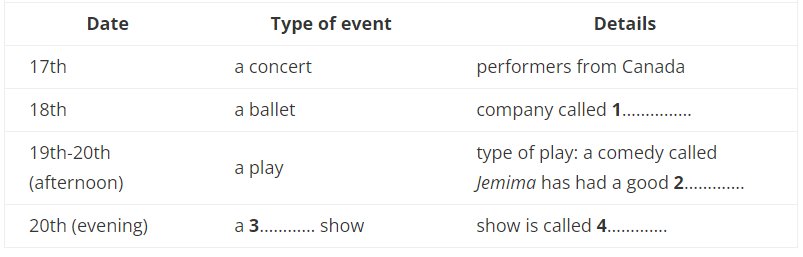
● Address of agency: 497 Eastside, Docklands ● Name of agent: Becky 1
● Phone number: 07866 510333 ● Best to call her in the 2
Typical jobs ● Clerical and admin roles, mainly in the finance industry ● Must have good 3
skills ● Jobs are usually for at least one 4
● Pay is usually £ 5
per hour Registration process ● Wear a 6
to the interview ● Must bring your 7
to the interview ● They will ask questions about each applicant’s 8
Advantages of using an agency ● The 9
you receive at interview will benefit you ● Will get access to vacancies which are not advertised ● Less 10
is involved in applying for jobs
Complete the notes below. Write ONE WORD ONLY for each answer.
Workshops ● Making 1
food ● (children only) Making 2
● (adults only) Making toys from 3
using various tools Outdoor activities ● Swimming in the 4
● Walking in the woods, led by an expert on 5
See the festival organiser’s 6
for more information
Section 2
Questions
11 – 14
Choose the correct letter, A, B or C.
- 11
The park was originally established
- A
as an amenity provided by the city council.
Bas land belonging to a private house.
Cas a shared area set up by the local community.
- 12
Why is there a statue of Diane Gosforth in the park?
- A
She was a resident who helped to lead a campaign.
BShe was a council member responsible for giving the public access.
CShe was a senior worker at the park for many years.
- 13
During the First World War, the park was mainly used for
- A
exercises by troops.
Bgrowing vegetables.
Cpublic meetings.
- 14
When did the physical transformation of the park begin?
- A
2013
B2015
C2016
Questions
15 – 20
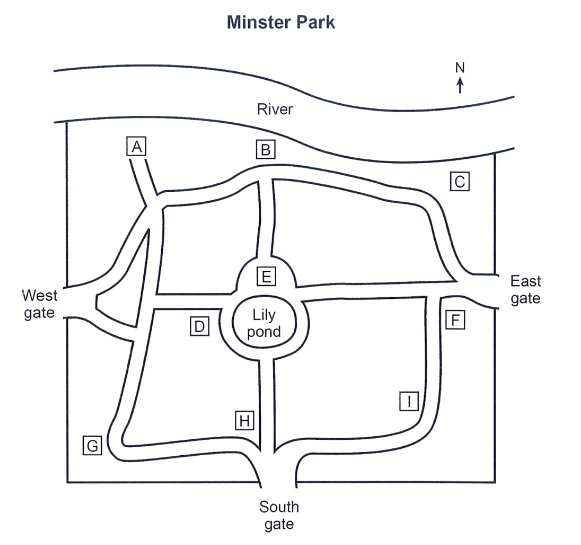
Label the map below. Write the correct letter, A-I, next to Questions 15-20.
Section 3
Questions
21 – 26
Choose TWO letters, A-E. Which TWO groups of people is the display primarily intended for?
- 1314
- Astudent from the English departmentBresidents of the local areaCthe university’s teaching staffDpotential new studentsEstudents from other departments
Questions
27 – 28
Choose TWO letters, A-E. What are Cathy and Graham’s TWO reasons for choosing the novelist Charles Dickens?
- 1516
- AHis speeches inspired others to try to improve society.BHe used his publications to draw attention to social problems.CHis novels are well-known now.DHe was consulted on a number of social issues.EHis reputation has changed in recent times.
Questions
29 – 30
What topic do Cathy and Graham choose to illustrate with each novel? Choose SIX answers from the box and match the correct letter, A-H, with Questions 25-30.
Section 4
Questions
31 – 40
Complete the notes below. Write ONE WORD ONLY for each answer.
Agricultural programme in Mozambique
Importance ● it provides 31
and food for a wide range of species ● its leaves provide 32
which is used to make a disinfectant Reasons for present decline in number A) Diseases (i) ‘Mundulla Yellows’ ● Cause – lime used for making 33
was absorbed – trees were unable to take in necessary iron through their roots (ii) ‘Bell-miner Associated Die-back’ ● Cause – 34
feed on eucalyptus leaves – they secrete a substance containing sugar – bell-miner birds are attracted by this and keep away other species B) Bushfires William Jackson’s theory: ● high-frequency bushfires have impact on vegetation, resulting in the growth of 35
● mid-frequency bushfires result in the growth of eucalyptus forests, because they: – make more 36
available to the trees – maintain the quality of the 37
● low-frequency bushfires result in the growth of 38‘
rainforest’, which is: – a 39
Ecosystem – an ideal environment for the 40
of the bell-miner
Section 1
Questions
1 – 4Complete the table below. Write ONE WORD ONLY for each answer.
Festival information
Giải thích đáp án
TIM: Good morning. You’re through to the tourist information office, Tim speaking. How can I help you?
JEAN: Oh hello. Could you give me some information about next month’s festival, please? My family and I will be staying in the town that week.
TIM: Of course. Well it starts with a concert on the afternoon of the 17th.
JEAN: Oh I heard about that. The orchestra and singers come from the USA, don’t they?
TIM: They’re from Canada. They’re very popular over there. They’re going to perform a number of well-known pieces that will appeal to children as well as adults.
JEAN: That sounds good. My whole family are interested in music.
TIM: (Q1) The next day, the 18th, there’s a performance by a ballet company called Eustatis. (Ngày hôm sau, ngày 18, có buổi biểu diễn của một vũ đoàn ba lê Eustatis)
JEAN: Sorry?
TIM: The name is spelt (Q1) E-U-S-T-A-T-I-S. They appeared in last year’s festival, and went down very well. Again, their programme is designed for all ages.
JEAN: Good. I expect we’ll go to that. I hope there’s going to be a play during the festival, a comedy, ideally.
TIM: You’re in luck! On the 19th and 20th a local amateur group are performing one written by a member of the group. It’s called Jemima. That’ll be on in the town hall. They’ve already performed it two or three times. I haven’t seen it myself, but (Q2) the review in the local paper was very good. (nó được đánh giá rất cao trong tờ báo địa phương)
JEAN: And is it suitable for children?
TIM: Yes, in fact it’s aimed more at children than at adults, so both performances are in the afternoon.
JEAN: And (Q3) what about dance? (Còn về phần nhảy thì sao?) Will there be any performances?
TIM: Yes, also on the 20th, but in the evening. A professional company is putting on a show of modern pieces, with electronic music by young composers.
JEAN: Uh-huh.
TIM: The show is about how people communicate, or fail to communicate, with each other, so (Q4) it’s got the rather strange name, Chat. (nó có một cái tên tương đối lạ: Chat)
JEAN: I suppose that’s because that’s something we do both face to face and online.
TIM: That’s right.
Questions
5 – 10Complete the notes below. Write ONE WORD ONLY for each answer.
Giải thích đáp án
TIM: Now there are also some workshops and other activities. They’ll all take place at least once every day, so everyone who wants to take part will have a chance.
JEAN: Good. We’re particularly interested in cookery – you don’t happen to have a cookery workshop, do you?
TIM: We certainly do. (Q5) It’s going to focus on how to make food part of a healthy lifestyle (Nó sẽ tập trung vào việc làm thế nào để biến thức ăn trở thành một phần của lối sống lành mạnh), and it’ll show that even sweet things like cakes can contain much less sugar than they usually do.
JEAN: That might be worth going to. We’re trying to encourage our children to cook.
TIM: (Q6) Another workshop is just for children, and that’s on creating posters to reflect the history of the town (Một buổi hội thảo nữa thì chỉ dành cho trẻ em, về việc sáng tạo ra những tấm áp phích phản ánh lịch sử của thị trấn). The aim is to make children aware of how both the town and people’s lives have changed over the centuries. The results will be exhibited in the community center. Then the other workshop is in toy-making, and that’s for adults only.
JEAN: Oh, why’s that?
TIM: Because it involves carpentry – (Q7) participants will be making toys out of wood, so there’ll be a lot of sharp chisels and other tools around. (những người tham gia sẽ làm đồ chơi bằng gỗ, bởi vậy sẽ có nhiều chiếc đục sắc bén cùng những công cụ khác xung quanh)
JEAN: It makes sense to keep children away from it.
TIM: Exactly. Now let me tell you about some of the outdoor activities. There’ll be supervised wild swimming …
JEAN: Wild swimming? What’s that?
TIM: It just means swimming in natural waters, rather than a swimming pool. (Nó chỉ là bơi ở chỗ nước tự nhiên, thay vì bể bơi thôi)
JEAN: Oh OK. (Q8) In a lake, for instance (Ví dụ như ở hồ).
TIM: Yes, there’s a beautiful one just outside the town, and that’ll be the venue for the swimming. There’ll be lifeguards on duty, so it’s suitable for all ages. (Q9) And finally, there’ll be a walk in some nearby woods every day. The leader is an expert on insects. (Và cuối cùng là chuyến đi bộ trong một vài khu rừng gần đó hằng ngày. Người dẫn đoàn là một chuyên gia về côn trùng). He’ll show some that live in the woods, and how important they are for the environment. So there are going to be all sorts of different things to do during the festival.
JEAN: There certainly are.
TIM: (Q10) If you’d like to read about how the preparations for the festival are going, the festival organizer is keeping a blog. (Nếu bạn muốn đọc về quá trình chuẩn bị cho lễ hội diễn ra như thế nào thì người tổ chức lễ hội đang giữ một bài viết). Just search online for the festival website, and you’ll find it.
JEAN: Well, thank you very much for all the information.
TIM: You’re welcome. Goodbye.
JEAN: Goodbye.
Section 2
Questions
11 – 14Choose the correct letter, A, B or C.
- 11
The park was originally established
Bạn chưa trả lời câu hỏi này
- A
as an amenity provided by the city council.
Bas land belonging to a private house.
Cas a shared area set up by the local community.
Giải thích đáp án
Mark nói về nguồn gốc của công viên Minster: “What perhaps isn’t so well known is the origin of the park: unlike many public parks that started in private ownership, as the garden of a large house, for instance, Minster was some waste land, which people living nearby started planting with flowers in 1892.” (Thứ có lẽ ít được biết đến là nguồn gốc của công viên: khác với nhiều công viên bắt nguồn từ sở hữu cá nhân, ví dụ như khu vườn của một ngôi nhà lớn, Minster lại là vài mảnh đất bỏ hoang, nơi mà người dân sống quanh đó trồng hoa năm 1892.)
- 12
Why is there a statue of Diane Gosforth in the park?
Bạn chưa trả lời câu hỏi này
- A
She was a resident who helped to lead a campaign.
BShe was a council member responsible for giving the public access.
CShe was a senior worker at the park for many years.
Giải thích đáp án
Many local people wanted it to remain a place that everyone could go to, to enjoy the fresh air and natural environment – remember the park is in a densely populated residential area. Diane Gosforth was one of those people, and she organized petitions and demonstrations, which eventually made the council change its mind about the future of the land. (Diane Gosforth là một trong số đó, và bà ấy đã đưa ra những kiến nghị cùng những cuộc biểu tình, thứ làm hội đồng phải thay đổi suy nghĩ về tương lai của mảnh đất)
- 13
During the First World War, the park was mainly used for
Bạn chưa trả lời câu hỏi này
- A
exercises by troops.
Bgrowing vegetables.
Cpublic meetings.
Giải thích đáp án
Soon after this the First World War broke out, in 1914, and most of the park was dug up and planted with vegetables (công viên gần như được đào xới hết lên và trồng rau lên đó), which were sold locally.
- 14
When did the physical transformation of the park begin?
Bạn chưa trả lời câu hỏi này
- A
2013
B2015
C2016
Giải thích đáp án
Xuất hiện các mốc thời gian, từ những dự định “thay áo mới” cho công viên đến quá trình xem xét sửa đổi kế hoạch, cuối cùng là đi vào thực thi. “Plans for transforming it were drawn up at various times, most recently in 2013, though they were revised in 2015, before any work had started. The changes finally got going in 2016 (Những thay đổi bắt đầu đi vào thực thi năm 2016), and were finished on schedule last year.”
Questions
15 – 20Label the map below. Write the correct letter, A-I, next to Questions 15-20.
Bạn chưa trả lời câu hỏi này
Position E
Bạn chưa trả lời câu hỏi này
Position C
Bạn chưa trả lời câu hỏi này
Position B
Bạn chưa trả lời câu hỏi này
Position A
Bạn chưa trả lời câu hỏi này
Position G
Bạn chưa trả lời câu hỏi này
Position D
Giải thích đáp án
OK, let me tell you about some of the changes that have been made – and some things that have been retained. If you look at this map, you’ll see the familiar outline of the park, with the river forming the northern boundary, and a gate in each of the other three walls. The statue of Diane Gosforth has been moved: it used to be close to the south gate, but it’s now (Q15) immediately to the north of the lily pond, almost in the centre of the park (ở ngay phía bắc của ao súng, gần trong trung tâm công viên), which makes it much more visible.
There’s a new area of wooden sculptures, which are (Q16) on the river bank, where the path from the east gate makes a sharp bend. (nằm bên bờ sông, nơi con đường ở cổng phía đông ngoặt gấp vào)
There are two areas that are particularly intended for children. The playground has been enlarged and improved, and that’s (Q17) between the river and the path that leads from the pond to the river. (ở giữa dòng sông và con đường dẫn từ hồ ra sông)
Then there’s a new maze, a circular series of paths, separated by low hedges. That’s (Q18) near the west gate – you go north from there towards the river and then turn left to reach it. (ở gần cổng tây – bạn đi về phía bắc từ đó theo hướng sông, rồi rẽ trái để đến)
There have been tennis courts in the park for many years, and they’ve been doubled, from four to eight. They’re still (Q19) in the south-west corner of the park, where there’s a right-angle bend in the path. (ở phía tây nam của công viên, nơi có khúc cua vuông góc trên đường đi)
Something else I’d like to mention is the new fitness area. This is (Q20) right next to the lily pond on the same side as the west gate (ngay cạnh hồ súng, cùng phía với cổng tây).
Now, as you’re all gardeners, I’m sure you’ll like to hear about the plants that have been chosen for the park.
Section 3
Questions
21 – 22Choose TWO letters, A-E. Which TWO groups of people is the display primarily intended for?
- 2122
- Astudent from the English department
Bạn chọn thiếu đáp án này
Bresidents of the local areaCthe university’s teaching staffBạn chọn thiếu đáp án này
Dpotential new studentsEstudents from other departments
Giải thích đáp án
CÂU HỎI VÀ TRẢ LỜI | TRANSCRIPT & GIẢI THÍCH |
21-22: Which TWO groups of people is the display primarily intended for? A. student from the English department B. residents of the local area C. the university’s teaching staff D. potential new students E. students from other departments | It’ll be publicised in the city, to encourage people to come and find out something of what goes on here. (Nó được quảng bá rộng rãi trong thành phố, để khuyến khích mọi người đến xem và tìm hiểu những gì đang diễn ra nơi đây). And it’s included in the information that’s sent to people who are considering applying to study here next year. (những người đang cân nhắc việc đăng ký học tập tại đây trong năm tới) |
DỊCH NGHĨA | |
Buổi trưng bày chủ yếu hướng tới HAI nhóm đối tượng nào? A. sinh viên khoa ngôn ngữ Anh B. người dân địa phương C. đội ngũ giảng viên đại học D. những học sinh mới tiềm năng E. sinh viên từ các khoa khác |
Questions
23 – 24Choose TWO letters, A-E. What are Cathy and Graham’s TWO reasons for choosing the novelist Charles Dickens?
- 2324
- AHis speeches inspired others to try to improve society.
Bạn chọn thiếu đáp án này
BHe used his publications to draw attention to social problems.Bạn chọn thiếu đáp án này
CHis novels are well-known now.DHe was consulted on a number of social issues.EHis reputation has changed in recent times.
Giải thích đáp án
CÂU HỎI VÀ TRẢ LỜI | TRANSCRIPT & GIẢI THÍCH |
23-24: What are Cathy and Graham’s TWO reasons for choosing the novelist Charles Dickens? A. His speeches inspired others to try to improve society. B. He used his publications to draw attention to social problems. C. His novels are well-known now. D. He was consulted on a number of social issues. E. His reputation has changed in recent times. | Cathy nói rằng: “Most people have heard of him, and have probably read some of his novels, or seen films based on them (Đa số mọi người đều đã nghe về ông ấy và có thể đã đọc một vài cuốn tiểu thuyết hay xem vài bộ phim chuyển thể của ông), so that’s a good lead-in to life in his time.”
Còn với Graham: “And his novels show the awful conditions that most people had to live in, don’t they: he wanted to shock people into doing something about it.” (Và những cuốn tiểu thuyết của ông ấy phản ánh điều kiện sống của hầu hết mọi người, ông ấy muốn kích động họ muốn làm gì đó) |
DỊCH NGHĨA | |
HAI lý do khiến Cathy và Graham lựa chọn tiểu thuyết gia Charles Dickens là gì? A. Bài phát biểu của ông ấy truyền cảm hứng khiến mọi người muốn cố gắng cải thiện xã hội. B. Ông ấy đã sử dụng các ấn phẩm của mình để thu hút sự chú ý của mọi người vào các vấn đề xã hội. C. Những cuốn tiểu thuyết của ông ấy được nhiều người biết đến ở thời điểm hiện tại. D. Ông ấy đã được hỏi ý kiến về một số vấn đề xã hội. E. Danh tiếng của ông ấy đã thay đổi trong thời gian gần đây. |
Questions
25 – 30What topic do Cathy and Graham choose to illustrate with each novel? Choose SIX answers from the box and match the correct letter, A-H, with Questions 25-30.
Bạn chưa trả lời câu hỏi này
G. medicine
Bạn chưa trả lời câu hỏi này
B. education
Bạn chưa trả lời câu hỏi này
D. entertainment
Bạn chưa trả lời câu hỏi này
C. Dickens’s travels
Bạn chưa trả lời câu hỏi này
H. a woman’s life
Bạn chưa trả lời câu hỏi này
F. wealth
Giải thích đáp án
CATHY: OK, so now shall we think about a topic linked to each novel?
GRAHAM: Yes. I’ve printed out a list of Dicken’s novels in the order they were published, in the hope you’d agree to focus on him!
CATHY: You’re lucky I did agree! Let’s have a look. OK, the first was The Pickwick Papers, published in 1836. It was very successful when it came out, wasn’t it, and was adapted for the theatre straight away.
GRAHAM: There’s an interesting point, though, that (Q25) there’s a character who keeps falling asleep, and that medical condition (=medicine) was named after the book – Pickwickian Syndrome. (có một nhân vật liên tục buồn ngủ và tình trạng sức khỏe ấy được đặt tên cho cuốn sách – Triệu chứng Pickwickian)
CATHY: Oh, so why don’t we use that as the topic, and include some quotations from the novel?
GRAHAM: Right, Next is Oliver Twist. There’s a lot in the novel about poverty. But maybe something less obvious …
CATHY: Well Oliver is taught how to steal, isn’t he? We could use that to illustrate the fact that (Q26) very few children went to school, particularly not poor children, so they learnt (=education) in other ways. (ít đứa trẻ nào được đến trường, đặc biệt là không phải trẻ em nghèo, vì vậy họ học theo những cách khác)
GRAHAM: Good idea. What’s next?
CATHY: Maybe Nicholas Nickleby. Actually he taught in a really cruel school, didn’t he?
GRAHAM: That’s right. But (Q27) there’s also the company of touring actors that Nicholas joins. We could do something in theaters and other amusements (=entertainment) of the time. (Nhưng cũng có công ty của những diễn viên lưu diễn mà Nicholas tham gia. Chúng ta có thể làm điều gì đó trong rạp hát và những trò giải trí khác tại thời điểm đó.) We don’t want only the bad things, do we?
CATHY: OK.
GRAHAM: What about Martin Chuzzlewit? (Q28) He goes to the USA, doesn’t he? (Anh ấy đến Mỹ có phải không?)
CATHY: (Q28) Yes, and Dickens himself had been there (=Dickens’s travels) a year before, and drew on his experience there in the novel. (Đúng vậy, và Dickens đã đến một năm trước đấy, và đúc kết những kinh nghiệm của bản thân trong cuốn tiểu thuyết)
GRAHAM: I wonder, though … The main theme is selfishness, so we could do something on social justice? No, too general, let’s keep to your idea – I think it would work well.
CATHY: He wrote Bleak House next – that’s my favorite of his novels.
GRAHAM: Yes, mine too. His satire of the legal system is pretty powerful.
CATHY: That’s true, but think about Esther, (Q29) the heroine (=woman). As a child she lives with someone she doesn’t know is her aunt, who treats her very badly. (nhân vật nữ chính. Khi còn bé, cô ấy phải sống với một người mà cô không hề quen biết là dì của cô, người đối xử với cô vô cùng tệ bạc) Then she’s very happy living with her guardian, and he puts her in charge of the household. And at the end she gets married and her guardian gives her and her husband a house, where of course they’re very happy.
GRAHAM: Yes, I like that.
CATHY: What shall we take next? Little Dorrit? Old Mr Dorrit has been in a debtors’ prison for years …
GRAHAM: So was Dickens’s father, wasn’t he?
CATHY: That’s right.
GRAHAM: (Q30) What about focusing on the part when Mr Dorrit inherits a fortune, and he starts pretending he’s always been rich (=wealth)? (Còn về phần tập trung vào phần ngài Dorrit thừa hưởng một gia tài, và anh ấy bắt đầu giả bộ rằng mình trước giờ vốn vẫn luôn giàu có?)
CATHY: Good idea.
GRAHAM: OK, so next we need to think about what materials we want to illustrate each issue. That’s going to be quite hard.
Section 4
Questions
31 – 40Complete the notes below. Write ONE WORD ONLY for each answer.
Agricultural programme in Mozambique
Giải thích đáp án
I’m going to report on a case study of a programme which has been set up to help rural populations in Mozambique, a largely agricultural country in South-East Africa.
The programme worked with three communities in Chicualacuala district, near the Limpopo River. This is a dry and arid region, with unpredictable rainfall. Because of this, people in the area were unable to support themselves through agriculture and instead they used the forest as a means of providing themselves with an income, mainly by selling charcoal. However, this was not a sustainable way of living in the long term, as they were rapidly using up this resource.
(Q31) To support agriculture in this dry region, the programme focused primarily (=the main priority) on making use of existing water resources from the Limpopo River by setting up systems of irrigation (Để hỗ trợ nông nghiệp ở vùng khô hạn này, chương trình tập trung chủ yếu vào việc sử dụng các nguồn nước hiện có từ sông Limpopo bằng cách thiết lập các hệ thống tưới tiêu), which would provide a dependable water supply for crops and animals. The programme worked closely with the district government in order to find the best way of implementing this. The region already had one farmers’ association, and it was decided to set up two more of these. (Q32) These associations planned and carried out activities including water management, livestock breeding and agriculture, and it was notable that in general, women formed the majority of the workforce (=most of the work). (Các hiệp hội này đã lên kế hoạch và thực hiện các hoạt động bao gồm quản lý nước, chăn nuôi và nông nghiệp, và điều đáng chú ý là phụ nữ nhìn chung chiếm đa số trong lực lượng lao động)
It was decided that in order to keep the crops safe from animals, both wild and domestic, special areas should be fenced off where the crops could be grown. (Q33) The community was responsible for creating these fences, but the programme provided the necessary wire for making them. (Cộng đồng chịu trách nhiệm tạo ra những rào chắn này, nhưng chương trình đã cung cấp dây cần thiết để làm chúng)
Once the area had been fenced off, it could be cultivated. The land was dug, so that vegetables and cereals appropriate to the climate could be grown, and (Q34) the programme provided the necessary seeds for this (chương trình cung cấp hạt giống cần thiết). The programme also provided pumps so that water could be brought from the river in pipes to the fields. However, the labour was all provided by local people, and (Q35) they also provided and put up the posts that supported the fences around the fields. (họ cũng cung cấp và đặt các trụ hỗ trợ hàng rào xung quanh các cánh đồng)
Once the programme had been set up, its development was monitored carefully. The farmers were able to grow enough produce not just for their own needs, but also to sell. (Q36) However, getting the produce to places where it could be marketed was sometimes a problem, as the farmers did not have access to (= lack of) transport (Tuy nhiên, việc đưa sản phẩm đến nơi tiêu thụ đôi khi là một vấn đề, vì những người nông dân không được tiếp cận với các phương tiện vận chuyển), and this resulted in large amounts of produce, especially vegetables, being spoiled. This problem was discussed with the farmers’ associations and it was decided that (Q37) in order to prevent food from being spoiled, the farmers needed to learn techniques (= methods) for its preservation. (để tránh đồ ăn bị hỏng, người nông dân cần học những kỹ thuật bảo quản)
There was also an additional initiative that had not been originally planned, but which became a central feature of the programme. (Q38) This was when farmers started to dig holes for tanks in the fenced-off areas (= special places) and to fill these with water and use them for breeding fish – an important source of protein. (Đó là khi những người nông dân bắt đầu đào hố cho các bể chứa trong khu vực có hàng rào và đổ đầy nước vào các bể và sử dụng chúng để sản sinh ra cá – một nguồn protein quan trọng)
(Q39) After a time, another suggestion was made by local people which hadn’t been part of the programme’s original proposal, but which was also adopted later on. They decided to try setting up colonies of bees, (Sau một thời gian, người dân địa phương đưa ra một đề xuất khác không nằm trong đề xuất ban đầu của chương trình, nhưng sau đó cũng đã được chấp nhận. Họ quyết định thử thiết lập những đàn ong) which would provide honey both for their own consumption and to sell.
So what lessons can be learned from this programme? First of all, it tells us that in dry, arid regions, if there is access to a reliable source of water, there is great potential for the development of agriculture. In Chicualacuala, there was a marked improvement in agricultural production, which improved food security and benefited local people by providing them with both food and income. (Q40) However, it’s important to set realistic timelines for each phase of the programme, especially for its design, as mistakes made at this stage may be hard to correct later on. (Tuy nhiên, điều quan trọng là ta phải đặt ra các mốc thời gian thực tế cho từng giai đoạn của chương trình, đặc biệt là đối với thiết kế của nó, vì những sai lầm mắc phải ở giai đoạn này có thể khó sửa chữa sau này)
The programme demonstrates that sustainable development is possible in areas where …
