
IELTS Handbook 15 – Test 4
17/10/2024 2024-10-17 1:04IELTS Handbook 15 – Test 4
Section 1
Questions
1 – 10
Complete the form below. Write ONE WORD AND/OR A NUMBER for each answer.
Customer Satisfaction Survey
First Job Administrative assistant in a company that produces 1
(North London) Responsibilities ● data entry ● go to 2
and take notes ● general admin ● management of 3
Requirements ● good computer skills including spreadsheets ● good interpersonal skills ● attention to 4
Experience ● need a minimum of 5
of experience of teleconferencing Second Job Warehouse assistant in South London Responsibilities ● stock management ● managing 6
Requirements ● ability to work with numbers ● good computer skills ● very organised and 7
● good communication skills ● used to working in a 8
● able to cope with items that are 9
Need experience of ● driving in London ● warehouse work ● 10
service
Section 2
Questions
11 – 16
Label the map below. Write the correct letter, A-H, next to Questions 11-16
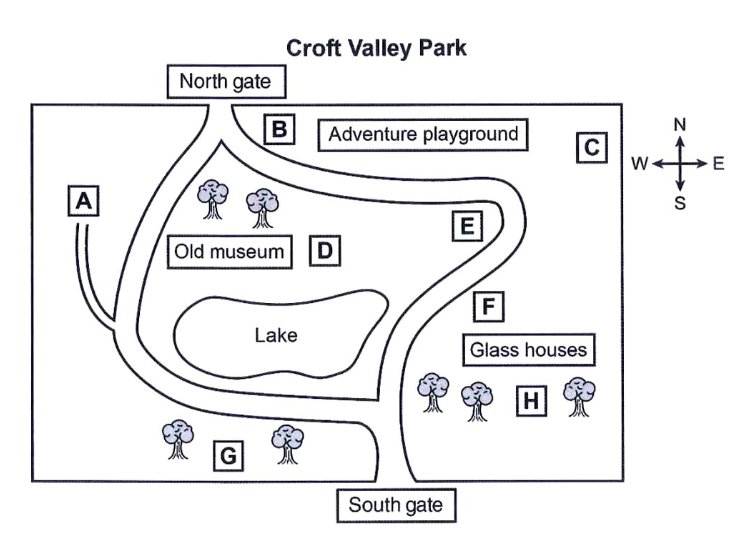
Questions
17 – 18
Choose TWO letters, A-E. What does the speakers say about the adventure playground?
- 1718
- AChildren must be supervised.BIt costs more in winter.CSome activities are only for younger children.DNo payment is required.EIt was recently expanded.
Questions
19 – 20
Choose TWO letters, A-E. What does the speaker say about the glass houses?
- 1920
- AThey are closed at weekends.BVolunteers are needed to work there.CThey were badly damaged by fire.DMore money is needed to repair some of the glass.EVisitors can see palm trees from tropical regions.
Section 3
Questions
21 – 26
Choose the correct letter, A, B or C.
- 7
What did Annie discover from reading about icehouses?
- A
why they were first created
Bhow the ice was kept frozen
Cwhere they were located
- 8
What point does Annie make about refrigeration in ancient Rome?
- A
It became a commercial business.
BIt used snow from nearby.
CIt took a long time to become popular.
- 9
In connection with modern refrigerator, both Annie and Jack are worried about
- A
the complexity of the technology.
Bthe fact that some are disposed of irresponsibly.
Cthe large number that quickly break down.
- 10
What do Jack and Annie agree regarding domestic fridges?
- A
They are generally good value for money.
BThere are plenty of useful variations.
CThey are more useful than other domestic appliances.
Questions
27 – 30
Who is going to do research into each topic? Match the correct letter, A, B or C, with Questions 25-30.
Section 4
Questions
31 – 40
Complete the notes below. Write ONE WORD ONLY for each answer.
How the Industrial Revolution affected life in Britain
Prehistoric times: ● water was used to wash off 31
Ancient Babylon ● soap-like material found in 32
cylinders Ancient Greece: ● people cleaned themselves with sand and other substances ● used a strigil – scraper made of 33
● washed clothes in streams Ancient Germany and Gaul: ● used soap to colour their 34
Ancient Rome: ● animal fat, ashes and clay mixed through action of rain, used for washing clothes ● from about 312 BC, water carried to Roman 35
by aqueducts Europe in Middle Ages: ● decline in bathing contributed to occurrence of 36
● 37
began to be added to soap Europe from 17th century: ● 1600s: cleanliness and bathing started becoming usual ● 1791: Leblanc invented a way of making soda ash from 38
● early 1800s: Chevreul turned soapmaking into a 39
● from 1800s, there was no longer a 40
on soap.
Section 1
Questions
1 – 10Complete the form below. Write ONE WORD AND/OR A NUMBER for each answer.
Customer Satisfaction Survey
Giải thích đáp án
MAN: Hello. Do you mind if I ask you some questions about your journey today? We’re doing a customer satisfaction survey.
SOPHIE: Yes. OK. I’ve got about ten minutes before my train home leaves. I’m on a day trip.
MAN: Great. Thank you. So first of all, could you tell me your name?
SOPHIE: It’s Sophie Bird.
MAN: Thank you. And would you mind telling me what you do (=occupation)?
SOPHIE: (Q1) I’m a journalist. [Tôi là phóng viên].
MAN: Oh really? That must be interesting.
SOPHIE: Yes. It is.
MAN: So was the reason for your visit here today work?
SOPHIE: Actually, it’s my day off. (Q2) I came here to do some shopping. [Trên thực tế, đó là ngày nghỉ của tôi. Tôi đến đây để mua sắm.]
MAN: Oh right.
SOPHIE: But I do sometimes come here for work.
MAN: OK. Now I’d like to ask some questions about your journey today, if that’s OK.
SOPHIE: Yes. No problem.
MAN: Right, so can you tell me which station you’re travelling back (=name of station returning) to? [Được rồi, vậy bạn có thể nói cho tôi biết rằng bạn đang di chuyển lại về ga nào được không?]
SOPHIE: (Q3) Staunfirth , where I live. [Staunfirth, nơi tôi sống.]
MAN: Can I just check the spelling? S-T-A-U-N-F-I-R-T-H?
SOPHIE: That’s right.
MAN: And you travelled from there this morning?
SOPHIE: Yes.
MAN: OK, good. Next, can I ask what kind of ticket you bought? I assume it wasn’t a season ticket, as you don’t travel every day.
SOPHIE: That’s right. (Q4) No, I just got a normal return ticket. [Không, tôi chỉ mua vé về hạng phổ thông thôi.] I don’t have a rail card so I didn’t get any discount. I keep meaning to get one because it’s a lot cheaper.
MAN: Yes – you’d have saved 20% on your ticket today. So you paid the full price for your ticket? [Vậy bạn đã thanh toán giá gốc cho vé của mình à?]
SOPHIE: (Q5) I paid £23.70 [Tôi trả £23.70]
MAN: OK. Do you think that’s good value for money?
SOPHIE: Not really. I think it’s too much for a journey that only takes 45 minutes.
MAN: Yes, that’s one of the main complaints we get. So, you didn’t buy your ticket in advance?
SOPHIE: No. I know it’s cheaper if you buy a week in advance but I didn’t know I was coming then.
MAN: I know. You can’t always plan ahead. So, did you buy it this morning?
SOPHIE: No, it was yesterday.
MAN: Right. And do you usually buy your tickets at the station (= Where ticket was bought)?
SOPHIE: Well, I do usually but the ticket office closes early and I hate using ticket machines. I think ticket offices should be open for longer hours. There’s always a queue for the machines and they’re often out of order.
MAN: A lot of customers are saying the same thing.
SOPHIE: So to answer your question … (Q6) I got an e-ticket online. [Tôi mua vé điện tử online.]
—————————-
MAN: OK. Thank you. Now I’d like to ask you about your satisfaction with your journey. So what would you say you were most satisfied with today?
SOPHIE: Well, I like the wifi on the train. It’s improved a lot. It makes it easier for me to work if I want to.
MAN: That’s the first time today anyone’s mentioned that. It’s good to get some positive feedback on that.
SOPHIE: Mmm.
MAN: And, is there anything you weren’t satisfied (= Least satisfied) with?
SOPHIE: Well, normally, the trains run on time and are pretty reliable but (Q7) today there was a delay [nhưng hôm nay chuyến bị delay] ; the train was about 15 minutes behind schedule.
MAN: OK. I’ll put that down. Now I’d also like to ask about the facilities at this station. You’ve probably noticed that the whole station’s been upgraded. What are you most satisfied with?
SOPHIE: I think (Q8) the best thing is that they’ve improved the amount of (=how much) information about train times [điều tuyệt vời nhất mà họ đã cải thiện là lượng thông tin về thời gian các chuyến tàu] etc. that’s given to passengers – it’s much clearer – before there was only one board and I couldn’t always see it properly – which was frustrating.
MAN: That’s good. And is there anything you’re not satisfied with?
SOPHIE: Let’s see … I think things have generally improved a lot. The trains are much more modern and I like the new café. But one thing is that (Q9) there aren’t enough places to sit down (=lack of seats), especially on the platforms. [không có đủ chỗ để ngồi, đặc biệt là tại sân ga.]
MAN: OK – so I’ll put ‘seating’ down, shall I, as the thing you’re least satisfied with?
SOPHIE: Yes, OK.
MAN: Can I ask your opinion about some of the other facilities? We’d like feedback on whether people are satisfied, dissatisfied or neither satisfied nor dissatisfied.
SOPHIE: OK.
MAN: (Q10) What about the parking at the station? [Thế còn việc đỗ xe ở ga thì sao?]
SOPHIE: Well to be honest, I don’t really have an opinion as I never use it.
MAN: So, neither satisfied nor dissatisfied for that then.
SOPHIE: Yes, I suppose so …
MAN: OK, and what about …?
Section 2
Questions
11 – 16Label the map below. Write the correct letter, A-H, next to Questions 11-16
Bạn chưa trả lời câu hỏi này
Position D
Bạn chưa trả lời câu hỏi này
Position C
Bạn chưa trả lời câu hỏi này
Position G
Bạn chưa trả lời câu hỏi này
Position H
Bạn chưa trả lời câu hỏi này
Position A
Bạn chưa trả lời câu hỏi này
Position E
Giải thích đáp án
As chair of the town council subcommittee on park facilities, I’d like to bring you up to date on some of the changes that have been made recently to the Croft Valley Park. So if you could just take a look at the map I handed out, let’s begin with a general overview. So the basic arrangement of the park hasn’t changed – it still has two gates, north and south, and a lake in the middle.
The café continues to serve an assortment of drinks and snacks and is still in the same place, looking out over the lake and next to the old museum. [nhìn ra hồ và bên cạnh bảo tàng cũ.] D (Q11)
We’re hoping to change the location of the toilets, and bring them nearer to the centre of the park as they’re a bit out of the way at present, near the adventure playground, in the corner of your map. [gần sân chơi cho trẻ em, ở góc bản đồ.] C (Q12)
The formal gardens have been replanted and should be at their best in a month or two. They used to be behind the old museum, but we’re now used the space near the south gate – between the park boundary and the path that goes past the lake towards the old museum. [không gian gần cổng phía nam – giữa ranh giới công viên và con đường đi qua hồ hướng về phía bảo tàng cũ.] G (Q13)
We have a new outdoor gym for adults and children, which is already proving very popular. It’s by the glass houses, just to the right of the path from the south gate. You have to look for it as it’s a bit hidden in the trees. [cạnh những ngôi nhà bằng kính, ngay bên phải lối đi từ cổng phía nam. Bạn phải tìm nó vì nó hơi khuất trong những hàng cây.] H (Q14)
One very successful introduction has been our skateboard ramp. It’s in constant use during the evenings and holidays. It’s near the old museum, at the end of a little path that leads off from the main path between the lake and the museum. [gần bảo tàng cũ, ở cuối con đường nhỏ dẫn ra khỏi con đường chính giữa hồ và bảo tàng.] A (Q15)
We’ve also introduced a new area for wild flowers, to attract bees and butterflies. It’s on a bend in the path that goes round the east side of the lake, just south of the adventure playground. [trên khúc uốn cong của con đường đi vòng qua phía đông của hồ, ngay phía nam của sân chơi mạo hiểm.] E (Q16)
Questions
17 – 18Choose TWO letters, A-E. What does the speakers say about the adventure playground?
- 1718
Bạn chọn thiếu đáp án này
AChildren must be supervised.BIt costs more in winter.CSome activities are only for younger children.Bạn chọn thiếu đáp án này
DNo payment is required.EIt was recently expanded.
Giải thích đáp án
CÂU HỎI 17 & 18 | TRANSCRIPT & GIẢI THÍCH |
Choose TWO letters, A-E. What does the speakers say about the adventure playground? A Children must be supervised. B It costs more in winter. C Some activities are only for younger children. D No payment is required. E It was recently expanded. | Người nói giới thiệu về sân chơi trẻ em như sau: It’s open year-round, though it close early in the winter months, and entrance is completely free (= no payment is required) (Q17/Q18) [vào cửa hoàn toàn miễn phí]. Children can choose whatever activities they want to do, irrespective of their age, but we do ask adults not to leave them on their own there (= children must be supervised) (Q17/Q18) [Trẻ em có thể chọn bất kỳ hoạt động nào các bé muốn làm, không phân biệt độ tuổi nhưng chúng tôi yêu cầu người lớn không để các bé ở đó một mình]. There are plenty of seats where parents can relax and keep an eye on their children at the same time. |
DỊCH NGHĨA | |
Chọn HAI chữ cái, từ A đến E. Diễn giả nói gì về sân chơi trẻ em? A Trẻ em phải được giám sát. B Chi phí cao hơn vào mùa đông. C Một số hoạt động chỉ dành cho trẻ nhỏ. D Không cần thanh toán. E Nó mới được mở rộng gần đây.
|
Questions
19 – 20Choose TWO letters, A-E. What does the speaker say about the glass houses?
- 1920
Bạn chọn thiếu đáp án này
AThey are closed at weekends.BVolunteers are needed to work there.Bạn chọn thiếu đáp án này
CThey were badly damaged by fire.DMore money is needed to repair some of the glass.EVisitors can see palm trees from tropical regions.
Giải thích đáp án
CÂU HỎI 19 & 20 | TRANSCRIPT & GIẢI THÍCH |
What does the speaker say about the glass houses? A They are closed at weekends. B Volunteers are needed to work there. C They were badly damaged by fire. D More money is needed to repair some of the glass. E Visitors can see palm trees from tropical regions. | Về khu nhà kính: A huge amount of work has been done on them to repair the damage following the disastrous fire that recently destroyed their western side (= were badly damaged by fire) (Q19/Q20) [Thiệt hại sau trận hỏa hoạn thảm khốc gần đây đã phá hủy phía tây của họ]. Over £80,000 was spent on replacing the glass walls and the metal supports, as well as the plants that had been destroyed, although unfortunately the collection of tropical palm trees has proved too expensive to replace up to now. At present the glass houses are open from 10am to 3pm Mondays to Thursdays, and it’s hoped to extend this to the weekend soon (= closed at weekends) (Q19/Q20) [Khu nhà kính mở cửa từ 10 giờ sáng đến 3 giờ chiều từ thứ Hai đến thứ Năm và nó đang được hy vọng sẽ sớm kéo dài sang cuối tuần trong thời gian sớm nhất]. |
DỊCH NGHĨA | |
Người nói nói gì về những ngôi nhà kính? A Chúng đóng cửa vào cuối tuần. B Cần có tình nguyện viên để làm việc ở đó. C Chúng đã bị hư hỏng nặng do hỏa hoạn. D Cần thêm tiền để sửa một số kính. E Du khách có thể nhìn ngắm những cây cọ từ các vùng nhiệt đới. |
Section 3
Questions
21 – 24Choose the correct letter, A, B or C.
- 21
What did Annie discover from reading about icehouses?
Bạn chưa trả lời câu hỏi này
- A
why they were first created
Bhow the ice was kept frozen
Cwhere they were located
Giải thích đáp án
CÂU HỎI 21 | TRANSCRIPT & GIẢI THÍCH |
What did Annie discover from reading about icehouses? A why they were first created B how the ice was kept frozen C where they were located | Annie thực hiện nghiên cứu về phòng ướp lạnh, và điều cô ấy phát hiện là: “But I didn’t realise that insulating the blocks with straw or sawdust meant they didn’t melt for months.” [Nhưng tôi không nhận ra rằng việc cách nhiệt các khối băng bằng rơm hoặc mùn cưa làm chúng không tan chảy trong nhiều tháng] |
DỊCH NGHĨA | |
Annie đã khám phá ra điều gì khi đọc về phòng ướp lạnh?
A tại sao chúng được tạo ra lần đầu tiên B làm thế nào băng giữ được sự đông lạnh C nơi phòng ướp lạnh được đặt |
- 22
What point does Annie make about refrigeration in ancient Rome?
Bạn chưa trả lời câu hỏi này
- A
It became a commercial business.
BIt used snow from nearby.
CIt took a long time to become popular.
Giải thích đáp án
CÂU HỎI 22 | TRANSCRIPT & GIẢI THÍCH |
What point does Annie make about refrigeration in ancient Rome? A It became a commercial business. B It used snow from nearby. C It took a long time to become popular. | Annie giải thích rằng: “Both the ice and the snow were then sold” [Ngày đó, cả đá và tuyết đều được bán] |
DỊCH NGHĨA | |
Annie đưa ra quan điểm gì về điện lạnh ở La Mã cổ đại?
A Nó đã trở thành một một mặt hàng kinh doanh thương mại. B Tuyết ở vùng lân cận đã được sử dụng. C Phải mất một thời gian dài để nó trở nên phổ biến.
|
- 23
In connection with modern refrigerator, both Annie and Jack are worried about
Bạn chưa trả lời câu hỏi này
- A
the complexity of the technology.
Bthe fact that some are disposed of irresponsibly.
Cthe large number that quickly break down.
Giải thích đáp án
CÂU HỎI 23 | TRANSCRIPT & GIẢI THÍCH |
In connection with modern refrigerator, both Annie and Jack are worried about A the complexity of the technology. B the fact that some are disposed of irresponsibly. C the large number that quickly break down. | Khi đề cập đến việc con người vứt bỏ tủ lạnh cũ, Annie nói rằng: “At least these are now plenty of organisations that will recycle most of the components safety, but of course some people just dump old fridges in the countryside.” và Jack phản hồi rằng: “It’s hard to see how they can be stopped unfortunately”
[Ít nhất hiện nay có rất nhiều tổ chức sẽ tái chế hầu hết các thành phần theo cách an toàn, nhưng tất nhiên một số người chỉ vứt tủ lạnh cũ ở quê.
Không may thay, thật khó để biết được rằng bằng cách nào có thể ngăn chặn được những người ấy lại.] |
DỊCH NGHĨA | |
Liên quan đến tủ lạnh hiện đại, cả Annie và Jack đều lo lắng về A sự phức tạp của công nghệ. B thực tế là một số bị vứt bỏ một cách vô trách nhiệm. C số lượng lớn nhanh chóng bị hỏng hóc. |
- 24
What do Jack and Annie agree regarding domestic fridges?
Bạn chưa trả lời câu hỏi này
- A
They are generally good value for money.
BThere are plenty of useful variations.
CThey are more useful than other domestic appliances.
Giải thích đáp án
CÂU HỎI 24 | TRANSCRIPT & GIẢI THÍCH |
What do Jack and Annie agree regarding domestic fridges? A They are generally good value for money. B There are plenty of useful variations. C They are more useful than other domestic appliances. | Jack giải thích rằng: “In this country we keep domestic fridges for 11 years on average, and a lot last for 20 or more. So if you divide the cost by the number of years you can use a fridge, they’re not expensive, compared with some household appliances.” [Vì vậy, nếu bạn chia chi phí cho số năm bạn có thể sử dụng tủ lạnh, chúng không đắt so với một số thiết bị gia dụng.]
|
DỊCH NGHĨA | |
Jack và Annie đồng ý gì về tủ lạnh nội địa?
A Nhìn chung chúng rất đáng đồng tiền. B Có rất nhiều biến thể hữu ích. C Chúng hữu ích hơn các thiết bị gia dụng khác. |
Questions
25 – 30Who is going to do research into each topic? Match the correct letter, A, B or C, with Questions 25-30.
Bạn chưa trả lời câu hỏi này
A. Annie
Bạn chưa trả lời câu hỏi này
A. Annie
Bạn chưa trả lời câu hỏi này
B. Jack
Bạn chưa trả lời câu hỏi này
B. Jack
Bạn chưa trả lời câu hỏi này
A. Annie
Bạn chưa trả lời câu hỏi này
C. both Annie and Jack
Giải thích đáp án
JACK: Right, let’s make a list of topics to cover in our presentation, and decide who’s going to do more research on them. Then later, we can get together and plan the next step.
ANNIE: OK. How about starting with how useful refrigeration is, and the range of goods that are refrigerated (Q25) [phạm vi của thực phẩm được trữ lạnh] nowadays? Because of course it’s not just food and drinks.
JACK: No, I suppose flowers and medicines are refrigerated, too.
ANNIE: And computers. I could do that [Tôi có thể làm phần đó], unless you particularly want to.
JACK: No, that’s fine by me. What about the effects of refrigeration on people’s health (Q26) [Ảnh hưởng của điện lạnh lên sức khoẻ con người] ? After all, some of the chemicals used in the 19th century were pretty harmful, but there have been lots of benefits too, like always have access to fresh food. Do you fancy dealing with that?
ANNIE: I’m no terribly keen, to be honest.
JACK: Nor me. My mind just goes blank when I read anything about chemicals.
ANNIE (Q26): Oh, all right then, I’ll do you a favour [Tôi sẽ giúp bạn lần này]. But you own me, Jack.
What about the effects on food producers (Q27) [Thế còn những ảnh hưởng lên những nhà sản xuất lương thực], like farmers in poorer countries being able to export their produce to developed countries? Something for you, maybe?
JACK (Q27): I don’t mind. It should be quite interesting. [Chắc nó sẽ khá thú vị đây.]
ANNIE: I think we should also look at how refrigeration has helped whole cities (Q28) [cách mà điện lạnh đã giúp cho cả thành phố] – like Las Vegas, which couldn’t exist without refrigeration because it’s in the middle of a desert.
JACK: Right. I had a quick look at an economics book in the library that’s got a chapter about this sort of thing. I could give you the title, if you want to do this section.
ANNIE: Not particularly, to be honest. I find economics books pretty heavy going, as a rule.
JACK (Q28): OK, leave it to me, then. [Ừ, rồi, để phần đó cho tôi.]
ANNIE (Q29): Thanks. Then there’s transport, and the difference that refrigerated trucks (=transport) (Q29) [xe tải đông lạnh] have made. I wouldn’t mind having a go at that. [Tôi không thấy phiền khi nhận phần đó đâu.]
JACK: Don’t forget trains, too. I read something about milk and butter being transported in refrigerated railroad cars in the USA, right back in the 1840s.
ANNIE: I hadn’t thought of trains. Thanks.
JACK: Shall we have a separate section on domestic fridges [tủ lạnh nội địa] (Q30)? After all, they’re something everyone’s familiar with.
ANNIE: What about splitting it into two (=Jack & Annie) (Q30)[Chia đôi phần đó ra thì sao]? You could investigate 19th- and 20th-century fridges, and I’ll concentrate on what’s available these days, and how manufacturers differentiate their products from those of their competitors.
JACK: OK, that’d suit me. [Ừ, phần đó sẽ hợp với tôi]
Section 4
Questions
31 – 40Complete the notes below. Write ONE WORD ONLY for each answer.
How the Industrial Revolution affected life in Britain
Giải thích đáp án
Hi everyone, in this session I’ll be presenting my research about the social history of Britain during the Industrial Revolution. I particularly looked at how ordinary lives were affected by changes that happened at that time. This was a time that saw the beginning of a new phenomenon; consumerism – where buying and selling goods became a major part of ordinary people’s lives.
In fact, it was in the 19th century that the quantity and quality of people’s possessions was used as an indication the wealth (Q31) of the country [chất lượng và số lượng tài sản của người dân được sử dụng để chỉ ra sự thịnh vượng của đất nước]. Before this, the vast majority of people had very few possessions, but all that was changed by the Industrial Revolution. This was the era from the mid-18th to the late 19th century, when improvements (=developments) in how goods were made as well as in technology (Q32) triggered massive social changes that transformed life for just about everybody in several key areas. [những cải tiến trong cách tạo ra hàng hóa cũng như trong công nghệ đã tạo ra những thay đổi xã hội lớn làm thay đổi cuộc sống cho hầu hết mọi người trong một số lĩnh vực chính.]
First let’s look at manufacturing. When it comes to manufacturing, we tend to think of the Industrial Revolution in images of steam engines and coal. And it’s true that the Industrial Revolution couldn’t have taken place at all if it weren’t for these new sources of power (Q33). [chúng ta có xu hướng nghĩ về cuộc Cách mạng Công nghiệp với hình ảnh của động cơ hơi nước và than đá. Và đúng là Cách mạng Công nghiệp đã không thể diễn ra nếu không có những nguồn năng lượng mới này]. They marked an important shift away from the traditional watermills and windmills that had dominated before this. The most advanced industry for much of the 19th century was textiles (Q34). [Nền công nghiệp tân tiến nhất trong phần lớn thế kỷ 19 là dệt may.] This meant that fashionable fabrics, and lace and ribbons were made available to everyone
Before the Industrial Revolution, most people made goods to sell in small workshops, often in their own homes. But enormous new machines (Q35) were now being created that could produce the goods faster and on a larger scale, and these required a lot more space. So large factories were built replacing the workshops, and forcing workers to travel to work. [Nhưng những máy móc khổng lồ được tạo ra ở thời điểm hiện tại có thể sản xuất hàng hoá nhanh hơn, trên một quy mô lớn hơn, và điều này yêu cầu thêm nhiều không gian hơn. Vì thế mà các nhà máy lớn được xây dựng thay thế cho các xưởng, bắt buộc công nhân phải di chuyển đến chỗ làm]. In fact, large numbers of people migrated from villages into towns as a result.
———————–
As well as manufacturing, there were new technologies in transport, contributing to the growth of consumerism. The horse-drawn stagecoaches and carts of the 18th century, which carried very few people and good, and travelled slowly along poorly surfaced roads, were gradually replaced by the numerous canals that were constructed. These were particularly important for the transportation of goods. The canals gradually fell out of use, though, as railways were developed, becoming the main way of moving goods and people from one end of the country to the other. And the goods they moved weren’t just coal, iron, clothes, and so on – significantly, they included newspapers (Q36), which meant that thousands of people were not only more knowledgeable about what was going on in the country, but could also read about what was available in the shops . [Và hàng hóa mà họ chuyển đi không chỉ là than đá, bàn là, quần áo, v.v. mà chúng còn bao gồm cả báo chí, có nghĩa là sẽ cóhàng nghìn người không chỉ hiểu biết nhiều hơn về những gì đang diễn ra trong nước, mà còn có thể cũng đọc về những gì có sẵn trong các cửa hàng]. And that encouraged them to buy more. So faster forms of transport resulted in distribution becoming far more efficient – goods could now be sold all over the country, instead of just in the local (Q37) market. [hàng hóa hiện có thể được bán trên toàn quốc, thay vì chỉ ở thị trường địa phương].
The third main area that saw changes that contributed to consumerism was retailing. The number and quality of shops grew rapidly, and in particular, small shops suffered as customers flocked to the growing number of department stores – a form of retailing that was new in the 19th century. The entrepreneurs who opened these found new ways to stock them with goods, and to attract customers: for instance, improved lighting (Q38) inside greatly increased the visibility of the goods for sale. [hệ thống chiếu sáng được cải thiện bên trong làm tăng đáng kể độ hiển thị của hàng hóa bày bán]. Another development that made goods more visible from outside resulted from the use of plate glass, which made it possible for windows (Q39) to be much larger than previously [Một sự phát triển khác làm cho hàng hóa dễ nhìn thấy hơn từ bên ngoài là kết quả của việc sử dụng tấm kính giúp cửa sổ có thể đạt kích cỡ lớn hơn nhiều so với trước đây]. New ways of promoting goods were introduced, too. Previously, the focus had been on informing potential customers about the availability of goods; now there was an explosion in (=was persuasively became) advertising (Q40) trying to persuade people to go shopping. [hiện tại, sự bùng nổ trong quảng cáo đang cố gắng thuyết phục mọi người đi mua sắm].
Flanders claims that one of the great effects of the Industrial Revolution was that it created choice. All sorts of things that had previously been luxuries – from sugar to cutlery – became conveniences, and before long they’d turned into necessities: life without sugar or cutlery was unimaginable. Rather like mobile phones these days!
