
IELTS Handbook 16 – Test 1
17/10/2024 2024-10-17 0:23IELTS Handbook 16 – Test 1
Part 1
Questions
1 – 10
Complete the notes below. Write ONE WORD AND/OR A NUMBER for each answer.
Children’s Engineering Workshops Tiny Engineers (ages 4-5) Activities ● Create a cover for an 1
, so they can drop it from a height without breaking it. ● Take part in a competition to build the tallest 2
● Make a 3
powered by a balloon. Junior Engineers (ages 6-8) Activities: ● Build model cars, trucks, and 4
and learn how to program them so they can move. ● Take part in a competition to build the longest 5
using card and wood. ● Create a short 6
with special software. ● Build, 7
and program a humanoid robot. Cost for a five-week block: £50 Held on 8
from 10 am to 11 am Location Building 10A, 9
Industrial Estate, Grasford Plenty of 10
is available.
Part 2
Questions
11 – 14
Choose the correct letter, A, B or C
- 11
Stevenson’s was founded in
- A
1923
B1924
C1926
- 12
Originally, Stevenson’s manufactured goods for
- A
the healthcare industry.
Bthe automotive industry.
Cthe machine tools industry.
- 13
What does the speaker say about the company premises?
- A
The company has recently moved.
BThe company has no plans to move.
CThe company is going to move shortly.
- 14
The program for the work experience group includes
- A
time to do research.
Bmeetings with a teacher.
Ctalks by staff.
Questions
15 – 20
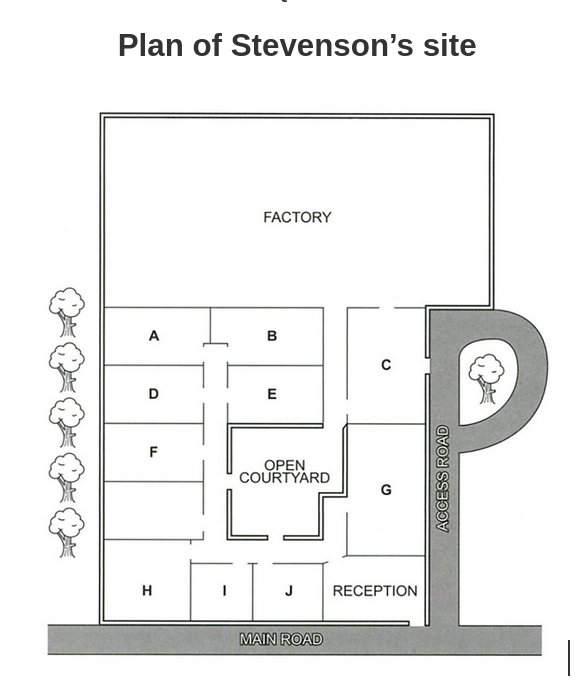
Label the map below. Match the correct letter, A-J, next to Questions 15-20.
Part 3
Questions
21 – 22
Choose TWO letters, A-E. Which TWO parts of the introductory stage to their art projects do Jess and Tom agree were useful?
- 2122
- Athe Bird Park visitBthe workshop sessionsCthe Natural History Museum visitDthe projects done in previous yearsEthe handouts with research sources
Questions
23 – 24
Choose TWO letters, A-E. In which TWO ways do both Jess and Tom decide to change their proposals?
- 2324
- Aby giving a rationale for their action plansBby being less specific about the outcomeCby adding a video diary presentationDby providing a timeline and a mind mapEby making their notes more evaluative
Questions
25 – 30
Which personal meaning do the students decide to give to each of the following pictures? Choose SIX answers from the box and write the correct letter, A-H, next to Questions 25-30.
Part 4
Questions
31 – 40
Complete the notes below. Write ONE WORD ONLY for each answer.
Stoicism Stoicism is still relevant today because of its 31
appeal. Ancient Stoics ● Stoicism was founded over 2,000 years ago in Greece. ● The Stoics’ ideas are surprisingly well known, despite not being intended for 32
Stoic principles ● Happiness could be achieved by leading a virtuous life. ● Controlling emotions was essential. ● Epictetus said that external events cannot be controlled, but the 33
people make in response can be controlled. ● A Stoic is someone who has a different view on experiences which others would consider as 34
The influence of Stoicism ● George Washington organised a 35
about Cato to motivate his men. ● The French artist Delacroix was a Stoic. ● Adam Smith’s ideas on 36
were influenced by Stoicism. ● Some of today’s political leaders are inspired by the Stoics. ● Cognitive Behaviour Therapy (CBT) – the treatment for 37
is based on ideas from Stoicism – people learn to base their thinking on 38
● In business, people benefit from Stoicism by identifying obstacles as 39
Relevance of Stoicism ● It requires a lot of 40
, but Stoicism can help people to lead a good life. ● It teaches people that having a strong character is more important than anything else.
Part 1
Questions
1 – 10Complete the notes below. Write ONE WORD AND/OR A NUMBER for each answer.
Giải thích đáp án
Transcript
Lưu ý
Những từ bôi vàng: Các keywords xuất hiện trong câu hỏi
Những từ bôi cam: Ngôn ngữ chỉ dẫn
Những từ bôi xanh: Đáp án
SARAH: Hello. Children’s Engineering Workshops.
FATHER: Oh hello. I wanted some information about the workshops in the school holidays.
SARAH: Sure.
FATHER: I have two daughters who are interested. The younger one’s Lydia, she’s four – do you take children as young as that?
Ads by Ad.Plus
SARAH: Yes, our Tiny Engineers workshop is for four to five-year-olds.
FATHER: What sorts of activities do they do?
SARAH: All sorts. For example, they work together to design a special cover that goes round an egg [họ làm việc cùng nhau để thiết kế một vỏ bọc đặc biệt bao quanh một quả trứng] (Question 1), so that when it’s inside they can drop it from a height and it doesn’t break. Well, sometimes it does break but that’s part of the fun!
FATHER: Right. And Lydia loves building things. Is there any opportunity for her to do that?
SARAH: Well, they have a competition to see who can make the highest [= build the tallest] tower [họ có một cuộc thi để xem ai có thể làm được tháp cao nhất] (Question 2). You’d be amazed how high they can go.
FATHER: Right.
SARAH: But they’re learning all the time as well as having fun. For example, one thing they do is to design and build a car that’s attached to a balloon [một điều họ làm là thiết kế và chế tạo một chiếc ô tô gắn vào khinh khí cầu] (Question 3), and the force of the air in that actually powers the car and makes it move along. They go really fast too.
FATHER: OK, well, all this sounds perfect.
————————–
FATHER: Now Carly, that’s my older daughter, has just had her seventh birthday, so presumably she’d be in a different group?
SARAH: Yes, she’d be in the Junior Engineers. That’s for children from six to eight.
FATHER: And do they do the same sorts of activities?
SARAH: Some are the same, but a bit more advanced. So they work out how to build model vehicles, things like cars and trucks, but also how to construct animals [họ tìm ra cách chế tạo các loại xe mô hình, những thứ như ô tô và xe tải, cũng như cách chế tạo động vật] (Question 4) using the same sorts of material and technique, and then they learn how they can program them and make them move.
FATHER: So they learn a bit of coding?
SARAH: They do. They pick it up really quickly. We’re there to help if they need it, but they learn from one another too.
FATHER: Right. And do they have competition too?
SARAH: Yes, with the Junior Engineers, it’s to use recycled materials like card and wood to build a bridge [đó là sử dụng các vật liệu tái chế như thẻ và gỗ để xây dựng một cây cầu] (Question 5), and the longest one gets a prize.
FATHER: That sounds fun. I wouldn’t mind doing that myself!
SARAH: Then they have something a bit different, which is to think up an idea for a five-minute [= short] movie and then film it, using special animation software [nghĩ ra ý tưởng cho một bộ phim dài năm phút và sau đó quay phim bằng cách sử dụng phần mềm hoạt hình đặc biệt] (Question 6) You’d be amazed what they come up with.
FATHER: And of course, that’s something they can put on their phone and take home to show all their friends.
SARAH: Exactly. And then they also build a robot in the shape of a human, and they decorate it and program it so that it can move its arms and legs [chế tạo một con rô bốt với hình dáng của con người, họ trang trí và lập trình để nó có thể cử động tay và chân] (Question 7)
FATHER: Perfect. So, is it the same price as the Tiny Engineers?
SARAH: It’s just a bit more: £50 for the five weeks.
FATHER: And are the classes on a Monday, too? [Là đáp án gây nhiễu cũng đồng thời là ngôn ngữ chỉ dẫn – cần sự xác nhận về ngày diễn ra lớp học]
SARAH: They used to be, but we found it didn’t give our staff enough time to clear up after the first workshop, so we moved them to Wednesdays [Trước đây là như vậy, nhưng chúng tôi nhận thấy điều đó không cho nhân viên của chúng tôi đủ thời gian để dọn dẹp sau hội thảo đầu tiên, vì vậy chúng tôi đã chuyển các lớp sang Thứ Tư] (Question 8). The classes are held in the morning from ten to eleven.
FATHER: OK. That’s better for me actually. And what about the location? Where exactly are the workshops held?
SARAH: They’re in building 10A – there’s a big sign on the door, you can’t miss it, and that’s in Fradstone Industrial Estate.
FATHER: Sorry? [Ngôn ngữ chỉ dẫn để báo trước việc sẽ có đánh vần tên riêng]
SARAH: Fradstone – that’s F-R-A-D-S-T-O-N-E. (Question 9)
FATHER: And that’s in Grasford, isn’t it?
SARAH: Yes, up past the station.
FATHER: And will I have any parking problems there? (Question 10)
SARAH: No, there’s always plenty available [Và liệu tôi có gặp vấn đề gì khi đỗ xe ở đó không?- Không, luôn có nhiều] So would you like to enrol Lydia and Carly now?
FATHER: OK.
SARAH: So can I have your full name …
Part 2
Questions
11 – 14Choose the correct letter, A, B or C
- 11
Stevenson’s was founded in
Bạn chưa trả lời câu hỏi này
- A
1923
B1924
C1926
Giải thích đáp án
Transcript
Lưu ý
Những từ bôi vàng: Các keywords xuất hiện trong đề bài
Những từ bôi cam: Đáp án gây nhiễu
Những từ bôi xanh: Đáp án
Good morning, everyone, and welcome to Stevenson’s, one of the country’s major manufacturers of metal goods. Thank you for choosing us for your two weeks of work experience. My name is Julia Simmons, and since the beginning of this year I’ve been the managing director.
Stevenson’s is quite an old company. Like me, the founder, Ronald Stevenson, went into the steel industry when he left school – that was in 1923 [Đây là năm Stevenson bỏ học ⇒ loại đáp án A]. He set up this company when he finished his apprenticeship, in 1926 [Ông thành lập công ty này khi hoàn thành khóa học việc của mình vào năm 1926 ⇒ đáp án B] (Question 11), although he actually started making plans two years earlier, in 1924 [Đây là năm ông lên kế hoạch cho việc thành lập công ty, không phải năm công ty được thành lập ⇒ loại đáp án B]. He was a very determined young man!
- 12
Originally, Stevenson’s manufactured goods for
Bạn chưa trả lời câu hỏi này
- A
the healthcare industry.
Bthe automotive industry.
Cthe machine tools industry.
Giải thích đáp án
Transcript
Lưu ý
Những từ bôi vàng: Các keywords xuất hiện trong đề bài
Những từ bôi cam: Đáp án gây nhiễu
Những từ bôi xanh: Đáp án
Stevenson’s long-term plan was to manufacture components for the machine tools industry – although in fact that never came about – and for the automotive industry [Đây là các kế hoạch dài hạn và chưa bao giờ xảy ra ⇒ loại đáp án B & C] that is, cars and lorries. However, there was a delay of five years before that happened, because shortly before the company went into production [= originally], Stevenson was given the opportunity to make goods for hospitals and other players in the healthcare industry [Stevenson đã có cơ hội sản xuất hàng hóa cho các bệnh viện và những người chơi khác trong ngành chăm sóc sức khỏe ⇒ đáp án A] (Question 12), so that’s what we did for the first five years.
- 13
What does the speaker say about the company premises?
Bạn chưa trả lời câu hỏi này
- A
The company has recently moved.
BThe company has no plans to move.
CThe company is going to move shortly.
Giải thích đáp án
Transcript
Lưu ý
Những từ bôi vàng: Các keywords xuất hiện trong đề bài
Những từ bôi cam: Đáp án gây nhiễu
Những từ bôi xanh: Đáp án
Over the years, we’ve expanded the premises considerably – we were lucky that the site is big enough, so moving to a new location has never been necessary [chúng tôi may mắn rằng địa điểm làm việc đủ lớn, vì vậy việc di chuyển đến một địa điểm mới chưa bao giờ là cần thiết = Công ty không có kế hoạch dời đi ⇒ đáp án B] (Question 13). However, the layout is far from ideal for modern machinery and production methods, so we intend to carry out major refurbishment of this site over the next five years.
- 14
The program for the work experience group includes
Bạn chưa trả lời câu hỏi này
- A
time to do research.
Bmeetings with a teacher.
Ctalks by staff.
Giải thích đáp án
Transcript
Lưu ý
Những từ bôi vàng: Các keywords xuất hiện trong đề bài
Những từ bôi cam: Đáp án gây nhiễu
Những từ bôi xanh: Đáp án
I’d better give you some idea of what you’ll be doing during your two weeks with us [= The programme for the work experience group], so you know what to expect. Most mornings you’ll have a presentation from one of the managers [một bài thuyết trình từ một trong những người quản lý = những bài nói với nhân viên ⇒ đáp án C (Question 14), to learn about their department, starting this morning with research and development. And you’ll all spend some time in each department, observing what’s going on and talking to people – as long as you don’t stop them from doing their work altogether! In the past, a teacher from your school has come [Hoạt động này chỉ diễn ra trong quá khứ ⇒ loại đáp án B]in at the end of each week to find out how the group were getting on, but your school isn’t able to arrange that this year.
Questions
15 – 20Label the map below. Match the correct letter, A-J, next to Questions 15-20.
Bạn chưa trả lời câu hỏi này
H
Bạn chưa trả lời câu hỏi này
C
Bạn chưa trả lời câu hỏi này
G
Bạn chưa trả lời câu hỏi này
B
Bạn chưa trả lời câu hỏi này
I
Bạn chưa trả lời câu hỏi này
A
Giải thích đáp án
Transcript
Lưu ý
Những từ bôi vàng: Các điểm cố định trên bản đồ
Những từ bôi cam: Ngôn ngữ chỉ dẫn
Những từ bôi xanh: Điểm cần xác định
OK, now I’ll briefly help you to orientate yourselves around the site. As you can see, we’re in the reception area, which we try to make attractive and welcoming to visitors. There’s a corridor running left from here, and if you go along that, the door facing you at the end is the entrance to the coffee room [Có một hành lang chạy bên trái từ đây và nếu bạn đi dọc theo đó, cánh cửa đối diện với bạn ở cuối là lối vào phòng cà phê ⇒ đáp án H] (Question 15) This looks out onto the main road on one side, and some trees on the other, and that’ll be where you meet each morning.
The factory is the very big room on the far side of the site. Next to it is the warehouse [Nhà máy là một căn phòng rất lớn ở phía xa của địa điểm. Bên cạnh đó là nhà kho ⇒ đáp án C] which can be accessed by lorries going up the road to the turning area at the end. You can get to the warehouse by crossing to the far side of the courtyard, and then the door is on your right (Question 16).
Somewhere you’ll be keen to find is the staff canteen. This is right next to reception [Nó ở ngay cạnh quầy lễ tân ⇒ đáp án G] (Question 17). I can confidently say that the food’s very good, but the view isn’t. The windows on one side look onto a corridor and courtyard, which aren’t very attractive at all, and on the other onto the access road, which isn’t much better.
You’ll be using the meeting room quite often, and you’ll find it by walking along the corridor to the left of the courtyard, and continuing along it to the end. The meeting room is the last one on the right [đi dọc theo hành lang bên trái của sân, và tiếp tục dọc theo nó cho đến cuối. Phòng họp là phòng cuối cùng bên phải ⇒ đáp án B] (Question 18), and I’m afraid there’s no natural daylight in the room.
Then you’ll need to know where some of the offices are. The human resources department is all the front of this building, so you head to the left along the corridor from reception, and it’s the second room you come to [Bộ phận nhân sự là tất cả mặt trước của tòa nhà này, vì vậy bạn đi về bên trái dọc theo hành lang từ lễ tân và đó là phòng thứ hai bạn đến ⇒ đáp án I] It looks out onto the main road (Question 19)
And finally, the boardroom, where you’ll be meeting sometimes. That has quite a pleasant view, as it looks out onto the trees. Go along the corridor past the courtyard, right to the end. The boardroom is on the left, next to the factory [Đi dọc hành lang qua sân, đến cuối sân. Phòng họp ở bên trái, bên cạnh nhà máy ⇒ đáp án A] (Question 20)
OK, now are there any questions before we …
Part 3
Questions
21 – 22Choose TWO letters, A-E. Which TWO parts of the introductory stage to their art projects do Jess and Tom agree were useful?
- 2122
Bạn chọn thiếu đáp án này
Bạn chọn thiếu đáp án này
Giải thích đáp án
Transcript
Lưu ý
Những từ bôi vàng: Các keywords xuất hiện trong đề bài
Những từ bôi cam: Đáp án gây nhiễu
Những từ bôi xanh: Đáp án
*Lưu ý câu hỏi 21 và 22 muốn tìm ra 2 điểm là Jess và Tom ĐỒNG Ý (agree) với nhau, vậy nên hãy chú ý tới các dấu hiệu thể hiện sự đồng tình như “ Me too” hay “Yeah”, và các dấu hiệu thể hiện sự không đồng tình như “What a letdown” trong hội thoại
JESS: How are you getting on with your art project, Tom?
TOM: OK. Like, they gave us the theme of birds to base our project on, and I’m not really all that interested in wildlife. But I’m starting to get into it. I’ve pretty well finished the introductory stage.
JESS: So have I. When they gave us all those handouts with details of books and websites to look at [những tài liệu phát với thông tin chi tiết về sách và trang web để xem ⇒ đáp án C] (Question 21 & Question 22), I was really put off, but the more I read, the more interested I got.
TOM: Me too. I found I could research so many different aspects of birds in art – colour, movement, texture. So I was looking forward to the Bird Park visit [Đây là điều mà mọi người mong chờ nhưng vì trời mưa nên không quan sát được gì ⇒ loại đáp án A]
JESS: What a letdown! It poured with rain and we hardly saw a single bird. Much less use than the trip to the Natural History Museum [Ít sử dụng hơn nhiều so với chuyến đi đến Bảo tàng Lịch sử Tự nhiên ⇒ đáp án E] (Question 21 & Question 22).
TOM: Yeah, I liked all the stuff about evolution there. The workshop sessions with Dr Fletcher were good too, especially the brainstorming sessions.
JESS: I missed those because I was ill [Jess bỏ lỡ workshop sessions ⇒ loại đáp án B]. I wish we could’ve seen the projects last year’s students did.
TOM: Mm. I suppose they want us to do our own thing, not copy [Không nhắc tới việc Jess và Tom cảm thấy tài liệu này hữu ích ⇒ loại đáp án D]
Questions
23 – 24Choose TWO letters, A-E. In which TWO ways do both Jess and Tom decide to change their proposals?
- 2324
Bạn chọn thiếu đáp án này
Bạn chọn thiếu đáp án này
Giải thích đáp án
Transcript
Lưu ý
Những từ bôi vàng: Các keywords xuất hiện trong đề bài
Những từ bôi cam: Đáp án gây nhiễu
Những từ bôi xanh: Đáp án
*Lưu ý câu hỏi 23 và 24 muốn tìm ra 2 điểm mà CẢ JESS VÀ TOM QUYẾT ĐỊNH THAY ĐỔI.
JESS: Have you drafted your proposal yet?
TOM: Yes, but I haven’t handed it in. I need to amend some parts. I’ve realised the notes from my research are almost all just descriptions, I haven’t actually evaluated anything So I’ll have to fix [= change] that [ghi chú từ nghiên cứu của tôi hầu như chỉ là mô tả, tôi chưa thực sự đánh giá bất cứ điều gì. Vậy nên tôi sẽ sửa nó = làm cho ghi chú của họ mang tính đánh giá cao hơn ⇒ đáp án E] (Question 23 & Question 24).
JESS: Oh, I didn’t know we had to do that. I’ll have to look at that too. Did you do a timeline for the project?
TOM: Yes, and a mind map
JESS: Yeah, so did I [Cả 2 người đều làm timeline và mindmap rồi, không nhắc tới việc cần thay đổi ⇒ loại đáp án D]. I quite enjoyed that. But it was hard having to explain the basis for my decisions in my action plan.
TOM: What?
JESS: You know, give a rationale.
TOM: I didn’t realise we had to do that [Tom không biết cần phải làm action plan ⇒ loại đáp án A]. OK, I can add it now. And I’ve done the video diary presentation [Không đề cập tới cần thay đổi gì ⇒ loại đáp án C] and worked out what I want my outcome to be in the project.
JESS: Someone told me it’s best not to be too precise about your actual outcome at this stage, so you have more scope to explore your ideas later on. So I’m going to go back to my proposal to make it a bit more vague.
TOM: Really? OK, I’ll change that too then. [tốt nhất là không nên quá chính xác về kết quả thực tế của bạn – OK tôi cũng sẽ thay đổi nó = ít cụ thể hơn về kết quả ⇒ đáp án B] (Question 23 & Question 24)
Questions
25 – 30Which personal meaning do the students decide to give to each of the following pictures? Choose SIX answers from the box and write the correct letter, A-H, next to Questions 25-30.
Bạn chưa trả lời câu hỏi này
D. a potential threat
Bạn chưa trả lời câu hỏi này
C. fast movement
Bạn chưa trả lời câu hỏi này
A. a childhood memory
Bạn chưa trả lời câu hỏi này
H. a confused attitude to nature
Bạn chưa trả lời câu hỏi này
F. the continuity of life
Bạn chưa trả lời câu hỏi này
G. protection of nature
Giải thích đáp án
Transcript
Lưu ý
Những từ bôi vàng: Tên bức tranh
Những từ bôi xanh: Đáp án
TOM: One part of the project I’m unsure about is where we choose some paintings of birds and say what they mean to us. Like, I chose a painting of a falcon by Landseer. I like it because the bird’s standing there with his head turned to one side, but he seems to be staring straight at you. But I can’t just say it’s a bit scary, can I?
JESS: You could talk about the possible danger suggested by the bird’s look [mối nguy hiểm có thể xảy ra do cái nhìn của con chim = một mối đe dọa tiềm ẩn ⇒ đáp án D] (Question 25).
TOM: Oh, OK.
JESS: There’s a picture of a fish hawk by Audubon I like. It’s swooping over the water with a fish in its talons, and with great black wings which take up most of the picture.
TOM: So you could discuss it in relation to predators and food chains?
JESS: Well actually I think I’ll concentrate on the impression of rapid motion it gives [tập trung vào ấn tượng về chuyển động nhanh mà nó mang lại ⇒ đáp án C] (Question 26)
TOM: Right.
JESS: Do you know that picture of a kingfisher by van Gosh – it’s perching on a reed growing near a stream.
TOM: Yes, it’s got these beautiful blue and red and black shades.
JESS: Mm hm. I’ve actually chosen it because I saw a real kingfisher once when I was little, I was out walking with my grandfather [khi tôi còn nhỏ, tôi đã đi dạo với ông của tôi = kỷ niệm thời thơ ấu ⇒ đáp án A] (Question 27), and I’ve never forgotten it.
TOM: So we can use a personal link?
JESS: Sure.
TOM: OK. There’s a portrait called William Wells. I can’t remember the artist but it’s a middle-aged man who’s just shot a bird. And his expression, and the way he’s holding the bird in his hand suggests he’s not sure about what he’s done. To me it’s about how ambiguous people are in the way they exploit the natural world [con người mơ hồ như thế nào trong cách họ khai thác thế giới tự nhiên = một thái độ bối rối với thiên nhiên ⇒ đáp án H] (Question 28)
JESS: Interesting. There’s Gauguin’s picture Vairumati. He did it in Tahiti. It’s a woman with a white bird behind her that is eating a lizard, and what I’m interested in is what idea this bird refers to. Apparently, it’s a reference to the never-ending cycle of existence. [chu kỳ tồn tại không bao giờ kết thúc = sự liên tục của cuộc sống ⇒ đáp án F] (Question 29)
TOM: Wow. I chose a portrait of a little boy, Giovanni de Medici. He’s holding a tiny bird in one fist [nắm tay một con chim nhỏ = sự bảo vệ thiên nhiên ⇒ đáp án G] (Question 30). I like the way he’s holding it carefully so he doesn’t hurt it.
JESS: Ah right.
