
IELTS Handbook 18 – Test 2
11/10/2024 2024-10-11 1:26IELTS Handbook 18 – Test 2
PART 1
Questions
1 – 10
Questions 1-5. Complete the notes below. Write ONE WORD ONLY for each answer.
Transport survey Name: Sadie Jones Year of birth: 1991 Postcode: 1
Travelling by bus Date of bus journey: 2
Reason for trip: shopping and visit to the 3
Travelled by bus because cost of: 4
too high Got on bus at: 5
Street Complaints about bus service: – bus today was 6
– frequency of buses in the 7
Travelling by car Goes to the 8
by car Travelling by bicycle Dislikes travelling by bike in the city centre because of the 9
Doesn’t own a bike because of a lack of 10
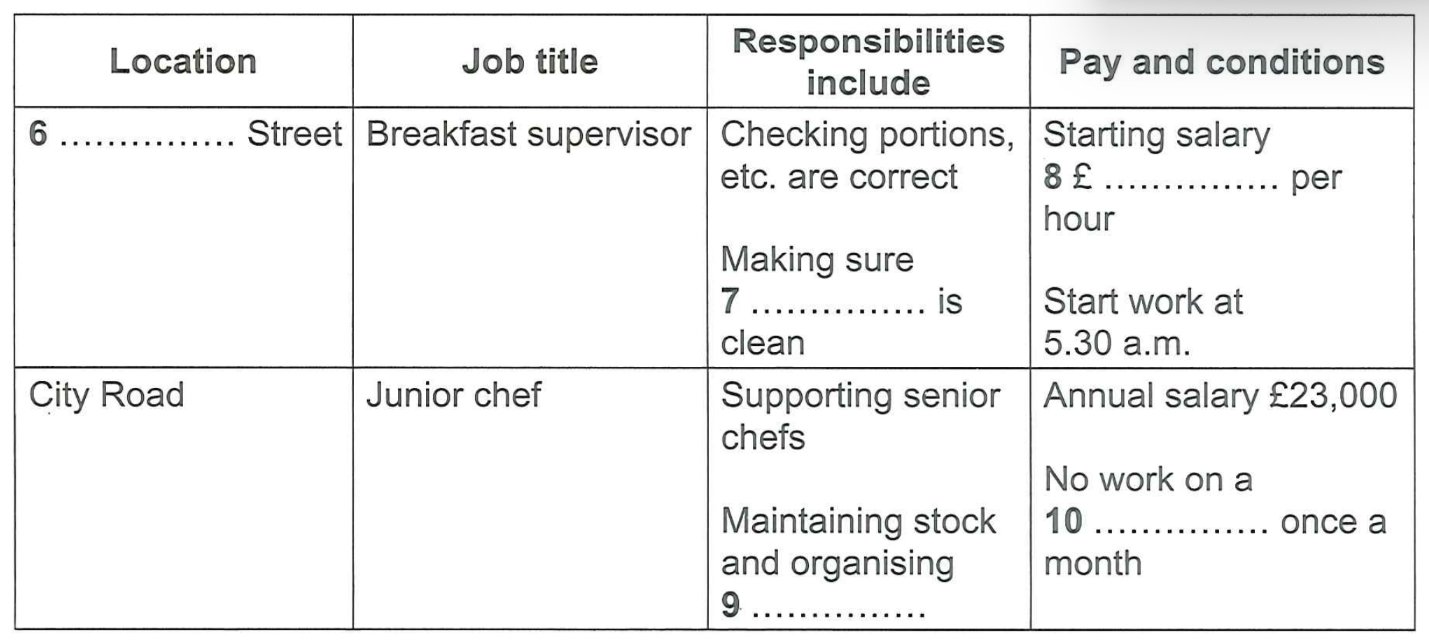
Questions 6-10 Complete the table below. Write ONE WORD AND/OR A NUMBER for each answer.
Question 6: 1
Question 7: 2
Question 8: 3
Question 9: 4
Question 10: 5
PART 2
Questions
11 – 13
Questions 11 and 12 Choose TWO letters, A-E. What are the TWO main reasons why this site has been chosen for the housing development?
- 67
- AIt has suitable geographical features.BThere is easy access to local facilities.CIt has good connections with the airport.DThe land is of little agricultural value.EIt will be convenient for workers.
Questions
14 – 15
Questions 13 and 14 Choose TWO letters, A-E. Which TWO aspects of the planned housing development have people given positive feedback about?
- 1415
- Athe facilities for cyclistsBthe impact on the environmentCthe encouragement of good relations between residentsDthe low cost of all the accommodationEthe rural location
Questions
16 – 20
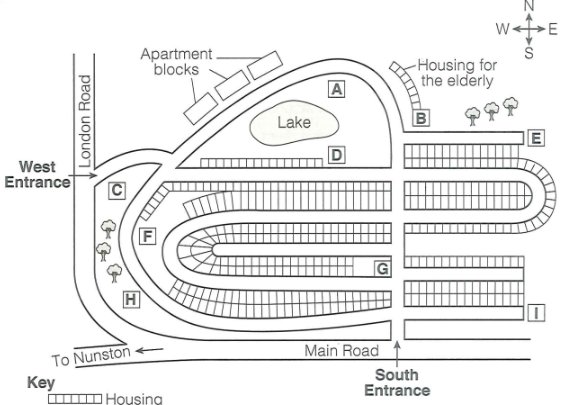
Questions 15-20 Label the map below. Write the correct letter, A-I, next to Questions 15-20.
PART 3
Questions
21 – 26
Questions 21-24 Choose the correct letter, A, B or C.
- 21
Questions 21. Why do the students think the Laki eruption of 1783 is so important?
- A
It was the most severe eruption in modern times.
BIt led to the formal study of volcanoes.
CIt had a profound effect on society.
- 22
Questions 22. What surprised Adam about observations made at the time?
- A
the number of places producing them
Bthe contradictions in them
Cthe lack of scientific data to support them
- 23
Questions 23. According to Michelle, what did the contemporary sources say about the Laki haze?
- A
People thought it was similar to ordinary fog.
BIt was associated with health issues.
CIt completely blocked out the sun for weeks.
- 24
Questions 24. Adam corrects Michelle when she claims that Benjamin Franklin
- A
came to the wrong conclusion about the cause of the haze.
Bwas the first to identify the reason for the haze.
Csupported the opinions of other observers about the haze.
Questions
27 – 28
Questions 25 and 26 Choose TWO letters, A-E. Which TWO issues following the Laki eruption surprised the students?
- 2728
- Ahow widespread the effects wereBhow long-lasting the effects wereCthe number of deaths it causedDthe speed at which the volcanic ash cloud spreadEhow people ignored the warning signs
Questions
29 – 30
Questions 27-30 What comment do the students make about the impact of the Laki eruption on the following countries? Choose FOUR answers from the box and write the correct letter, A-F, next to Questions 27-30.
PART 4
Questions
31 – 40Questions 31-40 Complete the notes below. Write ONE WORD ONLY for each answer.
PART 1
Questions
1 – 5Questions 1-5. Complete the notes below. Write ONE WORD ONLY for each answer.
Giải thích đáp án
WOMAN: So, I understand you’re interested in restaurant work?
MAN: Yes. I’ve got a bit of experience and I can provide references.
WOMAN: That’s good. I can check all that later. Now, Milo’s Restaurants have some vacancies at the moment. They’re a really good company to work for. Lots of benefits.
MAN: Oh right.
WOMAN: Yes. They’ve got a very good reputation for looking after staff. For example, (Q1) all employees (= all staff) get training [tất cả các nhân viên đều được đào tạo] – even temporary staff.
MAN: Oh really? That’s quite unusual, isn’t it?
WOMAN: Certainly is.
MAN: And do staff get free uniforms too?
WOMAN: Um… you just need to wear a white T-shirt and black trousers, it says here. So I guess not… But another benefit of working for a big company like this is that (Q2) you can get a discount at any of their restaurants. [bạn có thể được giảm giá tại bất kỳ nhà hàng nào.]
MAN: Even at weekends? [Ngay cả vào cuối tuần sao?]
WOMAN: No (= during weekdays) [Không đâu], but you’ll be working then anyway.
MAN: Oh yes. I suppose so. Most of their restaurants are in the city centre, aren’t they? So, easy to get to by bus?
WOMAN: Yes. That’s right. (Q3) But if you have to do a late shift and finish work after midnight, the company will pay for you to get a taxi home [Nhưng nếu bạn phải làm ca muộn và xong việc sau nửa đêm, công ty sẽ trả tiền taxi cho bạn về nhà].
MAN: I probably won’t need one. I think I’d use my bike.
WOMAN: OK. Now, they do have some quite specific requirements for the kind of person they’re looking for. Milo’s is a young, dynamic company and they’re really keen on creating a strong team. It’s really important that you can fit in and get on well with everyone.
MAN: Yeah. I’ve got no problem with that. It sounds good, actually. The last place I worked for was quite demanding too. (Q4) We had to make sure we gave a really high level (= high standard) of service [Chúng tôi phải đảm bảo cung cấp dịch vụ chất lượng cao].
WOMAN: That’s good to hear because that will be equally important at Milo’s. I know they want people who have an eye for detail.
MAN: That’s fine. I’m very used to working in that kind of environment.
WOMAN: Perfect. So the only other thing that’s required is good communication skills, (Q5) so you’ll need to have a certificate (= qualification) in English [vì vậy bạn sẽ cần phải có chứng chỉ tiếng Anh].
MAN: Sure.
Questions
6 – 10Questions 6-10 Complete the table below. Write ONE WORD AND/OR A NUMBER for each answer.
Giải thích đáp án
WOMAN: OK. Let’s have a look at the current job vacancies at Milo’s. The first one is (Q6) in Wivenhoe Street [ở Đường Wivenhoe].
MAN: Sorry, where?
WOMAN: Wivenhoe. W-I-V-E-N-H-O-E. It’s quite central, just off Cork Street.
MAN: Oh right.
WOMAN: They’re looking for a breakfast supervisor.
MAN: That would be OK.
WOMAN: So you’re probably familiar with the kind of responsibilities involved. Obviously checking that all the portions are correct, etc., and (Q7) then things like checking all the procedures for cleaning the equipment are being followed [sau đó là những việc như kiểm tra tất cả các quy trình vệ sinh thiết bị].
MAN: OK. And what about the salary? In my last job I was getting £9.50 per hour. I was hoping to get a bit more than that.
WOMAN: Well, (Q8) to begin with, you’d be getting £9.75 [ban đầu, bạn sẽ nhận được £9.75] but that goes up to £11.25 after three months.
MAN: That’s not too bad. And I suppose it’s a very early start?
WOMAN: Mmm. That’s the only unattractive thing about this job. But then you have the afternoons and evenings free. So the restaurant starts serving breakfast from 7 a.m. And you’d have to be there at 5.30 to set everything up. But you’d be finished at 12.30.
MAN: Mmm. Well, as you say, there are advantages to that.
WOMAN: Now, you might also be interested in the job at the City Road branch. That’s for a junior chef, so again a position of responsibility.
MAN: I might prefer that, actually.
WOMAN: Right, well obviously this role would involve supporting the sous chef and other senior staff. (Q9) And you’d be responsible for making sure there’s enough stock each week – and sorting out (= organizing) all the deliveries [Và bạn sẽ có trách nhiệm đảm bảo đủ hàng tồn kho hàng tuần – và sắp xếp tất cả các đơn giao hàng].
MAN: I’ve never done that before, but I imagine it’s fairly straightforward, once you get the hang of it.
WOMAN: Yes, and you’d be working alongside more experienced staff to begin with, so I’m sure it wouldn’t be a problem. The salary’s slightly higher here. It’s an annual salary of £23,000.
MAN: Right.
WOMAN: I know that if they like you, it’s likely you’ll be promoted quite quickly. So that’s worth thinking about.
MAN: Yes. It does sound interesting. What are the hours like?
WOMAN: The usual, I think. There’s a lot of evening and weekend work, but they’re closed on Mondays. (Q10) But you do get one Sunday off every four weeks (= once a month) [Nhưng cách bốn tuần bạn lại được nghỉ một ngày Chủ nhật]. So would you like me to send off your…
PART 2
Questions
11 – 12Questions 11 and 12 Choose TWO letters, A-E. What are the TWO main reasons why this site has been chosen for the housing development?
- 1112
- AIt has suitable geographical features.
Bạn chọn thiếu đáp án này
BThere is easy access to local facilities.CIt has good connections with the airport.DThe land is of little agricultural value.Bạn chọn thiếu đáp án này
EIt will be convenient for workers.
Giải thích đáp án
CÂU HỎI | TRANSCRIPT & GIẢI THÍCH |
What are the TWO main reasons why this site has been chosen for the housing development? A. It has suitable geographical features. B. There is easy access to local facilities. C. It has good connections with the airport. D. The land is of little agricultural value. E. It will be convenient for workers. | So one thing I’m sure you’ll want to know is why we’ve selected this particular site for a housing development. At present it’s being used for farming, like much of the land around Nunston. But because of the new industrial centre in Nunston, there’s a lot of demand for housing for employees in the region, as many employees are having to commute long distances at present. (=> E) [có nhu cầu lớn về nhà ở cho nhân viên trong khu vực, vì hiện nay nhiều nhân viên phải đi làm xa] Of course, there’s also the fact that we have an international airport just 20 minutes’ drive away, but although that’s certainly convenient, it wasn’t one of our major criteria for choosing the site. We were more interested in the fact that there’s an excellent hospital just 15 kilometres away, and a large secondary school even closer than that. (=> B) [Chúng tôi cảm thấy hứng thú hơn với việc có một bệnh viện tốt chỉ cách đó 15km và một trường trung học lớn thậm chí còn gần hơn thế.] |
DỊCH NGHĨA | |
Đâu là HAI nguyên nhân chính cho việc chọn địa điểm này cho dự án phát triển nhà ở? A. Nó có những đặc điểm về địa lý phù hợp. B. Dễ dàng tiếp cận với các tiện ích địa phương. C. Có thể dễ dàng di chuyển từ đó đến sân bay. D. Đất có ít giá trị nông nghiệp. E. Nó sẽ thuận tiện cho những người lao động. |
Questions
13 – 14Questions 13 and 14 Choose TWO letters, A-E. Which TWO aspects of the planned housing development have people given positive feedback about?
- 1314
- Athe facilities for cyclists
Bạn chọn thiếu đáp án này
Bthe impact on the environmentBạn chọn thiếu đáp án này
Cthe encouragement of good relations between residentsDthe low cost of all the accommodationEthe rural location
Giải thích đáp án
CÂU HỎI | TRANSCRIPT & GIẢI THÍCH |
Which TWO aspects of the planned housing development have people given positive feedback about? A. the facilities for cyclists B. the impact on the environment C. the encouragement of good relations between residents D. the low cost of all the accommodation E. the rural location | We’ve had a lot of positive feedback about the plans. People like the wide variety of accommodation types and prices, and the fact that it’s only a short drive to get out into the countryside from the development. We were particularly pleased that so many people liked the designs for the layout of the development, with the majority of people saying it generally made a good impression and blended in well with the natural features of the landscape, with provision made for protecting trees and wildlife on the site. (=> B) [nhìn chung nó tạo ấn tượng tốt và hòa hợp với những đặc điểm tự nhiên của cảnh quan, cùng với việc bảo vệ cây cối và động vật hoang dã trong khu vực] Some people have mentioned that they’d like to see more facilities for cyclists, and we’ll look at that, but the overall feedback has been that the design and facilities of the development make it seem a place where people of all ages can live together happily. (=> C) [thiết kế và cơ sở vật chất của dự án phát triển khiến nó trở thành nơi mà tất cả mọi người ở mọi lứa tuổi đều có thể chung sống hạnh phúc với nhau.] |
DỊCH NGHĨA | |
HAI khía cạnh nào của dự án phát triển nhà ở theo kế hoạch đã được người dân phản hồi tích cực? A. cơ sở vật chất cho những người đi xe đạp B. tác động đến môi trường C. sự khuyến khích những mối quan hệ tốt đẹp giữa các cư dân D. chi phi ăn ở thấp E. vị trí ở vùng nông thôn |
Questions
15 – 20Questions 15-20 Label the map below. Write the correct letter, A-I, next to Questions 15-20.
Bạn chưa trả lời câu hỏi này
G
Bạn chưa trả lời câu hỏi này
C
Bạn chưa trả lời câu hỏi này
D
Bạn chưa trả lời câu hỏi này
B
Bạn chưa trả lời câu hỏi này
H
Bạn chưa trả lời câu hỏi này
A
Giải thích đáp án
OK. So I’ll put a map of the proposed development up on the screen. You’ll see it’s bounded on the south side by the main road, which then goes on to Nunston. Another boundary is formed by London Road, on the western side of the development. Inside the development there’ll be about 400 houses and 3 apartment blocks.
There’ll also be a school for children up to 11 years old. (Q15) If you look at the South Entrance at the bottom of the map, there’s a road from there that goes right up through the development. The school will be on that road, at the corner of the second turning to the left. [Nếu bạn nhìn vào Lối vào phía Nam ở phía dưới của bản đồ, có một con đường từ đó đi thẳng qua khu đô thị mới. Trường học sẽ nằm trên con đường đó, ở góc của ngã rẽ thứ hai bên trái.]
A large sports centre is planned with facilities for indoor and outdoor activities. (Q16) This will be on the western side of the development, just below the road that branches off from London Road. [Nó sẽ nằm phía tây của khu đô thị mới, ngay bên dưới con đường rẽ nhánh từ Đường London.]
There’ll be a clinic where residents can go if they have any health problems. (Q17) Can you see the lake towards the top of the map? The clinic will be just below this, to the right of a street of houses. [Bạn có thấy cái hồ ở phía trên cùng của bản đồ không? Phòng khám sẽ ở ngay bên dưới cái này, phía bên phải của một dãy nhà.]
There’ll also be a community centre for people of all ages. (Q18) On the northeast side of the development, there’ll be a row of specially designed houses specifically for residents over 65, and the community centre will be adjoining this. [Ở phía đông bắc của khu đô thị mới, sẽ có một dãy nhà được thiết kế đặc biệt dành riêng cho những cư dân trên 65 tuổi, và trung tâm cộng đồng sẽ nằm liền kề với khu vực này.]
We haven’t forgotten about shopping. (Q19) There’ll be a supermarket between the two entrances to the development. We’re planning to leave the three large trees near London Road, and it’ll be just to the south of these. [Sẽ có một siêu thị giữa hai lối vào của khu đô thị mới. Chúng tôi dự định sẽ để lại ba cái cây lớn gần Đường London, và nó sẽ ở ngay phía nam của những cái cây này.]
It’s planned to have a playground for younger children. (Q20) If you look at the road that goes up from the South Entrance, you’ll see it curves round to the left at the top, and the playground will be in that curve, with nice views of the lake. [Nếu bạn nhìn vào con đường đi lên từ Lối vào phía Nam, bạn sẽ thấy nó uốn cong về phía bên trái ở trên cùng, và sân chơi sẽ nằm ở khúc cua đó, với tầm nhìn tuyệt đẹp hướng ra hồ.]
OK, so now does anyone …
PART 3
Questions
21 – 24Questions 21-24 Choose the correct letter, A, B or C.
- 21
Questions 21. Why do the students think the Laki eruption of 1783 is so important?
Bạn chưa trả lời câu hỏi này
- A
It was the most severe eruption in modern times.
BIt led to the formal study of volcanoes.
CIt had a profound effect on society.
Giải thích đáp án
CÂU HỎI | TRANSCRIPT & GIẢI THÍCH |
Why do the students think the Laki eruption of 1783 is so important? A. It was the most severe eruption in modern times. B. It led to the formal study of volcanoes. C. It had a profound effect on society. | Michelle: That’s right. But what I found more significant was how it impacted directly and indirectly on political events, as well as having massive social and economic consequences. [điều tôi thấy quan trọng hơn cả là cách nó tác động trực tiếp và gián tiếp đến các sự kiện chính trị, cũng như gây ra những hậu quả kinh tế và xã hội to lớn.] |
DỊCH NGHĨA | |
Tại sao học sinh lại nghĩ vụ phun trào Laki năm 1783 quan trọng? A. Nó là vụ phun trào dữ dội nhất trong thời hiện đại. B. Nó đã dẫn đến việc nghiên cứu chính thức về núi lửa. C. Nó đã có ảnh hưởng sâu sắc đến xã hội. |
- 22
Questions 22. What surprised Adam about observations made at the time?
Bạn chưa trả lời câu hỏi này
- A
the number of places producing them
Bthe contradictions in them
Cthe lack of scientific data to support them
Giải thích đáp án
CÂU HỎI | TRANSCRIPT & GIẢI THÍCH |
What surprised Adam about observations made at the time? A. the number of places producing them B. the contradictions in them C. the lack of scientific data to support them | Adam: Yeah. I was surprised there were so many weather stations established by that time [Tôi đã rất ngạc nhiên khi có nhiều trạm khí hậu được xây dựng vào thời điểm đó như vậy] – so, you know, you can see how the weather changed, often by the hour. |
DỊCH NGHĨA | |
Điều gì khiến Adam ngạc nhiên về những quan sát được thực hiện ở thời điểm đó? A. số nơi tạo ra chúng B. những mâu thuẫn bên trong chúng C. việc thiếu dữ liệu khoa học để củng cố chúng. |
- 23
Questions 23. According to Michelle, what did the contemporary sources say about the Laki haze?
Bạn chưa trả lời câu hỏi này
- A
People thought it was similar to ordinary fog.
BIt was associated with health issues.
CIt completely blocked out the sun for weeks.
Giải thích đáp án
CÂU HỎI | TRANSCRIPT & GIẢI THÍCH |
According to Michelle, what did the contemporary sources say about the Laki haze? A. People thought it was similar to ordinary fog. B. It was associated with health issues. C. It completely blocked out the sun for weeks. | Michelle: Reports from the period blamed the haze for an increase in headaches, respiratory issues and asthma attacks. [cho rằng khói mù là nguyên nhân làm gia tăng các cơn đau đầu, những vấn đề về hô hấp và hen suyễn.] |
DỊCH NGHĨA | |
Theo Michelle, những nguồn thông tin hiện nay nói gì về khói mù Laki? A. Mọi người nghĩ rằng nó giống như sương mù thông thường. B. Nó liên quan đến các vấn đề sức khỏe. C. Nó hoàn toàn che khuất đi ánh nắng mặt trời trong nhiều tuần. |
- 24
Questions 24. Adam corrects Michelle when she claims that Benjamin Franklin
Bạn chưa trả lời câu hỏi này
- A
came to the wrong conclusion about the cause of the haze.
Bwas the first to identify the reason for the haze.
Csupported the opinions of other observers about the haze.
Giải thích đáp án
CÂU HỎI | TRANSCRIPT & GIẢI THÍCH |
Adam corrects Michelle when she claims that Benjamin Franklin A. came to the wrong conclusion about the cause of the haze. B. was the first to identify the reason for the haze. C. supported the opinions of other observers about the haze. | Adam: Yeah. At first no one realised that the haze was caused by the volcanic eruption in Iceland. [Ban đầu không một ai nhận ra rằng khói mù là do núi lửa phun trào ở Iceland.] Michelle: It was Benjamin Franklin who realized that before anyone else. [Chính Benjamin Franklin đã nhận ra điều đó trước bất kỳ ai khác.] Adam: He’s often credited with that, apparently. But a French naturalist beat him to it [Rõ ràng là ông ấy thường được ghi nhận như vậy. Tuy nhiên một nhà tự nhiên học người Pháp đã làm được điều đó trước ông] – I can’t remember his name. |
DỊCH NGHĨA | |
Adam chữa lại lời của Michelle khi cô ấy cho rằng Benjamin Franklin A. đi đến kết luận sai về nguyên nhân dẫn đến khói mù. B. là người đầu tiên tìm ra nguyên nhân của khói mù. C. ủng hộ các quan điểm của những nhà quan sát khác về khói mù. |
Questions
25 – 26Questions 25 and 26 Choose TWO letters, A-E. Which TWO issues following the Laki eruption surprised the students?
- 2526
Bạn chọn thiếu đáp án này
Ahow widespread the effects wereBạn chọn thiếu đáp án này
Bhow long-lasting the effects wereCthe number of deaths it causedDthe speed at which the volcanic ash cloud spreadEhow people ignored the warning signs
Giải thích đáp án
CÂU HỎI | TRANSCRIPT & GIẢI THÍCH |
Which TWO issues following the Laki eruption surprised the students? A. how widespread the effects were B. how long-lasting the effects were C. the number of deaths it caused D. the speed at which the volcanic ash cloud spread E. how people ignored the warning signs | Adam: Mmm. You’d expect that – and the fact that the volcanic ash drifted so swiftly – but not that the effects would go on for so long. (=> B) [các ảnh hưởng sẽ tiếp diễn quá lâu] Or that two years after the eruption, strange weather events were being reported as far away as North America and North Africa. (=> A) [các hiện tượng thời tiết kỳ lạ đã được báo cáo ở tận Bắc Mỹ và Bắc Phi] |
DỊCH NGHĨA | |
HAI vấn đề nào sau đây sau vụ phun trào Laki đã khiến học sinh ngạc nhiên? A. mức độ lan tỏa của các ảnh hưởng B. các ảnh hưởng kéo dài bao lâu C. số ca tử vọng nó đã gây ra D. tốc độ lan rộng của đám mây tro bụi núi lửa E. cách con người lờ đi những dấu hiệu cảnh báo. |
Questions
27 – 30Questions 27-30 What comment do the students make about the impact of the Laki eruption on the following countries? Choose FOUR answers from the box and write the correct letter, A-F, next to Questions 27-30.
Bạn chưa trả lời câu hỏi này
D. Animals suffered from a sickness.
Bạn chưa trả lời câu hỏi này
A. This country suffered the most severe loss of life.
Bạn chưa trả lời câu hỏi này
C. There was a significant increase in deaths of young people.
Bạn chưa trả lời câu hỏi này
F. It caused a particularly harsh winter.
Giải thích đáp án
MICHELLE: We should run through some of the terrible consequences of the eruption experienced in different countries. There’s quite a varied range.
ADAM: Starting with Iceland, where the impact on farming was devastating.
MICHELLE: Mmm. One of the most dramatic things there was the effect on livestock (= Animals) as they grazed in the fields. They were poisoned (= sickness) (=> D) [Một trong những điều tồi tệ nhất là ảnh hưởng lên gia súc khi chúng được chăn thả trên đồng ruộng. Chúng đã bị trúng độc] because they ate vegetation that had been contaminated with fluorine as a result of the volcanic fallout.
ADAM: That was horrible. In Egypt, the bizarre weather patterns led to a severe drought and as a result the Nile didn’t flood, which meant the crops all failed.
MICHELLE: It’s so far from where the eruption happened and yet the famine there led to more people dying (= loss of life) than any other country. (=> A) [Nó cách xa nơi xảy ra vụ phun trào nhưng nạn đói ở đó đã dẫn đến nhiều người chết hơn bất kỳ quốc gia nào khác.] It was worse than the plague.
ADAM: OK. Then in the UK the mortality rate went up a lot – presumably from respiratory illnesses. According to one report it was about double the usual number and included an unusually high percentage of people under the age of 25 (= young people). (=> C) [Sau đó, ở Anh, tỷ lệ tử vong tăng mạnh – có lẽ là do các bệnh về đường hô hấp. Theo một báo cáo, con số này cao khoảng gấp đôi so với thông thường, trong đó tỷ lệ người dưới 25 tuổi cao một cách bất thường.]
MICHELLE: Mmm. I think people will be surprised to hear that the weather in the USA was badly affected too. George Washington even makes a note in his diary that they were snowbound until March in Virginia. [thời tiết ở Mỹ cũng bị ảnh hưởng xấu. George Washington thậm chí còn ghi chú trong nhật ký của mình rằng họ đã bị mắc kẹt trong tuyết cho đến tháng Ba ở Virginia.] That was before he became president.
ADAM: Yes, and there was ice floating down the Mississippi, which was unprecedented. (=> F) [Đúng vậy, và có cả băng trôi xuống Mississippi, điều này chưa từng có trước đây.]
MICHELLE: Astonishing, really. Anyway, what do you think…
PART 4
Questions
31 – 40Questions 31-40 Complete the notes below. Write ONE WORD ONLY for each answer.
Giải thích đáp án
Good morning. Now, we’ve been asked to choose an aspect of European clothing or fashion and to talk about its development over time.
I decided to focus on a rather small area of clothing and that’s pockets. I chose pockets for two reasons, really. We all have them – in jeans, jackets, coats, for example – and even though we often carry bags or briefcases as well, (Q31) nothing is quite as convenient as being able to pop your phone or credit card into your pocket [không có gì thuận tiện bằng việc có thể đút điện thoại hoặc thẻ tín dụng vào túi]. Yet, I suspect that, other than that, people don’t really think about pockets too much and they’re rather overlooked as a fashion item.
It’s certainly very interesting to go back in time and see how pockets developed for men and women. In the 18th century, fashions were quite different from the way they are now, and pockets were too. (Q32) If we think about male fashion first… that was the time when suits became popular [Nếu chúng ta nghĩ về thời trang nam trước… đó là thời điểm mà những bộ vest trở nên thịnh hành]. Trousers were knee-length only and referred to as ‘breeches’, the waistcoats were short and the jackets were long, but (Q33) all three garments were lined with material and pockets were sewn (= sewed pockets into the lining of the garments) into this cloth by whichever tailor the customer used [cả ba loại trang phục đều được lót bằng vải và túi được may vào lớp vải này bởi bất kỳ thợ may nào mà khách hàng đã thuê]. The wearer could then carry small objects such as pencils or coins on their person and reach them through a gap in the lining. Coat pockets became increasingly decorative on the outside for men who wanted to look stylish, but (Q34) they were often larger (= bigger) but plainer if the wearer was someone with a profession who needed to carry medical instruments – a doctor or physician, for example [chúng thường lớn hơn nhưng đơn giản hơn nếu người mặc là một người có nghề cần mang theo dụng cụ y tế – chẳng hạn như bác sĩ hay y sĩ.]
The development of women’s pockets was a little different. (Q35) For one thing, they weren’t nearly as visible or as easy to reach as men’s [Trước hết, chúng gần như không dễ thấy hoặc dễ tiếp cận như túi của đàn ông]. In the 18th and 19th centuries, women carried numerous possessions on their person and some of these could be worth a lot of money. Women were more vulnerable to theft and wealthy women, in particular, worried constantly about pickpockets. (Q36) So what they did was to have a pair of pockets made that were tied together (= link them together) with string [Vì vậy, những gì họ đã làm là tạo ra một cặp túi được buộc lại với nhau bằng dây]. The pockets were made of fabric, which might be recycled cloth if the wearer had little money or something more expensive, such as linen, sometimes featuring very delicate embroidery. (Q37) Women tied the pockets around their waist so that they hung beneath (= hung … under) their clothes [Những người phụ nữ đã buộc túi quanh eo để chúng treo dưới quần áo của họ]. Remember, skirts were long then and there was plenty of room to hide a whole range of small possessions between the layers of petticoats that were commonly worn. (Q38) They would have an opening (= a gap) in the folds of their skirts through which they could reach whatever they needed, like their perfume [Họ sẽ có một lỗ hở trong các nếp gấp của váy để có thể lấy bất cứ thứ gì họ cần, chẳng hạn như nước hoa]. Working women, of course, also needed to carry around items that they might use for whatever job or trade they were involved in, but their pairs of pockets still remained on the inside of their clothing, they just got bigger or longer-sometimes reaching down to their knees!
So the tie-on pockets went well into the 19th century and only changed when fashion altered towards the end of that period. (Q39) That’s when dresses became tighter and less bulky (= dresses changed shape), and the pairs of pockets became very noticeable – they stood out too much and detracted from (= had a negative effect on) the woman’s image [Đó là khi những chiếc váy trở nên ôm sát và ít phồng hơn, và những cặp túi trở nên lộ hơn – chúng quá nổi bật và làm giảm hình ảnh người phụ nữ]. Women who had been used to carrying around a range of personal possessions and still wanted to – needed somewhere to carry these items about their person. (Q40) That was when small bags, or pouches as they were known, came into fashion and, of course, they inevitably led on to the handbag of more modern times [Đó là khi những chiếc túi nhỏ, hay còn được gọi là túi pouch, trở nên thịnh hành và đương nhiên, chúng đã dẫn đến sự xuất hiện của túi xách ở thời đại hiện đại hơn], particularly when fashion removed pockets altogether.
