
Path to Success – Test 1
24/10/2024 2024-10-24 0:24Path to Success – Test 1
Part 1
Questions
1 – 6
Questions 1-6 Complete the notes below. Write NO MORE THAN TWO WORDS AND/OR A NUMBER for each answer.
PRESTON PARK RUN Details of run Example Day of Park Run: Saturday ————————– Start of run: in front of the 1
Time of start: 2
A.M. Length of run: 3
kilometres At end of run: volunteer scans a 4
Best way to register: on the 5
Cose of run: 6£
Questions
7 – 10
Questions 7-10 Complete the notes below. Write NO MORE THAN TWO WORDS AND/OR A NUMBER for each answer.
Volunteering Contact name: Pete 7
Phone number: 8
Activities: setting up course 9
the runners 10
for the weekly report
Part 2
Questions
11 – 14
Questions 11-14 Complete the table below. Write NO MORE THAN THREE WORDS AND/OR A NUMBER for each answer.
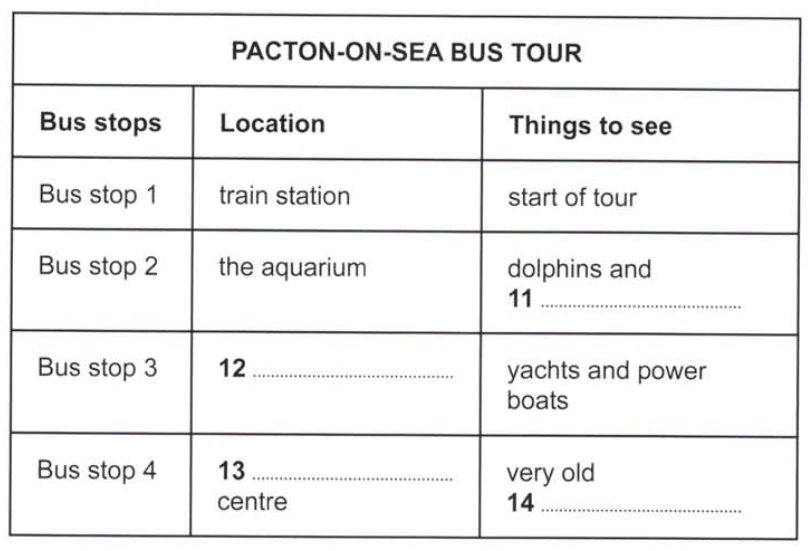
Chỗ trống 11: 11
Chỗ trống 12: 12
Chỗ trống 13: 13
Chỗ trống 14: 14
Questions
15 – 20
Questions 15-20 Complete the sentences below. Write NO MORE THAN TWO WORDS AND/OR A NUMBER for each answer.
You need to have a 15
to buy a ticket for £10. The bus tour lasts 16
in total. The cost of the bus ticket includes entrance to the 17
. You can listen to an audio commentary which has been made by the 18
. If the weather is wet, it is a good idea to bring 19
. Don’t forget to bring your 20
when you book online.
Part 3
Questions
21 – 26
Questions 21-26 Choose the correct letter, A, B or C.
- 21
Dave Hadley says that the computersystem has
- A
too many users.
Bnever worked well.
Cbecome outdated.
- 22
The main problem with the computersystem is that it
- A
is too slow.
Bstops working.
Cdisplays incorrect data.
- 23
Timetabling has become an issue because
- A
there is not enough time for anyone to do it.
Bthe system does not handle course options.
Cthe courses are constantly changing.
- 24
To solve the timetablingissues, Randhir suggests that
- A
students should create their own timetables.
BDave should have someone to assist him.
Cthe number of courses should be reduced.
- 25
Randhir says that a new system may
- A
need to be trialled.
Bstill have problems.
Cbe more economical.
- 26
Improvingthe existingsystem will take
- A
a few weeks.
Bfour or five months.
Cnine months.
Questions
27 – 30
Questions 27-30 Complete the flow-chart below. Write NO MORE THAN TWO WORDS for each answer.
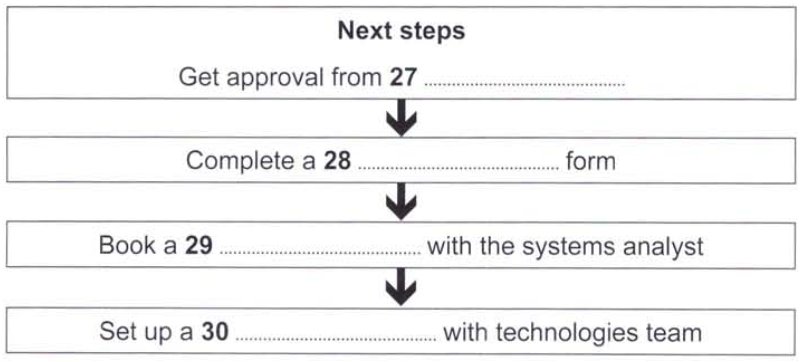
Chỗ trống 27: 27
Chỗ trống 28: 28
Chỗ trống 29: 29
Chỗ trống 30: 30
Part 4
Questions
31 – 40
Questions 31-40 Complete the sentences below. Write NO MORE THAN TWO WORDS AND/OR A NUMBER for each answer.
CERAMICS Ceramics date back approximately 31
. The first figurines were made in the area of 32
. Early humans could not use their pots to store 33
. The Chinese improved the quality of ceramics by mixing 34
with the clay. Chinese porcelain was also called 35
. Bottger added quartz and 36
to clay to make porcelain. GLASS Glass production is similar to clay ceramics apart from the rate of 37
. The Romans introduced the use of glass to make 38
. CONCRETE The discovery of concrete is probably due to observing reactions of water and 39
. The ability to build large 40
contributed to the success of the Roman Empire.
Part 1
Questions
1 – 6Questions 1-6 Complete the notes below. Write NO MORE THAN TWO WORDS AND/OR A NUMBER for each answer.
Giải thích đáp án
A: Good morning – Dave Smith speaking.
B: Hi- could I speak to the organizer of the Preston Park Run?
A: Yes, that’s me.
B: Great — um – I was talking to some friends of mine about the run and they suggested I contact you to get some more details.
A: Sure – what would you like to know?
B: Well – they said it takes place every Saturday, is that right?
A: Yes it does.
B: OK – great!
A: Do you know where the park is?
B: Oh yes — I’ve been there before. But it’s quite big and I’mnot sure where to go.
A: Well there’s a circular track that goes right around the park. (Q1)The run starts at the café, goes past the tennis courts then twice around the lake and finishes back where it started. (Cuộc thi chạy bắt đầu tại quán cà phê, đi qua sân quần vợt, sau đó là hai vòng quanh hồ và kết thúc ở nơi bắt đầu)
B: OK and what time is the run?
A: (Q2) Well the actual run begins at 9 am but the runners start arriving at about 8.45 (Chà, cuộc chạy thực tế bắt đầu lúc 9 giờ sáng nhưng các vận động viên bắt đầu đến vào khoảng 8 giờ 45 phút)
B: OK – so I need to get up early Saturday morning then. And how long is the run?
A: (Q3) Well it used to be three kilometers but most people wanted to do a bit more than that so we lengthened it to five kilometers – we now go round the lake twice and that adds an extra two kilometers. (Trước đây từng là 3km nhưng hầu hết mọi người muốn chạy nhiều hơn thế nên chúng tôi kéo dài nó thành 5km – bây giờ chúng ta đi vòng quanh hồ hai lần và như vậy thêm 2km nữa).
B: Right – not sure I’ve ever run that far so I’d better start doing a bit of training.
A: That’s a good idea. But it’s not a race, it’s really just for fun and the best thing would be to take it easy the first few times you do it and then see if you can gradually improve your time.
B: Is the run timed then? How do I know how well I’ve Done?
A: (Q4) When you cross the finish line you’ll be given a barcode and you take this to one of the run volunteers, who will scan it (Khi bạn vượt qua vạch đích, bạn sẽ nhận được một mã vạch và bạn mang mã vạch này cho một trong những tình nguyện viên của cuộc thi chạy, người này sẽ quét mã vạch đó). Then you can get your time online when you go home.
B: Oh – I see. You collect all the results.
A: Exactly.
B: I see —that’s great. So how do I register?
A: (Q5) Well there are several ways. I could take your details over the phone but it’s much easier if you do it using the website (Vâng, có một số cách. Tôi có thể lấy thông tin chi tiết của bạn qua điện thoại nhưng sẽ dễ dàng hơn nhiều nếu bạn sử dụng trang web).
B: OK – good. Um, I think that’s probably all I need to know for now. Oh yes – does it cost anything to register or do you collect money each week?
A: (Q6) Well it doesn’t cost anything to register but we do charge for the run. In fact we have just increased the charge to £1.50 (Chà, đăng ký không tốn bất kỳ chi phí nào nhưng chúng tôi tính phí cho cuộc chạy. Trên thực tế, chúng tôi vừa tăng phí lên £1,50). It used to be a pound but because we were making a bit of a loss we have had to increase it by 50p.
B: OK thanks. I think I have enough information on taking part in the run.
Questions
7 – 10Questions 7-10 Complete the notes below. Write NO MORE THAN TWO WORDS AND/OR A NUMBER for each answer.
Giải thích đáp án
B: Um – you mentioned volunteers. I have a friend who is interested in helping out. Can you give me some details so I can pass them on to her?
A: (Q7) Sure – well you need to ask your friend to contact Pete Maughan. He manages all the volunteers (Chắc chắn rồi – bạn cần bảo bạn mình liên hệ với Pete Maughan. Ông ấy quản lý tất cả các tình nguyện viên)
B: OK – I didn’t quite catch his surname – was it Morn —M-0-R-N?
A: No – just a bit more complicated – it’s M-A-U-G-H-A-N.
B: Right – thanks. And could you give me his phone number?
A: Yes – just a moment, It’s here somewhere – let me just find it. Ah I’ve two numbers for him. (Q8) I think the one that begins 0-1-2-7-3 is an old one so use this one: it’s 0-1-4-double 4-7-3-2-9-0-0 (Tôi nghĩ số bắt đầu 0-1-2-7-3 là số cũ nên hãy sử dụng số này: nó là 0-1-4-hai số 4- -7-3-2-9-0-0)
B: OK – got that. Can you tell me anything about volunteering? Like what kind of activities it involves?
A: Sure – well we need volunteers for basic stuff like setting up the course. We have to do that before all the runners arrive.
B: OK – so that’s a really early start!
A: Yes that’s right. (Q9) But if your friend would prefer to arrive a bit later she can also help with guiding the runners so they don’t go the wrong way (Nhưng nếu bạn của bạn muốn đến muộn hơn một chút, cô ấy cũng có thể giúp hướng dẫn người chạy để họ không đi sai đường)
B: Isee. I believe you do a report on some of the races.
A: Yes that’s right. In fact we do a weekly report on each race and we always try to illustrate it.
B: (Q10) OK – well my friend really likes taking photographs. She’s Just bought a new camera (OK – bạn tôi rất thích chụp ảnh. Cô ấy vừa mua một chiếc máy ảnh mới)
A: Actually that would be great. I don’t know whether Pete has anyone to take photographs with this week.
B: Oh, I’ll let her know.
A: OK, good. Could you ask your friend to phone Pete and let him know?
B: Yes I will.
A: OK thanks. Goodbye.
B: Goodbye.
Part 2
Questions
11 – 14Questions 11-14 Complete the table below. Write NO MORE THAN THREE WORDS AND/OR A NUMBER for each answer.
Giải thích đáp án
Questions
15 – 20Questions 15-20 Complete the sentences below. Write NO MORE THAN TWO WORDS AND/OR A NUMBER for each answer.
Giải thích đáp án
(Q15) An adult ticket costs £15, children under the age of fifteen are £5 and student tickets are £10 as long as you have a student card (Vé người lớn là £15, trẻ em dưới mười lăm tuổi là £5 và vé sinh viên là £10 miễn là bạn có thẻ sinh viên)
All tickets are valid for 24 hours, which means that you can get on and off the bus as many times as you like within a 24-hour period.
So you could, for example, start the tour in the afternoon and complete it the following morning.
The first bus of the day leaves the station at 10 am and the last one of the day leaves at 6 pm.
(Q16) Buses leave every thirty minutes and each tour takes a total of fifty minutes (Xe buýt khởi hành cứ sau ba mươi phút và mỗi chuyến tham quan mất tổng cộng năm mươi phút)
There are many attractions at each of the stops, so wherever you get off the bus there will be plenty to do.
(Q17) The bus tour tickets do not include entrance to any of these attractions apart from the museum which is located near the aquarium (Vé tham quan bằng xe buýt không bao gồm vé vào cổng bất kỳ điểm tham quan nào ngoài bảo tàng nằm gần thủy cung)
Some buses have local guides, who will point out places of interest and will provide information on the town.
(Q18) However, we cannot guarantee that every bus will have a guide and so we also have an audio commentary that has been specially recorded (=made) for the bus tour by the tourist office (Tuy nhiên, chúng tôi không thể đảm bảo rằng mọi xe buýt sẽ có hướng dẫn viên và vì vậy chúng tôi cũng có một bản thuyết minh đã được văn phòng du lịch ghi âm lại đặc biệt cho chuyến tham quan bằng xe buýt)
Headphones are available on the bus and these are easy to operate.
There is no extra charge for these – just plug in, select the required language and adjust the volume.
Due to the winter months being rather cold and wet in pacton-on-Sea, the bus tours only operate from March to September.
The weather is usually warm and sunny during these months so remember to bring some sun protection, especially on hot days.
(Q19) And of course, it does occasionally rain here in the summer so if the weather looks bad, remember to bring some rainwear (Và tất nhiên, ở đây thỉnh thoảng có mưa vào mùa hè nên nếu thời tiết có vẻ xấu, hãy nhớ mang theo áo mưa)
The bus tours are available no matter what the weather.
At the height of the summer the tours can get very busy so you are advised to book.
You can book tickets online, over the phone and also at the station and at any of the other tour stops.
When booking over the phone you can collect your tickets at any of the stops at the start of your tour.
(Q20) When you do it (=book) online you can print your e-ticket which you must remember to bring with you (Khi thực hiện trực tuyến, bạn có thể in vé điện tử và mang theo bên mình)
Thank you for calling the Paxton-on-Sea phone line and we look forward to seeing you soon on one of our tour buses.
Part 3
Questions
21 – 26Questions 21-26 Choose the correct letter, A, B or C.
- 21
Dave Hadley says that the computersystem has
Bạn chưa trả lời câu hỏi này
- A
too many users.
Bnever worked well.
Cbecome outdated.
Giải thích đáp án
CÂU HỎI | TRANSCRIPT & GIẢI THÍCH |
21. Dave Hadley says that the computer system has A. too many users. B. never worked well. C. become outdated. | Yes, that’s right. Um, I’m responsible for student admission to the college and I use a computer system to help process student enrolments and to do the timetabling. But it really doesn’t suit the way we work these days. It’s over ten years old and although it was fine when it was first introduced, it is just not good enough now (Nhưng nó thực sự không phù hợp với cách chúng ta làm việc ngày nay. Nó đã hơn mười năm tuổi và dù nó vẫn ổn khi lần đầu tiên được giới thiệu, nhưng bây giờ nó không đủ tốt) |
DỊCH NGHĨA | |
21. Dave Hadley nói rằng hệ thống máy tính có A. quá nhiều người dùng. B. không bao giờ làm việc tốt. C. trở nên lỗi thời. |
- 22
The main problem with the computersystem is that it
Bạn chưa trả lời câu hỏi này
- A
is too slow.
Bstops working.
Cdisplays incorrect data.
Giải thích đáp án
CÂU HỎI | TRANSCRIPT & GIẢI THÍCH |
22. The main problem with the computer system is that it A. is too slow. B. stops working. C. displays incorrect data. | Well, there’s a lot more data now and it sometimes seems the system has crashed but, in fact, it just takes ages to go from one screen to the next (phải mất nhiều thời gian để chuyển từ màn hình này sang màn hình tiếp theo). |
DỊCH NGHĨA | |
22. Vấn đề chính với hệ thống máy tính là nó A. quá chậm. B. ngừng hoạt động. C. hiển thị dữ liệu không chính xác. |
- 23
Timetabling has become an issue because
Bạn chưa trả lời câu hỏi này
- A
there is not enough time for anyone to do it.
Bthe system does not handle course options.
Cthe courses are constantly changing.
Giải thích đáp án
CÂU HỎI | TRANSCRIPT & GIẢI THÍCH |
23. Timetabling has become an issue because A. There is not enough time for anyone to do it. B. the system does not handle course options. C. The courses are constantly changing. | Dave: Well that’s the main one, but there are others. In the past, doing the timetable was quite simple but now we have a lot more courses and what’s made it complicated is that many of them have options (Trước đây, việc lập thời gian biểu khá đơn giản nhưng bây giờ chúng ta có nhiều khóa học hơn và điều khiến nó trở nên phức tạp là nhiều khóa học trong số đó có các tùy chọn) Randhir: Right – but the system should allow you to include those. (Đúng – nhưng hệ thống sẽ cho phép bạn bao gồm những thứ đó) Dave: Well no. It doesn’t (Ồ không. Nó không). It was supposed to – and a few years ago we did ask someone from the technology department to fix it, but they never seemed to have the time.
|
DỊCH NGHĨA | |
23. Thời gian biểu đã trở thành một vấn đề bởi vì A. Không có đủ thời gian cho bất cứ ai để làm điều đó. B. hệ thống không xử lý các tùy chọn khóa học. C. Các khóa học liên tục thay đổi. |
- 24
To solve the timetablingissues, Randhir suggests that
Bạn chưa trả lời câu hỏi này
- A
students should create their own timetables.
BDave should have someone to assist him.
Cthe number of courses should be reduced.
Giải thích đáp án
CÂU HỎI | TRANSCRIPT & GIẢI THÍCH |
24. To solve the timetabling issues, Randhir suggests that A. students should create their own timetables. B. Dave should have someone to assist him. C. The number of courses should be reduced. | Randhir: Well it sounds like you could do it with an assistant but that’s obviously not possible, so what about having an online system that students can use to do their scheduling (vậy còn việc có một hệ thống trực tuyến mà sinh viên có thể sử dụng để lập lịch trình thì sao?) Dave: How would that work? Randhir: Well – it may mean less choice for students but we could create a fixed schedule of all the courses and options and they could then view what was available…
|
DỊCH NGHĨA | |
24. Để giải quyết các vấn đề về thời gian biểu, Randhir gợi ý rằng A. sinh viên nên tự tạo thời gian biểu của riêng mình. B. Dave nên có người hỗ trợ anh ấy. C. Nên giảm số lượng các khóa học. |
- 25
Randhir says that a new system may
Bạn chưa trả lời câu hỏi này
- A
need to be trialled.
Bstill have problems.
Cbe more economical.
Giải thích đáp án
CÂU HỎI | TRANSCRIPT & GIẢI THÍCH |
25. Randhir says that a new system may A. need to be trialed. B. still has problems. C. be more economical. | Dave: Well I’d much prefer to have a new system. Quite frankly, I’ve had enough of the old one. Randhir: OK – that’ll probably take longer although it may save you money in the long run (OK – điều đó có thể sẽ mất nhiều thời gian hơn mặc dù về lâu dài nó có thể giúp bạn tiết kiệm tiền) When were you hoping to have this in place? |
DỊCH NGHĨA | |
25. Randhir nói rằng một hệ thống mới có thể A. cần được thử nghiệm. B. vẫn còn vấn đề. C. tiết kiệm hơn. |
- 26
Improvingthe existingsystem will take
Bạn chưa trả lời câu hỏi này
- A
a few weeks.
Bfour or five months.
Cnine months.
Giải thích đáp án
CÂU HỎI | TRANSCRIPT & GIẢI THÍCH |
26. Improving the existing system will take A. a few weeks. B. four or five months. C. nine months. | Dave: Well it’s January now and the new intake of students will be in September (Bây giờ là tháng 1 và đợt tuyển sinh mới sẽ diễn ra vào tháng 9). We need to start processing admissions – in the next few weeks really. Randhir: Well it will take more than a few weeks, I’m afraid. As an initial estimate I think we’ll be looking at April or May to improve the existing system, but for a new system it would take at least nine months. That would be October at the earliest (Theo ước tính ban đầu, tôi nghĩ chúng ta sẽ xem xét vào tháng 4 hoặc tháng 5 để cải thiện hệ thống hiện có,) |
DỊCH NGHĨA | |
26. Cải thiện hệ thống hiện tại sẽ mất A. một vài tuần. B. bốn hoặc năm tháng. C. chín tháng. |
Questions
27 – 30Questions 27-30 Complete the flow-chart below. Write NO MORE THAN TWO WORDS for each answer.
Giải thích đáp án
Dave: What are the next steps if we are to have a new system?
Randhir: (Q27) Well, the first question is – do you have support (=approval) from your senior management? (Chà, câu hỏi đầu tiên là – bạn có nhận được sự hỗ trợ từ quản lý cấp cao của mình không?)
Dave: Yes, I’ve already discussed it with them and they’re also keen to get this work done.
Randhir: OK, because I was going to say, that’s the first thing you need to do and without that we can’t go ahead.
Dave: Yes, I’ve done that.
Randhir: That’s good.
Dave: Actually, they mentioned that there’s probably a form I need to complete to formally start the project.
Randhir: Yes – that’s the next thing you need to do. (Q28) I’ll send you an email with a link so you can fill it in (=complete) online. It’s called a project request form (Tôi sẽ gửi cho bạn một email có liên kết để bạn có thể điền trực tuyến. Nó được gọi là mẫu yêu cầu dự án)
Dave: OK, great. And then what happens?
Randhir: Well, I have a list of things but I think the third thing you should do is see Samir. He’s our analyst who will look at the system and identify what needs to be done.
Dave: (Q29) OK – can you send me his contact details and I’ll set up (=book) a meeting with him (OK – bạn có thể gửi cho tôi thông tin liên lạc của anh ấy và tôi sẽ sắp xếp một cuộc gặp với anh ấy).
Randhir: OK that’s good, so we should soon be able to get a team together to start the work. Some members of our team work in different locations so it’s not easy to have face-to-face meetings.
Dave: (Q30) That’s OK- I’m used to having (=set up) conference calls providing they are not late at night (Không sao đâu- Tôi đã quen với các cuộc gọi hội nghị miễn là chúng không diễn ra vào đêm muộn).
Randhir: Right – so I’ll send you details of the team and if you could set up a call that would be great.
Dave: OK, I’ll do that.
Randhir: Thanks
Part 4
Questions
31 – 40Questions 31-40 Complete the sentences below. Write NO MORE THAN TWO WORDS AND/OR A NUMBER for each answer.
Giải thích đáp án
Hi everyone. Today, I’m going to be talking about the origins of ceramics. So, first of all, let’s start off with what is a ceramic? Well, generally speaking, ceramics are what you get when you apply heat to certain inorganic non-metallic solids and then allow them to cool. And examples of ceramics are everyday things like earthenware pots, crockery, glassware and even concrete.
So how did it all begin? (Q31) Well, it all started around (=date back) 29,000 years ago when humans discovered that if you dig up some soft clay from the ground, mold it into a shape and then heat it up to a very high temperature, when it cools the clay has been transformed into something hard and rigid (Chà, mọi chuyện bắt đầu vào khoảng 29.000 năm trước khi con người phát hiện ra rằng nếu bạn đào một ít đất sét mềm từ lòng đất lên, nặn nó thành hình và sau đó nung ở nhiệt độ rất cao, khi nó nguội đi, đất sét sẽ được biến thành một cái gì đó cứng v. And so – what did those first humans do with their discovery? Well they created figurines which were small statues and which depicted animals or gods or any shape that the clay could be molded into. (Q32) And all this activity was centered around (=in the area of) southern Europe where there is also evidence of ceramics that were created much later (Và tất cả hoạt động này tập trung quanh Nam Âu, nơi cũng có bằng chứng về đồ gốm được tạo ra muộn hơn nhiều)
The early humans also found a practical use for their discovery, such as storing things like grain – although there were drawbacks. (Q33) The pots were porous so that, although they could carry (=store) water in them, it wasn’t possible to store it over a long period (Những chiếc bình này xốp nên mặc dù có thể đựng nước bên trong nhưng không thể lưu trữ trong một thời gian dài). And also, they were quite brittle and shattered very easily if they were dropped.
But despite these problems, it was many thousands of years before there were any improvements. (Q34) In China at around 200 BC, they discovered that by adding minerals to the clay they could improve both the appearance and the strength (=quality) of the ceramics (Ở Trung Quốc vào khoảng năm 200 trước Công nguyên, họ đã phát hiện ra rằng bằng cách thêm khoáng chất vào đất sét, họ có thể cải thiện cả vẻ ngoài và độ bền của đồ gốm). But it took nearly a thousand years before they perfected the process to produce high-quality ceramics known as porcelain. And once they had perfected the process, they kept it a secret for another thousand years! Compared to the first ceramics, porcelain was lighter, finer, harder and whiter and became an important commodity in China’s trading with the rest of the world for hundreds of years. (Q35) In fact, it became so valuable that it was known as (=called) white gold and spies were sent to China to discover what they did to the clay to produce such high-quality merchandise (Trên thực tế, nó trở nên quý giá đến mức nó được gọi là vàng trắng và các điệp viên đã được cử đến Trung Quốc để khám phá xem họ đã làm gì với đất sét để sản xuất ra hàng hóa chất lượng cao như vậy)
It wasn’t until the eighteenth century that the secret began to unravel. A German alchemist called Johann Friedrich Bottger was asked by the king to make gold out of lead. Unfortunately, Bottger failed to achieve this and soon gave up, but in order to please the king he attempted to make high-quality porcelain. (Q36) And after many years of experimentation, he discovered that by adding quartz and a material called china stone to very high-quality clay he managed to get the same results that the Chinese had been achieving for the last 1,000 years (Và sau nhiều năm thử nghiệm, ông phát hiện ra rằng bằng cách thêm thạch anh và một vật liệu gọi là đá Trung Quốc vào đất sét chất lượng rất cao, ông đã thu được kết quả tương tự như kết quả mà người Trung Quốc đã đạt được trong 1.000 năm qua)
We’ll now look at another ceramic which is made from mixing sand with minerals and heating to over 600 degrees Celsius. When this mixture cools, the result is of course glass. (Q37) The main difference between ceramics made from clay and glass is that clay is made up of crystalline plates which become locked together in the cooling process whereas glass cools too quickly for crystals to form (Sự khác biệt chính giữa gốm làm từ đất sét và thủy tinh là đất sét được tạo thành từ các tấm tinh thể được khóa lại với nhau trong quá trình làm mát trong khi thủy tinh nguội đi quá nhanh để hình thành tinh thể). Apart from that, the process of heating up naturally occurring materials to transform them is the same.
The origins of glass date back to 3500 BC but it wasn’t until the Roman Empire, 2,000 years ago, that the art of glass-blowing and the practical uses of glass became more widespread. (Q38) One of the more innovative uses was to use it in windows as, up until then, they had just been holes in walls. It must have been very drafty in those days! (Một trong những cách sử dụng sáng tạo hơn là sử dụng nó trong các cửa sổ, vì cho đến lúc đó, chúng chỉ là những lỗ hổng trên tường).
The Romans were also responsible for inventing concrete. And although the origins are uncertain, experts think that this is largely due to the high level of volcanic activity in the area. (Q39) The Romans observed that, when volcanic ash mixes with water and then cools, it gets extremely hard and almost impossible to break up (Người La Mã quan sát thấy rằng, khi tro núi lửa trộn với nước và sau đó nguội đi, nó trở nên cực kỳ cứng và hầu như không thể bị vỡ ra). The chemical reaction that follows is very complex and continues for many years, and the concrete just keeps getting harder. Evidence of this is the numerous Roman remains that are still standing, many of which are almost completely intact.
One of the most important facts about concrete for the Romans was that it can be created underwater. (Q40) As the Roman Empire grew, the Romans needed to take control of the Seas and for this they needed to build harbors capable of holding a fleet of ships (Khi Đế chế La Mã phát triển, người La Mã cần nắm quyền kiểm soát Biển và để làm được điều này, họ cần xây dựng các bến cảng có khả năng chứa một hạm đội tàu). Pouring concrete mixture into the sea immediately started the hardening process and rather than just dissolving in the mass of water, the substance was tough and long-lasting. This strange characteristic of concrete made a significant contribution to the success of the Roman Empire.
