
Strategies for the IELTS 1 – Test 2
22/10/2024 2024-10-22 2:13Strategies for the IELTS 1 – Test 2
PART 1
Questions
1 – 6
Questions 1-6. Complete the form below. Write NO MORE THAN TWO WORDS for each answer.
PRIME RECRUITMENT Employee record Example: Surname: Riley Email: 1
@worldnet.com Nationality: 2
Reference (professional) – Name: John Keen – Job: manager of 3
Reference (personal) – Name: Eileen Dorsini – Job: 4
Special qualifications – current 5
certificate – certificate of competence in 6
Questions
7 – 10
Questions 7-10. Complete the table below. Write NO MORE THAN ONE WORD for each answer.
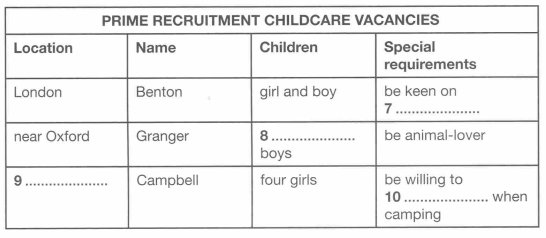
Chỗ trống 7
Chỗ trống 8
Chỗ trống 9
Chỗ trống 10
PART 2
Questions
11 – 12
Questions 11 and 12. Choose TWO letters, A-E. Which TWO sources of funding helped build the facility?
- 1112
- Athe central governmentBlocal governmentCa multinational companyDa national companyEcity residents
Questions
13 – 14
Questions 13 and 14. Choose TWO letters, A-E. Which TWO pre-existing features of the site are now part of the new facilities?
- 1314
- Afootball stadiumBplaying fieldsCpassenger hallDcontrol towerEaircraft hangars
Questions
15 – 20
Questions 15-20. Label the map below. Write the correct letter, A-H, next to questions 15-20.

PART 3
Questions
21 – 25
Questions 21-25. Choose the correct letter, A, B or C.
- 21
What is Chloe concerned about?
- A
her knowledge of maths
Bher ability to write essays
Cher lack of business experience
- 22
Which of the following does Ivan feel he has improved?
- A
his computer skills
Bhis presentation skills
Chis time management
- 23
What does Chloe especially like about the course?
- A
She won’t have to do a final examination.
BShe can spend time working in a business.
CShe can study a foreign language.
- 24
Ivan is pleased that the university is going to have
- A
more lecture rooms.
Ba larger library
Cmore courses.
- 25
What does Ivan advise Chloe to do?
- A
contact his tutor
Bread about some other universities
Cvisit the university
Questions
26 – 30
Questions 26-30. What does Chloe decide about the following subjects? Write the correct letter, A, B or C, next to questions 26-30.
|
PART 4
Questions
31 – 35
Questions 31-35. Complete the notes below. Write NO MORE THAN TWO WORDS for each answer.
History of weather forecasting Early methods – Almanacs connected the weather with the positions of different 31
at particular times. Invention of weather instruments – A hygrometer showed levels of 32
(Nicholas Cusa 1450) – Temperature variations first measured by a thermometer containing 33
(Galileo Galilei 1593) – A barometer indicated air pressure (Evangelista Torricelli 1643) Transmitting weather information – The use of the 34
allowed information to be passed around the world. – Daily 35
were produced by the French from 1863.
Questions
36 – 40
Questions 36-40. Complete the sentences below. Write NO MORE THAN TWO WORDS for each answer.
Producing a weather forecast 36. Weather observation stations are found mostly at 36
around the country. 37. Satellite images use the colour orange to show 37
38. The satellites give so much detail that meteorologists can distinguish a particular 38
39. Information about the upper atmosphere is sent from instruments attached to a 39
40. Radar is particularly useful for following the movement of 40
PART 1
Questions
1 – 6Questions 1-6. Complete the form below. Write NO MORE THAN TWO WORDS for each answer.
Giải thích đáp án
Clive: Hello, Edwina, is it? Have a seat.
Edwina: Yes, Edwina. Thanks. I’m looking for a job as a nanny. I like working with children. I talked to you yesterday?
Clive: Oh, yes. Well, we covered most of the ground on the phone yesterday. I’ve got a form I need to complete for my records. So, you’re Edwina Riley, and how should we contact you?
Edwina: By email I check it regularly.
Clive: What’s the address (= email)?
Edwina: It’s Edwina like my name then R-I, the first two letters of my surname, at worldnet dot com. (Địa chỉ là Edwina viết như tên tôi sau đó thêm R-I, hai chữ cái đầu của tên đệm, @.com.)
Clive: (Q1) E-D-W-I-N-A-R-I at worldnet dot com?
Edwina: Yes
Clive: Good. And you’re from Australia?
Edwina: (Q2) Actually, I’m a New Zealander. (Thực ra, tôi là người New Zealand.)
Clive: Oh, I’m sorry. I bet it’s really irritating being told you’re an Australian. Like Canadians being asked what part of the States they’re from.
Edwina: I’m used to it. It happens to us all the time.
Clive: And now, you said on the phone that you could bring me some references? One from someone who’s known you in a professional capacity and one personal one?
Edwina: Ah, yeah. Here’s one from (Q3) John Keen, who was the manager at the play centre in Wellington where l worked for three years after I left school. (John Keen, anh từng là quản lý tại trung tâm trò chơi ở Wellington, nơi tôi đã làm việc trong 3 năm sau khi tôi hoàn thành việc học.) It’s got all contact details on.
Clive: Thank you. So this was your last employer?
Edwina: Yes, apart from a bit of waitressing recently, but that was just temporary. I’m sure John will answer any questions if you contact him.
Clive: We do run checks, yes. And a personal reference?
Edwina: Ah, you can contact the friend of my mother’s I’m staying with here in London: Eileen Dorsini. (Q4) She’s a professor. (Eileen Dorsini. Cô ấy là một giáo sư.)
Edwina: She’s known me all my life because she used to be our neighbour back home when she was a primary school teacher there. Now she’s working here at the Institute of Education.
Clive: Oh good!
Edwina: I’ve got her contact details here for you.
Clive: Thanks. I think I have some jobs to suit you. Oh, do you have any practical qualifications, by the way? Life-saving, music, anything?
Edwina: Um, (Q5) I’ve got an up-to-date first aid certificate. (tôi đã có chứng chỉ sơ cứu gần đây.) I did a course when I was working.
Clive: That’s good. First aid. Anything else?
Edwina: Well, I’ve got a driving licence; as I told you on the phone. But that’s not special, you said, almost everyone needs that really. (Q6) I’ve got a sailing qualification, it’s a certificate of competence. (Tôi đã có bằng lái thuyền, đó là chứng chỉ năng lực.)
Clive: So you’re a yachtswoman?
Edwina: I love sailing.
Clive: Well, I’ll note you have a certificate. Hmm
Questions
7 – 10Questions 7-10. Complete the table below. Write NO MORE THAN ONE WORD for each answer.
Giải thích đáp án
Clive: Now, as I mentioned yesterday, there are three families and the job description is much the same for all of them, as I explained. There are a few other things you need to know. Anyway, the first family’s here in London.
Edwina: Yes, I did make a few notes. London, er, that’s the Bentons? With two children?
Edwina: Oh, well I know what to do if someone has an allergic reaction.
Clive: Good, but (Q7) what they mainly want is someone with an interest in sport, as that’s the kind of family they are. (chủ yếu là họ mong muốn một ai đó có niềm đam mê với thể thao, vì họ là kiểu gia đình như vậy.)
Edwina: Oh that’s OK. I’ll enjoy that.
Clive: Good. Now the next people are in the country, near Oxford.
Edwina: Oh yeah, the Grangers?
Clive: So, (Q8) they have twin/ two boys of five (họ có một cặp bé trai sinh đôi năm tuổi), who are a bit of a handful, I suspect, but it’s a lovely place, quite a grand house, and the family is extremely welcoming. They keep horses. Do you ride?
Edwina: I did when I was younger. I like animals generally.
Clive: Well, ‘animal-lover’ was their special request, so you’d be fine there. The last family …
Edwina: Yes?
Clive: (Q9) I don’t think I told you they live in Scotland. (Tôi không nghĩ là tôi đã nói cho bạn rằng họ sống ở Scotland.)
Edwina: Really? What’s their name?
Clive: Campbell.
Edwina: Oh, yes. And they have four girls under ten?
Clive: That’s it. They have a lovely city flat, and they own a small island
Edwina: Wow!
Clive: Actually, you might get on with them very well. (Q10) They particularly wanted someone who would be prepared (= willing) to cook when they go camping on the island. (Đặc biệt là họ muốn có một người sẵn sàng phụ trách nấu ăn khi họ đi cắm trại trên đảo)
Edwina: Camping would really suit me and I’m used to taking my turn doing the food. But it is a long way from London.
Clive: Mm. Yeah, well, you can think about it. Um, then as soon as I’ve checked your references, we can arrange for you to talk to all of the families.
Edwina: Right. Thanks very much!
Clive: Thank you! I’ll email you as soon as I can.
PART 2
Questions
11 – 12Questions 11 and 12. Choose TWO letters, A-E. Which TWO sources of funding helped build the facility?
- 1112
- Athe central governmentBlocal governmentCa multinational company
Bạn chọn thiếu đáp án này
Da national companyBạn chọn thiếu đáp án này
Ecity residents
Giải thích đáp án
CÂU HỎI VÀ TRẢ LỜI | TRANSCRIPT & GIẢI THÍCH |
Q11 – 12: Which TWO sources of funding helped build the facility? A. the central government B. local government C. a multinational company D. a national company E. city residents | We thought we’d never build it, but at the last moment, we had an amazing donation of several million pounds from a national transport company (=> D) (chúng tôi đã nhận được khoản đóng góp lớn trị giá vài triệu bảng Anh từ một công ty vận tải quốc gia), and that got us going again and we managed to get all the rest from local fundraising. (=> E) (chúng tôi đã thành công nhận được số còn lại từ việc gây quỹ tại địa phương.) |
DỊCH NGHĨA | |
HAI nguồn tài trợ nào đã góp phần xây dựng cơ sở vật chất? A. chính quyền trung ương B. chính quyền địa phương C. công ty đa quốc gia D. công ty trong nước E. những cư dân thành phố |
Questions
13 – 14Questions 13 and 14. Choose TWO letters, A-E. Which TWO pre-existing features of the site are now part of the new facilities?
- 1314
- Afootball stadium
Bạn chọn thiếu đáp án này
Bplaying fieldsBạn chọn thiếu đáp án này
Cpassenger hallDcontrol towerEaircraft hangars
Giải thích đáp án
CÂU HỎI VÀ TRẢ LỜI | TRANSCRIPT & GIẢI THÍCH |
Q13- 14: Which TWO pre-existing features of the site are now part of the new facilities? A. football stadium B. playing fields C. passenger hall D. control tower E. aircraft hangars | So we were able to plan a new stadium with plenty of room for all the things people wanted. The playing fields have been upgraded and referenced (Sân chơi đã được nâng cấp và được chứng nhận đủ điều kiện) (=> B) so they are now a set of top-quality outdoor pitches for amateur football, hockey and so on. We have both sports and other entertainments here. We want to encourage all kinds of people onto the site and hope some of them may come to use the cinema or the café and end up trying the fitness centre. These are all grouped together: the café is in the original 1930s passenger hall and the architects have managed to retain some of the elegant style of the building. (quán cà phê nằm ở phòng chờ đầu tiên vào những năm 1930 và các kiến trúc sư đã giữ lại được một phần phong cách trang nhã của tòa nhà.) (=> C) |
DỊCH NGHĨA | |
HAI tiện ích nào trước đây của công trình trở thành một phần của cơ sở vật chất mới? A. sân vận động bóng đá B. sân chơi C. phòng chờ D. đài quan sát E. nhà chứa máy bay |
Questions
15 – 20Questions 15-20. Label the map below. Write the correct letter, A-H, next to questions 15-20.
Bạn chưa trả lời câu hỏi này
E
Bạn chưa trả lời câu hỏi này
B
Bạn chưa trả lời câu hỏi này
A
Bạn chưa trả lời câu hỏi này
D
Bạn chưa trả lời câu hỏi này
F
Bạn chưa trả lời câu hỏi này
C
Giải thích đáp án
Right, now if you’d like to gather a little closer to the window I’ll point out the various buildings. We’re at the highest point of the stadium here in the rooftop café, on the opposite side to the main entrance doors. On our left, you can see two buildings just beyond the end of the stadium. The closest one is the business centre (Ở phía bên trái, bạn có thể thấy hai tòa nhà ngay phía bên kia của sân vận động) used for meetings and conferences, and so on, which provides a good source of revenue for the upkeep of the sports facilities; (Q15) and next to the business centre the biggest building is the hotel (và bên cạnh trung tâm trung tâm thương mại tòa nhà lớn nhất là khách sạn) which is rented from us by an independent company. As you see, they are served by the perimeter road which runs round three-quarters of the site. Now, coming round to the front of the building, (Q16) immediately in front of the entrance, that circular open space at the end of the road is the transport hub. (ngay phía trước lối vào, không gian mở hình tròn ở cuối con đường chính là đầu mối giao thông.) From here, there are buses and a monorail link to the free car park, about ten minutes from here, but you can’t see that. There’s also a large secure cycle park, about ten minutes from here, but you can’t see that. There’s also a large secure cycle park. Oh, and secure parking, of course. People find it’s very convenient and it keeps the site virtually car-free.
OK. Now if you look as far as you can over to the right, beyond the buildings, you can see our outdoor pitches, which I mentioned earlier. Between the pitches and the entrance is a little kind of pedestrian plaza…. are you with me? OK, (Q17) with the cinema in the building furthest away from us, next to the pitches (với rạp chiếu phim ở trong tòa nhà xa chúng ta nhất, ngay cạnh sân cỏ), then there’s the ten-pin bowling between the cinema and the road.
(Q18) Near the far end of the perimeter road and between the mini-roundabout and the pitches – there’s our fitness centre (Gần cuối đường vành đai và ở giữa bùng binh nhỏ và sân cỏ là trung tâm thể hình của chúng tôi), with all kinds of equipment, and a small pool, and changing rooms for teams using the pitches. Then, (Q19) joined on to the stadium, next to the entrance, is a range of small shops (nối liền với sân vận động, bên cạnh lối vào là dãy các cửa hàng nhỏ) which all specialise in sports equipment, clothes, shoes. They sell toys and so on as well, all that sort of thing.
They seem to be doing well! As you see, the service road goes right round, but we keep the traffic and the pedestrians well apart, so it’s all very relaxed round the plaza, popular with families. And (Q20) just in front of the bowling is our lovely restaurant. You can see it from here – it’s that building on the plaza between us and the bowling. (ngay phía trước sân bowling là nhà hàng xinh xắn của chúng tôi. Từ đây, bạn có thể nhìn thấy nó – đó là tòa nhà trong trung tâm mua sắm giữa chỗ chúng ta đang đứng và sân chơi bowling.) It’s open all day and in the evenings. There’s quite a queue there at weekends, I’m pleased to say.
So now, you’ve got the layout, we can go and have a closer look at everything.
PART 3
Questions
21 – 25Questions 21-25. Choose the correct letter, A, B or C.
- 21
What is Chloe concerned about?
Bạn chưa trả lời câu hỏi này
- A
her knowledge of maths
Bher ability to write essays
Cher lack of business experience
Giải thích đáp án
CÂU HỎI | TRANSCRIPT & GIẢI THÍCH |
21. What is Chloe concerned about? A. her knowledge of maths B. her ability to write essays C. her lack of business experience
| Chloe: Yeah, I know and I’m used to dealing with figures and percentages and things, but it’s been a while since I’ve sat down and put my ideas into an essay. (đã lâu rồi tôi mới ngồi lại và đưa ý tưởng của mình vào một bài luận.)
|
DỊCH NGHĨA | |
21. Chloe lo lắng về điều gì? A. kiến thức toán học của mình B. khả năng viết luận của mình C. sự thiếu kinh nghiệm trong lĩnh vực kinh doanh của mình |
- 22
Which of the following does Ivan feel he has improved?
Bạn chưa trả lời câu hỏi này
- A
his computer skills
Bhis presentation skills
Chis time management
Giải thích đáp án
CÂU HỎI | TRANSCRIPT & GIẢI THÍCH |
22. Which of the following does Ivan feel he has improved? A. his computer skills B. his presentation skills C. his time management | Ivan: It was OK but I was hopeless at getting them in by the deadline and I was always late for lectures, so I had to work hard at that and I tend to be early now. (tôi đã cảm thấy vô vọng để có thể hoàn thành chúng trước thời hạn và tôi luôn đến muộn trong các buổi học, vì vậy tôi cần phải làm việc chăm chỉ và giờ đây tôi thường đến sớm.)
|
DỊCH NGHĨA | |
22. Ivan cảm thấy mình đã tiến bộ ở điểm nào sau đây? A. kỹ năng máy tính của anh ấy B. kỹ năng thuyết trình của anh ấy C. việc quản lý thời gian của anh ấy |
- 23
What does Chloe especially like about the course?
Bạn chưa trả lời câu hỏi này
- A
She won’t have to do a final examination.
BShe can spend time working in a business.
CShe can study a foreign language.
Giải thích đáp án
CÂU HỎI | TRANSCRIPT & GIẢI THÍCH |
23. What does Chloe especially like about the course? A. She won’t have to do a final examination. B. She can spend time working in a business. C. She can study a foreign language. | Chloe: What really appeals to me though, is the idea of being assessed throughout the year. I think that’s a much more productive way of learning instead of everything being decided in an exam at the end. (Tuy nhiên, điều thực sự hấp dẫn tôi là việc được đánh giá trong suốt cả năm. Tôi nghĩ đó là một cách học hiệu quả hơn nhiều thay vì quyết định mọi thứ qua một kỳ thi cuối kỳ.)
|
DỊCH NGHĨA | |
23. Chloe đặc biệt thích điều gì ở khóa học? A. Cô ấy sẽ không phải làm bài kiểm tra cuối kỳ. B. Cô ấy có thể dành thời gian làm việc trong doanh nghiệp. C. Cô ấy có thể học ngoại ngữ. |
- 24
Ivan is pleased that the university is going to have
Bạn chưa trả lời câu hỏi này
- A
more lecture rooms.
Ba larger library
Cmore courses.
Giải thích đáp án
CÂU HỎI | TRANSCRIPT & GIẢI THÍCH |
24. Ivan is pleased that the university is going to have A. contact his tutor. B. a larger library. C. more courses. | Ivan: The university’s expanding all the time and there are lots of new courses coming next year. (có rất nhiều khóa học mới trong năm tới.)
|
DỊCH NGHĨA | |
24. Ivan hài lòng với việc trường đại học sẽ có A. liên lạc với giáo viên dạy kèm của mình. B. một thư viện lớn hơn. C. nhiều khóa học hơn. |
- 25
What does Ivan advise Chloe to do?
Bạn chưa trả lời câu hỏi này
- A
contact his tutor
Bread about some other universities
Cvisit the university
Giải thích đáp án
CÂU HỎI | TRANSCRIPT & GIẢI THÍCH |
25. What does Ivan advise Chloe to do? A. contact his tutor B. read about some other universities C. visit the university | Ivan: But you could email my tutor (bạn có thể gửi email cho gia sư của mình) – I know he’d be happy to answer any questions. I can give you his email address.
|
DỊCH NGHĨA | |
25. Ivan khuyên Chloe nên làm gì? A. liên hệ với giáo viên dạy kèm của anh ấy B. đọc về một số trường đại học khác C. tham quan trường đại học |
Questions
26 – 30Questions 26-30. What does Chloe decide about the following subjects? Write the correct letter, A, B or C, next to questions 26-30.
|
Bạn chưa trả lời câu hỏi này
C
Bạn chưa trả lời câu hỏi này
A
Bạn chưa trả lời câu hỏi này
A
Bạn chưa trả lời câu hỏi này
B
Bạn chưa trả lời câu hỏi này
C
Giải thích đáp án
Chloe: I was a bit unsure about all the different subjects you can choose on this course.
Ivan: Well, I can tell you a bit about them. There are some subjects you have to do and some that you can choose. The most interesting course I’ve done is public relations.
Chloe: From what I’ve read it doesn’t look very demanding – some of it is really just common sense.
Ivan: But it will be really useful if you want to go into marketing or advertising.
Chloe: (Q26) That’s true, but I need to find out a bit more about it first before I decide – if it will really help me. It’s difficult to tell from the prospectus. (= She might study it) (Đúng vậy, nhưng tôi cần tìm hiểu thêm một chút về nó trước khi quyết định – xem nó có thực sự giúp ích cho tôi hay không. Thật khó để nói được điều gì từ tờ quảng cáo này.)
Ivan: But you are interested in marketing?
Chloe: Oh, yes…
Ivan: Well, you can choose a marketing course. I wasn’t very impressed with that course actually. The tutor didn’t make it very interesting.
Chloe: Mm, it’s good to put on your CV that you’ve done a marketing course, though, (Q27) so that would be a definite for me (= She will study it) (vì vậy đó là một thứ chắc chắn với tôi) and maybe I’d get a different tutor. What other courses did you choose?
Ivan: I’m doing taxation as I was thinking of training to be an accountant but I’m not sure now.
Chloe: Oh, (Q28) that will be a good option for me because I enjoy working with figures. Although I don’t want to be an accountant, it’ll be good to have an understanding of taxation, especially if I ever run my own business. (= She will study it) (đó sẽ là một lựa chọn tốt cho tôi vì tôi thích làm việc với các con số. Mặc dù tôi không muốn trở thành một kế toán, nhưng sẽ rất tốt khi tôi hiểu về thuế, đặc biệt nếu tôi có thể mở công ty cho riêng mình.)
Ivan: Then there’s the most popular course, which is human resources and a lot of people seem to get jobs in that field.
Chloe: My friend works in human resources and she’s really good at it, but I don’t think I’ve got the right personality so I’d give that one a miss. (= She won’t study it) (Tôi không nghĩ rằng tôi có cá tính phù hợp, vậy nên tôi sẽ bỏ qua nó.) I’m more interested in how businesses actually work – the structure.
Ivan: That’s a compulsory course – the structure of business – but you might find information systems helpful.
Chloe: Is that kind of computer programs?
Ivan: Some of it is, but also databases, project management, and other things.
Chloe: Oh, sounds useful, but I’ll have to look at some of the other possibilities first. (= She might study it) (Tôi sẽ phải xem xét một vài khả năng khác trước.) You know, Ivan, this course sounds as though it would suit me. I’m going to apply.
Ivan: Great! If there’s anything else you want to ask me, you’ve got my number
Chloe: Thanks!
PART 4
Questions
31 – 35Questions 31-35. Complete the notes below. Write NO MORE THAN TWO WORDS for each answer.
Giải thích đáp án
I work for the National Weather Service and as part of your course on weather patterns, I’ve been asked to talk to you about how we predict the weather. We’re so used to switching on our TVs and getting an up-to-date weather forecast at any time of day or night that we probably forget that this level of sophistication has only been achieved in the last few decades and weather forecasting is actually an ancient art. So I want to start by looking back into history.
The earliest weather forecasts appeared in the 1500s in almanacs, which were lists of information produced every year. (Q31) Their predictions relied heavily on making links between the weather and where (= connected the weather with the positions of) the planets were in the sky on certain days. (Những dự đoán của họ chủ yếu dựa vào mối liên hệ giữa thời tiết và vị trí của các hành tinh trên bầu trời vào những ngày đó.) In addition, predictions were often based on information like if the fourth night after a new moon was clear, good weather was expected to follow.
But once basic weather instruments were invented, things slowly started to change. (Q32) In the mid-fifteenth century, a man called Nicholas Cusa, a German mathematician, designed a hygrometer which told people how much (= a hygrometer showed) humidity there was in the air. (Vào giữa thế kỷ 15, một người đàn ông tên là Nicholas Cusa, một nhà toán học người Đức, đã thiết kế ra một máy đo độ ẩm để ghi lại hàm lượng hơi nước trong không khí.) To do this, Cusa put some sheep’s wool on a set of scales and then monitored the change in the wool’s weight according to the air conditions.
A piece of equipment we all know and use is the thermometer. (Q33) Changes in temperature couldn’t really be measured until the Italian Galileo Galilei invented his thermometer in 1593. It wasn’t like a modern-day thermometer because it had water inside it instead of mercury. (Những thay đổi về nhiệt độ thực sự không thể đo được cho đến khi Galileo Galilei người Ý phát minh ra nhiệt kế vào năm 1593. Nó không giống nhiệt kế ngày nay vì bên trong nó có nước mà không phải thủy ngân.) In fact, it wasn’t until 1714 that Gabriel Fahrenheit invented the first mercury thermometer. In 1643 another Italian called Evangelista Torricelli invented the first barometer which measured atmospheric pressure. This was another big step forward in more accurate weather predicting.
As time went on, during the seventeenth, eighteenth and nineteenth centuries, all these meteorological instruments were improved and developed and people in different countries began to record measurements relating to their local weather. However, (Q34) in those days it was very difficult to send records from one part of the world to another so it wasn’t possible for them to share their information (= allowed information to be passed) until the electric telegraph became more widespread. (vào thời điểm đó, rất khó để có thể gửi tài liệu từ nơi này đến nơi khác trên thế giới, chỉ đến khi điện báo trở nên phổ biến hơn thì họ mới có thể chia sẻ thông tin.) This meant that weather observations could be sent on a regular basis to and from different countries. By the 1860s, therefore, weather forecasts were becoming more common and accurate because they were based on observations taken at the same time over a wide area. (Q35) In 1863, France started publishing weather maps each day (= daily). (Vào năm 1863, Pháp bắt đầu xuất bản những tấm bản đồ thời tiết mỗi ngày.) This hadn’t been done before, and other nations soon followed. So that was the start of national weather forecasting and I’ll now tell you how we at the National Weather Centre get the information we need to produce a forecast.
Questions
36 – 40Questions 36-40. Complete the sentences below. Write NO MORE THAN TWO WORDS for each answer.
Giải thích đáp án
Even today, one of the most important methods we use is observations which tell us what the weather is doing right now. Observation reports are sent automatically from equipment at a number of weather stations in different parts of the country. (Q36) They are nearly all (= mostly) based at airports although a few are in urban centres. (Gần như tất cả chúng đều có trụ sở tại các sân bay mặc dù một số ít nằm ở các trung tâm đô thị.) The equipment senses temperature, humidity, pressure and wind speed direction.
Meteorologists also rely really heavily on satellites which send images to our computer screens. What we see on our screens is bright colours. (Q37) Orange represents dry air and bright blue shows moisture levels in the atmosphere. (Màu cam tượng trưng cho không khí khô và màu xanh sáng cho thấy độ ẩm trong khí quyển.) The satellites are located 22,000 miles above the surface of the Earth and it’s amazing that despite that distance, (Q38) it’s possible for us to make out (= distinguish) an individual (= particular) cloud (chúng ta có thể nhận ra một đám mây riêng lẻ) and follow it as it moves across the landscape.
In addition to collecting data from the ground, we need to know what’s happening in the upper levels of the atmosphere. So a couple of times a day from many sites across the country, we send radiosondes into the air. (Q39) A radiosonde is a box containing a package of equipment (= instruments) and it hangs from a balloon which is filled with gas. (Máy do thám là một hộp chứa các thiết bị và được treo lên nhờ một quả bóng đầy khí.) Data is transmitted back to the weather station.
(Q40) Finally, radar. This was first used over 150 years ago and still is. New advances are being made all the time and it is one method for detecting and monitoring the progress (= following the movement) of hurricanes. (Cuối cùng là radar. Nó được sử dụng lần đầu vào hơn 150 năm trước và giờ vẫn còn được dùng. Những cải tiến vẫn luôn được thực hiện và đó là một phương pháp để phát hiện và theo dõi tiến trình của các cơn bão.) Crucial information is shown by different colours representing speed and direction. Radar is also used by aircraft, of course.
All this information from different sources is put into computer models which are like massive computer programs. Sometimes they all give us the same story and sometimes we have to use our own experience to decide which is showing the most accurate forecast which we then pass on to you.
So I hope next time you watch the weather forecast, you’ll think about how we meteorologists spend our time. And maybe I’ve persuaded some of you to study meteorology in more depth.
