
Strategies for the IELTS 1 – Test 3
22/10/2024 2024-10-22 2:27Strategies for the IELTS 1 – Test 3
PART 1
Questions
1 – 10
Questions 1-10. Complete the notes below. Write NO MORE THAN TWO WORDS AND/OR A NUMBER for each answer.
Midbury Drama Club BACKGROUND – (Example) club started in 1957 – prize recently won by 1
section – usually performs 2
plays MEETINGS – next auditions will be on Tuesday, 3
– help is needed with 4
– rehearsals take place in the 5
hall – nearest car park for rehearsals is in Ashburton Road opposite the 6
COSTS – annual membership fee is £ 7
– extra payment for 8
CONTACT – secretary’s name is Sarah 9
– secretary’s phone number is 10
PART 2
Questions
11 – 15
Questions 11-15. Choose the correct letter, A, B or C.
- 11
What does the charity Forward thinking do?
- A
It funds art exhibitions in hospitals.
BIt produces affordable materials for art therapy.
CIt encourages the use of arts projects in healthcare.
- 12
What benefit of Forward thinking’s work does Jasmine mention?
- A
People avoid going to hospital.
BPatients require fewer drugs.
CMedical students do better in tests.
- 13
When did the organisation become known as Forward thinking?
- A
1986
Bin the 1990s
C2005
- 14
Where does Forward thinking operate?
- A
within Clifton city
Bin all parts of London
Cin several towns and villages near Clifton
- 15
Jasmine explains that the Colville Centre is
- A
a school for people with health problems.
Ba venue for a range of different activities.
Ca building which needs repairing.
Questions
16 – 20
Questions 16-20. Who can take part in each of the classes?. Write the correct letter A, B or C next to questions 16-20.
Class participants
|
PART 3
Questions
21 – 26
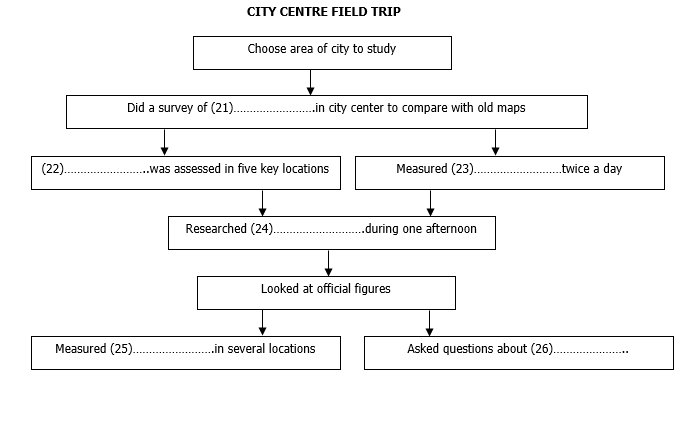
Questions 21-26. Complete the flow-chart below. Choose SIX answers from the box and write the correct letter, A-I, next to questions 21-26.
|
Questions
27 – 30
Questions 27-30. Who will be responsible for each task? Write the correct letter next to questions 27-30.
|
PART 4
Questions
31 – 35
Questions 31-35 Complete the sentences below. Write ONLY ONE WORD for each answer.
Manufacturing in the English Midlands 31. In the eighteenth century, the 31
still determined how most people made a living. 32. In the ground were minerals which supported the many 32
of the region. 33. Since the late sixteenth century the French settlers had made 33
34. In Cheshire 34
was mined and transported on the river Mersey. 35. Potters worked in a few 35
situated on the small hills of North Staffordshire.
Questions
36 – 40
Questions 36-40 Complete the notes below. Write ONE WORD for each answer.
Pottery notes EARTHENWARE +) advantages: – potters used 36
clay – saved money on 37
+) disadvantages: – needed two firings in the kiln to be 38
– fragility led to high 39
during manufacturing STONEWARE – more expensive but better – made from a 40
of clay and flint
PART 1
Questions
1 – 10Questions 1-10. Complete the notes below. Write NO MORE THAN TWO WORDS AND/OR A NUMBER for each answer.
Giải thích đáp án
Man: Hello. Robert Gladwell speaking.
Woman: Oh hi. My name’s Chloe Martin, I was given your name and phone number by Ben Winters. I work with him and he said you’re a member of Midbury Drama Club.
Man: Yes, I am.
Woman: Well, I’ve just moved to the area and I’m keen to join a drama club.
Man: Yes, I can give you some information. We’re one of the oldest drama clubs in the area as the club started in 1957. We now have about 60 members. Our youngest member is ten and our oldest member is 78.
Woman: I think I saw a picture in the newspaper the other day of some of your members being presented with a prize.
Man: (Q1) Yes, the youth section did very well in a competition and won £100 which will help with their next production. (Vâng, đoàn thanh thiếu niên đã làm rất tốt trong một cuộc thi và giành được 100 bảng Anh, số tiền này sẽ giúp ích cho sản phẩm tiếp theo của họ) Anyway, tell me a bit more about yourself.
Woman: Well, I’ve done a bit of acting. I was in a couple of musicals when 1 was at university and a historical play more recently.
Man: (Q2) Mm … we mainly do (=usually perform) comedy plays. We get good audiences for that kind of thing. (Mm… chúng tôi chủ yếu đóng kịch hài. Chúng tôi có được lượng khán giả tốt cho mục đó). We haven’t attempted a musical yet, but we might do one soon.
Woman: Oh! When do you usually meet?
Man: On Tuesdays.
Woman: Presumably I’ll need to do an audition?
Man: (Q3) Yes, there were a few auditions last Tuesday and we’ll be doing more at our next meeting which is in two weeks’ time, that’s on Tuesday the 12th of March. (Vâng, đã có một vài buổi thử giọng vào thứ ba tuần trước và chúng tôi sẽ làm nhiều hơn trong cuộc họp tiếp theo của chúng tôi trong thời gian hai tuần nữa, tức là vào thứ ba ngày 12 tháng ba). There’ll be another opportunity two weeks after that which will be on the 26th of March.
Woman: Oh, well I can come to your next meeting. And if I don’t get an acting part in a play, I’d be happy to help with something else. (Q4)I’ve designed publicity before (Tôi đã thiết kế quảng cáo trước đây.)
Man: Great! We’re very short of people who can do that, so that would be really good. There are a lot of people who like making scenery so we get plenty of help with that,
Man: but we haven’t got enough people to do the lights at the moment so if you think you can do that or you have any friends who would like to, do bring them along. We can show you what to do if you haven’t got any experience.
Woman: Mm … I’ll have to think about it. So do you meet in the theater?
Man: We do our performances in The lvlanor Theater but we only hire that for the nights of the actual performances. (Q5) We meet to rehearse every Tuesday evening in the community hall. (Chúng tôi gặp nhau để diễn tập vào mỗi tối thứ Ba tại hội trường cộng đồng). We rented a room there.
Woman: Oh, I’m not sure where that is. I’ll be coming by car because I don’t live in the town center.
Man: It’s in Ashburton Road. As you’re cornered towards the center down Regent Street, you need to turn left at the crossroads.
Woman: Oh, I know, there’s a big car park down there, just before you get to a hotel. (Q6) lt’s on the other side (=opposite) of the road from the sports center. (Nó ở bên kia đường từ trung tâm thể thao)
Man: That’s it. That’s the closest place to leave your car and you don’t have to pay in the evening to park there. We meet at 7.30 and we usually finish by 9.30 or 10.
Woman: OK!
Man: I haven’t mentioned that we have to make a charge. (Q7) Everyone pays a subscription of £180 to be a member for a year (=annual membership). (Mọi người trả phí đăng ký £180 để trở thành thành viên trong một năm). You can pay for the whole year at once or you can pay £15 every month.
Man: It works out the same. There are reductions for retired people and under-18s but I don’t think you come into either category?
Woman: No. I’m 26!
Man: (Q8) Oh! That fee covers all the costs like photocopying of scripts and producing the posters but it excludes (=extra payments) the costumes for the performances (Ồ! Khoản phí đó bao gồm tất cả các chi phí như sao chụp kịch bản và sản xuất áp phích nhưng nó không bao gồm trang phục biểu diễn.)
Man: We ask people to pay for the hire of those themselves. It does mean they look after them properly as they know they won’t get their deposit back otherwise.
Woman: Mm … can I come along to the next meeting then?
Man: Of course. We’d love to see you. And if you want to know more about how we run the auditions or the next play we’re doing, why don’t you give our secretary a ring? She’ll be really pleased to help you.
Woman: What’s her name? (Tên cô ấy là gì?)
Man: (Q9) It’s Sarah Sawdicott (Đó là Sarah Sawdicott). That’s S-A-W-D-t-C-0 double T.
Woman: Got that. And her phone number?
Man: (Q10) I’ve only got a mobile number for her. Um … just a minute … let me find it. Ahl It’s 07955 240063. (Tôi chỉ có số điện thoại di động của cô ấy. Ừm… đợi một chút… để tôi tìm nó. À nó là 07955 240063)
Woman: Great. Thanks for your help
PART 2
Questions
11 – 15Questions 11-15. Choose the correct letter, A, B or C.
- 11
What does the charity Forward thinking do?
Bạn chưa trả lời câu hỏi này
- A
It funds art exhibitions in hospitals.
BIt produces affordable materials for art therapy.
CIt encourages the use of arts projects in healthcare.
Giải thích đáp án
CÂU HỎI | TRANSCRIPT & GIẢI THÍCH |
11. What does the charity Forward thinking do? A. It funds art exhibitions in hospitals. B. It produces affordable materials for art therapy. C. It encourages the use of arts projects in healthcare. | Jasmine: The idea behind Forward thinking is to use the arts to promote wellbeing. The charity develops projects for people with special needs and health problems. and also delivers training to healthcare professionals in using the arts, as well as supplying them with information and advice. (Ý tưởng đằng sau Forward-Thinking là sử dụng nghệ thuật để thúc đẩy chất lượng cuộc sống. Tổ chức từ thiện phát triển các dự án cho những người có nhu cầu đặc biệt và các vấn đề về sức khỏe. và cũng cung cấp khóa đào tạo cho các chuyên gia chăm sóc sức khỏe trong việc sử dụng nghệ thuật, cũng như cung cấp cho họ thông tin và lời khuyên.) |
DỊCH NGHĨA | |
11. Tổ chức từ thiện Forward thinking làm gì? A. Nó tài trợ cho các cuộc triển lãm nghệ thuật trong bệnh viện. B. Nó sản xuất vật liệu giá cả phải chăng cho liệu pháp nghệ thuật. C. Nó khuyến khích sử dụng các dự án nghệ thuật trong chăm sóc sức khỏe.
|
- 12
What benefit of Forward thinking’s work does Jasmine mention?
Bạn chưa trả lời câu hỏi này
- A
People avoid going to hospital.
BPatients require fewer drugs.
CMedical students do better in tests.
Giải thích đáp án
CÂU HỎI | TRANSCRIPT & GIẢI THÍCH |
12. What benefit of Forward thinking’s work does Jasmine mention? A. People avoid going to the hospital. B. Patients require fewer drugs. C. Medical students do better in tests. | Forward thinking doesn’t just run art and craft classes to distract people who are ill, or recovering from illness, but arranges longer-term projects and courses, as it’s been shown that the arts can bring all sorts of positive changes in patients, including benefits such as shortening the length of stay in hospital and reducing the amounts of medicine they need. (vì người ta đã chứng minh rằng nghệ thuật có thể mang lại nhiều thay đổi tích cực cho bệnh nhân, bao gồm những lợi ích như rút ngắn thời gian nằm viện và giảm lượng thuốc họ cần.) |
DỊCH NGHĨA | |
12. Lợi ích nào của dự án Forward thinking mà Jasmine đề cập đến? A. Mọi người tránh đến bệnh viện. B. Bệnh nhân cần ít thuốc hơn. C. Sinh viên y khoa làm bài kiểm tra tốt hơn. |
- 13
When did the organisation become known as Forward thinking?
Bạn chưa trả lời câu hỏi này
- A
1986
Bin the 1990s
C2005
Giải thích đáp án
CÂU HỎI | TRANSCRIPT & GIẢI THÍCH |
13. When did the organization become known as Forward thinking? A. 1986 B. in the 1990s C. 2005 | Jasmine: The organization’s been around since 1986, and it gradually expanded during the 1990s. Then, in the new millennium, it was decided to find a memorable name, so it’s been operating as Forward thinking for several years, er, in fact since 2005. (Sau đó, trong thiên niên kỷ mới, nó đã quyết định tìm một cái tên dễ nhớ, vì vậy nó đã hoạt động với cái tên Forward-thinking trong vài năm, thực tế là từ năm 2005.) |
DỊCH NGHĨA | |
13. Khi nào tổ chức được gọi là Forward thinking? A. 1986 B. vào những năm 1990 C. 2005 |
- 14
Where does Forward thinking operate?
Bạn chưa trả lời câu hỏi này
- A
within Clifton city
Bin all parts of London
Cin several towns and villages near Clifton
Giải thích đáp án
CÂU HỎI | TRANSCRIPT & GIẢI THÍCH |
14. Where does Forward thinking operate? A. within Clifton city B. in all parts of London C. in several towns and villages near Clifton | Jasmine: It’s quite a locally based charity, mainly for people in the southern part of this region, which includes all rural and urban communities outside the city of Clifton, which has its own organization. (Đó là một tổ chức từ thiện có trụ sở tại địa phương, chủ yếu dành cho những người ở phía nam của khu vực này, bao gồm tất cả các cộng đồng nông thôn và thành thị bên ngoài thành phố Clifton, có tổ chức riêng.) |
DỊCH NGHĨA | |
14. Tư duy cầu tiến hoạt động ở đâu? A. trong thành phố Clifton B. ở tất cả các vùng của Luân Đôn C. ở một số thị trấn và làng mạc gần Clifton |
- 15
Jasmine explains that the Colville Centre is
Bạn chưa trả lời câu hỏi này
- A
a school for people with health problems.
Ba venue for a range of different activities.
Ca building which needs repairing.
Giải thích đáp án
CÂU HỎI | TRANSCRIPT & GIẢI THÍCH |
15. Jasmine explains that the Colville Centre is A. a school for people with health problems. B. a venue for a range of different activities. C. a building which needs repairing. | Jasmine: Yeah. Well, the charity needs funding in order to buy the Colville Centre. This is a former village school, which was built in 1868. It was modernized and refurbished by the present owners last year, so it’s ideal for art classes and for small social events, performances, seminars and so on. Forward thinking is fund-raising to purchase the building so they can use it to continue running classes and so on for the general public and eventually also for some of the people they help. (Nó đã được hiện đại hóa và tân trang lại bởi những người chủ hiện tại vào năm ngoái, vì vậy nó rất lý tưởng cho các lớp học nghệ thuật và các sự kiện xã hội nhỏ, các buổi biểu diễn, hội thảo, v.v. Tư duy tiến bộ là gây quỹ để mua tòa nhà để họ có thể sử dụng nó để tiếp tục điều hành các lớp học, v.v. cho công chúng và cuối cùng là cho một số người mà họ giúp đỡ.) |
DỊCH NGHĨA | |
15. Jasmine giải thích rằng Trung tâm Colville là A. một trường học dành cho những người có vấn đề về sức khỏe. B. một địa điểm cho một loạt các hoạt động khác nhau. C. một tòa nhà cần sửa chữa. |
Questions
16 – 20Questions 16-20. Who can take part in each of the classes?. Write the correct letter A, B or C next to questions 16-20.
Class participants
|
Bạn chưa trả lời câu hỏi này
B
Bạn chưa trả lời câu hỏi này
B
Bạn chưa trả lời câu hỏi này
C
Bạn chưa trả lời câu hỏi này
B
Bạn chưa trả lời câu hỏi này
A
Giải thích đáp án
Fergus: Right, so can you give us a few ideas about what classes people might do there? Is it all art classes?
Jasmine: Um, well, there are some very good art classes, but there are lots of other things going on as well. So, for example, there’s ‘Learn Salsa!’ with Nina Salina’s team.
Jasmine: They say that salsa is an easy dance to learn. It’s also an excellent form of exercise, according to Nina, and that class is for both men and women, of course.(Họ nói rằng salsa là một điệu nhảy dễ học. Theo Nina, đây cũng là một hình thức tập thể dục tuyệt vời và lớp học đó tất nhiên là dành cho cả nam và nữ). It’s ideal for beginners and what they call ‘refreshers’. That’s £100 for ten sessions.
Jasmine: Then another class is called ‘Smooth Movers’. It’s with Kevin Bennett and it’s for you if you don’t have the same energy levels as you used to when you were a teenager. (Đó là với Kevin Bennett và nó dành cho bạn nếu bạn không còn mức năng lượng như trước đây khi còn là một thiếu niên.)
Jasmine: It’s a gentle exercise class, geared to the needs of whoever is in the group in a particular session. And Kevin is qualified to teach classes to people getting over injuries and so on, and balance training. That’s £60 for ten sessions.
Jasmine:
Then there’s a day called ‘Art of the Forest‘, with Jamie Graham, where you discover Upper Wood, a short walk from the Colville Centre, and learn how to design in 3-D with natural materials. It’s an unusual and exciting way to be creative.
Jasmine:
Jamie is an artist, with a background also as a country park ranger. For this day, youngsters must be accompanied by a parent or guardian and the costs are: adults £40. under-14s £10, but it’s best value at £80 for a family of four. (Vào ngày này, trẻ em phải đi cùng với cha mẹ hoặc người giám hộ và chi phí là: người lớn £40. £10 dành cho trẻ dưới 14 tuổi, nhưng giá tốt nhất là £80 cho một gia đình bốn người).
Jasmine:
The next one is ‘The Money Maze’, and this is a series of talks by Peter O’Reilly, an Independent Financial Adviser.
Jasmine:
He gives advice on family finances. things like everything parents need to know about managing the costs of bringing up children, sending them to university, and actually, also, about care for elderly relatives (Anh ấy đưa ra lời khuyên về tài chính gia đình. những thứ như mọi thứ cha mẹ cần biết về quản lý chi phí nuôi dạy con cái, gửi chúng đến trường đại học, và thực ra, cả về chăm sóc người thân lớn tuổi). It’s £10 per talk, which will all go to support Forward thinking.
Jasmine:
And as a final example of what’s on offer, there’s ‘Make a Play’. That’s for 8-14s and this activity is such a hit that it usually sells out within days of being announced. (Đó là cho 8-14 tuổi và hoạt động này là một hit đến mức nó thường bán hết trong vòng vài ngày sau khi được công bố).
Jasmine:
Basically what you do is write, rehearse and perform a play in just two days and it doesn’t require any previous experience. l gather there’s lots of fun and silliness along the way and the best bit perhaps is that there’s a performance for family and friends at the end. It’s just £50 for two days.
Fergus:
Pretty good range of activities, I think. And all raising money for a good cause.
Jasmine:
Yes! And the all-important contact details are: colville@forwardthinking.org.uk or write to me …
PART 3
Questions
21 – 26Questions 21-26. Complete the flow-chart below. Choose SIX answers from the box and write the correct letter, A-I, next to questions 21-26.
|
Bạn chưa trả lời câu hỏi này
C
Bạn chưa trả lời câu hỏi này
A
Bạn chưa trả lời câu hỏi này
I
Bạn chưa trả lời câu hỏi này
F
Bạn chưa trả lời câu hỏi này
G
Bạn chưa trả lời câu hỏi này
E
Giải thích đáp án
Tutor: Now, Stefan and Lauren. You worked together on the assignment for your Urban Geography course, didn’t you? l know you made a plan of what you were going to do before you went on the field trip. Did you stick to it?
Stefan: More or less!
Tutor: OK. So where did you start?
Stefan: Well, first of all we selected one area of the city to work in – we decided on the center – and we looked in detail at how it has been developed by doing a survey.
Lauren: (Q21) Yeah …We did that by walking round and dividing the area into different categories such as residential, commercIal and Industrial so we could record land use. (Vâng …Chúng tôi đã làm điều đó bằng cách đi vòng quanh và chia khu vực thành các loại khác nhau như dân cư, thương mại và Công nghiệp để chúng tôi có thể ghi lại việc sử dụng đất.)
Lauren: We’re going to find some maps from 50 years ago and from 100 years ago so we can look at what has changed.
Tutor: Good! So that gives you a foundation. Then what did you do?
Stefan: Um, I was interested in looking at how polluted the city was.
Lauren: I thought that was too general a topic and would be difficult to check. But Stefan persuaded me and actually it was quite interesting because before we started, we assumed that a lot of the pollution problems would be caused by industry.
Stefan: In fact, most of the industrial development has been on the outskirts and most pollution is caused by the traffic which passes through the city center every day. (Q22) There are five major road junctions (=five key locations) around the edge of the city so we set up equipment to check the air quality on each of those three times in one day. (Có năm ngã ba đường chính xung quanh rìa thành phố, vì vậy chúng tôi đã lắp đặt thiết bị để kiểm tra chất lượng không khí tại mỗi nút giao thông đó ba lần trong một ngày.)
Lauren: In the morning and evening, which is when most journeys are made in and out of the city, and at 2.30 in the afternoon.
Stefan: (Q23) On the same day. We went to the two busiest junctions in the morning and evening (=twice a day) to calculate the traffic flow into the city. (Cùng ngày. Chúng tôi đến hai nút giao thông đông đúc nhất vào buổi sáng và chiều tối để tính toán lưu lượng phương tiện vào thành phố.)
Tutor: Right.
Stefan: We’ll be able to produce some graphs from the figures we collected.
Lauren: Yeah.
Tutor: Presumably you then looked at where all these cars ended up?
Lauren: l thought we should look at why people were coming into the city – um, whether it was for employment or education or leisure activities but Stefan thought that would be too difficult.
Stefan: (Q24) Because most people were in cars it would be hard to ask them. So we decided to spend an afternoon examining the parking facilities available instead. (Bởi vì hầu hết mọi người đều ở trong ô tô nên sẽ rất khó để hỏi họ. Vì vậy, chúng tôi quyết định dành một buổi chiều để kiểm tra các bãi đậu xe có sẵn)
Stefan:We established the capacity of each car park and we spent an afternoon counting cars in and out so we have an idea of how long people spend in the city center.
Tutor: So do you have evidence that most journeys are made by car within the city center?
Stefan: We checked local government statistics to see if that was true but they were inconclusive.
Lauren: Everything is quite close together in the city center and there are wide pavements so you would expect people to walk from one place to another.
Stefan: (Q25) So we chose a number of (=several) locations and we noted how many pedestrians passed a particular spot. (Vì vậy, chúng tôi đã chọn một số địa điểm và chúng tôi ghi nhận có bao nhiêu người đi bộ đi qua một địa điểm cụ thể)
Tutor: Um, how did you choose where to do that?
Stefan: Oh, we stood at two places in the business district, one in the shopping area and the other was in an area where there are more tourists.
Tutor: Right.
Lauren: (Q26) I thought it was really important to talk to people so we carried out a survey on how people usually traveled into the city. We asked them about their usual means of transport. (Tôi nghĩ việc nói chuyện với mọi người là rất quan trọng nên chúng tôi đã tiến hành một cuộc khảo sát về cách mọi người thường di chuyển vào thành phố. Chúng tôi hỏi họ về phương tiện vận chuyển thông thường của họ)
Stefan: We found out that it varied according to why people were traveling -if they were employed in the city they wanted to get there quickly but if they were coming in for their leisure time they didn’t mind using the bus.
Questions
27 – 30Questions 27-30. Who will be responsible for each task? Write the correct letter next to questions 27-30.
|
Bạn chưa trả lời câu hỏi này
B
Bạn chưa trả lời câu hỏi này
C
Bạn chưa trả lời câu hỏi này
A
Bạn chưa trả lời câu hỏi này
C
Giải thích đáp án
Lauren: That’s all we had time for while we were there.
Tutor: OK. So shall we talk about what you’re going to do next and how you’re going to divide the tasks up? How are you going to present the data you’ve got?
Stefan: Well, some of the information can be presented as graphs or maps.
Lauren: I’m quite good at software.
Stefan: You’d better do that then, Lauren. (Vậy bạn nên làm phần việc đó, Lauren) I’ll help you check all the statistics before you start.
Lauren: OK.
Tutor: Um, it’s good to present as much as you can visually. Is there anything else you can use as visuals?
Stefan: Mm … we’ve got a lot of photographs which we can go through.
Tutor: Aha.
Lauren: Er, we both took them so some will be duplicated. It’s going to take ages to go through them all. Maybe one of us should just choose some.
Tutor: It’s better if you collaborate. That way you’ll end up with the best of what you’ve got. (Sẽ tốt hơn nếu bạn hợp tác. Bằng cách đó bạn sẽ có thành quả với những gì tốt nhất mà bạn có).
Lauren: That’s fine. we’ll do that.
Tutor: And, er,when the graphs and maps are done, you’ll need to write a report, an analysis of the data. Will you do that together?
Stefan: I think that should be my responsibility if we’re going to share the work out evenly. (Tôi nghĩ đó phải là trách nhiệm của tôi nếu chúng ta chia sẻ công việc một cách đồng đều). I can use some of Lauren’s notes as well as my own.
Tutor: OK. And finally, you’ll be presenting your project to the rest of the group in a couple of weeks’ time.
Lauren: We thought it’d be better for Stefan to do that as he’s got more experience at that kind of thing.
Tutor: I would prefer to have input from both of you as I have to do an assessment. (Tôi muốn có ý kiến đóng góp từ cả hai bạn vì tôi phải thực hiện đánh giá.)
Stefan: We’ll take turns then. We’ll divide it into sections and talk about a few things each.
Tutor: Good. You’ll find it easier, Lauren, than doing a presentation on your own. Well, if you need to ask me any more questions while you’re working on this, email me. I look forward to seeing what you produce.
Lauren: Thanks!
Stefan: Thanks!
PART 4
Questions
31 – 35Questions 31-35 Complete the sentences below. Write ONLY ONE WORD for each answer.
Giải thích đáp án
Thank you for coming to this series of talks. Before I talk in detail about the experiments and innovations of the British ceramicists, I’d like to give you a summary of the social and manufacturing background in which they lived and worked.
So, we’re talking about England, or more specifically, the region known as ‘The Midlands’, and we need to go back, mainly to the eighteenth century and, briefly, even earlier, to put it in a global context.
Now, at that period the majority of the population, whatever their station in life, as you might say, were dependent for their living, in one way or another not on the geographical location of where they lived, (Q31)but on the physical characteristics of the actual land they lived on (=made a living). (nhưng về đặc điểm vật lý của vùng đất thực tế mà họ sinh sống)
This is true, whether we’re talking about the aristocracy, the owners of great estates, who incidentally had no snobbery about the concept of making money from all the reserves of coal, or timber, or stone on their rolling acres, or the farmers making a fat living from the rich soils.
(Q32) And besides these groups, and the less affluent ones, the deposits of iron ore and lead, the limestone and flint and the brown and yellow clays (=minerals) also sustained the numerous (=many) industries in the area. (Và bên cạnh những nhóm này, và những nhóm ít giàu có hơn, các mỏ quặng sắt và chì, đá vôi và đá lửa và đất sét màu nâu và vàng cũng duy trì nhiều ngành công nghiệp trong khu vực)
It’s important to recognise that it was already an industrial region, and had been so for centuries. There were many Midland trades, some of them indigenous, some of them not.
(Q33) For example, there were immigrants from France (=French settlers) who came as early as the late sixteenth century and they were producers of glass. (Ví dụ, có những người nhập cư từ Pháp đến sớm nhất vào cuối thế kỷ 16 và họ là những nhà sản xuất thủy tinh). A century later, there is plenty of evidence that the variety of trades was enormous: there was brewing in Burton-on-Trent; silk-weaving and ribbon-making near Coventry; framework knitting around Nottingham.
(Q34) And of course, in Cheshire men dug (=mined) the salt, as we still do nowadays even which in that era was sent (=transported) downriver to the estuary of the Mersey. (Và tất nhiên, ở Cheshire, đàn ông đào muối, như chúng ta vẫn làm ngày nay, ngay cả trong thời đại đó, muối đã được gửi xuôi dòng đến cửa sông Mersey.)
Now, among these well-established trades, one of the oldest of the local crafts was pottery. As you will probably be aware, ceramics have always been a mix of science, design and skill, and a good potter is in a sense an experimental chemist, trying out new mixes and glazes, and needing to be alert to the impact of changes of temperature on different types of clay.
For two hundred years, up to the time we are concerned with, potters had been making butter pots and pitchers and patterned plates, (Q35) using the clay which was plentiful in the area where they lived -in a handful of North Staffordshire villages dotted along the low hills. (sử dụng đất sét dồi dào ở khu vực họ sống – trong một số ngôi làng ở Bắc Staffordshire nằm rải rác dọc theo những ngọn đồi thấp)
Now I want to explain a little about the industrial processes which had preceded the great breakthrough in Germany in 1708. That’s when the formula for porcelain was discovered, a secret that had been held in China for a thousand years.
Questions
36 – 40Questions 36-40 Complete the notes below. Write ONE WORD for each answer.
Giải thích đáp án
In the Midlands, in England, as elsewhere, there had basically been two kinds of pottery. The first was known, and is still known, as ‘earthenware’.
Now this was a bit rough and ready, but it was deservedly popular for several reasons. To start with, it was relatively cheap, so it could be used by most households. (Q36) This was because it could be made from local clay without any complicated processing or added materials. (Điều này là do nó có thể được làm từ đất sét địa phương mà không cần bất kỳ quá trình xử lý phức tạp hay thêm nguyên liệu nào)
From the potter’s point of view there was another reason for its cheapness. (Q37) This was that it could be fired in simple ovens, or kilns, and at relatively low temperatures, so he didn’t have to spend so much money (=save money) on fuel to achieve the necessary heat. (Điều này nghĩa là nó có thể được nung trong các lò nướng bình thường hoặc lò nung, và ở nhiệt độ tương đối thấp, vì vậy người thợ không phải tốn quá nhiều tiền mua nhiên liệu để đạt được nhiệt độ cần thiết)
On the other hand, after one firing in the kiln, the problem with earthenware was that it remained porous so had limited usefulness. (Q38) So for most purposes it had to go back in the kiln for a second firing before it became waterproof. (Vì vậy, đối với hầu hết các mục đích, nó phải quay trở lại lò nung lần thứ hai trước khi nó trở nên không thấm nước).
And another thing was that it was extremely breakable -I mean, before it had even been sold.(Q39) I suppose the potter wouldn’t have minded so much if people just had to keep coming back for more every time they broke a jug or whatever! -but it was very inconvenient because it meant there was a lot of wastage in the course of (=during) the manufacturing process. (Tôi cho rằng người thợ gốm sẽ không quá bận tâm nếu mọi người chỉ tiếp tục quay lại mua thêm mỗi khi họ làm vỡ một cái bình hay bất cứ thứ gì tương tự! -nhưng nó rất bất tiện vì nó có nghĩa là có rất nhiều lãng phí trong quá trình sản xuất)
Anyway, for all these reasons, if people could afford it, and that would be all but the very poor, they would buy stoneware,a much tougher product.
(Q40) Now, for this, the potter used a slightly more expensive raw material, which was made by combining clay and flint and this mixture was fired at a far higher heat, with the result that the ingredients vitrified, (Bây giờ, đối với việc này, người thợ gốm đã sử dụng một nguyên liệu thô đắt tiền hơn một chút, được tạo ra bằng cách kết hợp đất sét và đá lửa và hỗn hợp này được nung ở nhiệt độ cao hơn nhiều), that is to say, in effect the whole thing became glassy and because of this it was non-porous, and naturally, this was regarded as a great advance.
Well, that’s the situation in the eighteenth century. Are there any questions at this stage? OK. So, now we can go on to look at the age of innovation.
