
IELTS Handbook 10 – Test 1 – R
09/11/2024 2024-11-09 20:36IELTS Handbook 10 – Test 1 – R
READING PASSAGE 1
You should spend about 20 minutes on Questions 1-13 which are based on Reading Passage 1 below.
Stepwells
A millennium ago, stepwells were fundamental to life in the driest parts of India. Although many have been neglected, recent restoration has returned them to their former glory. Richard Cox travelled to north-western India to document these spectacular monuments from a bygone era.
During the sixth and seventh centuries, the inhabitants of the modern-day states of Gujarat and Rajasthan in North-western India developed a method of gaining access to clean, fresh groundwater during the dry season for drinking, bathing, watering animals and irrigation. However, the significance of this invention – the stepwell – goes beyond its utilitarian application.
Unique to the region, stepwells are often architecturally complex and vary widely in size and shape. During their heyday, they were places of gathering, of leisure, of relaxation and of worship for villagers of all but the lowest castes. Most stepwells are found dotted around the desert areas of Gujarat (where they are called vav) and Rajasthan (where they are known as baori), while a few also survive in Delhi. Some were located in or near villages as public spaces for the community; others were positioned beside roads as resting places for travellers.
As their name suggests, stepwells comprise a series of stone steps descending from ground level to the water source (normally an underground aquifer) as it recedes following the rains. When the water level was high, the user needed only to descend a few steps to reach it; when it was low, several levels would have to be negotiated.
Some wells are vast, open craters with hundreds of steps paving each sloping side, often in tiers. Others are more elaborate, with long stepped passages leading to the water via several storeys. Built from stone and supported by pillars, they also included pavilions that sheltered visitors from the relentless heat. But perhaps the most impressive features are the intricate decorative sculptures that embellish many stepwells, showing activities from fighting and dancing to everyday acts such as women combing their hair and churning butter.
Down the centuries, thousands of wells were constructed throughout northwestern India, but the majority have now fallen into disuse; many are derelict and dry, as groundwater has been diverted for industrial use and the wells no longer reach the water table. Their condition hasn’t been helped by recent dry spells: southern Rajasthan suffered an eight-year drought between 1996 and 2004.
However, some important sites in Gujarat have recently undergone major restoration, and the state government announced in June last year that it plans to restore the stepwells throughout the state.
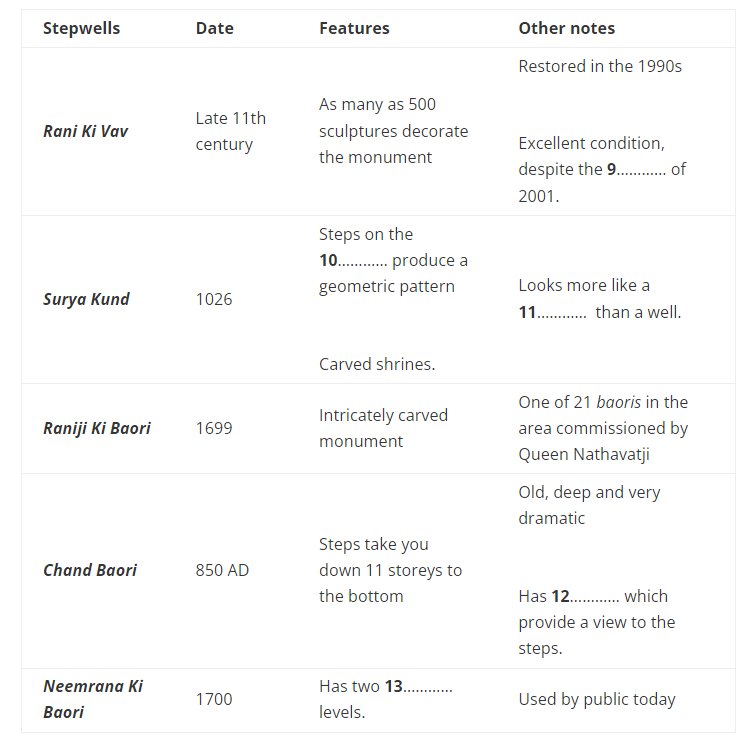
In Patan, the state’s ancient capital, the stepwell of Rani Ki Vav (Queen’s Stepwell) is perhaps the finest current example. It was built by Queen Udayamati during the late 11th century, but became silted up following a flood during the 13th century. But the Archaeological Survey of India began restoring it in the 1960s, and today it’s in pristine condition. At 65 metres long, 20 metres wide and 27 metres deep, Rani Ki Vav features 500 distinct sculptures carved into niches throughout the monument, depicting gods such as Vishnu and Parvati in various incarnations. Incredibly, in January 2001, this ancient structure survived a devastating earthquake that measured 7.6 on the Richter scale.
Another example is the Surya Kund in Modhera, northern Gujarat, next to the Sun Temple, built by King Bhima I in 1026 to honour the sun god Surya. It’s actually a tank (kund means reservoir or pond) rather than a well, but displays the hallmarks of stepwell architecture, including four sides of steps that descend to the bottom in a stunning geometrical formation. The terraces house 108 small, intricately carved shrines between the sets of steps.
Rajasthan also has a wealth of wells. The ancient city of Bundi, 200 kilometres south of Jaipur, is renowned for its architecture, including its stepwells. One of the larger examples is Raniji Ki Baori, which was built by the queen of the region, Nathavatji, in 1699. At 46 metres deep, 20 metres wide and 40 metres long, the intricately carved monument is one of 21 baoris commissioned in the Bundi area by Nathavatji.
In the old ruined town of Abhaneri, about 95 kilometres east of Jaipur, is Chand Baori, one of India’s oldest and deepest wells; aesthetically, it’s perhaps one of the most dramatic. Built in around 850 AD next to the temple of Harshat Mata, the baori comprises hundreds of zigzagging steps that run along three of its sides, steeply descending 11 storeys, resulting in a striking geometric pattern when seen from afar. On the fourth side, covered verandas supported by ornate pillars overlook the steps.
Still in public use is Neemrana Ki Baori, located just off the Jaipur–Dehli highway. Constructed in around 1700, it’s nine storeys deep, with the last two levels underwater. At ground level, there are 86 colonnaded openings from where the visitor descends 170 steps to the deepest water source.
Today, following years of neglect, many of these monuments to medieval engineering have been saved by the Archaeological Survey of India, which has recognised the importance of preserving them as part of the country’s rich history. Tourists flock to wells in far-flung corners of northwestern India to gaze in wonder at these architectural marvels from 1,000 years ago, which serve as a reminder of both the ingenuity and artistry of ancient civilisations and of the value of water to human existence.
Questions
1 – 5Do the following statements agree with the information given in Reading Passage 1?
In boxes 1–5 on your answer sheet, write
TRUE if the statement agrees with the information
FALSE if the statement contradicts the information
NOT GIVEN if there is no information on this
- 1
Examples of ancient stepwells can be found all over the world.
- A
True
BFalse
CNot Given
- 2
Stepwells had a range of functions, in addition to those related to water collection.
- A
True
BFalse
CNot Given
- 3
The few existing stepwells in Delhi are more attractive than those found elsewhere.
- A
True
BFalse
CNot Given
- 4
It took workers many years to build the stone steps characteristic of stepwells.
- A
True
BFalse
CNot Given
- 5
The number of steps above the water level in a stepwell altered during the course of a year.
- A
True
BFalse
CNot Given
Questions
6 – 8Answer the questions below. Choose ONE WORD ONLY from the passage for each answer. Write your answers in boxes 6–8 on your answer sheet.
Questions
9 – 13Complete the table below Choose ONE WORD AND/OR A NUMBER from the passage for each answer. Write your answers in boxes 9-13 on your answer sheet.
READING PASSAGE 2
You should spend about 20 minutes on Questions 14-26 which are based on Reading Passage 2 below.
EUROPEAN TRANSPORT SYSTEMS 1990-2010
What have been the trends and what are the prospects for European transport systems?
A
It is difficult to conceive of vigorous economic growth without an efficient transport system. Although modern information technologies can reduce the demand for physical transport by facilitating teleworking and teleservices, the requirement for transport continues to increase. There are two key factors behind this trend. For passenger transport, the determining factor is the spectacular growth in car use. The number of cars on European Union (EU) roads saw an increase of three million cars each year from 1990 to 2010, and in the next decade the EU will see a further substantial increase in its fleet.
B
As far as goods transport is concerned, growth is due to a large extent to changes in the European economy and its system of production. In the last 20 years, as internal frontiers have been abolished, the EU has moved from a ‘stock’ economy to a ‘flow’ economy. This phenomenon has been emphasised by the relocation of some industries, particularly those which are labour intensive, to reduce production costs, even though the production site is hundreds or even thousands of kilometres away from the final assembly plant or away from users.
C
The strong economic growth expected in countries which are candidates for entry to the EU will also increase transport flows, in particular road haulage traffic. In 1998, some of these countries already exported more than twice their 1990 volumes and imported more than five times their 1990 volumes. And although many candidate countries inherited a transport system which encourages rail, the distribution between modes has tipped sharply in favour of road transport since the 1990s. Between 1990 and 1998, road haulage increased by 19.4%, while during the same period rail haulage decreased by 43.5%, although – and this could benefit the enlarged EU – it is still on average at a much higher level than in existing member states.
D
However, a new imperative-sustainable development – offers an opportunity for adapting the EU’s common transport policy. This objective, agreed by the Gothenburg European Council, has to be achieved by integrating environmental considerations into Community policies, and shifting the balance between modes of transport lies at the heart of its strategy. The ambitious objective can only be fully achieved by 2020, but proposed measures are nonetheless a first essential step towards a sustainable transport system which will ideally be in place in 30 years‟ time, that is by 2040.
E
In 1998, energy consumption in the transport sector was to blame for 28% of emissions of CO2, the leading greenhouse gas. According to the latest estimates, if nothing is done to reverse the traffic growth trend, CO2 emissions from transport can be expected to increase by around 50% to 1,113 billion tonnes by 2020,compared with the 739 billion tonnes recorded in 1990. Once again, road transport is the main culprit since it alone accounts for 84% of the CO2 emissions attributable to transport. Using alternative fuels and improving energy efficiency is thus both an ecological necessity and a technological challenge.
F
At the same time greater efforts must be made to achieve a modal shift. Such a change cannot be achieved overnight, all the less so after over half a century of constant deterioration in favour of road. This has reached such a pitch that today rail freight services are facing marginalisation, with just 8% of market share, and with international goods trains struggling along at an average speed of 18km/h. Three possible options have emerged.
G
The first approach would consist of focusing on road transport solely through pricing. This option would not be accompanied by complementary measures in the other modes of transport. In the short term it might curb the growth in road transport through the better loading ratio of goods vehicles and occupancy rates of passenger vehicles expected as a result of the increase in the price of transport. However, the lack of measures available to revitalise other modes of transport would make it impossible for more sustainable modes of transport to take up the baton.
H
The second approach also concentrates on road transport pricing but is accompanied by measures to increase the efficiency of the other modes (better quality of services, logistics, technology). However, this approach does not include investment in new infrastructure, nor does it guarantee better regional cohesion. It could help to achieve greater uncoupling than the first approach, but road transport would keep the lion’s share of the market and continue to concentrate on saturated arteries, despite being the most polluting of the modes. It is therefore not enough to guarantee the necessary shift of the balance.
I
The third approach, which is not new, comprises a series of measures ranging from pricing to revitalising alternative modes of transport and targeting investment in the trans-European network. This integrated approach would allow the market shares of the other modes to return to their 1998 levels and thus make a shift of balance. It is far more ambitious than it looks, bearing in mind the historical imbalance in favour of roads for the last fifty years, but would achieve a marked break in the link between road transport growth and economic growth, without placing restrictions on the mobility of people and goods.
Questions
14 – 21Reading Passage 2 has nine paragraphs, A-I. Choose the correct heading for paragraphs A-E and G-I from the list of headings below. Match the correct number, i-xi, with questions 14-21.
Example: Paragraph F vii
Questions
22 – 26Do the following statements agree with the information given in Reading Passage 2?
In boxes 22-26 on your answer sheet, write
TRUE if the statement agrees with the information
FALSE if the statement contradicts the information
NOT GIVEN if there is no information on this
- 22
The need for transport is growing, despite technological developments.
- A
True
BFalse
CNot Given
- 23
To reduce production costs, some industries have been moved closer to their relevant consumers.
- A
True
BFalse
CNot Given
- 24
Cars are prohibitively expensive in some EU candidate countries.
- A
True
BFalse
CNot Given
- 25
The Gothenburg European Council was set up 30 years ago.
- A
True
BFalse
CNot Given
- 26
By the end of this decade, CO2 emissions from transport are predicted to reach 739 billion tonnes.
- A
True
BFalse
CNot Given
READING PASSAGE 3
You should spend about 20 minutes on Questions 27-40 which are based on Reading Passage 3 below.
The psychology of innovation
Why are so few companies truly innovative?
Innovation is key to business survival, and companies put substantial resources into inspiring employees to develop new ideas. There are, nevertheless, people working in luxurious, state-of-the-art centres designed to stimulate innovation who find that their environment doesn’t make them feel at all creative. And there are those who don’t have a budget, or much space, but who innovate successfully.
For Robert B. Cialdini, Professor of Psychology at Arizona State University, one reason that companies don’t succeed as often as they should is that innovation starts with recruitment. Research shows that the fit between an employee’s values and a company’s values makes a difference to what contribution they make and whether, two years after they join, they’re still at the company. Studies at Harvard Business School show that, although some individuals may be more creative than others, almost every individual can be creative in the right circumstances.
One of the most famous photographs in the story of rock’n’roll emphasises Ciaidini’s views. The 1956 picture of singers Elvis Presley, Carl Perkins, Johnny Cash and Jerry Lee Lewis jamming at a piano in Sun Studios in Memphis tells a hidden story. Sun’s ‘million-dollar quartet’ could have been a quintet. Missing from the picture is Roy Orbison’ a greater natural singer than Lewis, Perkins or Cash. Sam Phillips, who owned Sun, wanted to revolutionise popular music with songs that fused black and white music, and country and blues. Presley, Cash, Perkins and Lewis instinctively understood Phillips’s ambition and believed in it. Orbison wasn’t inspired by the goal, and only ever achieved one hit with the Sun label.
The value fit matters, says Cialdini, because innovation is, in part, a process of change, and under that pressure we, as a species, behave differently, ‘When things change, we are hard-wired to play it safe.’ Managers should therefore adopt an approach that appears counterintuitive -they should explain what stands to be lost if the company fails to seize a particular opportunity. Studies show that we invariably take more gambles when threatened with a loss than when offered a reward.
Managing innovation is a delicate art. It’s easy for a company to be pulled in conflicting directions as the marketing, product development, and finance departments each get different feedback from different sets of people. And without a system which ensures collaborative exchanges within the company, it’s also easy for small ‘pockets of innovation’ to disappear. Innovation is a contact sport. You can’t brief people just by saying, ‘We’re going in this direction and I’m going to take you with me.’
Cialdini believes that this ‘follow-the-leader syndrome, is dangerous, not least because it encourages bosses to go it alone. ‘It’s been scientifically proven that three people will be better than one at solving problems, even if that one person is the smartest person in the field.’ To prove his point, Cialdini cites an interview with molecular biologist James Watson. Watson, together with Francis Crick, discovered the structure of DNA, the genetic information carrier of all living organisms. ‘When asked how they had cracked the code ahead of an array of highly accomplished rival investigators, he said something that stunned me. He said he and Crick had succeeded because they were aware that they weren’t the most intelligent of the scientists pursuing the answer. The smartest scientist was called Rosalind Franklin who, Watson said, “was so intelligent she rarely sought advice”.’
Teamwork taps into one of the basic drivers of human behaviour. ‘The principle of social proof is so pervasive that we don’t even recognise it,’ says Cialdini. ‘If your project is being resisted, for example, by a group of veteran employees, ask another old-timer to speak up for it.’ Cialdini is not alone in advocating this strategy. Research shows that peer power, used horizontally not vertically, is much more powerful than any boss’s speech.
Writing, visualising and prototyping can stimulate the flow of new ideas. Cialdini cites scores of research papers and historical events that prove that even something as simple as writing deepens every individual’s engagement in the project. It is, he says, the reason why all those competitions on breakfast cereal packets encouraged us to write in saying, in no more than 10 words: ‘I like Kellogg’s Com Flakes because… .’ The very act of writing makes us more likely to believe it.
Authority doesn’t have to inhibit innovation but it often does. The wrong kind of leadership will lead to what Cialdini calls ‘captainitis, the regrettable tendency of team members to opt out of team responsibilities that are properly theirs’. He calls it captainitis because, he says, ‘crew members of multipilot aircraft exhibit a sometimes deadly passivity when the flight captain makes a clearly wrong-headed decision’. This behaviour is not, he says, unique to air travel, but can happen in any workplace where the leader is overbearing.
At the other end of the scale is the 1980s Memphis design collective, a group of young designers for whom ‘the only rule was that there were no rule’. This environment encouraged a free interchange of ideas, which led to more creativity with form, function, colour and materials that revolutionised attitudes to furniture design.
Many theorists believe the ideal boss should lead from behind, taking pride in collective accomplishment and giving credit where it is due. Cialdini says: ‘Leaders should encourage everyone to contribute and simultaneously assure all concerned that every recommendation is important to making the right decision and will be given full attention.’ The frustrating thing about innovation is that there are many approaches, but no magic formula. However, a manager who wants to create a truly innovative culture can make their job a lot easier by recognising these psychological realities.
Questions
27 – 30Choose the correct letter, A, B, C or D. Write the correct letter in boxes 27-30 on your answer sheet.
- 27
The example of the ‘million-dollar quartet’ underlines the writer’s point about
- A
recognising talent.
Bworking as a team.
Chaving a shared objective.
Dbeing an effective leader.
- 28
James Watson suggests that he and Francis Crick won the race to discover the DNA code because they
- A
were conscious of their own limitations.
Bbrought complementary skills to their partnership.
Cwere determined to outperform their brighter rivals.
Dencouraged each other to realise their joint ambition.
- 29
The writer mentions competitions on breakfast cereal packets as an example of how to
- A
inspire creative thinking.
Bgenerate concise writing.
Cpromote loyalty to a group.
Dstrengthen commitment to an idea.
- 30
In the last paragraph, the writer suggests that it is important for employees to
- A
be aware of their company’s goals.
Bfeel that their contributions are valued.
Chave respect for their co-workers‟ achievements.
Dunderstand why certain management decisions are made.
Questions
31 – 35Complete each sentence with the correct ending, A-G, below. Match the correct letter, A-G, with questions 31-35.
Questions
36 – 40Do the following statements agree with the claims of the writer in Reading Passage 3?
In boxes 36-40 on your answer sheet, write
YES if the statement agrees with the claims of the writer
NO if the statement contradicts the claims of the writer
NOT GIVEN if it is impossible to say what the writer thinks about this.
- 36
The physical surroundings in which a person works play a key role in determining their creativity.
- A
Yes
BNo
CNot Given
- 37
Most people have the potential to be creative.
- A
Yes
BNo
CNot Given
- 38
Teams work best when their members are of equally matched intelligence.
- A
Yes
BNo
CNot Given
- 39
It is easier for smaller companies to be innovative.
- A
Yes
BNo
CNot Given
- 40
A manager’s approval of an idea is more persuasive than that of a colleague.
- A
Yes
BNo
CNot Given
Questions
1 – 5Do the following statements agree with the information given in Reading Passage 1?
In boxes 1–5 on your answer sheet, write
TRUE if the statement agrees with the information
FALSE if the statement contradicts the information
NOT GIVEN if there is no information on this
- 1
Examples of ancient stepwells can be found all over the world.
- A
True
BFalse
CNot Given
Giải thích đáp án
CÂU HỎI 1 – FALSE Chú ý tới từ khóa “ancient stepwells” để tìm được Paragraph 2 chứa câu trả lời. | |
CÂU HỎI | VÙNG THÔNG TIN |
| Examples of ancient stepwells can be found all over the world. | Unique to the region, stepwells are often architecturally complex and vary widely in size and shape. |
DỊCH NGHĨA | |
Các ví dụ về những chiếc giếng bậc thang cổ đại có thể được tìm thấy ở mọi nơi trên thế giới | Là độc nhất ở khu vực này, những chiếc giếng bậc thang thường được xây dựng phức tạp về mặt kiến trúc và có nhiều kích thước và hình dạng khác nhau. |
Giải thích: Ở đầu đoạn văn, người viết có đề cập những kiến trúc bậc thang chỉ xuất hiện độc nhất ở vùng Tây Bắc Ấn Độ, chứ không có mặt trên khắp thế giới => FALSE | |
- 2
Stepwells had a range of functions, in addition to those related to water collection.
Bạn chưa trả lời câu hỏi này
- A
True
BFalse
CNot Given
Giải thích đáp án
CÂU HỎI 2 – TRUE Chú ý tới từ khóa “a range of functions” để tìm được Paragraph 2 chứa câu trả lời. | |
CÂU HỎI | VÙNG THÔNG TIN |
| Stepwells had a range of functions, in addition to those related to water collection. | During their heyday, they were places of gathering, of leisure, of relaxation and of worship for villagers of all but the lowest castes |
DỊCH NGHĨA | |
Những chiếc giếng bậc thang có rất nhiều các chức năng, ngoài những chức năng liên quan đến việc lấy nước | Vào thời hoàng kim, đó là nơi tụ họp, giải trí, thư giãn và thờ cúng của dân làng, trừ những tầng lớp thấp kém nhất |
Giải thích: Ở đây, tác giả muốn nói đến những chiếc giếng bậc thang còn được sử dụng với các mục đích khác như tụ họp, giải trí hay thờ cúng, chứ không phải chỉ để lấy nước => TRUE | |
- 3
The few existing stepwells in Delhi are more attractive than those found elsewhere.
Bạn chưa trả lời câu hỏi này
- A
True
BFalse
CNot Given
Giải thích đáp án
CÂU HỎI 3 – NOT GIVEN Chú ý tới từ khóa “Delhi” để tìm được Paragraph 2 chứa câu trả lời. | |
CÂU HỎI | VÙNG THÔNG TIN |
| The few existing stepwells in Delhi are more attractive than those found elsewhere. | Most stepwells are found dotted around the desert areas of Gujarat (where they are called vav) and Rajasthan (where they are known as baori), while a few also survive in Delhi. |
DỊCH NGHĨA | |
Một vài cái giếng bậc thang hiện còn tồn tại ở Delhi hấp dẫn hơn ở những nơi khác | Hầu hết các giếng bậc thang được tìm thấy rải rác xung quanh vùng sa mạc Gujarat (nơi chúng được gọi là vav) và Rajasthan (nơi chúng được gọi là baori), trong khi một số ít vẫn còn tồn tại ở Delhi. |
Giải thích: Bài khóa chỉ nói đến việc phần lớn giếng bậc thang phân bố ở vùng sa mạc Gujarat, Rajasthan và một vài giếng vẫn còn ở Delhi, nhưng không SO SÁNH giếng bậc thang ở Delhi với những cái giếng ở nơi khác xem ở đâu thu hút hơn => NOT GIVEN | |
- 4
It took workers many years to build the stone steps characteristic of stepwells.
Bạn chưa trả lời câu hỏi này
- A
True
BFalse
CNot Given
Giải thích đáp án
CÂU HỎI 4 – NOT GIVEN Chú ý tới từ khóa “stone steps” để tìm được Paragraph 3 chứa câu trả lời. | |
CÂU HỎI | VÙNG THÔNG TIN |
| It took workers many years to build the stone steps characteristic of stepwells. | As their name suggests, stepwells comprise a series of stone steps descending from ground level to the water source (normally an underground aquifer) as it recedes following the rains. When the water level was high, the user needed only to descend a few steps to reach it; when it was low, several levels would have to be negotiated. |
DỊCH NGHĨA | |
Những người thợ đã mất nhiều năm để xây dựng các bậc đá đặc thù cho giếng bậc thang | Giống như tên gọi, giếng bậc thang bao gồm một loạt các bậc đá đi từ mặt đất xuống đến nguồn nước (thường là một tầng chứa nước ngầm) khi nó rút đi sau những cơn mưa. Khi mực nước dâng cao, người dùng chỉ cần đi xuống vài bước là có thể đến được; khi nó rút xuống thấp, họ phải đi xuống thấp hơn.
|
Giải thích: Ta có thể tìm được keyword “stone steps” ở đoạn 3, tuy nhiên không có thông tin nào đề cập đến việc liệu những người thợ mất nhiều năm hay không để xây dựng các bậc đá ấy => NOT GIVEN | |
- 5
The number of steps above the water level in a stepwell altered during the course of a year.
Bạn chưa trả lời câu hỏi này
- A
True
BFalse
CNot Given
Giải thích đáp án
CÂU HỎI 5 – TRUE Chú ý tới từ khóa “steps above the water level” để tìm được Paragraph 3 chứa câu trả lời. | |
CÂU HỎI | VÙNG THÔNG TIN |
The number of steps above the water level in a stepwell altered during the course of a year. | When the water level was high, the user needed only to descend a few steps to reach it; when it was low, several levels would have to be negotiated. |
DỊCH NGHĨA | |
Số lượng bậc thang trên mực nước trong giếng bậc đã thay đổi trong suốt một năm. | Khi mực nước dâng cao, người ta chỉ cần đi xuống vài bậc thang là lấy được nước; khi mực nước xuống thấp, người ta phải đi nhiều bậc thang hơn. |
Giải thích: Thông tin bài khóa nói đến việc khi mực nước dâng, chỉ cần đi xuống vài bậc, khi mực nước xuống thấp, đi nhiều bậc hơn => số bậc trên mực nước thay đổi tùy thuộc vào mực nước dâng cao hay xuống thấp, theo từng thời điểm trong năm => TRUE | |
Questions
6 – 8Answer the questions below. Choose ONE WORD ONLY from the passage for each answer. Write your answers in boxes 6–8 on your answer sheet.
Giải thích đáp án
CÂU HỎI 6 – PAVILIONS Chú ý tới từ khóa “provided shade” để tìm được Paragraph 4 chứa câu trả lời. | |
CÂU HỎI | VÙNG THÔNG TIN |
Which part of some stepwells provided shade for people? Pavilions | Built from stone and supported by pillars, they also included pavilions that sheltered visitors from the relentless heat. |
DỊCH NGHĨA | |
Phần nào của những chiếc giếng bậc thang đã cung cấp bóng mát cho con người? Mái hiên | Được xây dựng từ đá và được đỡ bởi các trụ, chúng cũng có mái hiên để du khách tránh nóng. |
CÂU HỎI 7 – DROUGHT Chú ý tới từ khóa “southern Rajasthan” để tìm được Paragraph 5 chứa câu trả lời. | |
CÂU HỎI | VÙNG THÔNG TIN |
What type of serious climatic event, which took place in southern Rajasthan, is mentioned in the article? Drought | Their condition hasn’t been helped by recent dry spells: southern Rajasthan suffered an eight-year droughtbetween 1996 and 2004. |
DỊCH NGHĨA | |
Kiểu khí hậu nghiêm trọng nào diễn ra ở miền nam Rajasthan được đề cập trong bài viết? Hạn hán | Tình trạng của những chiếc giếng không được ủng hộ bởi những đợt khô hạn gần đây: miền Nam Rajasthan phải chịu một đợt hạn hán kéo dài 8 năm từ 1996 đến 2004. |
CÂU HỎI 8 – TOURISTS Chú ý tới từ khóa “frequent visitors” để tìm được Paragraph 12 chứa câu trả lời. | |
CÂU HỎI | VÙNG THÔNG TIN |
Who are frequent visitors to stepwells nowadays? Tourists | Tourists flock to wells in far-flung corners of northwestern India to gaze in wonder at these architectural marvels from 1,000 years ago, which serve as a reminder of both the ingenuity and artistry of ancient civilisations and of the value of water to human existence. |
DỊCH NGHĨA | |
Những người nào thường xuyên đến những chiếc giếng bậc thang đá ngày nay? Khách du lịch | Khách du lịch đổ xô đến các giếng ở những vùng đất xa xôi ở Tây Bắc Ấn Độ để chiêm ngưỡng những tuyệt tác kiến trúc từ 1000 năm trước, như một lời nhắc nhở về sự khéo léo lẫn nghệ thuật của các nền văn minh cổ đại cũng như tầm quan trọng của nước đối với sự tồn tại của con người. |
Questions
9 – 13Complete the table below Choose ONE WORD AND/OR A NUMBER from the passage for each answer. Write your answers in boxes 9-13 on your answer sheet.
Giải thích đáp án
CÂU HỎI 9 – EARTHQUAKE Chỗ trống cần điền đứng sau liên từ chỉ sự nhượng bộ “despite” => cần điền danh từ | |
CÂU HỎI | VÙNG THÔNG TIN |
Excellent condition, despite the earthquake of 2001.
| Incredibly, in January 2001, this ancient structure survived a devastating earthquake that measured 7.6 on the Richter scale. |
CÂU HỎI 10 – FOUR SIDES/ 4 SIDES Chỗ trống cần điền đứng sau mạo từ “the” => cần điền danh từ | |
CÂU HỎI | VÙNG THÔNG TIN |
Steps on the foursides/ 4 sidesproduce a geometric pattern
| It’s actually a tank (kund means reservoir or pond) rather than a well, but displays the hallmarks of stepwell architecture, including four sides of steps that descend to the bottom in a stunning geometrical formation. |
CÂU HỎI 11 – TANK Chỗ trống cần điền đặt trong quan hệ so sánh hơn với danh từ “well” => cần điền danh từ | |
CÂU HỎI | VÙNG THÔNG TIN |
| Looks more like a tank than a well. | It’s actually a tank (kund means reservoir or pond) rather than a well, but displays the hallmarks of stepwell architecture, including four sides of steps that descend to the bottom in a stunning geometrical formation. |
CÂU HỎI 12 – VERANDAS/ VERANDAHS Chỗ trống cần điền đứng trước mệnh đề quan hệ “which” => cần điền danh từ | |
CÂU HỎI | VÙNG THÔNG TIN |
Has verandas/ verandahs which provide a view to the steps. | On the fourth side, covered verandas supported by ornate pillars overlook the steps. |
CÂU HỎI 13 – UNDERWATER Chỗ trống cần điền đứng trước danh từ “levels” => cần điền tính từ | |
CÂU HỎI | VÙNG THÔNG TIN |
Has two underwater levels. | Constructed in around 1700, it’s nine storeys deep, with the last two levels underwater. |
Questions
14 – 21Reading Passage 2 has nine paragraphs, A-I. Choose the correct heading for paragraphs A-E and G-I from the list of headings below. Match the correct number, i-xi, with questions 14-21.
Example: Paragraph F vii
Bạn chưa trả lời câu hỏi này
viii. The rapid growth of private transport
Bạn chưa trả lời câu hỏi này
iii. Changes affecting the distances goods may be transported
Bạn chưa trả lời câu hỏi này
xi. Transport trends in countries awaiting EU admission
Bạn chưa trả lời câu hỏi này
i. A fresh and important long-term goal
Bạn chưa trả lời câu hỏi này
v. The environmental costs of road transport
Bạn chưa trả lời câu hỏi này
x. Restricting road use through charging policies alone
Bạn chưa trả lời câu hỏi này
ii. Charging for roads and improving other transport methods
Bạn chưa trả lời câu hỏi này
iv. Taking all the steps necessary to change transport patterns
Giải thích đáp án
PARAGRAPH A – HEADING VIII Chú ý tới từ khóa “private transport” trong heading. | |
HEADING | VÙNG THÔNG TIN |
The rapid growth of private transport | Although modern information technologies can reduce the demand for physical transport by facilitating teleworking and teleservices, the requirement for transport continues to increase. There are two key factors behind this trend. For passenger transport, the determining factor is the spectacular growth in car use. |
DỊCH NGHĨA | |
Sự gia tăng nhanh chóng của phương tiện cá nhân | |
Giải thích: Trong đoạn văn đề cập đến nhu cầu sử dụng phương tiện ngày càng tăng lên dù công nghệ hiện đại đã làm giảm nhu cầu di chuyển nhờ vào các việc làm từ xa, dịch vụ từ xa. Người viết đề cập đến hai nguyên nhân, trong đó yếu tố quyết định là sự tăng trưởng ngoạn mục trong việc sử dụng xe hơi.
=> Heading VIII | |
PARAGRAPH B – HEADING III Chú ý tới từ khóa “affecting the distances” trong heading. | |
HEADING | VÙNG THÔNG TIN |
Changes affecting the distances goods may be transported | This phenomenon has been emphasised by the relocation of some industries, particularly those which are labour intensive, to reduce production costs, even though the production site is hundreds or even thousands of kilometres away from the final assembly plant or away from users. |
DỊCH NGHĨA | |
Những thay đổi ảnh hưởng đến quãng đường vận chuyển hàng hóa | |
Giải thích: Trong đoạn văn đề cập đến nguyên nhân tại sao một số nơi sản xuất lại nằm cách xa công xưởng lắp ráp hoàn thiện và người tiêu dùng, thậm chí cách hàng trăm, hàng nghìn ki-lô-mét (the production site is hundreds or even thousands of kilometres away from the final assembly plant or away from users). Điều đó có nghĩa là sự thay đổi địa điểm ảnh hưởng đến khoảng cách vận chuyển. => Heading III | |
PARAGRAPH C – HEADING XI Chú ý tới từ khóa “countries awaiting EU admission” trong heading. | |
HEADING | VÙNG THÔNG TIN |
Transport trends in countries awaiting EU admission | The strong economic growth expected in countries which are candidates for entry to the EU will also increase transport flows, in particular road haulage traffic. Between 1990 and 1998, road haulage increased by 19.4%, while during the same period rail haulage decreased by 43.5% |
DỊCH NGHĨA | |
Xu hướng vận tải ở các nước đang chờ gia nhập Liên minh châu Âu | |
Giải thích: Trong đoạn văn đề cập đến ở các quốc gia đang là ứng cử viên gia nhập Liên minh châu Âu, nền kinh tế tăng trưởng mạnh mẽ đã góp phần gia tăng luồng giao thông, đặc biệt trong giao thông vận chuyển hàng hóa bằng đường bộ. Ở câu cuối đoạn C có số liệu (%) thống kê xu hướng vận tải trong giai đoạn 1990-1998:
=> Xu hướng: tăng tỉ trọng chở hàng bằng đường bộ, giảm tỉ trọng chở hàng bằng đường sắt => Heading XI | |
PARAGRAPH D – HEADING I Chú ý tới từ khóa “long-term goal” trong heading. | |
HEADING | VÙNG THÔNG TIN |
A fresh and important long-term goal | However, a new imperative – sustainable development – offers an opportunity for adapting the EU’s common transport policy. |
DỊCH NGHĨA | |
Một mục tiêu dài hạn hoàn toàn mới và quan trọng | |
Giải thích: Trong đoạn văn đề cập đến một mục tiêu mới mẻ, mang tính phát triển bền vững, dài hạn (a new imperative – sustainable development) để thích nghi với chính sách vận tải chung của Liên minh châu Âu.
=> Heading I | |
PARAGRAPH E – HEADING V Chú ý tới từ khóa “environmental costs” trong heading. | |
HEADING | VÙNG THÔNG TIN |
The environmental costs of road transport | In 1998, energy consumption in the transport sector was to blame for 28% of emissions of CO2, the leading greenhouse gas. Once again, road transport is the main culprit since it alone accounts for 84% of the CO2 emissions attributable to transport. |
DỊCH NGHĨA | |
Chi phí liên quan đến thiệt hại môi trường do giao thông đường bộ | |
Giải thích: Trong đoạn văn đề cập đến lĩnh vực vận tải đã ảnh hưởng đến môi trường như thế nào:
=> Heading V | |
PARAGRAPH G – HEADING X Chú ý tới từ khóa “charging policies” trong heading. | |
HEADING | VÙNG THÔNG TIN |
Restricting road use through charging policies alone | The first approach would consist of focusing on road transport solely through pricing. In the short term it might curb the growth in road transport … |
DỊCH NGHĨA | |
Hạn chế sử dụng đường bộ chỉ thông qua các chính sách thu phí | |
Giải thích: Cách tiếp cận đầu tiên sẽ bao gồm việc chỉ tập trung vào vận tải đường bộ thông qua việc thu phí. Về mục tiêu ngắn hạn, nó giúp kiểm soát sự phát triển vận tải đường bộ (curb the growth in road transport)
=> Heading X | |
PARAGRAPH H – HEADING II Chú ý tới từ khóa “improving other transport methods” trong heading. | |
HEADING | VÙNG THÔNG TIN |
Charging for roads and improving other transport methods | The second approach also concentrates on road transport pricing but is accompanied by measures to increase the efficiency of the other modes (better quality of services, logistics, technology). |
DỊCH NGHĨA | |
Thu phí đường bộ và cải thiện các hình thức vận tải khác | |
Giải thích: Trong đoạn văn đề cập đến giải pháp thứ hai là sự kết hợp của:
=> Heading II | |
PARAGRAPH I – HEADING IV Chú ý tới từ khóa “Taking all the steps necessary” trong heading. | |
HEADING | VÙNG THÔNG TIN |
Taking all the steps necessary to change transport patterns | The third approach, which is not new, comprises a series of measures ranging from pricing to revitalising alternative modes of transport and targeting investment in the trans-European network. |
DỊCH NGHĨA | |
Thực hiện tất cả các bước cần thiết để thay đổi hình thức vận tải | |
Giải thích: Trong đoạn văn đề cập đến giải pháp thứ ba, gồm chuỗi các biện pháp từ việc thu phí đến khôi phục các phương thức vận tải thay thế và nhắm đến đầu tư vào mạng lưới xuyên châu Âu => các biện pháp cần thiết để thay đổi hình thức vận tải => Heading IV | |
Questions
22 – 26Do the following statements agree with the information given in Reading Passage 2?
In boxes 22-26 on your answer sheet, write
TRUE if the statement agrees with the information
FALSE if the statement contradicts the information
NOT GIVEN if there is no information on this
- 22
The need for transport is growing, despite technological developments.
Bạn chưa trả lời câu hỏi này
- A
True
BFalse
CNot Given
Giải thích đáp án
CÂU HỎI 22 – TRUE Chú ý tới từ khóa “the need for transport is growing” để tìm được Paragraph A chứa câu trả lời. | |
CÂU HỎI | VÙNG THÔNG TIN |
The need for transport is growing, despite technological developments. | Although modern information technologies can reduce the demand for physical transport by facilitating teleworking and teleservices, the requirement for transport continues to increase. |
DỊCH NGHĨA | |
Nhu cầu vận chuyển ngày càng lớn, bất chấp những phát triển của công nghệ | Mặc dù công nghệ thông tin hiện đại làm giảm nhu cầu vận chuyển vật lý bằng cách tạo điều kiện thuận lợi cho việc làm và dịch vụ từ xa, nhưng nhu cầu vận tải vẫn tiếp tục tăng. |
Giải thích: Thông tin bài khóa đề cập đến nhu cầu vận tải vẫn tăng, dù công nghệ thông tin phát triển (nhờ các việc làm từ xa và dịch vụ từ xa) => TRUE | |
- 23
To reduce production costs, some industries have been moved closer to their relevant consumers.
Bạn chưa trả lời câu hỏi này
- A
True
BFalse
CNot Given
Giải thích đáp án
CÂU HỎI 23 – FALSE Chú ý tới từ khóa “reduce production costs” để tìm được Paragraph B chứa câu trả lời. | |
CÂU HỎI | VÙNG THÔNG TIN |
To reduce production costs, some industries have been moved closer to their relevant consumers. | This phenomenon has been emphasised by the relocation of some industries, particularly those which are labour intensive, to reduce production costs, even though the production site is hundreds or even thousands of kilometres away from the final assembly plant or away from users. |
DỊCH NGHĨA | |
Để giảm chi phí sản xuất, một số ngành công nghiệp đã được chuyển đến gần hơn với người tiêu dùng có liên quan. | Hiện tượng này được nhấn mạnh thông qua việc di dời một vài ngành công nghiệp, đặc biệt là những ngành dùng nhiều lao động, để giảm chi phí sản xuất, dù cho vùng sản xuất cách xa hàng trăm đến hàng ngàn cây số so với xưởng lắp ráp hoàn thiện và người tiêu dùng. |
Giải thích: Thông tin trong bài khóa có đề cập tới di dời các ngành công nghiệp, mặc dù vùng sản xuất cách xa hàng trăm đến hàng ngàn cây số so với xưởng lắp ráp hoàn thiện và người tiêu dùng => không được chuyển gần hơn đến người tiêu dùng như trong câu 23 => FALSE | |
- 24
Cars are prohibitively expensive in some EU candidate countries.
Bạn chưa trả lời câu hỏi này
- A
True
BFalse
CNot Given
Giải thích đáp án
CÂU HỎI 24 – NOT GIVEN Chú ý tới từ khóa “EU candidate countries” để tìm được Paragraph C chứa câu trả lời. | |
CÂU HỎI | VÙNG THÔNG TIN |
Cars are prohibitively expensive in some EU candidate countries. | The strong economic growth expected in countries which are candidates for entry to the EU will also increase transport flows, in particular road haulage traffic. |
DỊCH NGHĨA | |
Ở một vài đất nước chờ gia nhập Liên minh châu Âu thì giá xe hơi rất đắt đỏ | Sự phát triển kinh tế mạnh mẽ ở các quốc gia chờ gia nhập Liên minh châu Âu sẽ làm tăng lưu lượng giao thông, đặc biệt là giao thông đường bộ. |
Giải thích: Thông tin bài khóa có đề cập đến các quốc gia chờ gia nhập Liên minh châu Âu với việc tăng lưu lượng giao thông đường bộ, mà không nhắc đến giá xe hơi ở những đất nước đó đắt hay rẻ => NOT GIVEN | |
- 25
The Gothenburg European Council was set up 30 years ago.
Bạn chưa trả lời câu hỏi này
- A
True
BFalse
CNot Given
Giải thích đáp án
CÂU HỎI 25 – NOT GIVEN Chú ý tới từ khóa “Gothenburg European Council” để tìm được Paragraph D chứa câu trả lời. | |
CÂU HỎI | VÙNG THÔNG TIN |
The Gothenburg European Council was set up 30 years ago. | However, a new imperative-sustainable development – offers an opportunity for adapting the EU’s common transport policy. This objective, agreed by the Gothenburg European Council, has to be achieved by integrating environmental considerations into Community policies, and shifting the balance between modes of transport lies at the heart of its strategy. The ambitious objective can only be fully achieved by 2020, but proposed measures are nonetheless a first essential step towards a sustainable transport system which will ideally be in place in 30 years’ time, that is by 2040. |
DỊCH NGHĨA | |
Hội đồng châu Âu Gothenburg được thành lập 30 năm trước | Tuy nhiên, mục tiêu mới cho sự phát triển bền vững mang lại một cơ hội để thích ứng với chính sách vận tải chung của Liên minh châu Âu. Có được sự nhất trí của Hội đồng Châu Âu Gothenburg, mục tiêu này phải đạt được bằng cách lồng ghép các mối quan tâm về môi trường vào các chính sách của Cộng đồng, và chuyển đổi sự cân bằng giữa các phương thức vận tải là trọng tâm của chiến lược. Mục tiêu đầy tham vọng chỉ có thể được hoàn thiện vào năm 2020, nhưng các biện pháp đề xuất dù sao cũng là bước thiết yếu đầu tiên hướng đến một hệ thống vận tải bền vững với thời gian lý tưởng là 30 năm tới, tức vào năm 2040. |
Giải thích: Thông tin bài khóa tuy có đề cập đến con số 30, nhưng nó không chỉ thời gian hội đồng thành lập mà lại là kế hoạch sẽ có thể đạt được trong vòng 30 năm tới => không xác định được thời gian thành lập hội đồng => NOT GIVEN | |
- 26
By the end of this decade, CO2 emissions from transport are predicted to reach 739 billion tonnes.
Bạn chưa trả lời câu hỏi này
- A
True
BFalse
CNot Given
Giải thích đáp án
CÂU HỎI 26 – FALSE Chú ý tới từ khóa “739 billion tonnes” để tìm được Paragraph E chứa câu trả lời. | |
CÂU HỎI | VÙNG THÔNG TIN |
By the end of this decade, CO2 emissions from transport are predicted to reach 739 billion tonnes. | According to the latest estimates, if nothing is done to reverse the traffic growth trend, CO2 emissions from transport can be expected to increase by around 50% to 1,113 billion tonnes by 2020,compared with the 739 billion tonnes recorded in 1990. |
DỊCH NGHĨA | |
Đến cuối thập kỷ này, lượng khí CO2 thải ra từ các phương tiện dự đoán đạt mốc 739 tỉ tấn. | Theo số liệu thống kê mới nhất, nếu chúng ta không làm gì để đảo ngược xu hướng phát triển của giao thông, thì lượng khí CO2 từ các phương tiện dự đoán sẽ tăng khoảng 50% lên 1113 tỉ tấn đến năm 2020, so với 739 tỉ tấn thống kê được năm 1990. |
Giải thích: Thông tin bài khóa cho thấy đến cuối thập kỉ này (năm 2020), lượng khí CO2 từ các phương tiện giao thông sẽ tăng lên 1113 tỉ tấn, chứ không phải 739 tỉ tấn (739 tỉ tấn là số liệu thống kê được năm 1990) => FALSE | |
Questions
27 – 30Choose the correct letter, A, B, C or D. Write the correct letter in boxes 27-30 on your answer sheet.
- 27
The example of the ‘million-dollar quartet’ underlines the writer’s point about
Bạn chưa trả lời câu hỏi này
- A
recognising talent.
Bworking as a team.
Chaving a shared objective.
Dbeing an effective leader.
Giải thích đáp án
CÂU HỎI 27 – PARAGRAPH 3 | |
CÂU HỎI | VÙNG THÔNG TIN |
27. The example of the ‘million-dollar quartet’ underlines the writer’s point about A. recognising talent. B. working as a team. C. having a shared objective. D. being an effective leader. | Sun’s ‘million-dollar quartet’ could have been a quintet. Missing from the picture is Roy Orbison’ a greater natural singer than Lewis, Perkins or Cash. Sam Phillips, who owned Sun, wanted to revolutionise popular music with songs that fused black and white music, and country and blues. Presley, Cash, Perkins and Lewis instinctively understood Phillips’s ambition and believed in it. Orbison wasn’t inspired by the goal, and only ever achieved one hit with the Sun label. |
DỊCH NGHĨA | |
27. Ví dụ về “bộ tứ triệu đô” nhấn mạnh quan điểm của người viết về A. công nhận tài năng. B. làm việc theo nhóm. C. có một mục tiêu chung. D. trở thành một nhà lãnh đạo hiệu quả. | “Bộ tứ triệu đô” của Sun có thể là một nhóm ngũ tấu. Người không xuất hiện trong bức tranh ấy là Roy Orbison, một ca sĩ có năng khiếu tuyệt vời hơn cả Lewis, Perkins hay Cash. Sam Phillips, người sở hữu Sun, muốn cách mạng hóa âm nhạc đại chúng bằng những bài hát kết hợp giữa nhạc đen trắng, nhạc đồng quê và nhạc blues. Presley, Cash, Perkins và Lewis hiểu tham vọng của Phillips và tin vào nó. Orbison không được truyền cảm hứng bởi mục tiêu đó và chỉ có được một bản hit với danh hiệu của Sun. |
| |
- 28
James Watson suggests that he and Francis Crick won the race to discover the DNA code because they
Bạn chưa trả lời câu hỏi này
- A
were conscious of their own limitations.
Bbrought complementary skills to their partnership.
Cwere determined to outperform their brighter rivals.
Dencouraged each other to realise their joint ambition.
Giải thích đáp án
CÂU HỎI 28 – PARAGRAPH 6 | |
CÂU HỎI | VÙNG THÔNG TIN |
28. James Watson suggests that he and Francis Crick won the race to discover the DNA code because they A. were conscious of their own limitations. B. brought complementary skills to their partnership. C. were determined to outperform their brighter rivals. D. encouraged each other to realise their joint ambition.
| He (James Watson) said ‘he and Crick had succeeded because they were aware that they weren’t the most intelligent of the scientists pursuing the answer. |
DỊCH NGHĨA | |
28. James Watson gợi ý rằng ông ấy và Francis Crick đã chiến thắng trong cuộc đua khám phá mã DNA vì họ A. ý thức được những hạn chế của chính họ. B. bổ sung cho nhau những kỹ năng cần thiết C. đã quyết tâm làm tốt hơn các đối thủ sáng giá hơn mình. D. khuyến khích nhau thực hiện mục tiêu chung. | Ông ấy (James Watson) nói rằng: “Ông và Crick đã thành công vì họ nhận thức được rằng họ không phải là người thông minh nhất trong các nhà khoa học đang trên con đường tìm kiếm câu trả lời. |
| |
- 29
The writer mentions competitions on breakfast cereal packets as an example of how to
Bạn chưa trả lời câu hỏi này
- A
inspire creative thinking.
Bgenerate concise writing.
Cpromote loyalty to a group.
Dstrengthen commitment to an idea.
Giải thích đáp án
CÂU HỎI 29 – PARAGRAPH 8 | |
CÂU HỎI | VÙNG THÔNG TIN |
29. The writer mentions competitions on breakfast cereal packets as an example of how to A. inspire creative thinking. B. generate concise writing. C. promote loyalty to a group. D. strengthen commitment to an idea. | It is, he says, the reason why all those competitions on breakfast cereal packets encouraged us to write in saying, in no more than 10 words: ‘I like Kellogg’s Com Flakes because… .’ The very act of writing makes us more likely to believe it. |
DỊCH NGHĨA | |
29. Người viết đề cập đến các cuộc thi về gói ngũ cốc ăn sáng như một ví dụ về cách A. khơi dậy tư duy sáng tạo. B. tạo ra văn bản ngắn gọn. C. thúc đẩy lòng trung thành với một nhóm. D. củng cố sự cam kết cho một ý tưởng. | Ông ấy nói, đó là lý do tại sao tất cả các cuộc thi về gói ngũ cốc ăn sáng khuyến khích chúng tôi viết những câu nói không quá 10 từ: ‘Tôi thích Kellogg’s Com Flakes bởi vì….’ Lối viết như vậy làm chúng ta dễ tin tưởng vào nó hơn. |
| |
- 30
In the last paragraph, the writer suggests that it is important for employees to
Bạn chưa trả lời câu hỏi này
- A
be aware of their company’s goals.
Bfeel that their contributions are valued.
Chave respect for their co-workers‟ achievements.
Dunderstand why certain management decisions are made.
Giải thích đáp án
CÂU HỎI 30 – PARAGRAPH 11 | |
CÂU HỎI | VÙNG THÔNG TIN |
30. In the last paragraph, the writer suggests that it is important for employees to A. be aware of their company’s goals. B. feel that their contributions are valued. C. have respect for their co-workers‟ achievements. D. understand why certain management decisions are made. | Cialdini says: ‘Leaders should encourage everyone to contribute and simultaneously assure all concerned that every recommendation is important to making the right decision and will be given full attention.’ |
DỊCH NGHĨA | |
30. Trong đoạn văn cuối, người viết gợi ý rằng điều quan trọng là nhân viên phải A. nhận thức được các mục tiêu của công ty họ. B. cảm thấy rằng những đóng góp của họ được trân trọng. C. tôn trọng thành tích của đồng nghiệp. D. hiểu tại sao một số quyết định quản lý cụ thể được đưa ra. | Cialdini nói rằng: “Các nhà lãnh đạo nên khuyến khích mọi người đóng góp và đồng thời đảm bảo với tất cả những người có liên quan rằng mỗi lời đề xuất đều quan trọng trong việc đưa ra quyết định đúng đắn và sẽ nhận được sự quan tâm, chú ý từ mọi người. |
| |
Questions
31 – 35Complete each sentence with the correct ending, A-G, below. Match the correct letter, A-G, with questions 31-35.
Bạn chưa trả lời câu hỏi này
G. remain in their jobs.
Bạn chưa trả lời câu hỏi này
E. avoid risk.
Bạn chưa trả lời câu hỏi này
A. take chances.
Bạn chưa trả lời câu hỏi này
F. ignore their duties.
Bạn chưa trả lời câu hỏi này
B. share their ideas.
Giải thích đáp án
CÂU HỎI 31 – G (remain in their jobs) Chú ý tới từ khóa “values match those of their employers” để tìm được Paragraph B chứa câu trả lời. | |
CÂU HỎI | VÙNG THÔNG TIN |
Employees whose values match those of their employers are more likely to remain in their jobs. | Research shows that the fit between an employee’s values and a company’s values makes a difference to what contribution they make and whether, two years after they join, they’re still at the company. |
DỊCH NGHĨA | |
Những nhân viên có giá trị phù hợp với người quản lý thì có nhiều khả năng sẽ ở lại với công việc hơn. | Nghiên cứu chỉ ra rằng sự phù hợp giữa giá trị của nhân viên và giá trị của công ty sẽ tạo ra sự khác biệt đối với những gì họ đóng góp và việc họ liệu có còn ở lại công ty sau hai năm làm việc hay không. |
CÂU HỎI 32 – E (avoid risks) Chú ý tới từ khóa “at times of change” để tìm được Paragraph D chứa câu trả lời. | |
CÂU HỎI | VÙNG THÔNG TIN |
At times of change, people tend to avoid risks | ‘When things change, we are hard-wired to play it safe.’ |
DỊCH NGHĨA | |
Khi có sự thay đổi, con người thường có xu hướng tránh rủi ro | Khi có sự thay đổi, chúng ta thận trọng, làm việc một cách chắc ăn |
CÂU HỎI 33 – A (take chances) Chú ý tới từ khóa “what they might lose” để tìm được Paragraph D chứa câu trả lời. | |
CÂU HỎI | VÙNG THÔNG TIN |
If people are aware of what they might lose, they will often take chances. | Studies show that we invariably take more gambles when threatened with a loss than when offered a reward. |
DỊCH NGHĨA | |
Khi con người nhận thức được những thứ họ có thể mất, họ thường sẽ biết nắm bắt cơ hội hơn. | Nghiên cứu chỉ ra rằng chúng ta luôn đánh cược nhiều hơn khi bị đe dọa thua lỗ hơn là khi được thưởng. |
CÂU HỎI 34 – F (ignore their duties) Chú ý tới từ khóa “working under a dominant boss” để tìm được Paragraph I chứa câu trả lời. | |
CÂU HỎI | VÙNG THÔNG TIN |
People working under a dominant boss are liable to ignore their duties | The wrong kind of leadership will lead to what Cialdini calls ‘captainitis, the regrettable tendency of team members to opt out of team responsibilities that are properly theirs. |
DỊCH NGHĨA | |
Những người làm việc dưới quyền của một người sếp thống trị thì có khả năng sẽ trốn tránh tránh trách nhiệm của mình | Cách lãnh đạo không đúng hướng sẽ dẫn đến cái mà Cialdini gọi là ‘captainitis’, một xu hướng đáng thất vọng khi các thành viên trong nhóm quyết định từ bỏ những trách nhiệm mà đáng lẽ là của họ. |
CÂU HỎI 35 – B (share their ideas) Chú ý tới từ khóa “few rules” để tìm được Paragraph K chứa câu trả lời. | |
CÂU HỎI | VÙNG THÔNG TIN |
Employees working in organisations with few rules are more likely to share their ideas. | ‘the only rule was that there were no rules’. This environment encouraged a free interchange of ideas,… |
DỊCH NGHĨA | |
Nhân viên làm việc trong các tổ chức có ít quy tắc sẽ có nhiều khả năng chia sẻ ý tưởng của họ hơn. | ‘quy tắc duy nhất là không có quy tắc’. Môi trường này khuyến khích mọi người trao đổi ý tưởng một cách thoải mái,… |
Questions
36 – 40Do the following statements agree with the claims of the writer in Reading Passage 3?
In boxes 36-40 on your answer sheet, write
YES if the statement agrees with the claims of the writer
NO if the statement contradicts the claims of the writer
NOT GIVEN if it is impossible to say what the writer thinks about this.
- 36
The physical surroundings in which a person works play a key role in determining their creativity.
Bạn chưa trả lời câu hỏi này
- A
Yes
BNo
CNot Given
Giải thích đáp án
CÂU HỎI 36 – NO Chú ý tới từ khóa “physical surroundings” để tìm được Paragraph 1 chứa câu trả lời. | |
CÂU HỎI | VÙNG THÔNG TIN |
The physical surroundings in which a person works play a key role in determining their creativity. | There are, nevertheless, people working in luxurious, state-of-the-art centres designed to stimulate innovation who find that their environment doesn’t make them feel at all creative. And there are those who don’t have a budget, or much space, but who innovate successfully. |
DỊCH NGHĨA | |
Môi trường vật lý xung quanh một người đang làm việc đóng vai trò quan trọng trong việc quyết định khả năng sáng tạo của họ | Tuy nhiên, có những người làm việc trong các trung tâm sang trọng và hiện đại, được thiết kế để kích thích sự sáng tạo nhưng họ lại thấy môi trường đó không làm họ cảm thấy sáng tạo chút nào. Và có những người không có tiền hay có không gian, nhưng họ vẫn có khả năng sáng tạo rất tốt. |
Giải thích: Thông tin bài khóa có đề cập đến những người làm việc trong môi trường xa hoa lộng lẫy hay hiện đại, tưởng chừng như sẽ kích thích sự sáng tạo, đổi mới, lại làm cho họ cảm thấy môi trường không làm họ sáng tạo chút nào => môi trường vật lý không quan trọng trong quyết định sự sáng tạo => NO | |
- 37
Most people have the potential to be creative.
Bạn chưa trả lời câu hỏi này
- A
Yes
BNo
CNot Given
Giải thích đáp án
CÂU HỎI 37 – YES Chú ý tới từ khóa “the potential to be creative” để tìm được Paragraph 2 chứa câu trả lời. | |
CÂU HỎI | VÙNG THÔNG TIN |
Most people have the potential to be creative. | Studies at Harvard Business School show that, although some individuals may be more creative than others, almost every individual can be creative in the right circumstances. |
DỊCH NGHĨA | |
Đa số mọi người đều có khả năng sáng tạo. | Các cuộc nghiên cứu tại trường Kinh doanh Harvard chỉ ra rằng, mặc dù một vài người có thể sáng tạo hơn người khác, nhưng đa số mỗi chúng ta đều có thể sáng tạo vào đúng hoàn cảnh. |
Giải thích: Thông tin bài khóa đề cập đến cuộc nghiên cứu tại trường Kinh doanh Harvard, nghiên cứu chỉ ra rằng đa số mọi người đều có khả năng sáng tạo vào đúng hoàn cảnh => YES | |
- 38
Teams work best when their members are of equally matched intelligence.
Bạn chưa trả lời câu hỏi này
- A
Yes
BNo
CNot Given
Giải thích đáp án
CÂU HỎI 38 – NOT GIVEN Chú ý tới từ khóa “teams work” để tìm được Paragraph 7 chứa câu trả lời. | |
CÂU HỎI | VÙNG THÔNG TIN |
Teams work best when their members are of equally matched intelligence. | Teamwork taps into one of the basic drivers of human behaviour. ‘The principle of social proof is so pervasive that we don’t even recognise it,’ says Cialdini. |
DỊCH NGHĨA | |
Một nhóm làm việc tốt nhất khi các thành viên có trình độ ngang nhau. | Làm việc theo nhóm đánh vào một trong những động lực cơ bản của hành vi con người. Cialdini nói: “Nguyên tắc bằng chứng xã hội phổ biến đến mức chúng tôi thậm chí không hề nhận ra nó.” |
Giải thích: Thông tin trong bài khóa không đề cập đến hiệu quả làm việc nhóm khi các thành viên trong nhóm giỏi ở mức ngang nhau. => NOT GIVEN | |
- 39
It is easier for smaller companies to be innovative.
Bạn chưa trả lời câu hỏi này
- A
Yes
BNo
CNot Given
Giải thích đáp án
CÂU HỎI 39 – NOT GIVEN Chú ý tới từ khóa “for small companies to be innovative” để tìm được Paragraph 5 chứa câu trả lời. | |
CÂU HỎI | VÙNG THÔNG TIN |
It is easier for smaller companies to be innovative. | It’s easy for a company to be pulled in conflicting directions as the marketing, product development, and finance departments each get different feedback from different sets of people. And without a system which ensures collaborative exchanges within the company, it’s also easy for small ‘pockets of innovation’ to disappear. Innovation is a contact sport. You can’t brief people just by saying, ‘We’re going in this direction and I’m going to take you with me.’ |
DỊCH NGHĨA | |
Những công ty nhỏ hơn dễ sáng tạo hơn | Một công ty rất dễ trở nên hỗn loạn khi bộ phận tiếp thị, phát triển sản phẩm và bộ phận tài chính nhận được feedback từ những nhóm người khác nhau. Và nếu không có hệ thống đảm bảo sự hợp tác thống nhất trong cả công ty thì rất dễ làm mất đi những ý tưởng đối mới nhỏ. Đổi mới là một môn thể thao đối kháng. Bạn không thể chỉ một ai đó bằng cách nói rằng “Chúng ta sẽ đi theo hướng này và tôi sẽ dẫn bạn theo” |
Giải thích: Thông tin bài khóa không đưa ra sự phản bác hay ủng hộ việc những công ty nhỏ hơn thì dễ sáng tạo hơn => NOT GIVEN | |
- 40
A manager’s approval of an idea is more persuasive than that of a colleague.
Bạn chưa trả lời câu hỏi này
- A
Yes
BNo
CNot Given
Giải thích đáp án
CÂU HỎI 40 – NO Chú ý tới từ khóa “manager’s approval of an idea” để tìm được Paragraph 7 chứa câu trả lời. | |
CÂU HỎI | VÙNG THÔNG TIN |
A manager’s approval of an idea is more persuasive than that of a colleague. | Research shows that peer power, used horizontally not vertically, is much more powerful than any boss’s speech. |
DỊCH NGHĨA | |
Sự chấp thuận của quản lý về một ý tưởng thì có sức thuyết phục hơn một đồng nghiệp. | Nghiên cứu cũng chỉ ra rằng sức mạnh của bạn bè (tức sức mạnh từ những người ngang hàng chứ không phải cấp trên – cấp dưới) sẽ có uy lực lớn hơn lời nói của sếp |
Giải thích: Thông tin bài khóa có đề cập đến sức mạnh của bạn bè, đồng nghiệp – những người ngang hàng sẽ lớn hơn, mang tính thuyết phục hơn của cấp trên => NO | |
