
IELTS Handbook 15 – Test 2 – R
09/11/2024 2024-11-09 13:49IELTS Handbook 15 – Test 2 – R
READING PASSAGE 1
You should spend about 20 minutes on Questions 1-13 which are based on Reading Passage 1 below.
Could urban engineers learn from dance?
A
The way we travel around cities has a major impact on whether they are sustainable. Transportation is estimated to account for 30% of energy consumption in most of the world’s most developed nations, so lowering the need for energy-using vehicles is essential for decreasing the environmental impact of mobility. But as more and more people move to cities, it is important to think about other kinds of sustainable travel too. The ways we travel affect our physical and mental health, our social lives, our access to work and culture, and the air we breathe. Engineers are tasked with changing how we travel round cities through urban design, but the engineering industry still works on the assumptions that led to the creation of the energy-consuming transport systems we have now: the emphasis placed solely on efficiency, speed, and quantitative data. We need radical changes, to make it healthier, more enjoyable, and less environmentally damaging to travel around cities.
B
Dance might hold some of the answers. That is not to suggest everyone should dance their way to work, however healthy and happy it might make us, but rather that the techniques used by choreographers to experiment with and design movement in dance could provide engineers with tools to stimulate new ideas in city-making. Richard Sennett, an influential urbanist and sociologist who has transformed ideas about the way cities are made, argues that urban design has suffered from a separation between mind and body since the introduction of the architectural blueprint.
C
Whereas medieval builders improvised and adapted construction through their intimate knowledge of materials and personal experience of the conditions on a site, building designs are now conceived and stored in media technologies that detach the designer from the physical and social realities they are creating. While the design practices created by these new technologies are essential for managing the technical complexity of the modern city, they have the drawback of simplifying reality in the process.
D
To illustrate, Sennett discusses the Peachtree Center in Atlanta, USA, a development typical of the modernist approach to urban planning prevalent in the 1970s. Peachtree created a grid of streets and towers intended as a new pedestrian-friendly downtown for Atlanta. According to Sennett, this failed because its designers had invested too much faith in computer-aided design to tell them how it would operate. They failed to take into account that purpose-built street cafés could not operate in the hot sun without the protective awnings common in older buildings, and would need energy-consuming air conditioning instead, or that its giant car park would feel so unwelcoming that it would put people off getting out of their cars. What seems entirely predictable and controllable on screen has unexpected results when translated into reality.
E
The same is true in transport engineering, which uses models to predict and shape the way people move through the city. Again, these models are necessary, but they are built on specific world views in which certain forms of efficiency and safety are considered and other experience of the city ignored. Designs that seem logical in models appear counter-intuitive in the actual experience of their users. The guard rails that will be familiar to anyone who has attempted to cross a British road, for example, were an engineering solution to pedestrian safety based on models that prioritise the smooth flow of traffic. On wide major roads, they often guide pedestrians to specific crossing points and slow down their progress across the road by using staggered access points divide the crossing into two – one for each carriageway. In doing so they make crossings feel longer, introducing psychological barriers greatly impacting those that are the least mobile, and encouraging others to make dangerous crossings to get around the guard rails. These barriers don’t just make it harder to cross the road: they divide communities and decrease opportunities for healthy transport. As a result, many are now being removed, causing disruption, cost, and waste.
F
If their designers had had the tools to think with their bodies – like dancers – and imagine how these barriers would feel, there might have been a better solution. In order to bring about fundamental changes to the ways we use our cities, engineering will need to develop a richer understanding of why people move in certain ways, and how this movement affects them. Choreography may not seem an obvious choice for tackling this problem. Yet it shares with engineering the aim of designing patterns of movement within limitations of space. It is an art form developed almost entirely by trying out ideas with the body, and gaining instant feedback on how the results feel. Choreographers have deep understanding of the psychological, aesthetic, and physical implications of different ways of moving.
G
Observing the choreographer Wayne McGregor, cognitive scientist David Kirsh described how he ‘thinks with the body’, Kirsh argues that by using the body to simulate outcomes, McGregor is able to imagine solutions that would not be possible using purely abstract thought. This kind of physical knowledge is valued in many areas of expertise, but currently has no place in formal engineering design processes. A suggested method for transport engineers is to improvise design solutions and instant feedback about how they would work from their own experience of them, or model designs at full scale in the way choreographers experiment with groups of dancers. Above all, perhaps, they might learn to design for emotional as well as functional effects.
Questions
1 – 5Reading Passage 1 has seven paragraphs, A-G. Which paragraph contains the following information? Match the correct letter, A-G, with boxes 1-6 on your answer sheet.
Questions
6 – 13Complete the summary below. Choose ONE WORD ONLY from the passage for each answer. Write your answers in boxes 7-13 on your answer sheet.
READING PASSAGE 2
You should spend about 20 minutes on Questions 14-26 which are based on Reading Passage 2 below.
Should we try to bring extinct species back to life?
A
The passenger pigeon was a legendary species. Flying in vast numbers across North America, with potentially many millions within a single flock, their migration was once one of nature’s great spectacles. Sadly, the passenger pigeon’s existence came to an end on 1 September 1914, when the last living specimen died at Cincinnati Zoo. Geneticist Ben Novak is lead researcher on an ambitious project which now aims to bring the bird back to life through a process known as ‘de-extinction’. The basic premise involves using cloning technology to turn the DNA of extinct animals into a fertilised embryo, which is carried by the nearest relative still in existence – in this case, the abundant band-tailed pigeon – before being born as a living, breathing animal. Passenger pigeons are one of the pioneering species in this field, but they are far from the only ones on which this cutting-edge technology is being trialled.
B
In Australia, the thylacine, more commonly known as the Tasmanian tiger, is another extinct creature which genetic scientists are striving to bring back to life. ‘There is no carnivore now in Tasmania that fills the niche which thylacines once occupied,’ explains Michael Archer of the University of New South Wales. He points out that in the decades since the thylacine went extinct, there has been a spread in a ‘dangerously debilitating’ facial tumour syndrome which threatens the existence of the Tasmanian devils, the island’s other notorious resident. Thylacines would have prevented this spread because they would have killed significant numbers of Tasmanian devils. ‘If that contagious cancer had popped up previously, it would have burned out in whatever region it started. The return of thylacines to Tasmania could help to ensure that devils are never again subjected to risks of this kind.’
C
If extinct species can be brought back to life, can humanity begin to correct the damage it has caused to the natural world over the past few millennia? ‘The idea of de-extinction is that we can reverse this process, bringing species that no longer exist back to life,’ says Beth Shapiro of University of California Santa Cruz’s Genomics Institute. ‘I don’t think that we can do this. There is no way to bring back something that is 100 per cent identical to a species that went extinct a long time ago.’ A more practical approach for long-extinct species is to take the DNA of existing species as a template, ready for the insertion of strands of extinct animal DNA to create something new; a hybrid, based on the living species, but which looks and/or acts like the animal which died out.
D
This complicated process and questionable outcome begs the question: what is the actual point of this technology? ‘For us, the goal has always been replacing the extinct species with a suitable replacement,’ explains Novak. ‘When it comes to breeding, band-tailed pigeons scatter and make maybe one or two nests per hectare, whereas passenger pigeons were very social and would make 10,000 or more nests in one hectare.’ Since the disappearance of this key species, ecosystems in the eastern US have suffered, as the lack of disturbance caused by thousands of passenger pigeons wrecking trees and branches means there has been minimal need for regrowth. This has left forests stagnant and therefore unwelcoming to the plants and animals which evolved to help regenerate the forest after a disturbance. According to Novak, a hybridized band-tailed pigeon, with the added nesting habits of a passenger pigeon, could, in theory, re-establish that forest disturbance, thereby creating a habitat necessary for a great many other native species to thrive.
E
Another popular candidate for this technology is the woolly mammoth. George Church, professor at Harvard Medical School and leader of the Woolly Mammoth Revival Project, has been focusing on cold resistance, the main way in which the extinct woolly mammoth and its nearest living relative, the Asian elephant, differ. By pinpointing which genetic traits made it possible for mammoths to survive the icy climate of the tundra, the project’s goal is to return mammoths, or a mammoth-like species, to the area. ‘My highest priority would be preserving the endangered Asian elephant,’ says Church, ‘expanding their range to the huge ecosystem of the tundra. Necessary adaptations would include smaller ears, thicker hair, and extra insulating fat, all for the purpose of reducing heat loss in the tundra, and all traits found in the now extinct woolly mammoth.’ This repopulation of the tundra and boreal forests of Eurasia and North America with large mammals could also be a useful factor in reducing carbon emissions – elephants punch holes through snow and knock down trees, which encourages grass growth. This grass growth would reduce temperature, and mitigate emissions from melting permafrost.
F
While the prospect of bringing extinct animals back to life might capture imaginations, it is, of course, far easier to try to save an existing species which is merely threatened with extinction. ‘Many of the technologies that people have in mind when they think about de-extinction can be used as a form of “genetic rescue”,’ explains Shapiro. She prefers to focus the debate on how this emerging technology could be used to fully understand why various species went extinct in the first place, and therefore how we could use it to make genetic modifications which could prevent mass extinctions in the future. ‘I would also say there’s an incredible moral hazard to not do anything at all,’ she continues. ‘We know that what we are doing today is not enough, and we have to be willing to take some calculated and measured risks.’
Questions
14 – 19Reading Passage 2 has six paragraphs, A-F. Which paragraph contains the following information? Write the correct letter, A-F, in boxes 14-17 on your answer sheet. NB You may use any letter more than once.
Questions
20 – 22Complete the summary below. Choose NO MORE THAN TWO WORDS from the passage for each answer. Write your answers in boxes 18-22 on your answer sheet.
Questions
23 – 24Look at the following statements (Questions 23-26) and the list of people below. Match each statement with the correct person, A, B or C. NB You may use any letter more than once.
READING PASSAGE 3
You should spend about 20 minutes on Questions 27-40 which are based on Reading Passage 3 below.
Having a laugh
The findings of psychological scientists reveal the importance of humour
Humans start developing a sense of humour as early as six weeks old, when babies begin to laugh and smile in response to stimuli. Laughter is universal across all human cultures and even exists in some form in rats, chimps, and bonobos. Like other human emotions and expressions, laughter and humour psychological scientists with rich resources for studying human psychology, ranging from the development of language to the neuroscience of social perception.
Theories focusing on the evolution of laughter point to it as an important adaptation for social communication. Take, for example, the recorded laughter in TV comedy shows. Back in 1950, US sound engineer Charley Douglass hated dealing with the unpredictable laughter of live audiences, so started recording his own ‘laugh tracks’. These were intended to help people at home feel like they were in a social situation, such as a crowded theatre. Douglass even recorded various types of laughter, as well as mixtures of laugher from men, women, and children. In doing so, he picked up on a quality of laughter that is now interesting researchers: a simple ‘haha’ communicates a remarkable amount of socially relevant information.
In one study conducted in 2016, samples of laughter from pairs of English-speaking students were recorded at the University of California, Santa Cruz. A team made up of more than 30 psychological scientists, anthropologists, and biologists then played these recording to listeners from 24 diverse societies, from indigenous tribes in New Guinea to city-dwellers in India and Europe. Participants were asked whether they thought the people laughing were friends or strangers. On average, the results were remarkably consistent: worldwide, people’s guesses were correct approximately 60% of the time.
Researchers have also found that different types of laughter serve as codes to complex human social hierarchies. A team led by Christopher Oveis from the University of California, San Diego, found that high-status individuals had different laughs from low-status individuals, and that strangers’ judgements of an individual’s social status were influenced by the dominant or submissive quality of their laughter. In their study, 48 male college students were randomly assigned to groups of four, with each group composed of two low-status members, who had just joined their college fraternity group, and two high-status members, older student took a turn at being teased by the others, involving the use of mildly insulting nicknames. Analysis revealed that, as expected, high-status individuals produced more dominant laughs and fewer submissive laughs relative to the low-status individuals. Meanwhile, low-status individuals were more likely to change their laughter based on their position of power; that is, the newcomers produced more dominant laughs when they were in the ‘powerful’ role of teasers. Dominant laughter was higher in pitch, louder, and more variable in tone than submissive laughter.
A random group of volunteers then listened to an equal number of dominant and submissive laughs from both the high- and low-status individuals, and were asked to estimate the social status of the laughter. In line with predictions, laughers producing dominant laughs were perceived to be significantly higher in status than laughers producing submissive laughs. ‘This was particularly true for low-status individuals, who were rated as significantly higher in status when displaying a dominant versus submissive laugh,’ Oveis and colleagues note. ‘Thus, by strategically displaying more dominant laughter when the context allows, low-status individuals may achieve higher status in the eyes of others.’ However, high-status individuals were rated as high-status whether they produced their natural dominant laugh or tried to do a submissive one.
Another study, conducted by David Cheng and Lu Wang of Australian National University, was based on the hypothesis that humour might provide a respite from tedious situations in the workplace. This ‘mental break’ might facilitate the replenishment of mental resources. To test this theory, the researchers recruited 74 business students, ostensibly for an experiment on perception. First, the students performed a tedious task in which they had to cross out every instance of the letter ‘e’ over two pages of text. The students then were randomly assigned to watch a video clip eliciting either humour, contentment, or neutral feelings. Some watched a clip of the BBC comedy Mr. Bean, others a relaxing scene with dolphins swimming in the ocean, and others a factual video about the management profession.
The students then completed a task requiring persistence in which they were asked to guess the potential performance of employees based on provided profiles, and were told that making 10 correct assessments in a row would lead to a win. However, the software was programmed such that is was nearly impossible to achieve 10 consecutive correct answers. Participants were allowed to quit the task at any point. Students who had watched the Mr. Bean video ended up spending significantly more time working on the task, making twice as many predictions as the other two groups.
Cheng and Wang then replicated these results in a second study, during which they had participants complete long multiplication questions by hand. Again, participants who watched the humorous video spent significantly more time working on this tedious task and completed more questions correctly than did the students in either of the other groups.
‘Although humour has been found to help relieve stress and facilitate social relationships, traditional view of task performance implies that individuals should avoid things such as humour that may distract them from the accomplishment of task goals,’ Cheng and Wang conclude. ‘We suggest that humour is not only enjoyable but more importantly, energising.’
Questions
27 – 32Choose the correct letter, A, B, C or D. Write the correct letter in boxes 27-31 on your answer sheet.
- 27
When referring to laughter in the first paragraphs, the writer emphasises
- A
its impact on language.
Bits function in human culture.
Cits value to scientific research.
Dits universality in animal societies.
- 28
What does the writer suggest about Charley Douglass?
- A
He understood the importance of enjoying humour in a group setting.
BHe believed that TV viewers at home needed to be told when to laugh.
CHe wanted his shows to appeal to audiences across the social spectrum.
DHe preferred shows where audiences were present in the recording studio.
- 29
What makes the Santa Cruz study particularly significant?
- A
the various different types of laughter that were studied
Bthe similar results produced by a wide range of cultures
Cthe number of different academic disciplines involved
Dthe many kinds of people whose laughter was recorded
- 30
Which of the following happened in the San Diego study?
- A
Some participants became very upset.
BParticipants exchanged roles.
CParticipants who had not met before became friends.
DSome participants were unable to laugh.
- 31
In the fifth paragraph, what did the results of the San Diego study suggest?
- A
It is clear whether a dominant laugh is produced by a high- or low-status person.
BLow-status individuals in a position of power will still produce submissive laughs.
CThe submissive laughs of low- and high-status individuals are surprisingly similar.
DHigh-status individuals can always be identified by their way of laughing.
Questions
33 – 37Complete the summary using the list of words, A-H, below. Write the correct letter, A-H, in boxes 32-36 on your answer sheet.
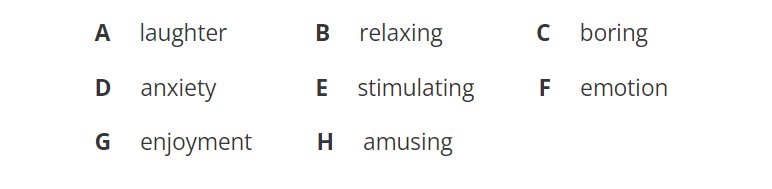
Questions
38 – 40Do the following statements agree with the information given in Reading Passage 3?
In boxes 37-40 on your answer sheet, write
YES if the statement agrees with the claims of the writer
NO if the statement contradicts the claims of the writer
NOT GIVEN if it is impossible to say what the writer thinks about this
- 16
Participants in the Santa Cruz study were more accurate at identifying the laughs of friends than those of strangers.
- A
Yes
BNo
CNot Given
- 17
The researchers in the San Diego study were correct in their predictions regarding the behaviour of the high-status individuals.
- A
Yes
BNo
CNot Given
- 18
The participants in the Australian National University study were given a fixed amount of time to complete the task focusing on employee profiles.
- A
Yes
BNo
CNot Given
- 19
Cheng and Wang’s conclusions were in line with established notions regarding task performance.
- A
Yes
BNo
CNot Given
Questions
1 – 6Reading Passage 1 has seven paragraphs, A-G. Which paragraph contains the following information? Match the correct letter, A-G, with boxes 1-6 on your answer sheet.
Paragraph B
Bạn chưa trả lời câu hỏi này
Paragraph C
Bạn chưa trả lời câu hỏi này
Paragraph F
Bạn chưa trả lời câu hỏi này
Paragraph D
Bạn chưa trả lời câu hỏi này
Paragraph E
Bạn chưa trả lời câu hỏi này
Paragraph A
Giải thích đáp án
CÂU HỎI 1 – PARAGRAPH B Chú ý tới từ khóa “dance” để tìm được Paragraph B chứa câu trả lời. | |
CÂU HỎI | VÙNG THÔNG TIN |
reference to an appealing way of using dance that the writer is not proposing | That is not to suggest everyone should dance their way to work, however healthy and happy it might make us, but rather that the techniques used by choreographers to experiment with and design movement in dance could provide engineers with tools to stimulate new ideas in city-making. |
DỊCH NGHĨA | |
Đề cập tới một cách khiêu vũ hấp dẫn mà người viết không đề xuất | Tất nhiên rằng tôi không khuyên mọi người khiêu vũ trên đường đi làm, dù nó giúp chúng ta trở nên khỏe mạnh và vui vẻ đi chăng nữa, mà ý tôi là những kỹ thuật được các nhà biên đạo múa sử dụng để tập dượt các điệu khiêu vũ có thể cho kỹ sư những gợi ý kích thích những ý tưởng mới trong việc quy hoạch thành phố. |
CÂU HỎI 2 – PARAGRAPH C Chú ý tới từ khóa “past and present approaches to building” để tìm được Paragraph C chứa câu trả lời. | |
CÂU HỎI | VÙNG THÔNG TIN |
an example of a contrast between past and present approaches to building | Whereas medieval builders improvised and adapted construction through their intimate knowledge of materials and personal experience of the conditions on a site, building designs are now conceived and stored in media technologies that detach the designer from the physical and social realities they are creating. |
DỊCH NGHĨA | |
Một ví dụ về sự tương phản giữa cách tiếp cận xây dựng của xưa và nay | Trong khi các nhà xây dựng thời trung cổ tự ứng biến trong việc xây dựng các công trình dựa trên kiến thức sâu rộng về vật liệu và kinh nghiệm cá nhân về những điều kiện ở khu vực xây dựng thì các bản vẽ thiết kế hiện này được áp dụng những công nghệ hiện đại, khiến nhà thiết kế chưa cần đến khu vực xây dựng để xem xét các vấn đề về vật lý hay xã hội của nó. |
CÂU HỎI 3 – PARAGRAPH F Chú ý tới từ khóa “objective of both dance and engineering” để tìm được Paragraph F chứa câu trả lời. | |
CÂU HỎI | VÙNG THÔNG TIN |
mention of an objective of both dance and engineering | Choreography may not seem an obvious choice for tackling this problem. Yet it shares with engineering the aim of designing patterns of movement within limitations of space. |
DỊCH NGHĨA | |
Đề cập tới mục đích của cả vũ đạo và kỹ thuật | Vũ đạo dường như không phải là một lựa chọn rõ ràng để giải quyết vấn đề này. Tuy nhiên, vũ đạo có chung mục đích với kỹ thuật trong việc thiết kế các mô hình chuyển động trong giới hạn của không gian. |
CÂU HỎI 4 – PARAGRAPH D Chú ý tới từ khóa “climate” để tìm được Paragraph D chứa câu trả lời. | |
CÂU HỎI | VÙNG THÔNG TIN |
reference to an unforeseen problem arising from ignoring the climate | They failed to take into account that purpose-built street cafés could not operate in the hot sun without the protective awnings common in older buildings, and would need energy-consuming air conditioning instead, or that its giant car park would feel so unwelcoming that it would put people off getting out of their cars. What seems entirely predictable and controllable on screen has unexpected results when translated into reality. |
DỊCH NGHĨA | |
Đề cập tới một vấn đề không biết trước nảy sinh từ việc phớt lờ điều kiện thời tiết | Họ không tính đến vấn đề là những quán cafe đường phố được xây dựng có mục đích không thể vận hành dưới ánh mặt trời nóng bức mà không có mái hiên bảo vệ, thứ chúng cần là những chiếc điều hòa tiêu tốn năng lượng, hay những bãi đỗ xe khổng lồ không mang lại cảm giác chào đón khiến mọi người không muốn rời khỏi chiếc xe của mình. Điều dường như hoàn toàn có thể dự đoán và kiểm soát được trên màn hình máy tính lại mang đến những kết quả không mong đợi khi đưa vào thực tiễn. |
CÂU HỎI 5 – PARAGRAPH E Chú ý tới từ khóa “measures intended to help people” để tìm được Paragraph E chứa câu trả lời. | |
CÂU HỎI | VÙNG THÔNG TIN |
why some measures intended to help people are being reversed | The same is true in transport engineering, which uses models to predict and shape the way people move through the city. Again, these models are necessary, but they are built on specific world views in which certain forms of efficiency and safety are considered and other experiences of the city ignored. Designs that seem logical in models appear counter-intuitive in the actual experience of their users |
DỊCH NGHĨA | |
Lý do tại sao những biện pháp nhằm giúp đỡ con người lại đang bị đảo lộn | Điều tương tự xảy ra trong kỹ thuật vận tải, khi ta sử dụng các mô hình để dự đoán và định hình cách mọi người di chuyển trong thành phố. Một lần nữa, những mô hình này là cần thiết, nhưng chúng được xây dựng trên một thế giới quan mà tính hiệu quả và sự an toàn được cân nhắc nhưng nhiều khía cạnh khác của thành phố bị bỏ qua. Các thiết kế nghe dương như hợp lý khi ở trong các mô hình lại đi ngược lại những gì được mong đợi trong những trải nghiệm thực tế của người dùng. |
CÂU HỎI 6 – PARAGRAPH A Chú ý tới từ khóa “transport has an impact” để tìm được Paragraph A chứa câu trả lời. | |
CÂU HỎI | VÙNG THÔNG TIN |
reference to how transport has an impact on human lives | The ways we travel affect our physical and mental health, our social lives, our access to work and culture, and the air we breathe. |
DỊCH NGHĨA | |
Đề cập đến việc giao thông ảnh hưởng ra sao đến cuộc sống con người | Cách chúng ta di chuyển, đi lại ảnh hưởng đến sức khỏe thể chất lẫn tinh thần, đời sống xã hội, cách ta tiếp cận với công việc và văn hóa, và cả bầu không khí chúng ta hít thở. |
Questions
7 – 13Complete the summary below. Choose ONE WORD ONLY from the passage for each answer. Write your answers in boxes 7-13 on your answer sheet.
Giải thích đáp án
CÂU HỎI 7 – SAFETY Chỗ trống cần điền đứng sau mạo từ “the” ⇒ cần điền danh từ | |
CÂU HỎI | VÙNG THÔNG TIN |
Guard rails were introduced on British roads to improve the safety of pedestrians, […] | The guard rails that will be familiar to anyone who has attempted to cross a British road, for example, were an engineering solution to pedestrian safety based on models that prioritize the smooth flow of traffic |
CÂU HỎI 8 – TRAFFIC Chỗ trống cần điền đứng sau giới từ “of” và phía sau là mệnh đề vị ngữ => cần điền danh từ | |
CÂU HỎI | VÙNG THÔNG TIN |
[…], while ensuring that the movement of traffic is not disrupted. | The guard rails that will be familiar to anyone who has attempted to cross a British road, for example, were an engineering solution to pedestrian safety based on models that prioritize the smooth flow of traffic |
CÂU HỎI 9 – CARRIAGEWAY Chỗ trống cần điền đứng sau từ “one” ⇒ cần điền danh từ | |
CÂU HỎI | VÙNG THÔNG TIN |
Pedestrians are led to access points, and encouraged to cross one carriageway at a time. | On wide major roads, they often guide pedestrians to specific crossing points and slow down their progress across the road by using staggered access points divide the crossing into two – one for each carriageway |
CÂU HỎI 10 – MOBILE Chỗ trống cần điền đứng trước danh từ “people”⇒ cần điền tính từ | |
CÂU HỎI | VÙNG THÔNG TIN |
An unintended effect is to create psychological difficulties in crossing the road, particularly for less mobile people. | In doing so they make crossings feel longer, introducing psychological barriers greatly impacting those that are the least mobile and encouraging others to make dangerous crossings to get around the guard rails |
CÂU HỎI 11 – DANGEROUS Chỗ trống cần điền đứng trước danh từ “way” ⇒ cần điền tính từ | |
CÂU HỎI | VÙNG THÔNG TIN |
Another result is that some people cross the road in a dangerous way. | In doing so they make crossings feel longer, introducing psychological barriers greatly impacting those that are the least mobile and encouraging others to make dangerous crossings to get around the guard rails |
CÂU HỎI 12 – COMMUNITIES Chỗ trống cần điền đứng sau chủ ngữ “The guard rails” ⇒ cần điền động từ | |
CÂU HỎI | VÙNG THÔNG TIN |
The guard rails separate communities, and make it more difficult to introduce forms of transport that are [13] | These barriers don’t just make it harder to cross the road: they divide communities and decrease opportunities for healthy transport. |
CÂU HỎI 13 – HEALTHY Chỗ trống cần điền đứng sau giới từ “of” ⇒ cần điền danh từ | |
CÂU HỎI | VÙNG THÔNG TIN |
The guard rails separate [12], and make it more difficult to introduce forms of transport that are healthy | These barriers don’t just make it harder to cross the road: they divide communities and decrease opportunities for healthy transport. |
Questions
14 – 17Reading Passage 2 has six paragraphs, A-F. Which paragraph contains the following information? Write the correct letter, A-F, in boxes 14-17 on your answer sheet. NB You may use any letter more than once.
Bạn chưa trả lời câu hỏi này
Paragraph F
Bạn chưa trả lời câu hỏi này
Paragraph A
Bạn chưa trả lời câu hỏi này
Paragraph D
Bạn chưa trả lời câu hỏi này
Paragraph A
Giải thích đáp án
CÂU HỎI 14 – PARAGRAPH F Chú ý tới từ khóa “disappearance of multiple species” để tìm được Paragraph F chứa câu trả lời. | |
CÂU HỎI | VÙNG THÔNG TIN |
a reference to how further disappearance of multiple species could be avoided. | She prefers to focus the debate on how this emerging technology could be used to fully understand why various species went extinct in the first place, and therefore how we could use it to make genetic modifications which could prevent mass extinctions in the future |
DỊCH NGHĨA | |
Đề cập tới việc làm thế nào để ngăn chặn sự biến mất của nhiều loài động vật. | Bà ấy trước tiên muốn tập trung vào các cuộc tranh luận làm thế nào để công nghệ mới nổi này được sử dụng để ta hoàn toàn hiểu được lý do tuyệt chủng của các loài, và từ đó tạo ra những điều chỉnh gen để ngăn chặn sự tuyệt chủng hàng loạt trong tương lai |
CÂU HỎI 15 – PARAGRAPH A Chú ý tới từ khóa “reproducing an extinct animal” để tìm được Paragraph A chứa câu trả lời. | |
CÂU HỎI | VÙNG THÔNG TIN |
explanation of a way of reproducing an extinct animal using the DNA of only that species | The basic premise involves using cloning technology to turn the DNA of extinct animals into a fertilized embryo, which is carried by the nearest relative still in existence in this case, the abundant band-tailed pigeon-before being born as a living, breathing animal. |
DỊCH NGHĨA | |
Giải thích cách tái sinh một loài động vật tuyệt chủng bằng cách sử dụng DNA của chính giống loài đó | Tiền đề cơ bản bao gồm việc sử dụng công nghệ nhân bản để biến DNA của những động vật tuyệt chủng thành phôi thụ tinh, phôi này được mang bởi những cá thể họ hàng gần nhất với chúng – chim bồ câu đuôi quạt – trước khi được sinh ra như một sinh vật sống |
CÂU HỎI 16 – PARAGRAPH D Chú ý tới từ khóa “a habitat which has suffered” để tìm được Paragraph D chứa câu trả lời. | |
CÂU HỎI | VÙNG THÔNG TIN |
reference to a habitat which has suffered following the extinction of a species | Since the disappearance of this key species, ecosystems in the eastern US have suffered, as the lack of disturbance caused by thousands of passenger pigeons wrecking trees and branches means there has been minimal need for regrowth |
DỊCH NGHĨA | |
Đề cập tới một môi trường sống đã bị ảnh hưởng sau sự tuyệt chủng của một giống loài | Kể từ khi giống loài này tuyệt chủng, các hệ sinh thái ở miền đông Hoa Kỳ đã chịu ảnh hưởng tương đối nhiều, vì cây cối không còn bị phá hoại bởi hàng ngàn chú chim bồ câu viễn khách, điều đó làm giảm nhu cầu tái sinh trưởng |
CÂU HỎI 17 – PARAGRAPH A Chú ý tới từ khóa “the exact point” để tìm được Paragraph A chứa câu trả lời. | |
CÂU HỎI | VÙNG THÔNG TIN |
mention of the exact point at which a particular species became extinct | Flying in vast numbers across North America, with potentially many millions within a single flock, their migration was once one of nature’s great spectacles. Sadly, the passenger pigeon’s existence came to an end on 1 September 1914, when the last living specimen died at Cincinnati Zoo |
DỊCH NGHĨA | |
Đề cập tới thời điểm chính xác mà một giống loài tuyệt chủng | Một số lượng lớn bay trên khắp Bắc Mỹ, với hàng triệu con một đàn, những cuộc di cư của chúng từng được coi là một trong những cảnh tượng tuyệt vời nhất của tự nhiên. Đáng buồn thay, sự tồn tại của loài chim bồ câu viễn khách đã chấm dứt vào ngày 1 tháng 9 năm 1914, khi cá thể sống cuối cùng chết tại sở thú Cincinnati. |
Questions
18 – 22Complete the summary below. Choose NO MORE THAN TWO WORDS from the passage for each answer. Write your answers in boxes 18-22 on your answer sheet.
Giải thích đáp án
CÂU HỎI 18 – GENETIC TRAITS Chỗ trống cần điền đứng sau mạo từ “the” ⇒ cần điền danh từ | |
CÂU HỎI | VÙNG THÔNG TIN |
Professor George Church and his team are trying to identify the genetic traits which enabled mammoths to live in the tundra. | By pinpointing which genetic traits made it possible for mammoths to survive the icy climate of the tundra, the project’s goal is to return mammoths, or a mammoth-like species, to the area. |
CÂU HỎI 19 – HEAT LOSS Chỗ trống cần điền đứng sau động từ “minimize” ⇒ cần điền danh từ | |
CÂU HỎI | VÙNG THÔNG TIN |
According to Church, introducing Asian elephants to the tundra would involve certain physical adaptations to minimize heat loss | Necessary adaptations would include smaller ears, thicker hair, and extra insulating fat, all for the purpose of reducing heat loss in the tundra, and all traits found in the now extinct woolly mammoth. |
CÂU HỎI 20 – EARS Chỗ trống cần điền đang đứng cùng chuỗi liệt kê với danh từ “hair” => theo quy tắc song song, điền danh từ | |
CÂU HỎI | VÙNG THÔNG TIN |
To survive in the tundra, the species would need to have the mammoth-like features of thicker hair, ears of a reduced size and more [21] | Necessary adaptations would include smaller ears, thicker hair, and extra insulating fat, all for the purpose of reducing heat loss in the tundra, and all traits found in the now extinct woolly mammoth. |
CÂU HỎI 21 – (INSULATING) FAT Chỗ trống cần điền đứng cùng chuỗi liệt kê với danh từ “hair”⇒ cần điền danh từ | |
CÂU HỎI | VÙNG THÔNG TIN |
To survive in the tundra, the species would need to have the mammoth-like features of thicker hair, [20] of a reduced size and more (insulating) fat | Necessary adaptations would include smaller ears, thicker hair, and extra insulating fat, all for the purpose of reducing heat loss in the tundra, and all traits found in the now extinct woolly mammoth. |
CÂU HỎI 22 – (CARBON) EMISSIONS Chỗ trống cần điền đứng sau động từ “decrease” ⇒ cần điền danh từ | |
CÂU HỎI | VÙNG THÔNG TIN |
Repopulating the tundra with mammoths or Asian elephant/mammoth hybrids would also have an impact on the environment, which could help to reduce temperatures and decrease (carbon) emissions. | This repopulation of the tundra and boreal forests of Eurasia and North America with large mammals could also be a useful factor in reducing carbon emissions – elephants punch holes through snow and knock down trees, which encourages grass growth. |
Questions
23 – 26Look at the following statements (Questions 23-26) and the list of people below. Match each statement with the correct person, A, B or C. NB You may use any letter more than once.
Bạn chưa trả lời câu hỏi này
B. Michael Archer
Bạn chưa trả lời câu hỏi này
C. Beth Shapiro
Bạn chưa trả lời câu hỏi này
A. Ben Novak
Bạn chưa trả lời câu hỏi này
C. Beth Shapiro
Giải thích đáp án
CÂU HỎI 23 – PERSON B (MICHAEL ARCHER) Chú ý tới từ khóa “reintroducing” để tìm được Paragraph B chứa câu trả lời. | |
CÂU HỎI | VÙNG THÔNG TIN |
Reintroducing an extinct species to its original habitat could improve the health of a particular species living there. | The return of thylacines to Tasmania could help to ensure that devils are never again subjected to risks of this kind.
|
DỊCH NGHĨA | |
Việc đưa một loài đã tuyệt chủng trở lại môi trường sống ban đầu của nó có thể cải thiện sức khỏe của một loài sống ở đó | Việc tái sinh hổ Tasmania có thể giúp đảm bảo rằng quỷ Tasmania sẽ không còn phải trải qua những rủi ro mắc bệnh kiểu này nữa |
CÂU HỎI 24 – PERSON C (BETH SHAPIRO) Chú ý tới từ khóa “the causes of an animal’s extinction” để tìm được Paragraph F chứa câu trả lời. | |
CÂU HỎI | VÙNG THÔNG TIN |
It is important to concentrate on the causes of an animal’s extinction. | She prefers to focus the debate on how this emerging technology could be used to fully understand why various species went extinct in the first place, and therefore how we could use it to make genetic modifications which could prevent mass extinctions in the future |
DỊCH NGHĨA | |
Điều quan trọng là phải tập trung vào nguyên nhân dẫn đến sự tuyệt chủng của động vật | Bà ấy trước tiên muốn tập trung vào các cuộc tranh luận làm thế nào để công nghệ mới nổi này được sử dụng để ta hoàn toàn hiểu được lý do tuyệt chủng của các loài, và từ đó tạo ra những điều chỉnh gen để ngăn chặn sự tuyệt chủng hàng loạt trong tương lai |
CÂU HỎI 25 – PERSON A (BETH NOVAK) Chú ý tới từ khóa “vegetation” để tìm được Paragraph E chứa câu trả lời. | |
CÂU HỎI | VÙNG THÔNG TIN |
A species brought back from extinction could have an important beneficial impact on the vegetation of its habitat. | This repopulation of the tundra and boreal forests of Eurasia and North America with large mammals could also be a useful factor in reducing carbon emissions – elephants punch holes through snow and knock down trees, which encourages grass growth. This grass growth would reduce temperature, and mitigate emissions from melting permafrost. |
DỊCH NGHĨA | |
Một giống loài được đưa trở lại sau khi tuyệt chủng có tác động quan trọng, có lợi cho thảm thực vật của môi trường sống | Sự tái sinh này của các lãnh nguyên và rừng cây ở Âu Á và Bắc Mỹ với các loài động vật lớn cũng có thể là một yếu tố có lợi trong việc giảm lượng khí thải carbon – voi đục lỗ xuyên tuyết và đánh sập cây cối, khuyến khích cỏ phát triển. Sự phát triển của cỏ này sẽ giảm nhiệt độ và giảm thiểu lượng khí thải do lớp băng vĩnh cửu tan chảy. |
CÂU HỎI 26 – PERSON C (BETH SHAPIRO) Chú ý tới từ khóa “current efforts” để tìm được Paragraph F chứa câu trả lời. | |
CÂU HỎI | VÙNG THÔNG TIN |
Our current efforts at preserving biodiversity are insufficient. | ‘We know that what we are doing today is not enough, and we have to be willing to take some calculated and measured risks.’ |
DỊCH NGHĨA | |
Những nỗ lực bảo tồn hệ sinh thái của chúng ta bây giờ vẫn chưa đủ. | ‘Chúng tôi biết rằng những gì chúng ta đang làm ngày hôm nay là chưa đủ, và chúng ta cần phải sẵn sàng đón nhận một vài rủi ro đã tính toán từ trước’ |
Questions
27 – 31Choose the correct letter, A, B, C or D. Write the correct letter in boxes 27-31 on your answer sheet.
- 27
When referring to laughter in the first paragraphs, the writer emphasises
Bạn chưa trả lời câu hỏi này
- A
its impact on language.
Bits function in human culture.
Cits value to scientific research.
Dits universality in animal societies.
Giải thích đáp án
CÂU HỎI 27 – PARAGRAPH 1 | |
CÂU HỎI | VÙNG THÔNG TIN |
27. When referring to laughter in the first paragraphs, the writer emphasises A. its impact on language. B. its function in human culture. C. its value to scientific research. D. its universality in animal societies. | Like other human emotions and expressions, laughter and humour provide psychological scientists with rich resources for studying human psychology, ranging from the development of language to the neuroscience of social perception |
DỊCH NGHĨA | |
27. Khi đề cập tới tiếng cười ở những đoạn văn đầu tiên, người viết nhấn mạnh A. ảnh hưởng của nó lên ngôn ngữ B. chức năng của nó trong văn hóa nhân loại C. giá trị của nó đối với nghiên cứu khoa học D. tính phổ biến của nó trong xã hội động vật | Giống như những cảm xúc và biểu cảm khác của con người, tiếng cười và sự hài hước mang lại cho các nhà tâm lý học nguồn tài liệu nghiên cứu tâm lý con người phong phú, từ sự phát triển của ngôn ngữ đến khoa học thần kinh về nhận thức xã hội. |
| |
- 28
What does the writer suggest about Charley Douglass?
Bạn chưa trả lời câu hỏi này
- A
He understood the importance of enjoying humour in a group setting.
BHe believed that TV viewers at home needed to be told when to laugh.
CHe wanted his shows to appeal to audiences across the social spectrum.
DHe preferred shows where audiences were present in the recording studio.
Giải thích đáp án
CÂU HỎI 28 – PARAGRAPH 2 | |
CÂU HỎI | VÙNG THÔNG TIN |
28. What does the writer suggest about Charley Douglass? A. He understood the importance of enjoying humour in a group setting. B. He believed that TV viewers at home needed to be told when to laugh. C. He wanted his shows to appeal to audiences across the social spectrum. D. He preferred shows where audiences were present in the recording studio. | Back in 1950, US sound engineer Charley Douglass hated dealing with the unpredictable laughter of live audiences, so started recording his own ‘laugh tracks’. These were intended to help people at home feel like they were in a social situation, such as a crowded theater |
DỊCH NGHĨA | |
28. Tác giả đã nói gì về Charley Douglass? A. Ông ấy hiểu được tầm quan trọng của việc tận hưởng sự khôi hài trong một nhóm người B. Ông ấy tin rằng những người xem TV tại nhà cần được biết khi nào cười C. Ông ấy muốn những buổi diễn của mình thu hút khán giả trên toàn xã hội. D. Ông ấy thích những buổi diễn có sự hiện diện của khán giả ở phòng thu âm. | Năm 1950, kỹ sư âm thanh người Mỹ Charley Douglass ghét việc xử lý những tiếng cười không thể đoán trước của khán giả xem ở trường quay, vì vậy ông ấy bắt đầu thu âm lại tiếng người cho sẵn vào băng. Những băng thu tiếng cười ấy giúp khán giả ở nhà cảm thấy như đang ở một nơi đông người, ví dụ như ở một nhà hát vậy. |
| |
- 29
What makes the Santa Cruz study particularly significant?
Bạn chưa trả lời câu hỏi này
- A
the various different types of laughter that were studied
Bthe similar results produced by a wide range of cultures
Cthe number of different academic disciplines involved
Dthe many kinds of people whose laughter was recorded
Giải thích đáp án
CÂU HỎI 29 – PARAGRAPH 3 | |
CÂU HỎI | VÙNG THÔNG TIN |
29. What makes the Santa Cruz study particularly significant? A. the various different types of laughter that were studied B. the similar results produced by a wide range of cultures C. the number of different academic disciplines involved D. the many kinds of people whose laughter was recorded | In one study conducted in 2016, samples of laughter from pairs of English-speaking students were recorded at the University of California, Santa Cruz. A team made up of more than 30 psychological scientists, anthropologists, and biologists then played these recordings to listeners from 24 diverse societies, from indigenous tribes in New Guinea to city-dwellers in India and Europe. Participants were asked whether they thought the people laughing were friends or strangers. On average, the results were remarkably consistent: worldwide, people’s guesses were correct approximately 60% of the time |
DỊCH NGHĨA | |
29. Điều gì làm cho nghiên cứu ở Santa Cruz trở nên đặc biệt quan trọng? A. những loại tiếng cười khác nhau được nghiên cứu B. những kết quả giống nhau từ những nền văn hóa khác nhau C. số lượng những ngành học khác nhau liên quan D. nhiều kiểu người được thu âm tiếng cười | Trong một nghiên cứu năm 2016, các mẫu tiếng cười của các cặp sinh viên nói tiếng Anh đã được ghi lại tại Đại học California, Santa Cruz. Một nhóm gồm hơn 30 nhà khoa học tâm lý, nhà nhân chủng học và nhà sinh học sau đó đã phát những bản ghi âm này cho người nghe đến từ 24 nơi có hoàn cảnh xã hội khác nhau, từ các bộ lạc bản địa ở New Guinea đến cư dân thành thị ở Ấn Độ và châu Âu. Những người tham gia được hỏi xem họ nghĩ rằng những người cười là bạn của nhau hay người lạ. Tính trung bình thì kết quả tương đối nhất quán: 60% những người tham gia đoán đúng. |
| |
- 30
Which of the following happened in the San Diego study?
Bạn chưa trả lời câu hỏi này
- A
Some participants became very upset.
BParticipants exchanged roles.
CParticipants who had not met before became friends.
DSome participants were unable to laugh.
Giải thích đáp án
CÂU HỎI 30 – PARAGRAPH 4 | |
CÂU HỎI | VÙNG THÔNG TIN |
30. Which of the following happened in the San Diego study? A. Some participants became very upset. B. Participants exchanged roles. C. Participants who had not met before became friends. D. Some participants were unable to laugh.
| A team led by Christopher Oveis from the University of California, San Diego, found that high-status individuals had different laughs from low-status individuals, and that strangers’ judgements of an individual’s social status were influenced by the dominant or submissive quality of their laughter. In their study, 48 male college students were randomly assigned to groups of four, with each group composed of two low-status members, who had just joined their college fraternity group, and two high-status members, older student took a turn at being teased by the others, involving the use of mildly insulting nicknames. |
DỊCH NGHĨA | |
30. Điều gì diễn ra trong nghiên cứu ở San Diego? A. Một vài người tham gia trở nên buồn bã, chán nản B. Những người tham gia đổi vai trò cho nhau C. Những người tham gia chưa từng gặp trước đây lại trở thành những người bạn của nhau D. Một vài người tham gia không thể cười | Một nhóm nghiên cứu do Christopher Oveis từ Đại học California, San Diego dẫn dắt, phát hiện ra rằng những người có địa vị cao có tiếng cười khác với những người có địa vị thấp và những đánh giá của người lạ về địa vị xã hội của một cá nhân bị ảnh hưởng bởi tiếng cười thống trị hay phục tùng của họ. Trong nghiên cứu của họ, 48 nam sinh viên đại học được chọn ngẫu nhiên vào nhóm bốn người, mỗi nhóm gồm hai người địa vị xã hội thấp từng là anh em bằng hữu thời đại học, và hai người địa vị xã hội cao trong đó người lớn tuổi hơn lần lượt bị những người khác trêu chọc, thậm chí sử dụng những cái tên có đôi phần xúc phạm. |
| |
- 31
In the fifth paragraph, what did the results of the San Diego study suggest?
Bạn chưa trả lời câu hỏi này
- A
It is clear whether a dominant laugh is produced by a high- or low-status person.
BLow-status individuals in a position of power will still produce submissive laughs.
CThe submissive laughs of low- and high-status individuals are surprisingly similar.
DHigh-status individuals can always be identified by their way of laughing.
Giải thích đáp án
CÂU HỎI 31 – PARAGRAPH 5 | |
CÂU HỎI | VÙNG THÔNG TIN |
31. In the fifth paragraph, what did the results of the San Diego study suggest? A. It is clear whether a dominant laugh is produced by a high- or low-status person. B. Low-status individuals in a position of power will still produce submissive laughs. C. The submissive laughs of low- and high-status individuals are surprisingly similar. D. High-status individuals can always be identified by their way of laughing. | ‘Thus, by strategically displaying more dominant laughter when the context allows, low-status individuals may achieve higher status in the eyes of others.’ However, high-status individuals were rated as high-status whether they produced their natural dominant laugh or tried to do a submissive one |
DỊCH NGHĨA | |
31. Trong đoạn thứ năm, kết quả của cuộc nghiên cứu ở San Diego đã gợi ý điều gì? A. Dễ dàng nhận ra được tiếng cười lấn át đó là của người có địa vị cao hay thấp B. Những người có địa vị thấp đặt trong một vị trí quyền lực vẫn sẽ tạo ra tiếng cười phục tùng. C. Tiếng cười phục tùng của những người có địa vị thấp và cao giống nhau đến bất ngờ D. Những người có địa vị cao luôn có thể được xác định bằng cách cười của họ.
| ‘Do đó, trong hoàn cảnh cho phép, những người có địa vị thấp có thể cười kiểu lấn át để có được địa vị cao hơn trong mắt người khác.’ Tuy nhiên, những người có địa vị cao luôn được đánh giá là có địa vị cao dù họ cười lấn át một cách tự nhiên hay cố gắng cười kiểu phục tùng |
| |
Questions
32 – 36Complete the summary using the list of words, A-H, below. Write the correct letter, A-H, in boxes 32-36 on your answer sheet.
Giải thích đáp án
CÂU HỎI 32 – F (EMOTION) Chỗ trống cần điền đứng sau giới từ “of” ⇒ cần điền danh từ | |
CÂU HỎI | VÙNG THÔNG TIN |
In one study at Australian National University, randomly chosen groups of participants were shown one of three videos, each designed to generate a different kind of emotion | The students then were randomly assigned to watch a video clip eliciting either humour, contentment, or neutral feelings. |
CÂU HỎI 33 – H (AMUSING) Chỗ trống cần điền đứng trước danh từ “video” ⇒ cần điền tính từ | |
CÂU HỎI | VÙNG THÔNG TIN |
When all participants were then given a deliberately frustrating task to do, it was found that those who had watched the amusing video persisted with the task for longer and tried harder to accomplish the task than either of the other two groups. | However, the software was programmed such that it was nearly impossible to achieve 10 consecutive correct answers. Participants were allowed to quit the task at any point. Students who had watched theMr. Bean video ended up spending significantly more time working on the task, making twice as many predictions as the other two groups. |
CÂU HỎI 34 – C (BORING) Chỗ trống cần điền đứng trước danh từ “task” ⇒ cần điền tính từ | |
A second study in which participants were asked to perform a particularly boring task produced similar results. | Cheng and Wang then replicated these results in a second study, during which they had participants complete long multiplication questions by hand. Again, participants who watched the humorous video spent significantly more time working on this tedious task and completed more questions correctly than did the students in either of the other groups. |
CÂU HỎI 35 – D (ANXIETY) Chỗ trống cần điền đứng sau động từ “reduces” ⇒ cần điền danh từ | |
CÂU HỎI | VÙNG THÔNG TIN |
According to researchers David Cheng and Lu Wang, these findings suggest that humour not only reduces anxiety and helps build social connections but it may also have a [36] effect on the body and mind. | ‘Although humour has been found to help relieve stress and facilitate social relationships, traditional view of task performance implies that individuals should avoid things such as humour that may distract them from the accomplishment of task goals,’ Cheng and Wang conclude. |
CÂU HỎI 36 – E (STIMULATING) Chỗ trống cần điền đứng trước danh từ “effect” ⇒ cần điền tính từ | |
CÂU HỎI | VÙNG THÔNG TIN |
According to researchers David Cheng and Lu Wang, these findings suggest that humour not only reduces [35] and helps build social connections but it may also have a stimulating effect on the body and mind. | ‘We suggest that humour is not only enjoyable but more importantly, energising.’ |
Questions
37 – 40Do the following statements agree with the information given in Reading Passage 3?
In boxes 37-40 on your answer sheet, write
YES if the statement agrees with the claims of the writer
NO if the statement contradicts the claims of the writer
NOT GIVEN if it is impossible to say what the writer thinks about this
- 37
Participants in the Santa Cruz study were more accurate at identifying the laughs of friends than those of strangers.
Bạn chưa trả lời câu hỏi này
- A
Yes
BNo
CNot Given
Giải thích đáp án
CÂU HỎI 37 – NOT GIVEN Chú ý tới từ khóa “friends” hoặc “strangers” để tìm được Paragraph 3 chứa câu trả lời. | |
CÂU HỎI | VÙNG THÔNG TIN |
Participants in the Santa Cruz study were more accurate at identifying the laughs of friends than those of strangers. | Participants were asked whether they thought the people laughing were friends or strangers. On average, the results were remarkably consistent: worldwide, people’s guesses were correct approximately 60% of the time. |
DỊCH NGHĨA | |
Những người tham gia nghiên cứu ở Santa Cruz có khả năng nhận ra tiếng cười của bạn bè chuẩn xác hơn tiếng cười của người lạ mặt. | Những người tham gia được hỏi về người đang cười liệu là bạn bè hay người lạ. Kết quả trung bình tương đối đồng nhất: trên toàn thế giới, mọi người đoán đúng đến khoảng 60% |
Giải thích: Bài khóa không đề cập tới việc người tham gia đoán đúng tiếng cười của ai hơn (không hề so sánh) mà chỉ nhắc đến con số 60% – khả năng chọn đúng giữa tiếng cười của bạn bè hay người lạ => NOT GIVEN | |
- 38
The researchers in the San Diego study were correct in their predictions regarding the behaviour of the high-status individuals.
Bạn chưa trả lời câu hỏi này
- A
Yes
BNo
CNot Given
Giải thích đáp án
- 39
The participants in the Australian National University study were given a fixed amount of time to complete the task focusing on employee profiles.
Bạn chưa trả lời câu hỏi này
- A
Yes
BNo
CNot Given
Giải thích đáp án
CÂU HỎI 39 – FALSE Chú ý tới từ khóa “employee profiles” để tìm được Paragraph 7 chứa câu trả lời. | |
CÂU HỎI | VÙNG THÔNG TIN |
The participants in the Australian National University study were given a fixed amount of time to complete the task focusing on employee profiles. | The students then completed a task requiring persistence in which they were asked to guess the potential performance of employees based on provided profiles, and were told that making 10 correct assessments in a row would lead to a win. However, the software was programmed such that it was nearly impossible to achieve 10 consecutive correct answers. Participants were allowed to quit the task at any point. |
DỊCH NGHĨA | |
Người tham gia trong nghiên cứu của trường Đại học Quốc gia Úc được dành một khoảng thời gian cố định để hoàn thành nhiệm vụ tập trung vào hồ sơ của nhân viên. | Sau đó, các sinh viên hoàn thành một nhiệm vụ đòi hỏi sự kiên trì, phải đoán hiệu suất tiềm năng của nhân viên dựa trên hồ sơ được cung cấp, biết rằng thực hiện 10 đánh giá đúng liên tiếp sẽ dành chiến thắng. Tuy nhiên, phần mềm đã được lập trình để gần như không thể đạt được 10 câu trả lời đúng liên tiếp. Những người tham gia được phép bỏ nhiệm vụ bất cứ lúc nào. |
Giải thích: Nhiệm vụ sinh viên cần làm trong nghiên cứu của trường Đại học Quốc gia Úc được phần mềm lập trình sao cho không thể đúng 10 câu liên tiếp. Người tham gia hoàn toàn có thể bỏ nhiệm vụ đó bất kỳ lúc nào, chứ không bị giới hạn phải hoàn thành trong một khoảng thời gian cụ thể. => FALSE Note: Không chọn từ khóa tên riêng “Australian National University”, vì từ khóa này trong bài cũng xuất hiện trong đoạn 6 dẫn đến chọn sai đáp án | |
- 40
Cheng and Wang’s conclusions were in line with established notions regarding task performance.
Bạn chưa trả lời câu hỏi này
- A
Yes
BNo
CNot Given
Giải thích đáp án
CÂU HỎI 40 – FALSE Chú ý tới từ khóa “Cheng and Wang” để tìm được Paragraph 9 chứa câu trả lời. | |
CÂU HỎI | VÙNG THÔNG TIN |
Cheng and Wang’s conclusions were in line with established notions regarding task performance. | Cheng and Wang then replicated these results in a second study, during which they had participants complete long multiplication questions by hand. Again, participants who watched the humorous video spent significantly more time working on this tedious task and completed more questions correctly than did the students in either of the other groups.
‘Although humour has been found to help relieve stress and facilitate social relationships, traditional view of task performance implies that individuals should avoid things such as humour that may distract them from the accomplishment of task goals,’ Cheng and Wang conclude. |
DỊCH NGHĨA | |
Kết luận của Cheng và Wang trùng với quan điểm sẵn có về kết quả làm việc cá nhân | Cheng và Wang sau đó có những kết quả này y hệt trong nghiên cứu thứ hai, họ cho những người tham gia hoàn thành các câu hỏi nhân dài bằng tay. Một lần nữa, những người tham gia mà đã xem đoạn video hài hước dành nhiều thời gian hơn để thực hiện nhiệm vụ tẻ nhạt này và hoàn thành nhiều câu hỏi một cách chính xác hơn so với những sinh viên ở một trong hai nhóm còn lại.
Cheng và Wang kết luận một điều ràng: “Tuy sự khôi hài có thể giải tỏa căng thẳng và phát triển các mối quan hệ xã hội, nhưng cách nhìn nhận truyền thống về kết quả làm việc cá nhân chỉ ra rằng mỗi người nên tránh xa những thứ như sự hài hước để hạn chế việc bị xao nhãng, không hoàn thành được mục tiêu công việc” |
Giải thích: Cheng và Wang đưa ra kết luận về sự khôi hài (có lợi, giúp giải tỏa căng thẳng, phát triển mối quan hệ), không giống với quan điểm truyền thống (gây xao nhãng, không hoàn thành được mục tiêu) => FALSE | |
