IELTS Handbook 16 – Test 4 – R

READING PASSAGE 1


You should spend about 20 minutes on Questions 1-13 which are based on Reading Passage 1 below.


Roman tunnels

The Romans, who once controlled areas of Europe, North Africa and Asia Minor, adopted the construction techniques of other civilizations to build tunnels in their territories

The Persians, who lived in present-day Iran, were one of the first civilizations to build tunnels that provided a reliable supply of water to human settlements in dry areas. In the early first millennium BCE, they introduced the qanat method of tunnel construction, which consisted of placing posts over a hill in a straight line, to ensure that the tunnel kept to its route, and then digging vertical shafts down into the ground at regular intervals. Underground, workers removed the earth from between the ends of the shafts, creating a tunnel. The excavated soil was taken up to the surface using the shafts, which also provided ventilation during the work. Once the tunnel was completed, it allowed water to flow from the top of a hillside down towards a canal, which supplied water for human use. Remarkably, some qanats built by the Persians 2,700 years ago are still in use today.

They later passed on their knowledge to the Romans, who also used the qanat method to construct water-supply tunnels for agriculture. Roma qanat tunnels were constructed with vertical shafts dug at intervals of between 30 and 60 meters. The shafts were equipped with handholds and footholds to help those climbing in and out of them and were covered with a wooden or stone lid. To ensure that the shafts were vertical, Romans hung a plumb line from a rod placed across the top of each shaft and made sure that the weight at the end of it hung in the center of the shaft. Plumb lines were also used to measure the depth of the shaft and to determine the slope of the tunnel. The 5.6-kilometer-long Claudius tunnel, built in 41 CE to drain the Fucine Lake in central Italy, had shafts that were up to 122 meters deep, took 11 years to build and involved approximately 30,000 workers.

By the 6th century BCE, a second method of tunnel construction appeared called the counter-excavation method, in which the tunnel was constructed from both ends. It was used to cut through high mountains when the qanat method was not a practical alternative. This method required greater planning and advanced knowledge of surveying, mathematics and geometry as both ends of a tunnel had to meet correctly at the center of the mountain. Adjustments to the direction of the tunnel also had to be made whenever builders encountered geological problems or when it deviated from its set path. They constantly checked the tunnel’s advancing direction, for example, by looking back at the light that penetrated through the tunnel mouth, and made corrections whenever necessary. Large deviations could happen, and they could result in one end of the tunnel not being usable. An inscription written on the side of a 428-meter tunnel, built by the Romans as part of the Saldae aqueduct system in modern-day Algeria, describes how the two teams of builders missed each other in the mountain and how the later construction of a lateral link between both corridors corrected the initial error.

The Romans dug tunnels for their roads using the counter-excavation method, whenever they encountered obstacles such as hills or mountains that were too high for roads to pass over. An example is the 37-meter-long, 6-meter-high, Furlo Pass Tunnel built in Italy in 69-79 CE. Remarkably, a modern road still uses this tunnel today. Tunnels were also built for mineral extraction. Miners would locate a mineral vein and then pursue it with shafts and tunnels underground. Traces of such tunnels used to mine gold can still be found at the Dolaucothi mines in Wales. When the sole purpose of a tunnel was mineral extraction, construction required less planning, as the tunnel route was determined by the mineral vein.

Roman tunnel projects were carefully planned and carried out. The length of time it took to construct a tunnel depended on the method being used and the type of rock being excavated. The qanat construction method was usually faster than the counter-excavation method as it was more straightforward. This was because the mountain could be excavated not only from the tunnel mouths but also from shafts. The type of rock could also influence construction times. When the rock was hard, the Romans employed a technique called fire quenching which consisted of heating the rock with fire, and then suddenly cooling it with cold water so that it would crack. Progress through hard rock could be very slow, and it was not uncommon for tunnels to take years, if not decades, to be built. Construction marks left on a Roman tunnel in Bologna show that the rate of advance through solid rock was 30 centimeters per day. In contrast, the rate of advance of the Claudius tunnel can be calculated at 1.4 meters per day. Most tunnels had inscriptions showing the names of patrons who ordered construction and sometimes the name of the architect. For example, the 1.4-kilometer Çevlik tunnel in Turkey, built to divert the floodwater threatening the harbor of the ancient city of Seleuceia Pieria, had inscriptions on the entrance, still visible today, that also indicate that the tunnel was started in 69 CE and was completed in 81 CE.

Questions

– 6

Label the diagrams below. Choose ONE WORD ONLY from the passage for each answer. Write your answers in boxes 1-6
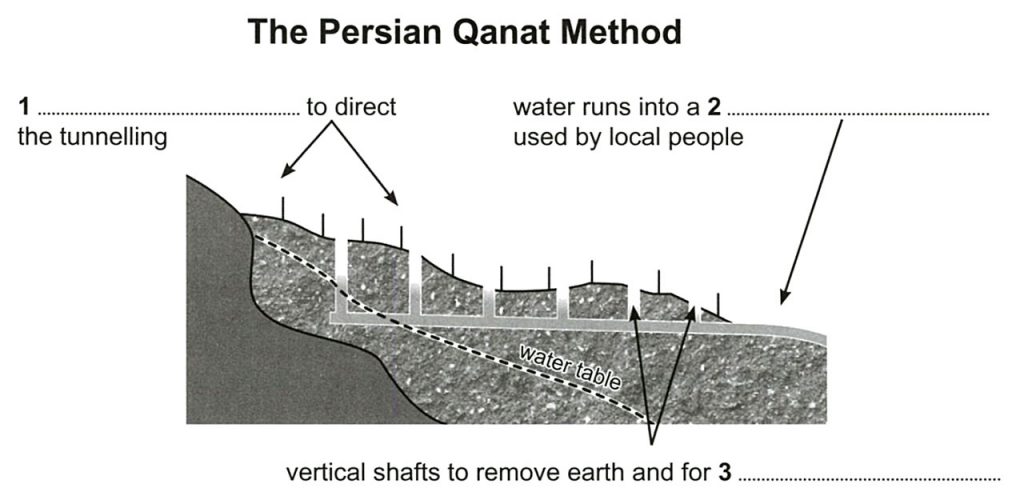
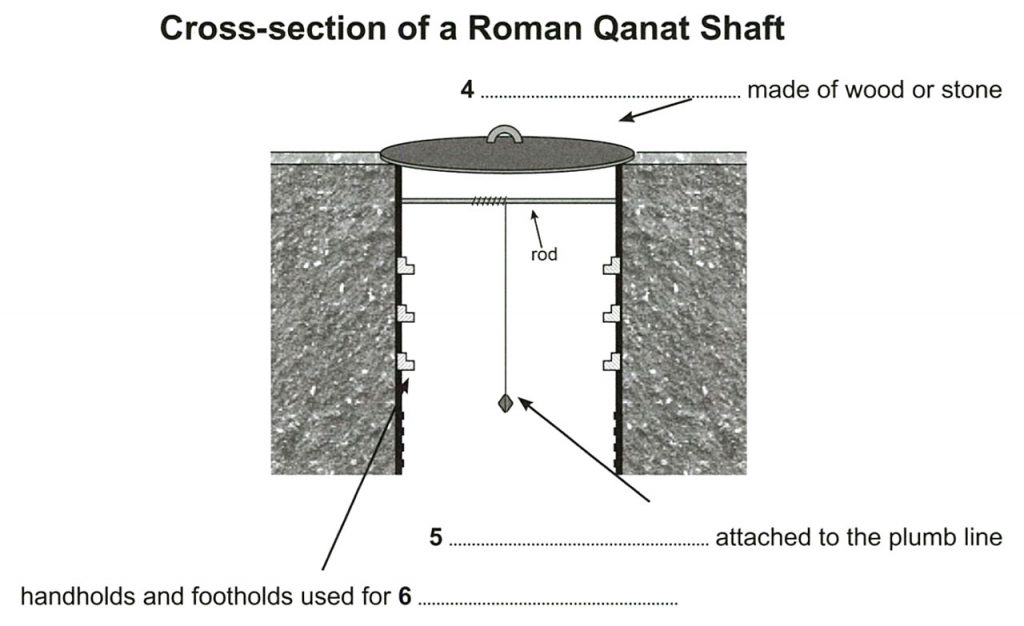
image
image
 
 
image
image
 
1
 
2
 
3
 
4
 
5
 
6
 

Questions

– 10
 

Do the following statements agree with the information given in Reading Passage 1?

TRUE           if the statement agrees with the information

FALSE          if the statement contradicts the information

NOT GIVEN    if there is no information on this

  • 7

    The counter-excavation method completely replaced the qanat method in the 6th century BCE

     
  • A

    True

    B

    False

    C

    Not Given

  • 8

    Only experienced builders were employed to construct a tunnel using the counter-excavation method.

     
  • A

    True

    B

    False

    C

    Not Given

  • 9

    The information about a problem that occurred during the construction of the Saldae aqueduct system was found in an ancient book.

     
  • A

    True

    B

    False

    C

    Not Given

  • 10

    The mistake made by the builders of the Saldae aqueduct system was that the two parts of the tunnel failed to meet.

     
  • A

    True

    B

    False

    C

    Not Given

Questions

11 – 13
 

Answer the questions below. Choose NO MORE THAN TWO WORDS from the passage for each answer. Write your answers in boxes 11-13

What type of mineral were the Dolaucothi mines in Wales built to extract? 11
 
In addition to the patron, whose name might be carved onto a tunnel? 12
 
What part of Seleuceia Pieria was the Çevlik tunnel built to protect? 13


READING PASSAGE 2


You should spend about 20 minutes on Questions 14-26 which are based on Reading Passage 2 below. 


Changes in reading habits

What are the implications of the way we read today?

Look around on your next plane trip. The iPad is the new pacifier for babies and toddlers. Younger school-aged children read stories on smartphones; older kids don’t read at all, but hunch over video games. Parents and other passengers read on tablets or skim a flotilla of email and news feeds. Unbeknown to most of us, an invisible, game-changing transformation links everyone in this picture: the neuronal circuit that underlies the brain’s ability to read is subtly, rapidly changing and this has implications for everyone from the pre-reading toddler to the expert adult.

As work in neurosciences indicates, the acquisition of literacy necessitated a new circuit in our species’ brain more than 6,000 years ago. That circuit evolved from a very simple mechanism for decoding basic information, like the number of goats in one’s herd, to the present, highly elaborated reading brain. My research depicts how the present reading brain enables the development of some of our most important intellectual and affective processes: internalized knowledge, analogical reasoning, and inference; perspective-taking and empathy; critical analysis and the generation of insight. Research surfacing in many parts of the world now cautions that each of these essential ‘deep reading’ processes may be under threat as we move into digital-based modes of reading.

This is not a simple, binary issue of print versus digital reading and technological innovations. As MIT scholar Sherry Turkle has written, we do not err as a society when we innovate but when we ignore what we disrupt or diminish while innovating. In this hinge moment between print and digital cultures, society needs to confront what is diminishing in the expert reading circuit, what our children and older students are not developing, and what we can do about it.

We know from research that the reading circuit is not given to human beings through a genetic blueprint like vision or language; it needs an environment to develop. Further, it will adapt to that environment’s requirements – from different writing systems to the characteristics of whatever medium is used. If the dominant medium advantages processes that are fast, multi-task oriented and well-suited for large volumes of information, like the current digital medium, so will the reading circuit. As UCLA psychologist Patricia Greenfield writes, the result is that less attention and time will be allocated to slower, time-demanding deep reading processes.

Increasing reports from educators and from researchers in psychology and the humanities bear this out. English literature scholar and teacher Mark Edmundson describes how many college students actively avoid the classic literature of the 19th and 20th centuries in favour of something simpler as they no longer have the patience to read longer, denser, more difficult texts. We should be less concerned with students’ ‘cognitive impatience’, however, than by what may underlie it: the potential inability of large numbers of students to read with a level of critical analysis sufficient to comprehend the complexity of thought and argument found in more demanding texts.

Multiple studies show that digital screen use may be causing a variety of troubling downstream effects on reading comprehension in older high school and college students. In Stavanger, Norway, psychologist Anne Mangen and colleagues studied how high school students comprehend the same material in different mediums. Mangen’s group asked subjects questions about a short story whose plot had universal student appeal; half of the students read the story on a tablet, the other half in paperback. Results indicated that students who read on print were superior in their comprehension to screen-reading peers, particularly in their ability to sequence detail and reconstruct the plot in chronological order.

Ziming Liu from San Jose State University has conducted a series of studies which indicate that the ‘new norm’ in reading is skimming, involving word-spotting and browsing through the text. Many readers now use a pattern when reading in which they sample the first line and then word-spot through the rest of the text. When the reading brain skims like this, it reduces time allocated to deep reading processes. In other words, we don’t have time to grasp complexity, to understand another’s feelings, to perceive beauty, and to create thoughts of the reader’s own.

The possibility that critical analysis, empathy and other deep reading processes could become the unintended ‘collateral damage’ of our digital culture is not a straightforward binary issue about print versus digital reading. It is about how we all have begun to read on various mediums and how that changes not only what we read, but also the purposes for which we read. Nor is it only about the young. The subtle atrophy of critical analysis and empathy affects us all equally. It affects our ability to navigate a constant bombardment of information. It incentivizes a retreat to the most familiar stores of unchecked information, which require and receive no analysis, leaving us susceptible to false information and irrational ideas.

There’s an old rule in neuroscience that does not alter with age: use it or lose it. It is a very hopeful principle when applied to critical thought in the reading brain because it implies choice. The story of the changing reading brain is hardly finished. We possess both the science and the technology to identify and redress the changes in how we read before they become entrenched. If we work to understand exactly what we will lose, alongside the extraordinary new capacities that the digital world has brought us, there is as much reason for excitement as caution.

Questions

14 – 17
 

Choose the correct letter, A, B, C or D.

  • 14

    What is the writer’s main point in the first paragraph?

     
  • A

    Our use of technology is having a hidden effect on us.

    B

    Technology can be used to help youngsters to read.

    C

    Travellers should be encouraged to use technology on planes.

    D

    Playing games is a more popular use of technology than reading.

  • 15

    What main point does Sherry Turkle make about innovation?

     
  • A

    Technological innovation has led to a reduction in print reading.

    B

    We should pay attention to what might be lost when innovation occurs.

    C

    We should encourage more young people to become involved in innovation.

    D

    There is a difference between developing products and developing ideas.

  • 16

    What point is the writer making in the fourth paragraph?

     
  • A

    Humans have an inborn ability to read and write.

    B

    Reading can be done using many different mediums.

    C

    Writing systems make unexpected demands on the brain.

    D

    Some brain circuits adjust to whatever is required of them.

  • 17

    According to Mark Edmundson, the attitude of college students

     
  • A

    has changed the way he teaches.

    B

    has influenced what they select to read.

    C

    does not worry him as much as it does others.

    D

    does not match the views of the general public.

Questions

18 – 22
 

Complete the summary using the list of words, A-H, below. Write the correct letter, A-H, in boxes 18-22

A     fast     isolatedC emotional    worrying
E     many    hardG combined    thorough

Studies on digital screen use

There have been many studies on digital screen use, showing some 18
 
trends. Psychologist Anne Mangen gave high-school students a short story to read, half using digital and half using print mediums. Her team then used a question-and-answer technique to find out how 19
 
each group’s understanding of the plot was. The findings showed a clear pattern in the responses, with those who read screens finding the order of information 20
 
to recall. Studies by Ziming Liu show that students are tending to read 21
 
words and phrases in a text to save time. This approach, she says, gives the reader a superficial understanding of the 22
 
content of material, leaving no time for thought.

Questions

23 – 26
 

Do the following statements agree with the views of the writer in Reading Passage 2?

TRUE           if the statement agrees with the views of the writer

FALSE          if the statement contradicts the views of the writer

NOT GIVEN    if it is impossible to say what the writer thinks about this

  • 23

    The medium we use to read can affect our choice of reading content. 

     
  • A

    True

    B

    False

    C

    Not Given

  • 24

    Some age groups are more likely to lose their complex reading skills than others.

     
  • A

    True

    B

    False

    C

    Not Given

  • 25

    False information has become more widespread in today’s digital era. 

     
  • A

    True

    B

    False

    C

    Not Given

  • 26

    We still have opportunities to rectify the problems that technology is presenting.

     
  • A

    True

    B

    False

    C

    Not Given

  •  

READING PASSAGE 3


You should spend about 20 minutes on Questions 27-40 which are based on Reading Passage 3 below.


Attitudes towards Artificial Intelligence

A

Artificial intelligence (AI) can already predict the future. Police forces are using it to map when and where crime is likely to occur. Doctors can use it to predict when a patient is most likely to have a heart attack or stroke. Researchers are even trying to give AI imagination so it can plan for unexpected consequences.

Many decisions in our lives require a good forecast, and AI is almost always better at forecasting than we are. Yet for all these technological advances, we still seem to deeply lack confidence in AI predictions. Recent cases show that people don’t like relying on AI and prefer to trust human experts, even if these experts are wrong.

If we want AI to really benefit people, we need to find a way to get people to trust it. To do that, we need to understand why people are so reluctant to trust AI in the first place.

B

Take the case of Watson for Oncology, one of technology giant IBM’s supercomputer programs. Their attempt to promote this program to cancer doctors was a PR disaster. The AI promised to deliver top-quality recommendations on the treatment of 12 cancers that accounted for 80% of the world’s cases. But when doctors first interacted with Watson, they found themselves in a rather difficult situation. On the one hand, if Watson provided guidance about a treatment that coincided with their own opinions, physicians did not see much point in Watson’s recommendations. The supercomputer was simply telling them what they already knew, and these recommendations did not change the actual treatment.

On the other hand, if Watson generated a recommendation that contradicted the experts’ opinion, doctors would typically conclude that Watson wasn’t competent. And the machine wouldn’t be able to explain why its treatment was plausible because its machine-learning algorithms were simply too complex to be fully understood by humans. Consequently, this has caused even more suspicion and disbelief, leading many doctors to ignore the seemingly outlandish AI recommendations and stick to their own expertise.

C

This is just one example of people’s lack of confidence in AI and their reluctance to accept what AI has to offer. Trust in other people is often based on our understanding of how others think and having experience of their reliability. This helps create a psychological feeling of safety. AI, on the other hand, is still fairly new and unfamiliar to most people. Even if it can be technically explained (and that’s not always the case), AI’s decision-making process is usually too difficult for most people to comprehend. And interacting with something we don’t understand can cause anxiety and give us a sense that we’re losing control.

Many people are also simply not familiar with many instances of AI actually working, because it often happens in the background. Instead, they are acutely aware of instances where AI goes wrong. Embarrassing AI failures receive a disproportionate amount of media attention, emphasising the message that we cannot rely on technology. Machine learning is not foolproof, in part because the humans who design it aren’t.

D

Feelings about AI run deep. In a recent experiment, people from a range of backgrounds were given various sci-fi films about AI to watch and then asked questions about automation in everyday life. It was found that, regardless of whether the film they watched depicted AI in a positive or negative light, simply watching a cinematic vision of our technological future polarised the participants’ attitudes. Optimists became more extreme in their enthusiasm for AI and sceptics became even more guarded.

This suggests people use relevant evidence about AI in a biased manner to support their existing attitudes, a deep-rooted human tendency known as “confirmation bias”. As AI is represented more and more in media and entertainment, it could lead to a society split between those who benefit from AI and those who reject it. More pertinently, refusing to accept the advantages offered by AI could place a large group of people at a serious disadvantage.

E

Fortunately, we already have some ideas about how to improve trust in AI. Simply having previous experience with AI can significantly improve people’s opinions about the technology, as was found in the study mentioned above. Evidence also suggests the more you use other technologies such as the internet, the more you trust them.

Another solution may be to reveal more about the algorithms which AI uses and the purposes they serve. Several high-profile social media companies and online marketplaces already release transparency reports about government requests and surveillance disclosures. A similar practice for AI could help people have a better understanding of the way algorithmic decisions are made.

F

Research suggests that allowing people some control over AI decision-making could also improve trust and enable AI to learn from human experience. For example, one study showed that when people were allowed the freedom to slightly modify an algorithm, they felt more satisfied with its decisions, more likely to believe it was superior and more likely to use it in the future.

We don’t need to understand the intricate inner workings of AI systems, but if people are given a degree of responsibility for how they are implemented, they will be more willing to accept AI into their lives.

Questions

27 – 32
 

Reading Passage 3 has six sections, A-F. Choose the correct heading for each section from the list of headings below.

27
Section A
Chọn đáp án
28
Section B
Chọn đáp án
29
Section C
Chọn đáp án
30
Section D
Chọn đáp án
31
Section E
Chọn đáp án
32
Section F
Chọn đáp án

Questions

33 – 35
 

Choose the correct letter, A, B, C or D.

  • 33

    What is the writer doing in Section A?

     
  • A

    providing a solution to a concern

    B

    justifying an opinion about an issue

    C

    highlighting the existence of a problem

    D

    explaining the reasons for a phenomenon

  • 34

    According to Section C, why might some people be reluctant to accept AI?

     
  • A

    They are afraid it will replace humans in decision-making jobs.

    B

    Its complexity makes them feel that they are at a disadvantage.

    C

    They would rather wait for the technology to be tested over a period of time.

    D

    Misunderstandings about how it works make it seem more challenging than it is.

  • 35

    What does the writer say about the media in Section C of the text?

     
  • A

    It leads the public to be mistrustful of AI.

    B

    It devotes an excessive amount of attention to AI.

    C

    Its reports of incidents involving AI are often inaccurate.

    D

    It gives the impression that AI failures are due to designer error.

Questions

36 – 40
 

Do the following statements agree with the claims of the writer in Reading Passage 3?

YES          if the statement agrees with the claims of the writer

NO           if the statement contradicts the claims of the writer

NOT GIVEN    if it is impossible to say what the writer thinks about this

  • 36

    Subjective depictions of AI in sci-fi films make people change their opinions about automation.

     
  • A

    Yes

    B

    No

    C

    Not Given

  • 37

    Portrayals of AI in media and entertainment are likely to become more positive.

     
  • A

    Yes

    B

    No

    C

    Not Given

  • 38

    Rejection of the possibilities of AI may have a negative effect on many people’s lives.

     
  • A

    Yes

    B

    No

    C

    Not Given

  • 39

    Familiarity with AI has very little impact on people’s attitudes to the technology.

     
  • A

    Yes

    B

    No

    C

    Not Given

  • 40

    AI applications which users are able to modify are more likely to gain consumer approval.

     
  • A

    Yes

    B

    No

    C

    Not Given

  •  


Questions

– 6

Label the diagrams below. Choose ONE WORD ONLY from the passage for each answer. Write your answers in boxes 1-6

image
image
 
 
image
image
 
1
posts
2
canal
3
ventilation
4
lid
5
weight
6
climbing

Giải thích đáp án


Question 1 – Posts
Câu hỏi

_____ to direct the tunnelling

_____ điều hướng việc đào đường hầm

Định vị vùng thông tin

qanat method of tunnel construction, which consisted of placing posts over a hill in a straight line, to ensure that the tunnel kept to its route, and then digging vertical shafts down into the ground at regular intervals. 

Phương pháp xây dựng đường hầm qanat, bao gồm việc đặt các trụ trên một ngọn đồi theo một đường thẳng, để đảm bảo rằng đường hầm giữ nguyên tuyến đường của nó, và sau đó đào các trục thẳng đứng xuống đất theo khoảng cách đều đặn.

NOTE: Câu đầu thường xuất hiện đầu tiên – bạn có thể dựa vào cụm “introduced the qanat method of tunnel construction” -> scan đc đây là vùng thông tin chứa ô trống số 1
Question 2 – canal
Câu hỏi

Water runs into a _____ used by local people

Nước chảy vào _____ được sử dụng bởi người dân địa phương

Định vị vùng thông tin

Once the tunnel was completed, it allowed water to flow from the top of a hillside down towards a canal, which supplied water for human use.

Khi đường hầm hoàn thành, nó cho phép nước chảy từ đỉnh đồi xuống kênh đàocung cấp nước cho con người.

NOTE: Vị trí của đáp án 2 xuất hiện sau vị trí đáp án 3. 
Question 3 – ventilation
Câu hỏi

Vertical shafts to remove earth and for _____

Trục dọc để loại bỏ đất và cho _____

Định vị vùng thông tin

Underground, workers removed the earth from between the ends of the shafts, creating a tunnel. The excavated soil was taken up to the surface using the shafts, which also provided ventilation during the work.

Dưới lòng đất, các công nhân đã loại bỏ đất từ giữa các đầu của trục, tạo ra một đường hầm. Đất đào được đưa lên bề mặt bằng các trục, điều này cũng tạo sự thông thoáng trong quá trình làm việc.

Question 4 – lid
Câu hỏi

_____ made of wood or stone

_____ làm bằng gỗ hoặc đá

Định vị vùng thông tin

The shafts were equipped with handholds and footholds to help those climbing in and out of them and were covered with a wooden or stone lid

Các trục được trang bị tay đỡ và giá đỡ để giúp những người leo lên và ra khỏi chúng và được đậy bằng nắp bằng gỗ hoặc đá

Question 5 – weight
Câu hỏi

_____ attached to the plumb line

_____ gắn vào dây dọi

Định vị vùng thông tin

To ensure that the shafts were vertical, Romans hung a plumb line from a rod placed across the top of each shaft and made sure that the weight at the end of it hung in the center of the shaft.

Để đảm bảo các trục thẳng đứng, người La Mã treo một sợi dây dọi từ một thanh đặt ngang đầu mỗi trục và đảm bảo rằng quả nặng ở cuối trục được treo ở giữa trục.

Question 6 – climbing
Câu hỏi

Handholds and footholds used for _____

Tay nắm và giá đỡ được sử dụng cho _____

Định vị vùng thông tin

The shafts were equipped with handholds and footholds to help those climbing in and out of them and were covered with a wooden or stone lid.

Các trục được trang bị tay nắm và giá đỡ để giúp những người đó leo lên và ra khỏi chúng và được đậy bằng nắp làm từ gỗ hoặc đá.

Questions

– 10
 

Do the following statements agree with the information given in Reading Passage 1?

TRUE           if the statement agrees with the information

FALSE          if the statement contradicts the information

NOT GIVEN    if there is no information on this

  • 7

    The counter-excavation method completely replaced the qanat method in the 6th century BCE

     
  • Bạn chưa trả lời câu hỏi này

  • A

    True

    B

    False

    C

    Not Given

Giải thích đáp án


Question 7 – FALSE
Câu hỏi

The counter-excavation method completely replaced the qanat method in the 6th century BCE

Phương pháp khai quật ngược hoàn toàn thay thế phương pháp qanat vào thế kỷ thứ 6 trước Công nguyên

Định vị vùng thông tin

By the 6th century BCE, a second method of tunnel construction appeared called the counter-excavation method, in which the tunnel was constructed from both ends. It was used to cut through high mountains when the qanat method was not a practical alternative.

Đến thế kỷ thứ 6 trước Công nguyên, một phương pháp xây dựng đường hầm thứ hai xuất hiện được gọi là phương pháp đào ngược, trong đó đường hầm được xây dựng từ cả hai đầu. Nó được sử dụng để cắt qua những ngọn núi cao khi phương pháp qanat không phải là một phương pháp thay thế có khả năng ứng dụng.

  • 8

    Only experienced builders were employed to construct a tunnel using the counter-excavation method.

     
  • Bạn chưa trả lời câu hỏi này

  • A

    True

    B

    False

    C

    Not Given

Giải thích đáp án


Question 8 – NOT GIVEN
Câu hỏi

Only experienced builders were employed to construct a tunnel using the counter-excavation method.

Chỉ những người xây dựng có kinh nghiệm mới được tuyển dụng để xây dựng đường hầm bằng phương pháp đào ngược.

Định vị vùng thông tin

This method required greater planning and advanced knowledge of surveying, mathematics and geometry as both ends of a tunnel had to meet correctly at the center of the mountain. Adjustments to the direction of the tunnel also had to be made whenever builders encountered geological problems or when it deviated from its set path

Phương pháp này đòi hỏi phải lập kế hoạch nhiều hơn và kiến thức nâng cao về khảo sát, toán học và hình học vì cả hai đầu của một đường hầm phải gặp nhau chính xác ở trung tâm của ngọn núi. Điều chỉnh hướng của đường hầm cũng phải được thực hiện bất cứ khi nào các nhà xây dựng gặp phải các vấn đề địa chất hoặc khi nó đi chệch khỏi đường đi đã định

NOTE: Đây là câu hỏi bẫy và học sinh sẽ thường trả lời sai do tự suy luận mà không bám sát vào dữ liệu trong đoạn trích

Đoạn trích có đề cập đến việc phương pháp này đòi hỏi rất nhiều kỹ năng ⇒ học sinh rất dễ tự suy luận rằng chỉ có những người thợ xây giàu kinh nghiệm mới được tuyển. Tuy nhiên đây là thông tin không hề được nhắc tới trong bài đọc

⇒ CHÚ Ý vào các tính từ tuyệt đối như “only”

  • 9

    The information about a problem that occurred during the construction of the Saldae aqueduct system was found in an ancient book.

     
  • Bạn chưa trả lời câu hỏi này

  • A

    True

    B

    False

    C

    Not Given

Giải thích đáp án


Question 9 – FALSE
Câu hỏi

The information about a problem that occurred during the construction of the Saldae aqueduct system was found in an ancient book.

Thông tin về sự cố xảy ra trong quá trình xây dựng hệ thống dẫn nước Saldae đã được tìm thấy trong một cuốn sách cổ.

Định vị vùng thông tin

An inscription written on the side of a 428-meter tunnel, built by the Romans as part of the Saldae aqueduct system in modern-day Algeria, describes how the two teams of builders missed each other in the mountain and how the later construction of a lateral link between both corridors corrected the initial error.

Một dòng chữ được viết trên mặt của một đường hầm dài 428 mét, được xây dựng bởi người La Mã như một phần của hệ thống dẫn nước Saldae ở Algeria ngày nay, mô tả cách hai đội xây dựng lạc nhau trong núi và cách việc xây dựng sau đó của một liên kết giữa cả hai hành lang đã sửa chữa lỗi ban đầu.

  • 10

    The mistake made by the builders of the Saldae aqueduct system was that the two parts of the tunnel failed to meet.

     
  • Bạn chưa trả lời câu hỏi này

  • A

    True

    B

    False

    C

    Not Given

Giải thích đáp án


Question 10 – TRUE
Câu hỏi

The mistake made by the builders of the Saldae aqueduct system was that the two parts of the tunnel failed to meet.

Sai lầm của những người xây dựng hệ thống dẫn nước Saldae là hai phần của đường hầm lệch nhau

Định vị vùng thông tin

An inscription written on the side of a 428-meter tunnel, built by the Romans as part of the Saldae aqueduct system in modern-day Algeria, describes how the two teams of builders missed each other in the mountain and how the later construction of a lateral link between both corridors corrected the initial error.

Một dòng chữ được viết trên mặt của một đường hầm dài 428 mét, được xây dựng bởi người La Mã như một phần của hệ thống dẫn nước Saldae ở Algeria ngày nay, mô tả cách hai đội xây dựng lạc nhau trong núi và cách việc xây dựng sau đó của một liên kết giữa cả hai hành lang đã sửa chữa lỗi ban đầu.

Questions

11 – 13
 

Answer the questions below. Choose NO MORE THAN TWO WORDS from the passage for each answer. Write your answers in boxes 11-13

What type of mineral were the Dolaucothi mines in Wales built to extract? 11
gold
In addition to the patron, whose name might be carved onto a tunnel? 12
What part of Seleuceia Pieria was the Çevlik tunnel built to protect? 13

Giải thích đáp án


Question 11 – gold
Câu hỏi

What type of mineral were the Dolaucothi mines in Wales built to extract?

Các mỏ Dolaucothi ở Wales được xây dựng để khai thác loại khoáng sản nào?

Định vị vùng thông tin

Traces of such tunnels used to mine gold can still be found at the Dolaucothi mines in Wales.

Dấu vết của những đường hầm như vậy được sử dụng để khai thác vàng vẫn có thể được tìm thấy tại các mỏ Dolaucothi ở Wales.

Question 12 – the architect / architect / architect’s name
Câu hỏi

In addition to the patron, whose name might be carved onto a tunnel?

Ngoài người bảo trợ, tên của ai có thể được khắc trên một đường hầm?

Định vị vùng thông tin

Most tunnels had inscriptions showing the names of patrons who ordered construction and sometimes the name of the architect

Hầu hết các đường hầm đều có khắc tên của những người bảo trợ đã đặt hàng xây dựng và đôi khi là tên của kiến trúc sư

Question 13 – the harbour / harbour / the harbor / harbor
Câu hỏi

What part of Seleuceia Pieria was the Çevlik tunnel built to protect?

Đường hầm Çevlik được xây dựng để bảo vệ phần nào của Seleuceia Pieria?

Định vị vùng thông tin

the 1.4-kilometer Ọevlik tunnel in Turkey, built to divert the floodwater threatening the harbor of the ancient city of Seleuceia Pieria, had inscriptions on the entrance, still visible today

Đường hầm Ọevlik dài 1,4 km ở Thổ Nhĩ Kỳ, được xây dựng để chuyển hướng nước lũ đe dọa bến cảng của thành phố cổ Seleuceia Pieria, có chữ khắc trên lối vào, vẫn còn nhìn thấy cho đến ngày nay

Questions

14 – 17
 

Choose the correct letter, A, B, C or D.

  • 14

    What is the writer’s main point in the first paragraph?

     
  • Bạn chưa trả lời câu hỏi này

  • A

    Our use of technology is having a hidden effect on us.

    B

    Technology can be used to help youngsters to read.

    C

    Travellers should be encouraged to use technology on planes.

    D

    Playing games is a more popular use of technology than reading.

Giải thích đáp án


*NOTE: Các từ được in đậm trong câu hỏi chính là từ khóa giúp bạn tìm được thông tin cần tìm nhanh hơn

Question 14 – A
Câu hỏi

What is the writer’s main point in the first paragraph?

A. Our use of technology is having a hidden effect on us.

B. Technology can be used to help youngsters to read.

C. Travellers should be encouraged to use technology on planes.

D. Playing games is a more popular use of technology than reading.

Điểm chính của người viết trong đoạn đầu tiên là gì?

A. Việc chúng ta sử dụng công nghệ đang có những tác động tiềm ẩn đối với chúng ta.

B. Công nghệ có thể được sử dụng để giúp trẻ đọc.

C. Du khách nên được khuyến khích sử dụng công nghệ trên máy bay.

D. Chơi game là cách sử dụng công nghệ phổ biến hơn là đọc sách.

Định vị vùng thông tin

The iPad is the new pacifier for babies and toddlers. Younger school-aged children read stories on smartphones; older kids don’t read at all, but hunch over video games. Parents and other passengers read on tablets or skim a flotilla of email and news feeds. Unbeknown to most of us, an invisible, game-changing transformation links everyone in this picture

IPad là núm vú giả mới dành cho trẻ sơ sinh và trẻ mới biết đi. Trẻ em trong độ tuổi đi học đọc truyện trên điện thoại thông minh; những đứa trẻ lớn hơn hoàn toàn không đọc, nhưng chăm chăm vào trò chơi điện tử. Cha mẹ và những hành khách khác đọc trên máy tính bảng hoặc đọc lướt một loạt email và nguồn cấp tin tức. Hầu hết chúng ta đều không biết, một sự biến đổi vô hình, thay đổi thế trận liên kết tất cả mọi người trong bức ảnh này

NOTE: Khi bạn chắc chắn đáp án là  A rồi thì có thể không cần kiểm chứng đáp án B, C và D nữa để chuyển sang làm câu sau -> Tiết kiệm thời gian hiệu quả.
  • 15

    What main point does Sherry Turkle make about innovation?

     
  • Bạn chưa trả lời câu hỏi này

  • A

    Technological innovation has led to a reduction in print reading.

    B

    We should pay attention to what might be lost when innovation occurs.

    C

    We should encourage more young people to become involved in innovation.

    D

    There is a difference between developing products and developing ideas.

Giải thích đáp án


*NOTE: Các từ được in đậm trong câu hỏi chính là từ khóa giúp bạn tìm được thông tin cần tìm nhanh hơn

Question 15 – B
Câu hỏi

What main point does Sherry Turkle make about innovation?

A. Technological innovation has led to a reduction in print reading.

B. We should pay attention to what might be lost when innovation occurs.

C. We should encourage more young people to become involved in innovation.

D. There is a difference between developing products and developing ideas.

Điểm chính nào của Sherry Turkle về sự đổi mới?

A. Sự đổi mới công nghệ đã dẫn đến việc giảm việc đọc bản in.

B. Chúng ta nên chú ý đến những gì có thể bị mất khi sự đổi mới xảy ra.

C. Chúng ta nên khuyến khích nhiều người trẻ hơn tham gia vào đổi mới.

D. Có sự khác biệt giữa phát triển sản phẩm và phát triển ý tưởng.

Định vị vùng thông tin

As MIT scholar Sherry Turkle has written, we do not err as a society when we innovate but when we ignore what we disrupt or diminish while innovating 

Như học giả MIT Sherry Turkle đã viết, chúng ta không phải là một xã hội sai lầm khi chúng ta đổi mới mà là khi chúng ta bỏ qua những gì chúng ta phá vỡ hoặc giảm bớt trong khi đổi mới

  • 16

    What point is the writer making in the fourth paragraph?

     
  • Bạn chưa trả lời câu hỏi này

  • A

    Humans have an inborn ability to read and write.

    B

    Reading can be done using many different mediums.

    C

    Writing systems make unexpected demands on the brain.

    D

    Some brain circuits adjust to whatever is required of them.

Giải thích đáp án


*NOTE: Các từ được in đậm trong câu hỏi chính là từ khóa giúp bạn tìm được thông tin cần tìm nhanh hơn

Question 16 – D
Câu hỏi

What point is the writer making in the fourth paragraph?

A. Humans have an inborn ability to read and write.

B. Reading can be done using many different mediums.

C. Writing systems make unexpected demands on the brain.

D. Some brain circuits adjust to whatever is required of them.

Người viết đã đưa ra luận điểm gì trong đoạn văn thứ tư?

A. Con người bẩm sinh đã có khả năng đọc và viết.

B. Việc đọc có thể được thực hiện bằng nhiều phương tiện khác nhau.

C. Hệ thống chữ viết đưa ra những đòi hỏi bất ngờ đối với não bộ.

D. Một số mạch não điều chỉnh theo yêu cầu của chúng.

Định vị vùng thông tin

it will adapt to that environment’s requirements – from different writing systems to the characteristics of whatever medium is used. If the dominant medium advantages processes that are fast, multi-task oriented and well-suited for large volumes of information, like the current digital medium, so will the reading circuit.

 sẽ thích ứng với các yêu cầu của môi trường đó – từ các hệ thống chữ viết khác nhau đến các đặc điểm của bất kỳ phương tiện nào được sử dụng. Nếu phương tiện vượt trội có lợi thế cho các quá trình nhanh, định hướng đa tác vụ và phù hợp với khối lượng thông tin lớn, như phương tiện kỹ thuật số hiện tại, thì mạch đọc cũng vậy.

NOTE: 

Loại đáp án A: the reading circuit is not given to human beings through a genetic blueprint like vision or language (mạch đọc không được cung cấp cho con người thông qua một bản thiết kế di truyền như thị giác hoặc ngôn ngữ) – đối lập với dữ kiện “bẩm sinh” 
 

Loại đáp án B: Further, it will adapt to that environment’s requirements – from different writing systems to the characteristics of whatever medium is used (Hơn nữa, việc đọc sẽ thích ứng với các yêu cầu của môi trường đó – từ các hệ thống chữ viết khác nhau đến các đặc điểm của bất kỳ phương tiện nào được sử dụng) – Thích ứng với các đặc điểm của các phương tiện khác nhau nhưng không phải là có thể đọc bằng các phương tiện khác nhau.

  • 17

    According to Mark Edmundson, the attitude of college students

     
  • Bạn chưa trả lời câu hỏi này

  • A

    has changed the way he teaches.

    B

    has influenced what they select to read.

    C

    does not worry him as much as it does others.

    D

    does not match the views of the general public.

Giải thích đáp án


*NOTE: Các từ được in đậm trong câu hỏi chính là từ khóa giúp bạn tìm được thông tin cần tìm nhanh hơn

Question 17 – B
Câu hỏi

According to Mark Edmundsonthe attitude of college students

A. has changed the way he teaches.

B. has influenced what they select to read.

C. does not worry him as much as it does others.

D. does not match the views of the general public.

Theo Mark Edmundsonthái độ của sinh viên đại học

A. đã thay đổi cách dạy.

B. đã ảnh hưởng đến những gì họ chọn để đọc.

C. không làm anh ấy lo lắng nhiều như những người khác.

D. không phù hợp với quan điểm của công chúng.

Định vị vùng thông tin

English literature scholar and teacher Mark Edmundson describes how many college students actively avoid the classic literature of the 19th and 20th centuries in favour of something simpler as they no longer have the patience to read longer, denser, more difficult texts.

Học giả và giáo viên văn học Anh Quốc Mark Edmundson mô tả nhiều sinh viên đại học chủ động tránh những tác phẩm văn học cổ điển của thế kỷ 19 và 20 để ủng hộ những thứ đơn giản hơn vì họ không còn đủ kiên nhẫn để đọc những văn bản khó hơn, dày đặc hơn.

Questions

18 – 22
 

Complete the summary using the list of words, A-H, below. Write the correct letter, A-H, in boxes 18-22

A     fast     isolatedC emotional    worrying
E     many    hardG combined    thorough

Studies on digital screen use

There have been many studies on digital screen use, showing some 18
D
trends. Psychologist Anne Mangen gave high-school students a short story to read, half using digital and half using print mediums. Her team then used a question-and-answer technique to find out how 19
H
each group’s understanding of the plot was. The findings showed a clear pattern in the responses, with those who read screens finding the order of information 20
F
to recall. Studies by Ziming Liu show that students are tending to read 21
B
words and phrases in a text to save time. This approach, she says, gives the reader a superficial understanding of the 22
C
content of material, leaving no time for thought.

Giải thích đáp án


Question 18 – D
Câu hỏi

There have been many studies on digital screen use, showing some _____ trends.

Đã có nhiều nghiên cứu về việc sử dụng màn hình kỹ thuật số, cho thấy một số xu hướng _____.

Định vị vùng thông tin

Multiple studies show that digital screen use may be causing a variety of troubling downstream effects on reading comprehension in older high school and college students.

Nhiều nghiên cứu chỉ ra rằng việc sử dụng màn hình kỹ thuật số có thể gây ra nhiều rắc rối với tác động khó lường đối với khả năng đọc hiểu ở học sinh trung học và đại học lớn tuổi hơn.

NOTE: troubling = worrying ⇒ đáp án D
Question 19 – H
Câu hỏi

Psychologist Anne Mangen gave high-school students a short story to readhalf using digital and half using print mediumsHer team then used a question-and-answer technique to find out how _____ each group’s understanding of the plot was.

Nhà tâm lý học Anne Mangen cho học sinh trung học đọc một truyện ngắnmột nửa sử dụng kỹ thuật số và một nửa sử dụng phương tiện in. Sau đó, nhóm của cô ấy sử dụng kỹ thuật hỏi và trả lời để tìm hiểu _____ sự hiểu biết của mỗi nhóm về cốt truyện như thế nào.

Định vị vùng thông tin

In Stavanger, Norway, psychologist Anne Mangen and her colleagues studied how high school students comprehend the same material in different mediumsMangen’s group asked subjects questions about a short story whose plot had universal student appeal; half of the students read the story on a tablet, the other half in paperback. Results indicated that students who read on print were superior in their comprehension to screen-reading peers, particularly in their ability to sequence detail and reconstruct the plot in chronological order.

Tại Stavanger, Na Uy, nhà tâm lý học Anne Mangen và các đồng nghiệp của cô đã nghiên cứu cách học sinh trung học hiểu cùng một tài liệu ở các phương tiện khác nhauNhóm của Mangen đặt câu hỏi cho các đối tượng về một truyện ngắn có cốt truyện thu hút được nhiều học sinh; một nửa số học sinh đọc câu chuyện trên máy tính bảng, nửa còn lại đọc sách bìa mềm. Kết quả chỉ ra rằng những sinh viên đọc trên bản in có khả năng hiểu cao hơn so với các bạn đọc trên màn hình, đặc biệt là ở khả năng sắp xếp trình tự chi tiết và tái tạo lại cốt truyện theo trình tự thời gian.

NOTE: sequence detail and reconstruct = thorough ⇒ đáp án H
Question 20 – F
Câu hỏi

The findings showed a clear pattern in the responses, with those who read screens finding the order of information _____ to recall.

Các phát hiện cho thấy một khuôn mẫu rõ ràng trong các câu trả lời, với những người đọc màn hình sẽ cảm thấy thứ tự thông tin _____ để nhớ lại.

Định vị vùng thông tin

Results indicated that students who read on print were superior in their comprehension to screen-reading peers, particularly in their ability to sequence detail and reconstruct the plot in chronological order.

Kết quả chỉ ra rằng những sinh viên đọc trên bản in có khả năng hiểu cao hơn so với các bạn đọc trên màn hình, đặc biệt là ở khả năng sắp xếp trình tự chi tiết và tái tạo lại cốt truyện theo trình tự thời gian.

NOTE: Để tìm đáp án cho câu 20 cần suy luận. Nghiên cứu chỉ ra rằng học sinh đọc trên giấy có khả năng đọc hiểu tốt hơn so với học sinh đọc trên màn hình điện thoại/máy tính ⇒ Học sinh đọc trên màn hình điện thoại/máy tính sẽ cảm thấy khó khăn hơn trong việc recall information ⇒ Đáp án cần điền là F
Question 21 – B
Câu hỏi

Studies by Ziming Liu show that students are tending to read _____ words and phrases in a text to save time.

Các nghiên cứu của Ziming Liu cho thấy học sinh có xu hướng đọc _____ từ và cụm từ trong một văn bản để tiết kiệm thời gian.

Định vị vùng thông tin

Ziming Liu from San Jose State University has conducted a series of studies which indicate that the ‘new norm’ in reading is skimming, involving word-spotting and browsing through the text. 

Ziming Liu từ Đại học Bang San Jose đã thực hiện một loạt nghiên cứu chỉ ra rằng ‘tiêu chuẩn mới’ trong việc đọc là đọc lướt, liên quan đến việc dò từ và duyệt qua văn bản.

NOTE: word-spotting = isolated ⇒ đáp án B
Question 22 – C
Câu hỏi

This approach, she says, gives the reader a superficial understanding of the ______ content of material, leaving no time for thought.

Cô ấy nói, cách tiếp cận này mang lại cho người đọc sự hiểu biết hời hợt về ______ của nội dung tài liệu, không để lại thời gian suy nghĩ.

Định vị vùng thông tin

When the reading brain skims like this, it reduces time allocated to deep reading processes. In other words, we don’t have time to grasp complexity, to understand another’s feelings, to perceive beauty, and to create thoughts of the reader’s own.

Khi não bộ đọc lướt như vậy, nó làm giảm thời gian phân bổ cho quá trình đọc sâu. Nói cách khác, chúng ta không có thời gian để nắm bắt sự phức tạp, để hiểu cảm xúc của người viết, cảm nhận vẻ đẹp và tạo ra suy nghĩ của riêng người đọc.

NOTE: feelings = emotional ⇒ đáp án C

Questions

23 – 26
 

Do the following statements agree with the views of the writer in Reading Passage 2?

TRUE           if the statement agrees with the views of the writer

FALSE          if the statement contradicts the views of the writer

NOT GIVEN    if it is impossible to say what the writer thinks about this

  • 23

    The medium we use to read can affect our choice of reading content. 

     
  • Bạn chưa trả lời câu hỏi này

  • A

    True

    B

    False

    C

    Not Given

Giải thích đáp án


Question 23 – TRUE
Câu hỏi

The medium we use to read can affect our choice of reading content. 

Phương tiện chúng ta sử dụng để đọc có thể ảnh hưởng đến lựa chọn nội dung đọc của chúng ta.

Định vị vùng thông tin

It is about how we all have begun to read on various mediums and how that changes not only what we read, but also the purposes for which we read. 

Đó là về cách tất cả chúng ta bắt đầu đọc trên nhiều phương tiện khác nhau và điều đó thay đổi không chỉ những gì chúng ta đọc mà còn cả mục đích chúng ta đọc.

  • 24

    Some age groups are more likely to lose their complex reading skills than others.

     
  • Bạn chưa trả lời câu hỏi này

  • A

    True

    B

    False

    C

    Not Given

Giải thích đáp án


Question 24 – FALSE
Câu hỏi

Some age groups are more likely to lose their complex reading skills than others.

Một số nhóm tuổi có nhiều khả năng bị mất các kỹ năng đọc phức tạp hơn những nhóm tuổi khác.

Định vị vùng thông tin

There’s an old rule in neuroscience that does not alter with age: use it or lose it.

Có một quy tắc cũ trong khoa học thần kinh không thay đổi theo tuổi tác: sử dụng nó hoặc mất nó.

  • 25

    False information has become more widespread in today’s digital era. 

     
  • Bạn chưa trả lời câu hỏi này

  • A

    True

    B

    False

    C

    Not Given

Giải thích đáp án


Question 25 – NOT GIVEN
Câu hỏi

False information has become more widespread in today’s digital era. 

Thông tin sai lệch ngày càng phổ biến trong kỷ nguyên kỹ thuật số ngày nay.

Định vị vùng thông tin

It incentivizes a retreat to the most familiar stores of unchecked information, which require and receive no analysis, leaving us susceptible to false information and irrational ideas.

Nó khuyến khích việc chìm vào vào những kho thông tin quen thuộc nhất chưa được kiểm tra, vốn không yêu cầu và không nhận được sự phân tích, khiến chúng ta dễ bị ảnh hưởng bởi những thông tin sai lệch và những ý tưởng phi lý.

NOTE: Bài đọc chỉ nhắc tới những thông tin sai lệch nhưng không nói rằng những thông tin này ngày càng phổ biến
  • 26

    We still have opportunities to rectify the problems that technology is presenting.

     
  • Bạn chưa trả lời câu hỏi này

  • A

    True

    B

    False

    C

    Not Given

Giải thích đáp án


Question 26 – TRUE
Câu hỏi

We still have opportunities to rectify the problems that technology is presenting.

Chúng ta vẫn có cơ hội để khắc phục các vấn đề mà công nghệ đang trình bày.

Định vị vùng thông tin

We possess both the science and the technology to identify and redress the changes in how we read before they become entrenched.

Chúng ta sở hữu cả khoa học và công nghệ để xác định và khắc phục những thay đổi trong cách chúng ta đọc trước khi chúng trở nên cố hữu.


Questions

27 – 32

Reading Passage 3 has six sections, A-F. Choose the correct heading for each section from the list of headings below.

27
Section A

Bạn chưa trả lời câu hỏi này

(iii) The superiority of AI projections over those made by humans

28
Section B

Bạn chưa trả lời câu hỏi này

(vi) Widespread distrust of an AI innovation

29
Section C

Bạn chưa trả lời câu hỏi này

(ii) Reasons why we have more faith in human judgement than in AI

30
Section D

Bạn chưa trả lời câu hỏi này

(i) An increasing divergence of attitudes towards AI

31
Section E

Bạn chưa trả lời câu hỏi này

(vii) Encouraging openness about how AI functions

32
Section F

Bạn chưa trả lời câu hỏi này

(v) The advantages of involving users in AI processes

Giải thích đáp án

Question 27 – iii
Câu hỏi

(iii) The superiority of AI projections over those made by humans

(iii) Tính ưu việt của các dự báo của AI so với các dự báo do con người tạo ra

Định vị vùng thông tin

Artificial intelligence (Al) can already predict the future […] Researchers are even trying to give AI imagination so it can plan for unexpected consequences.

Trí tuệ nhân tạo (Al) đã có thể dự đoán tương lai […] Các nhà nghiên cứu thậm chí đang cố gắng cho trí tưởng tượng của AI để nó có thể lên kế hoạch cho những hậu quả không mong đợi.

Question 28 – vi
Câu hỏi

(vi) Widespread distrust of an AI innovation

(vi) Sự ngờ vực rộng rãi về một sự đổi mới AI

Định vị vùng thông tin

Take the case of Watson for Oncology, one of technology giant IBM’s supercomputer programs. Their attempt to promote this program to cancer doctors was a PR disaster […] Consequently, this has caused even more suspicion and disbelief, leading many doctors to ignore the seemingly outlandish AI recommendations and stick to their own expertise. 

Lấy trường hợp của Watson for Oncology, một trong những chương trình siêu máy tính khổng lồ về công nghệ của IBM. Nỗ lực của họ để quảng bá chương trình này cho các bác sĩ ung thư là một thảm họa PR […] Do đó, điều này càng gây ra nhiều nghi ngờ và không tin tưởng, khiến nhiều bác sĩ bỏ qua các khuyến nghị AI có vẻ kỳ quặc và bám vào chuyên môn của họ.

Question 29 – ii
Câu hỏi

(ii) Reasons why we have more faith in human judgement than in AI

(ii) Lý do tại sao chúng ta tin tưởng vào khả năng phán đoán của con người hơn là vào AI

Định vị vùng thông tin

Trust in other people is often based on our understanding of how others think and having experience of their reliability.

[…]

AI’s decision-making process is usually too difficult for most people to comprehend.

[…]

Embarrassing AI failures receive a disproportionate amount of media attention, emphasising the message that we cannot rely on technology.

Sự tin tưởng vào con người thường dựa trên sự hiểu biết của chúng ta về cách người khác nghĩ và có kinh nghiệm về độ tin cậy của họ.

[…]

Quá trình ra quyết định của AI thường quá khó đối với hầu hết mọi người.

[…]

Những thất bại đáng xấu hổ của AI nhận được sự chú ý không tương xứng của giới truyền thông, nhấn mạnh thông điệp rằng chúng ta không thể dựa vào công nghệ.

NOTE: Đây là câu hỏi nâng cao, đòi hỏi người đọc có khả năng đọc hiểu toàn bộ đoạn văn
Question 30 – i
Câu hỏi

(i) An increasing divergence of attitudes towards AI

(i) Sự phân hóa về thái độ đối với AI  ngày càng tăng 

Định vị vùng thông tin

It was found that, regardless of whether the film they watched depicted AI in a positive or negative light, simply watching a cinematic vision of our technological future polarised the participants’ attitudes. Optimists became more extreme in their enthusiasm for AI and sceptics became even more guarded.

Người ta thấy rằng, bất kể bộ phim họ xem mô tả AI dưới góc nhìn tích cực hay tiêu cực, chỉ cần xem xét một tầm nhìn điện ảnh về tương lai công nghệ của chúng ta sẽ phân cực thái độ của những người tham gia. Những người lạc quan trở nên cực đoan hơn trong sự nhiệt tình của họ đối với AI và những người hoài nghi thậm chí còn trở nên đề phòng hơn.

Question 31 – vii
Câu hỏi

(vii) Encouraging openness about how AI functions

(vii) Khuyến khích sự cởi mở về cách thức hoạt động của AI

Định vị vùng thông tin

Fortunately, we already have some ideas about how to improve trust in AI.

May mắn thay, chúng tôi đã có một số ý tưởng về cách cải thiện niềm tin vào AI.

Question 32 – v
Câu hỏi

(v) The advantages of involving users in AI processes

(v) Những lợi ích của việc lôi kéo người dùng tham gia vào các quy trình AI

Định vị vùng thông tin

Research suggests that allowing people some control over AI decision-making could also improve trust and enable AI to learn from human experience.

Nghiên cứu cho thấy rằng việc cho phép mọi người kiểm soát việc ra quyết định của AI cũng có thể cải thiện sự tin tưởng và cho phép AI học hỏi kinh nghiệm của con người.

Questions

33 – 35

Choose the correct letter, A, B, C or D.

  • 33

    What is the writer doing in Section A?

  • Bạn chưa trả lời câu hỏi này

Giải thích đáp án

*NOTE: Các từ in đậm trong câu hỏi chính là từ khóa giúp bạn xác định vùng thông tin cần tìm nhanh hơn

Question 33 – Section A
Câu hỏi

What is the writer doing in Section A?

A. providing a solution to a concern

B. justifying an opinion about an issue

C. highlighting the existence of a problem

D. explaining the reasons for a phenomenon

Người viết đang làm gì trong Mục A?

A. cung cấp giải pháp cho mối quan tâm

B. biện minh cho một ý kiến về một vấn đề

C. làm nổi bật sự tồn tại của một vấn đề

D. giải thích lý do của một hiện tượng

Định vị vùng thông tin

Recent cases show that people don’t like relying on AI and prefer to trust human experts, even if these experts are wrong.

Các trường hợp gần đây cho thấy mọi người không thích dựa vào AI và thích tin tưởng các chuyên gia con người, ngay cả khi các chuyên gia này sai.


  • 34

    According to Section C, why might some people be reluctant to accept AI?

  • Bạn chưa trả lời câu hỏi này

Giải thích đáp án

*NOTE: Các từ được in đậm trong câu hỏi chính là từ khóa giúp bạn tìm được thông tin cần tìm nhanh hơn

Question 34 – Section C
Câu hỏi

According to Section C, why might some people be reluctant to accept AI?

A. They are afraid it will replace humans in decision-making jobs.

B. Its complexity makes them feel that they are at a disadvantage.

C. They would rather wait for the technology to be tested over a period of time.

D. Misunderstandings about how it works make it seem more challenging than it is.

Theo Phần C, tại sao một số người có thể miễn cưỡng chấp nhận AI?

A. Họ sợ nó sẽ thay thế con người trong các công việc ra quyết định.

B. Sự phức tạp của nó khiến họ cảm thấy mình gặp bất lợi.

C. Họ muốn đợi công nghệ được thử nghiệm trong một khoảng thời gian.

D. Những hiểu lầm về cách thức hoạt động của nó khiến nó có vẻ khó khăn hơn so với thực tế.

Định vị vùng thông tin

AI’s decision-making process is usually too difficult for most people to comprehend. And interacting with something we don’t understand can cause anxiety and give US a sense that we’re losing control

Quá trình ra quyết định của AI thường quá khó đối với hầu hết mọi người. Và việc tương tác với điều gì đó mà chúng tôi không hiểu có thể gây ra lo lắng và khiến Hoa Kỳ cảm thấy rằng chúng ta đang mất kiểm soát

  • 35

    What does the writer say about the media in Section C of the text?

  • Bạn chưa trả lời câu hỏi này

Giải thích đáp án

*NOTE: Các từ được in đậm trong câu hỏi chính là từ khóa giúp bạn tìm được thông tin cần tìm nhanh hơn

Question 35 – Section C
Câu hỏi

What does the writer say about the media in Section C of the text?

A. It leads the public to be mistrustful of AI.

B. It devotes an excessive amount of attention to AI.

C. Its reports of incidents involving AI are often inaccurate.

D. It gives the impression that AI failures are due to designer error.

Người viết nói gì về các phương tiện truyền thông trong mục C của văn bản?

A. Nó khiến công chúng không tin tưởng vào AI.

B. Nó dành quá nhiều sự chú ý cho AI.

C. Các báo cáo của nó về các sự cố liên quan đến AI thường không chính xác.

D. Nó tạo ấn tượng rằng những thất bại của AI là do lỗi của nhà thiết kế.

Định vị vùng thông tin

Embarrassing AI failures receive a disproportionate amount of media attention, emphasising the message that we cannot rely on technology

Những thất bại đáng xấu hổ của AI nhận được sự chú ý không tương xứng của giới truyền thông, nhấn mạnh thông điệp rằng chúng ta không thể dựa vào công nghệ

Questions

36 – 40

Do the following statements agree with the claims of the writer in Reading Passage 3?

YES          if the statement agrees with the claims of the writer

NO           if the statement contradicts the claims of the writer

NOT GIVEN    if it is impossible to say what the writer thinks about this

  • 36

    Subjective depictions of AI in sci-fi films make people change their opinions about automation.

  • Bạn chưa trả lời câu hỏi này

Giải thích đáp án

Question 36 – NO
Câu hỏi

Subjective depictions of AI in sci-fi films make people change their opinions about automation.

Những miêu tả chủ quan về AI trong các bộ phim khoa học viễn tưởng khiến mọi người thay đổi quan điểm về tự động hóa.

Định vị vùng thông tin

It was found that, regardless of whether the film they watched depicted AI in a positive or negative light, simply watching a cinematic vision of our technological future polarised the participants’ attitudes. Optimists became more extreme in their enthusiasm for AI and sceptics became even more guarded.

Người ta thấy rằng, bất kể bộ phim họ xem mô tả AI dưới ánh sáng tích cực hay tiêu cực, chỉ cần xem một tầm nhìn điện ảnh về tương lai công nghệ của chúng ta sẽ phân cực thái độ của những người tham gia. Những người lạc quan trở nên cực đoan hơn trong sự nhiệt tình của họ đối với AI và những người hoài nghi thậm chí còn trở nên đề phòng hơn.

  • 37

    Portrayals of AI in media and entertainment are likely to become more positive.

  • Bạn chưa trả lời câu hỏi này

Giải thích đáp án

Question 37 – NOT GIVEN
Câu hỏi

Portrayals of AI in media and entertainment are likely to become more positive.

Chân dung của AI trong lĩnh vực truyền thông và giải trí có khả năng trở nên tích cực hơn.

Định vị vùng thông tin

As AI is represented more and more in media and entertainment, it could lead to a society split between those who benefit from AI and those who reject it.

Khi AI được đại diện ngày càng nhiều trong các phương tiện truyền thông và giải trí, nó có thể dẫn đến sự chia rẽ xã hội giữa những người hưởng lợi từ AI và những người từ chối nó.

  • 38

    Rejection of the possibilities of AI may have a negative effect on many people’s lives.

  • Bạn chưa trả lời câu hỏi này

Giải thích đáp án

Question 38 – YES 
Câu hỏi

Rejection of the possibilities of AI may have a negative effect on many people’s lives.

Việc từ chối các khả năng của AI có thể có ảnh hưởng tiêu cực đến cuộc sống của nhiều người.

Định vị vùng thông tin

More pertinently, refusing to accept the advantages offered by AI could place a large group of people at a serious disadvantage

Nói một cách hợp lý hơn, việc từ chối chấp nhận những lợi thế mà AI đưa ra có thể khiến một nhóm lớn người rơi vào tình thế bất lợi nghiêm trọng

  • 39

    Familiarity with AI has very little impact on people’s attitudes to the technology.

  • Bạn chưa trả lời câu hỏi này

Giải thích đáp án

Question 39 – NO
Câu hỏi

Familiarity with AI has very little impact on people’s attitudes to technology.

Sự quen thuộc với AI có rất ít tác động đến thái độ của mọi người đối với công nghệ.

Định vị vùng thông tin

Simply having previous experience with AI can significantly improve people’s opinions about the technology

Chỉ cần có kinh nghiệm trước đây với AI có thể cải thiện đáng kể ý kiến của mọi người về công nghệ

  • 40

    AI applications which users are able to modify are more likely to gain consumer approval.

  • Bạn chưa trả lời câu hỏi này

Giải thích đáp án

Question 40 – YES
Câu hỏi

AI applications which users are able to modify are more likely to gain consumer approval.

Các ứng dụng AI mà người dùng có thể sửa đổi có nhiều khả năng nhận được sự chấp thuận của người tiêu dùng hơn.

Định vị vùng thông tin

For example, one study showed that when people were allowed the freedom to slightly modify an algorithmthey felt more satisfied with its decisions, more likely to believe it was superior and more likely to use it in the future.

Ví dụ: một nghiên cứu cho thấy rằng khi mọi người được phép tự do sửa đổi một chút thuật toán, họ cảm thấy hài lòng hơn với các quyết định của nó, nhiều khả năng tin rằng nó tốt hơn và có nhiều khả năng sử dụng nó hơn trong tương lai

Select the fields to be shown. Others will be hidden. Drag and drop to rearrange the order.
  • Image
  • SKU
  • Rating
  • Price
  • Stock
  • Availability
  • Add to cart
  • Description
  • Content
  • Weight
  • Dimensions
  • Additional information
Click outside to hide the comparison bar
Compare