
IELTS Handbook 18 – Test 1 – R
04/11/2024 2024-11-05 10:01IELTS Handbook 18 – Test 1 – R
Reading Passage 1
Urban farming
In Paris, urban farmers are trying a soil-free approach to agriculture that uses less space and fewer resources. Could it help cities face the threats to our food supplies?
On top of a striking new exhibition hall in southern Paris, the world’s largest urban rooftop farm has started to bear fruit. Strawberries that are small, intensely flavoured and resplendently red sprout abundantly from large plastic tubes. Peer inside and you see the tubes are completely hollow, the roots of dozens of strawberry plants dangling down inside them. From identical vertical tubes nearby burst row upon row of lettuces; near those are aromatic herbs, such as basil, sage and peppermint. Opposite, in narrow, horizontal trays packed not with soil but with coconut fibre, grow cherry tomatoes, shiny aubergines and brightly coloured chards.
Pascal Hardy, an engineer and sustainable development consultant, began experimenting with vertical farming and aeroponic growing towers — as the soil-free plastic tubes are known — on his Paris apartment block roof five years ago. The urban rooftop space above the exhibition hall is somewhat bigger: 14,000 square metres and almost exactly the size of a couple of football pitches. Already, the team of young urban farmers who tend it have picked, in one day, 3,000 lettuces and 150 punnets of strawberries. When the remaining two thirds of the vast open area are in production, 20 staff will harvest up to 1,000 kg of perhaps 35 different varieties of fruit and vegetables, every day. ‘We’re not ever, obviously, going to feed the whole city this way,’ cautions Hardy. ‘In the urban environment you’re working with very significant practical constraints, clearly, on what you can do and where. But if enough unused space can be developed like this, there’s no reason why you shouldn’t eventually target maybe between 5% and 10% of consumption.”
Perhaps most significantly, however, this is a real-life showcase for the work of Hardy’s flourishing urban agriculture consultancy, Agripolis, which is currently fielding enquiries from around the world to design, build and equip a new breed of soil-free inner-city farm. “The method’s advantages are many,” he says. ‘First, I don’t much like the fact that most of the fruit and vegetables we eat have been treated with something like 17 different pesticides, or that the intensive farming techniques that produced them are such huge generators of greenhouse gases. I don’t much like the fact, either, that they’ve travelled an average of 2,000 refrigerated kilometres to my plate, that their quality is so poor, because the varieties are selected for their capacity to withstand such substantial journeys, or that 80% of the price I pay goes to wholesalers and transport companies, not the producers.”
Produce grown using this oil-free method, on the other hand — which relies solely on a small quantity of water, enriched with organic nutrients, pumped around a closed circuit of pipes, towers and trays — is ‘produced up here, and sold locally, just down there. It barely travels at all,” Hardy says. ‘You can select crop varieties for their flavour, not their resistance to the transport and storage chain, and you can pick them when they’re really at their best, and not before.” No soil is exhausted, and the water that gently showers the plants’ roots every 12 minutes is recycled, so the method uses 90% less water than a classic intensive farm for the same yield.
Urban farming is not, of course, a new phenomenon. Inner-city agriculture is booming from Shanghai to Detroit and Tokyo to Bangkok. Strawberries are being grown in disused shipping containers, mushrooms in underground carparks. Aeroponic farming, he says, is ‘virtuous’. The equipment weighs little, can be installed on almost any flat surface and is cheap to buy: roughly €100 to €150 per square metre. It is cheap to run, too, consuming a tiny fraction of the electricity used by some techniques.
Produce grown this way typically sells at prices that, while generally higher than those of classic intensive agriculture, are lower than soil-based organic growers. There are limits to what farmers can grow this way, of course, and much of the produce is suited to the summer months. ‘Root vegetables we cannot do, at least not yet,’ he says. ‘Radishes are OK, but carrots, potatoes, that kind of thing — the roots are simply too long. Fruit trees are obviously not an option. And beans tend to take up & lot of space for not much return.’ Nevertheless, urban farming of the kind being practised in Paris is one part of a bigger and fast-changing picture that is bringing food production closer to our lives.
Questions
1 – 6Questions 1-3 Complete the sentences below. Choose NO MORE THAN TWO WORDS ANDIOR A NUMBER from the passage for each answer.
Questions
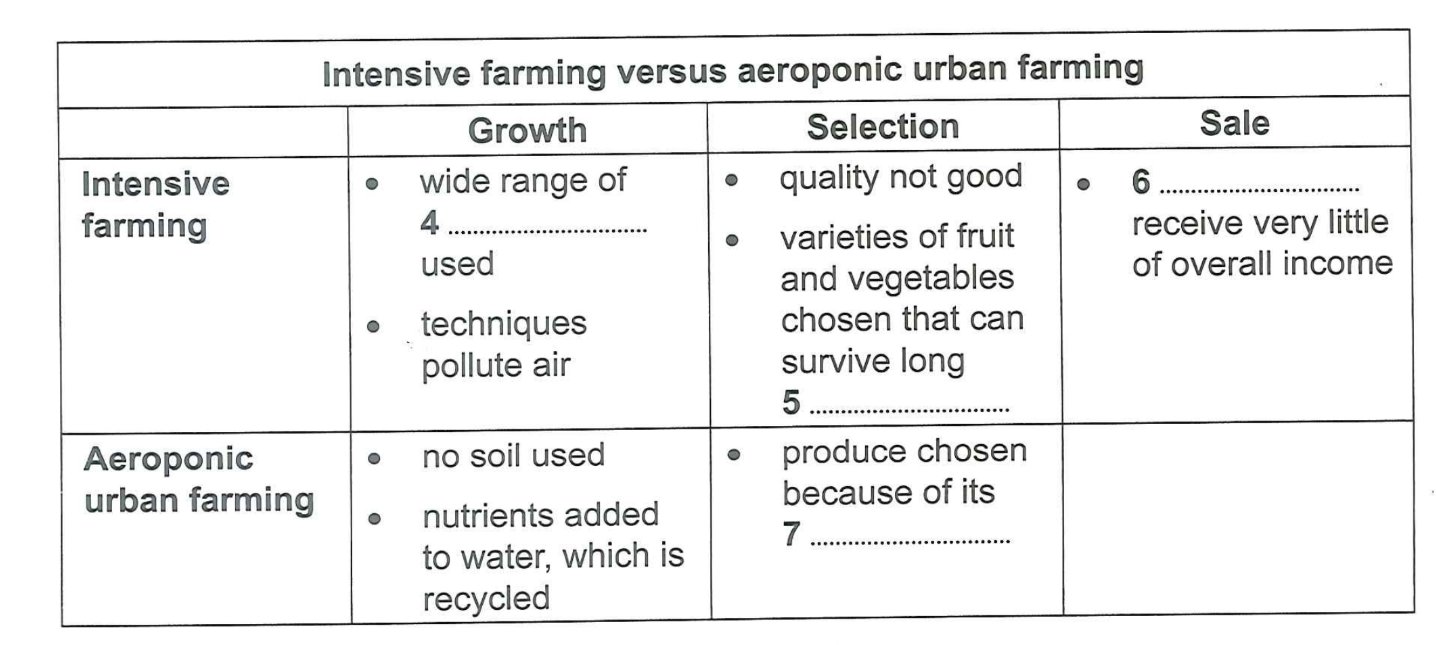
7 – 13Questions 4-7 Complete the table below. Choose ONE WORD ONLY from the passage for each answer. Write your answers in boxes 4-7 on your answer sheet.
Questions 8 – 13: Do the following statements agree with the information given in Reading Passage 1?
Choose:
TRUE if the statement agrees with the information
FALSE if the statement contradicts the information
NOT GIVEN if there is no information on this
- 4
Question 8 Urban farming can take place above or below ground.
- A
True
BFalse
CNot Given
- 5
Question 9 Some of the equipment used in aeroponic farming can be made by hand.
- A
True
BFalse
CNot Given
- 6
Question 10 Urban farming relies more on electricity than some other types of farming.
- A
True
BFalse
CNot Given
- 7
Question 11 Fruit and vegetables grown on an aeroponic urban farm are cheaper than traditionally grown organic produce.
- A
True
BFalse
CNot Given
- 8
Question 12 Most produce can be grown on an aeroponic urban farm at any time of the year.
- A
True
BFalse
CNot Given
- 9
Question 13 Beans take longer to grow on an urban farm than other vegetables.
- A
True
BFalse
CNot Given
Reading Passage 2
Forest management in Pennsylvania, USA
How managing low-quality wood (also known as low-use wood) for bioenergy can encourage sustainable forest management
A. A tree’s ‘value’ depends on several factors including its species, size, form, condition, quality, function, and accessibility, and depends on the management goals for a given forest. The same tree can be valued very differently by each person who looks at it. A large, straight black cherry tree has high value as timber to be cut into logs or made into furniture, but for a landowner more interested in wildlife habitat, the real value of that stem (or trunk) may be the food it provides to animals. Likewise, if the tree suffers from black knot disease, its value for timber decreases, but to a woodworker interested in making bowls, it brings an opportunity for a unique and beautiful piece of art.
B. In the past, Pennsylvania landowners were solely interested in the value of their trees as high-quality timber. The norm was to remove the stems of highest quality and leave behind poorly formed trees that were not as well suited to the site where they grew. This practice, called ‘high-grading’, has left a legacy of ‘low-use wood’ in the forests. Some people even call these ‘junk trees’, and they are abundant in Pennsylvania. These trees have lower economic value for traditional timber markets, compete for growth with higher-value trees, shade out desirable regeneration and decrease the health of a stand* leaving it more vulnerable to poor weather and disease. Management that specifically targets low-use wood can help landowners manage these forest health issues, and wood energy markets help promote this.
C. Wood energy markets can accept less expensive wood material of lower quality than would be suitable for traditional timber markets. Most wood used for energy in Pennsylvania is used to produce heat or electricity through combustion. Many schools and hospitals use wood boiler systems to heat and power their facilities, many homes are primarily heated with wood, and some coal plants incorporate wood into their coal streams to produce electricity. Wood can also be gasified for electrical generation and can even be made into liquid fuels like ethanol and gasoline for lorries and cars. All these products are made primarily from low-use wood. Several tree- and plant-cutting approaches, which could greatly improve the long-term quality of a forest, focus strongly or solely on the use of wood for those markets.
D. One such approach is called a Timber Stand Improvement (TSI) Cut. Ina TSI Cut, really poor-quality tree and plant material is cut down to allow more space, light, and other resources to the highest-valued stems that remain. Removing invasive plants might be another primary goal of a TSI Cut. The stems that are left behind might then grow in size and develop more foliage and larger crowns or tops that produce more coverage for wildlife; they have a better chance to regenerate in a less crowded environment. TSI Cuts can be tailored to one farmer’s specific management goals for his or her land.
E. Another approach that might yield a high amount of low-use wood is a Salvage Cut. With the many pests and pathogens visiting forests including hemlock wooly adelgid, Asian longhorned beetle, emerald ash borer, and gypsy moth, to name just a few, it is important to remember that those working in the forests can help ease these issues through cutting procedures. These types of cut reduce the number of sick trees and seek to manage the future spread of a pest problem. They leave vigorous trees that have stayed healthy enough to survive the outbreak.
F. A Shelterwood Cut, which only takes place in a mature forest that has already been thinned several times, involves removing all the mature trees when other seedlings have become established. This then allows the forester to decide which tree species are regenerated. It leaves a young forest where all trees are at a similar point in their growth. It can also be used to develop a two-tier forest so that there are two harvests and the money that comes in is spread out over a decade or more.
G. Thinnings and dense and dead wood removal for fire prevention also center on the production of low-use wood. However, it is important to remember that some retention of what many would classify as low-use wood is very important. The tops of trees that have been cut down should be left on the site so that their nutrients cycle back into the soil. In addition, trees with many cavities are extremely important habitats for insect predators like woodpeckers, bats and small mammals. They help control problem insects and increase the health and resilience of the forest. It’s also important to remember that not all small trees are low-use. For example, many species like hawthorn provide food for wildlife. Finally, rare species of trees in a forest should also stay behind as they add to its structural diversity.
* Stand – An area covered with trees that have common features (e.g. size)
Questions
14 – 17Which paragraph contains the following information?
Write the correct letter, A-G, in boxes 14—18 on your answer sheet.
NB You may use any letter more than once.
Questions
18 – 23Questions 19-21: Look at the following purposes (Questions 19-21) and the list of timber cuts below. Match each purpose with the correct timber cut, A, B or C.
Write the correct letter, A, B or C, in boxes 19-21 on your answer sheet.
NB You may use any letter more than once.
Questions
24 – 26Questions 22-26: Complete the sentences below. Choose ONE WORD ONLY from the passage for each answer.
Reading Passage 3
Conquering Earth’s space junk problem
Satellites, rocket shards and collision debris are creating major traffic risks in orbit
around the planet. Researchers are working to reduce these threats
A.
Last year, commercial companies, military and civil departments and amateurs sent more than 400 satellites into orbit, over four times the yearly average in the previous decade. Numbers could rise even more sharply if leading space companies follow through on plans to deploy hundreds to thousands of large constellations of satellites to space in the next few years.
All that traffic can lead to disaster. Ten years ago, a US commercial Iridium satellite smashed into an inactive Russian communications satellite called Cosmos-2251, creating thousands of new pieces of space shrapnel that now threaten other satellites in low Earth orbit — the zone stretching up to 2,000 kilometres in altitude. Altogether, there are roughly 20,000 human-made objects in orbit, from working satellites to small rocket pieces. And satellite operators can’t steer away from every potential crash, because each move consumes time and fuel that could otherwise be used for the spacecraft’s main job.
B.
Concern about space junk goes back to the beginning of the satellite era, but the number of objects in orbit is rising so rapidly that researchers are investigating new ways of attacking the problem. Several teams are trying to improve methods for assessing what is in orbit, so that satellite operators can work more efficiently in ever-more-crowded space. Some researchers are now starting to compile a massive data set that includes the best possible information on where everything is in orbit. Others are developing taxonomies of space debris — working on measuring properties such as the shape and size of an object, so that satellite operators know how much to worry about what’s coming their way.
The alternative, many say, is unthinkable. Just a few uncontrolled space crashes could generate enough debris to set off a runaway cascade of fragments, rendering near-Earth space unusable. ‘If we go on like this, we will reach a point of no return,’ says Carolin Frueh, an astrodynamical researcher at Purdue University in West Lafayette, Indiana.
C.
Even as our ability to monitor space objects increases, so too does the total number of items in orbit. That means companies, governments and other players in space are collaborating in new ways to avoid a shared threat. International groups such as the Inter-Agency Space Debris Coordination Committee have developed guidelines on space sustainability. Those include inactivating satellites at the end of their useful life by venting pressurised materials or leftover fuel that might lead to explosions. The intergovernmental groups also advise lowering satellites deep enough into the atmosphere that they will burn up or disintegrate within 25 years. But so far, only about half of all missions have abided by this 25-year goal, says Holger Krag, head of the European Space Agency’s space-debris office in Darmstadt, Germany. Operators of the planned large constellations of satellites say they will be responsible stewards in their enterprises in space, but Krag worries that problems could increase, despite their best intentions. ‘What happens to those that fail or go bankrupt?’ he asks. ‘They are probably not going to spend money to remove their satellites from space.’
D.
In theory, given the vastness of space, satellite operators should have plenty of room for all these missions to fly safely without ever nearing another object. So some scientists are tackling the problem of space junk by trying to find out where all the debris is to a high degree of precision. That would alleviate the need for many of the unnecessary manoeuvres that are carried out to avoid potential collisions. ‘If you knew precisely where everything was, you would almost never have a problem,’ says Marlon Sorge, a space-debris specialist at the Aerospace Corporation in EI Segundo, California.
E.
The field is called space traffic management, because it’s similar to managing traffic on the roads or in the air. Think about a busy day at an airport, says Moriba Jah, an astrodynamicist at the University of Texas at Austin: planes line up in the sky, landing and taking off close to one another in a carefully choreographed routine. Air-traffic controllers know the location of the planes down to one metre in accuracy. The same can’t be said for space debris. Not all objects in orbit are known, and even those included in databases are not tracked consistently.
F.
An additional problem is that there is no authoritative catalogue that accurately lists the orbits of all known space debris. Jah illustrates this with a web-based database that he has developed. It draws on several sources, such as catalogues maintained by the US and Russian governments, to visualise where objects are in space. When he types in an identifier for a particular space object, the database draws a purple line to designate its orbit. Only this doesn’t quite work for a number of objects, such as a Russian rocket body designated in the database as object number 32280. When Jah enters that number, the database draws two purple lines: the US and Russian sources contain two completely different orbits for the same object. Jah says that it is almost impossible to tell which is correct, unless a third source of information made it possible to cross-correlate.
Jah describes himself as a space environmentalist: ‘I want to make space a place that is safe to operate, that is free and useful for generations to come.’ Until that happens, he argues, the space community will continue devolving into a tragedy in which all spaceflight operators are polluting a common resource.
Questions
27 – 30Reading Passage 3 has six sections, A-F. Which section contains the following information?
Reading Passage 3 has six sections, A-F.
Which section contains the following information?
Questions
31 – 35Questions 32-35 Complete the summary below. Choose ONE WORD ONLY from the passage for each answer.
Questions
36 – 40Questions 36-40 Look at the following statements (Questions 36-40) and the list of people below. Match each statement with the correct person, A, B, C or D.
Questions
1 – 3Questions 1-3 Complete the sentences below. Choose NO MORE THAN TWO WORDS ANDIOR A NUMBER from the passage for each answer.
Giải thích đáp án
CÂU HỎI 1 – LETTUCES Chỗ trống cần điền đứng giữa 2 danh từ về các loại củ quả ⇒ cần điền danh từ về củ quả | |
CÂU HỎI | VÙNG THÔNG TIN |
Vertical tubes are used to grow strawberries, lettuces and herbs. | Peer inside and you see the tubes are completely hollow, the roots of dozens of strawberry plants dangling down inside them. From identical vertical tubes nearby burst row upon row of lettuces; near those are aromatic herbs, such as basil, sage and peppermint. |
CÂU HỎI 2 – 1,000 KG Chỗ trống cần điền đứng sau “as much as” và trước cụm danh từ chỉ cân nặng “in weight” ⇒ cần điền số cân nặng / số + đơn vị đo chỉ cân nặng | |
CÂU HỎI | VÙNG THÔNG TIN |
There will eventually be a daily harvest of as much as 1,000 kg in weight of fruit and vegetables. | When the remaining two thirds of the vast open area are in production, 20 staff will harvest up to 1,000 kg of perhaps 35 different varieties of fruit and vegetables, every day. |
CÂU HỎI 3 – (FOOD) CONSUMPTION Chỗ trống cần điền đứng sau từ sở hữu cách “the city’s” ⇒ cần điền danh từ | |
CÂU HỎI | VÙNG THÔNG TIN |
It may be possible that the farm’s produce will account for as much as 10% of the city’s (food) consumption overall | In the urban environment you’re working with very significant practical constraints, clearly, on what you can do and where. But if enough unused space can be developed like this, there’s no reason why you shouldn’t eventually target maybe between 5% and 10% of consumption. |
Questions
4 – 7Questions 4-7 Complete the table below. Choose ONE WORD ONLY from the passage for each answer. Write your answers in boxes 4-7 on your answer sheet.
Giải thích đáp án
CÂU HỎI 4 – PESTICIDES Chỗ trống cần điền đứng trước mệnh đề quan hệ rút gọn “used” ⇒ cần điền danh từ | |
CÂU HỎI | VÙNG THÔNG TIN |
| First, I don’t much like the fact that most of the fruit and vegetables we eat have been treated with something like 17 different pesticides, or that the intensive farming techniques that produced them are such huge generators of greenhouse gases. |
CÂU HỎI 5 – JOURNEYS Chỗ trống cần điền đứng sau tính từ “long” ⇒ cần điền danh từ | |
CÂU HỎI | VÙNG THÔNG TIN |
varieties of fruit and vegetables chosen that can survive long journeys | I don’t much like the fact, either, that they’ve traveled an average of 2,000 refrigerated kilometres to my plate, that their quality is so poor, because the varieties are selected for their capacity to withstand such substantial journeys, or that 80% of the price I pay goes to wholesalers and transport companies, not the producers. |
CÂU HỎI 6 – PRODUCERS Chỗ trống cần điền bắt đầu mệnh đề và đứng trước động từ “receive” ⇒ cần điền danh từ là chủ ngữ | |
CÂU HỎI | VÙNG THÔNG TIN |
producers receive very little of overall income | 80% of the price I pay goes to wholesalers and transport companies, not the producers. |
CÂU HỎI 7 – FLAVOUR Chỗ trống cần điền đứng sau đại từ sở hữu “its” ⇒ cần điền danh từ | |
CÂU HỎI | VÙNG THÔNG TIN |
produce chosen because of its flavour | You can select crop varieties for their flavour |
Questions
8 – 13Questions 8 – 13: Do the following statements agree with the information given in Reading Passage 1?
Choose:
TRUE if the statement agrees with the information
FALSE if the statement contradicts the information
NOT GIVEN if there is no information on this
- 8
Question 8 Urban farming can take place above or below ground.
Bạn chưa trả lời câu hỏi này
- A
True
BFalse
CNot Given
Giải thích đáp án
CÂU HỎI 8 – TRUE Chú ý tới từ khóa “below ground” để tìm được Paragraph 5 chứa câu trả lời. | |
|---|---|
CÂU HỎI | VÙNG THÔNG TIN |
Urban farming can take place above or below ground. | Urban farming is not, of course, a new phenomenon. Inner-city agriculture is booming from Shanghai to Detroit and Tokyo to Bangkok. Strawberries are being grown in disused shipping containers, mushrooms in underground carparks. |
DỊCH NGHĨA | |
Nông nghiệp đô thị có thể diễn ra trên hoặc dưới mặt đất. | Tất nhiên, nông nghiệp đô thị không phải là một hiện tượng mới. Nông nghiệp nội thành đang bùng nổ từ Thượng Hải đến Detroit và Tokyo đến Bangkok. Dâu tây đang được trồng trong các container vận chuyển không sử dụng, nấm trong bãi đậu xe ngầm. |
Giải thích: Nông nghiệp đô thị có thể thấy qua việc trồng dâu tây trong những container không được sử dụng (trên mặt đất) hay trồng nấm trong những bãi đậu xe dưới hầm (dưới mặt đất) ⇒ TRUE | |
- 9
Question 9 Some of the equipment used in aeroponic farming can be made by hand.
Bạn chưa trả lời câu hỏi này
- A
True
BFalse
CNot Given
Giải thích đáp án
CÂU HỎI 9 – NOT GIVEN Chú ý tới từ khóa “equipment used in aeroponic farming can be made by hand” để tìm được Paragraph 5 chứa câu trả lời. | |
|---|---|
CÂU HỎI | VÙNG THÔNG TIN |
Some of the equipment used in aeroponic farming can be made by hand. | Aeroponic farming, he says, is ‘virtuous’. The equipment weighs little, can be installed on almost any flat surface and is cheap to buy: roughly €100 to €150 per square metre. It is cheap to run, too, consuming a tiny fraction of the electricity used by some techniques. |
DỊCH NGHĨA | |
Một số thiết bị được sử dụng trong canh tác khí canh có thể được chế tạo bằng tay. | Anh ấy nói, canh tác khí canh là ‘có đạo đức’. Thiết bị có trọng lượng nhẹ, có thể được lắp đặt trên hầu hết mọi bề mặt phẳng và giá mua rẻ: khoảng €100 đến €150 mỗi mét vuông. Nó cũng rẻ để chạy, tiêu thụ một phần nhỏ điện năng được sử dụng bởi một số phương pháp. |
Giải thích: Phần thông tin không hề đề cập đến công đoạn sản xuất của thiết bị cho việc canh tác khí canh ⇒ NOT GIVEN | |
- 10
Question 10 Urban farming relies more on electricity than some other types of farming.
Bạn chưa trả lời câu hỏi này
- A
True
BFalse
CNot Given
Giải thích đáp án
CÂU HỎI 10 – FALSE Chú ý tới từ khóa “Urban farming relies more on electricity” để tìm được Paragraph 5 chứa câu trả lời. | |
|---|---|
CÂU HỎI | VÙNG THÔNG TIN |
Urban farming relies more on electricity than some other types of farming. | It is cheap to run, too, consuming a tiny fraction of the electricity used by some techniques. |
DỊCH NGHĨA | |
Nông nghiệp đô thị phụ thuộc nhiều vào điện hơn một số loại hình nông nghiệp khác. | Chi phí vận hành của nó cũng rẻ, tiêu thụ một phần nhỏ điện năng sử dụng cho một số phương pháp khác. |
Giải thích: Chủ ngữ “it” ở đây là “urban farming” được nhắc ở đầu đoạn văn, “some techniques” ở đây tương đương với “some other types of farming” ⇒ Nông nghiệp đô thị tiêu thụ một lượng điện nhỏ so với các phương pháp khác ⇒ Nó không phụ thuộc nhiều vào điện so với các phương pháp trồng nông nghiệp khác ⇒ FALSE | |
- 11
Question 11 Fruit and vegetables grown on an aeroponic urban farm are cheaper than traditionally grown organic produce.
Bạn chưa trả lời câu hỏi này
- A
True
BFalse
CNot Given
Giải thích đáp án
CÂU HỎI 11 – TRUE Chú ý tới từ khóa “cheaper than traditionally grown organic produce” để tìm được Paragraph 6 chứa câu trả lời. | |
|---|---|
CÂU HỎI | VÙNG THÔNG TIN |
Fruit and vegetables grown on an aeroponic urban farm are cheaper than traditionally grown organic produce. | Produce grown this way typically sells at prices that, while generally higher than those of classic intensive agriculture, are lower than soil-based organic growers. |
DỊCH NGHĨA | |
Trái cây và rau được trồng trong một trang trại đô thị khí canh có giá rẻ hơn so với các sản phẩm hữu cơ được trồng theo cách truyền thống. | Sản phẩm được trồng theo cách này thường bán với giá, mặc dù nhìn chung cao hơn so với giá của nền nông nghiệp thâm canh cổ điển, nhưng lại thấp hơn so với các loại cây và hoa quả hữu cơ được trồng trên đất. |
Giải thích: “this way” được paraphrase chính là “aeroponic urban farm” được nhắc đến ở đoạn trước, và có so sánh về giá, “lower” so với “soil-based”, hay phương pháp canh tác truyền thống ⇒ TRUE | |
- 12
Question 12 Most produce can be grown on an aeroponic urban farm at any time of the year.
Bạn chưa trả lời câu hỏi này
- A
True
BFalse
CNot Given
Giải thích đáp án
CÂU HỎI 12 – FALSE Chú ý tới từ khóa “Most produce” để tìm được Paragraph 6 chứa câu trả lời. | |
|---|---|
CÂU HỎI | VÙNG THÔNG TIN |
Most produce can be grown on an aeroponic urban farm at any time of the year. | There are limits to what farmers can grow this way, of course, and much of the produce is suited to the summer months. |
DỊCH NGHĨA | |
Hầu hết các sản phẩm có thể được trồng trong một trang trại đô thị khí canh vào bất kỳ thời điểm nào trong năm. | Tất nhiên, có những giới hạn đối với những gì nông dân có thể trồng theo cách này, và phần lớn các loại nông sản trồng theo phương pháp này chỉ có thể trồng vào mùa hè. |
Giải thích: Phần lớn các loại nông sản trồng theo phương pháp này chỉ có thể hoạt động trong mùa hè, không phải trong bất kỳ thời điểm nào trong năm như câu hỏi ⇒ FALSE | |
- 13
Question 13 Beans take longer to grow on an urban farm than other vegetables.
Bạn chưa trả lời câu hỏi này
- A
True
BFalse
CNot Given
Giải thích đáp án
CÂU HỎI 13 – NOT GIVEN Chú ý tới từ khóa “Beans” để tìm được Paragraph 6 chứa câu trả lời. | |
|---|---|
CÂU HỎI | VÙNG THÔNG TIN |
Beans take longer to grow on an urban farm than other vegetables. | And beans tend to take up a lot of space for not much return. |
DỊCH NGHĨA | |
Đậu mất nhiều thời gian hơn để phát triển trong một trang trại đô thị hơn các loại rau khác. | Và đậu có xu hướng chiếm nhiều không gian mà không mang lại nhiều lợi nhuận. |
Giải thích: Vùng thông tin chỉ đề cập rằng trồng đậu tốn diện tích mà đem lại ít lợi nhuận, không hề đề cập đến thời gian để phát triển của đậu ⇒ NOT GIVEN | |
Questions
14 – 18Which paragraph contains the following information?
Write the correct letter, A-G, in boxes 14—18 on your answer sheet.
NB You may use any letter more than once.
Bạn chưa trả lời câu hỏi này
B
Bạn chưa trả lời câu hỏi này
A
Bạn chưa trả lời câu hỏi này
C
Bạn chưa trả lời câu hỏi này
E
Bạn chưa trả lời câu hỏi này
B
Giải thích đáp án
CÂU HỎI 14 – PARAGRAPH B Chú ý tới từ khóa “bad outcomes for a forest” để tìm được Paragraph B chứa câu trả lời. | |
CÂU HỎI | VÙNG THÔNG TIN |
bad outcomes for a forest when people focus only on its financial reward |
|
DỊCH NGHĨA | |
kết quả xấu cho một khu rừng khi mọi người chỉ tập trung vào lợi ích tài chính của nó |
|
CÂU HỎI 15 – PARAGRAPH A Chú ý tới từ khóa “tree that contribute to its worth” để tìm được Paragraph A chứa câu trả lời. | |
CÂU HỎI | VÙNG THÔNG TIN |
reference to the aspects of any tree that contribute to its worth | A tree’s “value” depends on several factors including its species, size, form, condition, quality, function, and accessibility, and depends on the management goals for a given forest. |
DỊCH NGHĨA | |
đề cập đến các khía cạnh của bất kỳ loại cây mà tạo ra giá trị cho nó | “Giá trị” của cây phụ thuộc vào một số yếu tố bao gồm loài, kích thước, hình thức, tình trạng, chất lượng, chức năng và khả năng tiếp cận cũng như phụ thuộc vào các mục tiêu quản lý đối với một khu rừng nhất định. |
CÂU HỎI 16 – PARAGRAPH C Chú ý tới từ khóa “help run vehicles” để tìm được Paragraph C chứa câu trả lời. | |
CÂU HỎI | VÙNG THÔNG TIN |
mention of the potential use of wood to help run vehicles | Wood can also be gasified for electrical generation and can even be made into liquid fuels like ethanol and gasoline for lorries and cars. |
DỊCH NGHĨA | |
đề cập đến tiềm năng trong việc sử dụng gỗ để giúp các phương tiện hoạt động | Gỗ cũng có thể được khí hóa để phát điện và thậm chí có thể được chế tạo thành nhiên liệu lỏng như ethanol và xăng cho xe tải và ô tô. |
CÂU HỎI 17 – PARAGRAPH E Chú ý tới từ khóa “examples of insects” để tìm được Paragraph E chứa câu trả lời. | |
CÂU HỎI | VÙNG THÔNG TIN |
examples of insects that attack trees | With the many pests and pathogens visiting forests including hemlock wooly adelgid, Asian longhorned beetle, emerald ash borer, and gypsy moth, to name just a few, it is important to remember that those working in the forests can help ease these issues through cutting procedures. |
DỊCH NGHĨA | |
ví dụ về các loại côn trùng tấn công cây | Với nhiều loài gây hại và mầm bệnh xuất hiện trong các khu rừng bao gồm bọ cánh cứng len độc cần, bọ cánh cứng sừng dài châu Á, sâu đục thân và sâu bướm gypsy, điều quan trọng cần nhớ là những người làm việc trong rừng có thể giúp giảm bớt những vấn đề này thông qua các quy trình cắt . |
CÂU HỎI 18 – PARAGRAPH B Chú ý tới từ khóa “alternative name” để tìm được Paragraph B chứa câu trả lời. | |
CÂU HỎI | VÙNG THÔNG TIN |
an alternative name for trees that produce low-use wood | This practice, called ‘high-grading’, has left a legacy of ‘low-use wood’ in the forests. Some people even call these ‘junk trees’, and they are abundant in Pennsylvania. These trees have lower economic value for traditional timber markets |
DỊCH NGHĨA | |
một tên gọi khác cho loại cây có gỗ kém chất lượng | Một số người thậm chí còn gọi chúng là “cây rác”, và chúng có rất nhiều ở Pennsylvania. Những cây này có giá trị kinh tế thấp hơn đối với thị trường gỗ truyền thống |
Questions
19 – 21Questions 19-21: Look at the following purposes (Questions 19-21) and the list of timber cuts below. Match each purpose with the correct timber cut, A, B or C.
Write the correct letter, A, B or C, in boxes 19-21 on your answer sheet.
NB You may use any letter more than once.
Bạn chưa trả lời câu hỏi này
B. a Salvage Cut
Bạn chưa trả lời câu hỏi này
C. a Shelterwood Cut
Bạn chưa trả lời câu hỏi này
C. a Shelterwood Cut
Giải thích đáp án
CÂU HỎI 19 – B Chú ý tới từ khóa “remove trees that are diseased” và “Salvage Cut” để tìm được Paragraph E chứa câu trả lời. | |
CÂU HỎI | VÙNG THÔNG TIN |
to remove trees that are diseased |
|
DỊCH NGHĨA | |
để loại bỏ những cây bệnh |
|
CÂU HỎI 20 – C Chú ý tới từ khóa “generate income” và “Shelterwood Cut” để tìm được Paragraph F chứa câu trả lời. | |
CÂU HỎI | VÙNG THÔNG TIN |
to generate income across a number of years |
|
DỊCH NGHĨA | |
để tạo ra thu nhập trong một số năm |
|
CÂU HỎI 21 – C Chú ý tới từ khóa “close in age” và “Shelterwood Cut” để tìm được Paragraph F chứa câu trả lời. | |
CÂU HỎI | VÙNG THÔNG TIN |
to create a forest whose trees are close in age |
|
DỊCH NGHĨA | |
để tạo ra một khu rừng có cây gần tuổi nhau |
|
Questions
22 – 26Questions 22-26: Complete the sentences below. Choose ONE WORD ONLY from the passage for each answer.
Giải thích đáp án
CÂU HỎI 22 – FIRE Chỗ trống cần điền đứng sau giới từ “of” ⇒ cần điền danh từ / đại từ / V-ing | |
CÂU HỎI | VÙNG THÔNG TIN |
Some dead wood is removed to avoid the possibility of fire | Thinnings and dense and dead wood removal for fire prevention also center on the production of low-use wood. |
CÂU HỎI 23 – NUTRIENTS Chỗ trống cần điền đứng sau mạo từ “the” ⇒ cần điền danh từ | |
CÂU HỎI | VÙNG THÔNG TIN |
The nutrients from the tops of cut trees can help improve soil quality | The tops of trees that have been cut down should be left on the site so that their nutrients cycle back into the soil |
CÂU HỎI 24 – CAVITIES Chỗ trống cần điền đứng sau hạn định từ “their” ⇒ cần điền danh từ | |
CÂU HỎI | VÙNG THÔNG TIN |
Some damaged trees should be left, as their cavities provide habitats for a range of creatures. | In addition, trees with many cavities are extremely important habitats for insect predators like ‘woodpeckers, bats and small mammals |
CÂU HỎI 25 – HAWTHORN Chỗ trống cần điền đứng sau từ để liệt kê “such as” và trước đó đang nói về những loại cây “some small trees (Some trees that are small)” ⇒ cần điền danh từ là tên riêng của một trong những loại cây này | |
CÂU HỎI | VÙNG THÔNG TIN |
Some trees that are small, such as hawthorn, are a source of food for animals and insects | It’s also important to remember that not all small trees are low-use. For example, many species like hawthorn provide food for wildlife |
CÂU HỎI 26 – RARE Chỗ trống cần điền đứng sau động từ tobe “are” ⇒ cần điền tính từ | |
CÂU HỎI | VÙNG THÔNG TIN |
Any trees that are rare should be left to grow, as they add to the variety of species in the forest | Finally, rare species of trees in a forest should also stay behind as they add to its structural diversity |
Questions
Reading Passage 3 has six sections, A-F. Which section contains the following information?
Reading Passage 3 has six sections, A-F.
Which section contains the following information?
Bạn chưa trả lời câu hỏi này
C
Bạn chưa trả lời câu hỏi này
F
Bạn chưa trả lời câu hỏi này
A
Bạn chưa trả lời câu hỏi này
E
Bạn chưa trả lời câu hỏi này
B
Giải thích đáp án
CÂU HỎI 27 – PARAGRAPH C Chú ý tới từ khóa “cooperation, minimise risk” để tìm được Paragraph C chứa câu trả lời. | |
CÂU HỎI | VÙNG THÔNG TIN |
a reference to the cooperation that takes place to try and minimise risk | That means companies, governments and other players in space are collaborating in new ways to avoid a shared threat. |
DỊCH NGHĨA | |
đề cập đến sự hợp tác nhằm cố gắng giảm thiểu rủi ro | Điều đó có nghĩa là các công ty, chính phủ và những bên khác trong ngành vũ trụ đang hợp tác theo những cách mới để tránh mối đe dọa chung. |
CÂU HỎI 28 – PARAGRAPH F Chú ý tới từ khóa “a person’s aims” để tìm được Paragraph F chứa câu trả lời. | |
CÂU HỎI | VÙNG THÔNG TIN |
an explanation of a person’s aims | Jah describes himself as a space environmentalist: ‘I want to make space a place that is safe to operate, that is free and useful for generations to come.” |
DỊCH NGHĨA | |
một lời giải thích về mục tiêu của một người | Jah tự mô tả mình là một nhà bảo vệ môi trường vũ trụ: ‘Tôi muốn biến vũ trụ thành một nơi an toàn để hoạt động, miễn phí và hữu ích cho các thế hệ sau’. |
CÂU HỎI 29 – PARAGRAPH A Chú ý tới từ khóa “a major collision” để tìm được Paragraph A chứa câu trả lời. | |
CÂU HỎI | VÙNG THÔNG TIN |
a description of a major collision that occurred in space | Ten years ago, a US commercial Iridium satellite smashed into an inactive Russian communications satellite called Cosmos-2251, creating thousands of new pieces of space shrapnel that now threaten other satellites in low Earth orbit |
DỊCH NGHĨA | |
một mô tả về một vụ va chạm lớn xảy ra trong không gian | Mười năm trước, một vệ tinh Iridium thương mại của Hoa Kỳ đã đâm vào một vệ tinh liên lạc không hoạt động của Nga có tên là Cosmos-2251, tạo ra hàng nghìn mảnh đạn không gian mới hiện đang đe dọa các vệ tinh khác trên quỹ đạo thấp của Trái đất |
CÂU HỎI 30 – PARAGRAPH E Chú ý tới từ khóa “a comparison” để tìm được Paragraph E chứa câu trả lời. | |
CÂU HỎI | VÙNG THÔNG TIN |
a comparison between tracking objects in space and the efficiency of a transportation system | Air-traffic controllers know the location of the planes down to one metre in accuracy. The same can’t be said for space debris. Not all objects in orbit are known, and even those included in databases are not tracked consistently. |
DỊCH NGHĨA | |
so sánh giữa việc theo dõi các vật thể trong vũ trụ và hiệu quả của hệ thống giao thông | Bộ điều khiển không lưu biết vị trí của các máy bay với độ chính xác đến một mét. Điều tương tự không thể thực hiện đối với các mảnh vỡ không gian. Không phải tất cả các vật thể trên quỹ đạo đều được biết đến và ngay cả những vật thể có trong cơ sở dữ liệu cũng không được theo dõi một cách nhất quán. |
CÂU HỎI 31 – PARAGRAPH B Chú ý tới từ khóa “classify space junk” để tìm được Paragraph B chứa câu trả lời. | |
CÂU HỎI | VÙNG THÔNG TIN |
a reference to efforts to classify space junk | Several teams are trying to improve methods for assessing what is in orbit, so that satellite operators can work more efficiently in ever-more-crowded space |
DỊCH NGHĨA | |
đề cập tới những nỗ lực để phân loại rác không gian | Một số nhóm đang cố gắng cải thiện các phương pháp đánh giá những gì đang ở trên quỹ đạo, để các nhà khai thác vệ tinh có thể hoạt động hiệu quả hơn trong vũ trụ ngày càng đông đúc |
Questions
32 – 35Questions 32-35 Complete the summary below. Choose ONE WORD ONLY from the passage for each answer.
Giải thích đáp án
CÂU HỎI 32 – SUSTAINABILITY Chỗ trống cần điền đứng sau mạo từ “the” ⇒ cần điền danh từ | |
CÂU HỎI | VÙNG THÔNG TIN |
The committee gives advice on how the sustainability of space can be achieved. | Committee have developed guidelines on space sustainability |
CÂU HỎI 33 – FUEL; CÂU HỎI 34 – EXPLOSIONS Chỗ trống câu 33 cần điền đứng sau tính từ “unused” ⇒ cần điền danh từ Chỗ trống câu 34 cần điền đứng sau động từ “cause” ⇒ cần điền danh từ | |
CÂU HỎI | VÙNG THÔNG TIN |
The committee advises that when satellites are no longer active, any unused fuel or pressurised material that could cause explosions should be removed
| Those include inactivating satellites at the end of their useful life by venting pressurised materials or leftover fuel that might lead to explosions. |
CÂU HỎI 35 – BANKRUPT Chỗ trống cần điền đứng sau động từ “become” là 1 động từ nối (linking verb) ⇒ cần điền tính từ hoặc danh từ | |
CÂU HỎI | VÙNG THÔNG TIN |
Although operators of large satellite constellations accept that they have obligations as stewards of space, Holger Krag points out that the operators that become bankrupt are unlikely to prioritise removing their satellites from space. | Operators of the planned large constellations of satellites say they will be responsible stewards in their enterprises in space, but Krag worries that problems could increase, despite their best intentions. ‘What happens to those that fail or go bankrupt? he asks. ‘They are probably not going to spend money to remove their satellites from space.’ |
Questions
36 – 40Questions 36-40 Look at the following statements (Questions 36-40) and the list of people below. Match each statement with the correct person, A, B, C or D.
Bạn chưa trả lời câu hỏi này
C Marlon Sorge
Bạn chưa trả lời câu hỏi này
D Moriba Jah
Bạn chưa trả lời câu hỏi này
B Holger Krag
Bạn chưa trả lời câu hỏi này
D Moriba Jah
Bạn chưa trả lời câu hỏi này
A Carolin Frueh
Giải thích đáp án
CÂU HỎI 36 – Marion Sorge Chú ý tới từ khóa “the exact location” và “Marion Sorge” để tìm được Paragraph D chứa câu trả lời. | |
CÂU HỎI | VÙNG THÔNG TIN |
Knowing the exact location of space junk would help prevent any possible danger. | ‘If you knew precisely where everything was, you would almost never have a problem,’ says Marlon Sorge |
DỊCH NGHĨA | |
Biết chính xác vị trí của rác vũ trụ sẽ giúp ngăn ngừa mọi nguy hiểm có thể xảy ra. | Marlon Sorge nói: “Nếu bạn biết chính xác mọi thứ ở đâu, bạn sẽ gần như không gặp vấn đề gì.” |
CÂU HỎI 37 – Moriba Jah Chú ý tới từ khóa “be preserved for the future” và “Moriba Jah” để tìm được Paragraph F chứa câu trả lời. | |
CÂU HỎI | VÙNG THÔNG TIN |
Space should be available to everyone and should be preserved for the future. | Jah describes himself as a space environmentalist: ‘I want to make space a place that is safe to operate, that is free and useful for generations to come.’ |
DỊCH NGHĨA | |
Không gian vũ trụ nên dành cho tất cả mọi người và nên được bảo tồn cho tương lai. | Jah miêu tả anh ấy như là một nhà môi trường không gian: ‘Tôi muốn biến không gian vũ trụ thành một nơi an toàn để hoạt động, miễn phí và hữu ích cho các thế hệ mai sau.’ |
CÂU HỎI 38 – Holger Krag Chú ý tới từ khóa “A recommendation is widely ignored” và “Holger Krag” để tìm được Paragraph C chứa câu trả lời. | |
CÂU HỎI | VÙNG THÔNG TIN |
A recommendation regarding satellites is widely ignored.
| The intergovernmental groups also advise lowering satellites deep enough into the atmosphere that they will bum up or disintegrate within 25 years. But so far, only about half of all missions have abided by this 25-year goal, says Holger Krag, head of the European Space Agency’s space-debris office in Darmstadt, Germany |
DỊCH NGHĨA | |
Một khuyến nghị liên quan đến các vệ tinh bị ngó lơ. | Các nhóm liên chính phủ cũng khuyên nên hạ thấp các vệ tinh đủ sâu vào bầu khí quyển để chúng sẽ nổ tung hoặc phân rã trong vòng 25 năm. Nhưng cho đến nay, chỉ có khoảng một nửa trong số tất cả các nhiệm vụ tuân thủ mục tiêu 25 năm này, Holger Krag, người đứng đầu văn phòng mảnh vỡ không gian của Cơ quan Vũ trụ Châu Âu tại Darmstadt, Đức cho biết |
CÂU HỎI 39 – Moriba Jah Chú ý tới từ khóa “conflicting information” và “Moriba Jah” để tìm được Paragraph F chứa câu trả lời. | |
CÂU HỎI | VÙNG THÔNG TIN |
There is conflicting information about where some satellites are in space. | When Jah enters that number, the database draws two purple lines: the US and Russian sources contain two completely different orbits for the same object. Jah says that it is almost impossible to tell which is correct, unless a third source of information made it possible to cross-correlate. |
DỊCH NGHĨA | |
Có thông tin mâu thuẫn về vị trí của một số vệ tinh trong không gian. | Khi Jah nhập số đó vào, cơ sở dữ liệu sẽ vẽ hai đường màu tím: nguồn của Hoa Kỳ và Nga chứa hai quỹ đạo hoàn toàn khác nhau cho cùng một vật thể. Jah nói rằng hầu như không thể nói cái nào đúng, trừ khi nguồn thông tin thứ ba cho phép tương quan chéo. |
CÂU HỎI 40 – Carolin Frueh Chú ý tới từ khóa “undo the damage” và “Carolin Frueh” để tìm được Paragraph B chứa câu trả lời. | |
CÂU HỎI | VÙNG THÔNG TIN |
There is a risk we will not be able to undo the damage that occurs in space. | Just a few uncontrolled space crashes could generate enough debris to set off a runaway cascade of fragments, rendering near-Earth space unusable. ‘If we go on like this, we will reach a point of no return,” says Carolin Frueh |
DỊCH NGHĨA | |
Có một rủi ro là chúng ta sẽ không thể khắc phục những thiệt hại xảy ra trong vũ trụ. | Carolin Frueh nói: “Nếu chúng ta tiếp tục như thế này, chúng ta sẽ không thể quay đầu lại được nữa”. |
