
Path to Success – Test 1 – R
11/11/2024 2024-11-11 9:38Path to Success – Test 1 – R
Part 1
READING PASSAGE 1
You should spend about 20 minutes on Questions 1-13, which are based on Reading Passage 1 below.
The Dover Bronze-Ate Boat
A beautifully preserved boat, made around 3,000 yearsago and discovered by chance in a muddy hole, has had a profound impact on archaeological research.
It was 1992. In England, workmen were building a new road through the heart of Dover, to connect the ancient port and the Channel Tunnel, which, when it opened just two years later, was to be the first land link between Britain and Europe for over 10,000 years. A small team from the Canterbury Archaeological Trust (CAT) worked alongside the workmen, recording new discoveries brought to light by the machines.
At the base of a deep shaft six metres below the modern streets a wooden structure was revealed. Cleaning away the waterlogged site overlying the timbers, archaeologists realised its true nature. They had found a prehistoric boat, preserved by the type of sediment in which it was buried. It was then named the Dover Bronze-Age Boat.
About nine metres of the boat’s length was recovered; one end lay beyond the excavation and had to be left. What survived consisted essentially of four intricately carved oak planks: two on the bottom, joined along a central seam by a complicated system of wedges and timbers, and two at the side, curved and stitched to the others. The seams had been made watertight by pads of moss, fixed by wedges and yew stitches.
The timbers that closed the recovered end of the boat had been removed in antiquity when it was abandoned, but much about its original shape could be deduced. There was also evidence for missing upper side planks. The boat was not a wreck, but had been deliberately discarded, dismantled and broken. Perhaps it had been ‘ritually killed” at the end of its life, like otherBronze-Age objects.
With hindsight, it was significant that the boat was found and studied by mainstream archaeologists who naturally focused on its cultural context. At the time, ancient boats were often considered only from a narrower technological perspective, but news about the Dover boat reached a broad audience. In 2002, on the tenth anniversary of the discovery, the DoverBronze-Age Boat Trust hosted a conference, where this meeting of different traditions became apparent. Alongside technical papers about the boat, other speakers explored its social and economic contexts, and the religious perceptions of boats in Bronze-Age societies. Many speakers came from overseas, and debate about cultural connections was renewed.
Within seven years of excavation, the Dover boat had been conserved and displayed, but it was apparent that there were issues that could not be resolved simply by studying the old wood. Experimental archaeology seemed to be the solution: a boat reconstruction, half-scale or full-sized, would permit assessment of the different hypotheses regarding its build and the missing end. The possibility of returning to Dover to search for the boat’s unexcavated northern end was explored, but practical and financial difficulties were insurmountable — and there was no guarantee that the timbers had survived the previous decade in the changed environment.
Detailed proposals to reconstruct the boat were drawn up in 2004. Archaeological evidence was beginning to suggest a Bronze-Age community straddling the Channel, brought together by the sea, rather than separated by it. In a region today divided by languages and borders, archaeologists had a duty to inform the general public about their common cultural heritage.
The boat project began in England but it was conceived from the start as a European collaboration. Reconstruction was only part ofa scheme that would include a major exhibition and an extensive educational and out reach programme. Discussions began early in 2005 with archaeological bodies, universities and heritage organisations either side of the Channel. There was much enthusiasm and support, and an official launch of the project was held at an international seminar in France in 2007. Financial support was confirmed in 2008 and the project then namedBOAT 1550BC got under way in June 2011.
A small team began to make the boat at the startof 2012 on the Roman Lawn outside Dover museum.A full-scale reconstruction of a mid-section had been made in 1996, primarily to see how Bronze-Age replica tools performed. In 2012, however, the hull shape was at the centre of the work, so modern power tools were used to carve the oak planks, before turning to prehistoric tools for finishing.It was decided to make the replica half-scale for reasons of cost and time, and synthetic materials were used for the stitching, owing to doubts about the scaling and tight timetable.
Meanwhile, the exhibition was being prepared ready for opening in July 2012 at the Castle Museum in Boulogne-sur-Mer. Entitled ‘Beyondthe Horizon: Societies of the Channel & NorthSea 3,500 years ago’, it brought together for the first time a remarkable collection of Bronze-Ageobjects, including many new discoveries for commercial archaeology and some of the great treasure of the past. The reconstructed boat, as a symbol of the maritime connections that bound together the communities either side of the Channel, was the centrepiece.
Questions
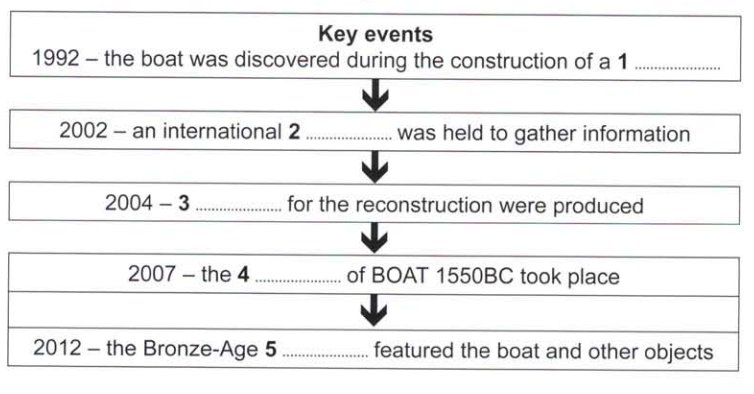
1 – 5Questions 1-5 Complete the flow-chart below. Choose ONE WORD ONLY from the text for each answer. Write your answers in boxes 1-5 on your answer sheet.
Questions
6 – 9Questions 6-9 Do the following statements agree with the information given in the text?
TRUE if the statement agrees with the information
FALSE if the statement contradicts the information
NOT GIVEN if there is no information on this
- 6
Archaeologists realisedthat the boat had been damaged on purpose.
- A
True
BFalse
CNot Given
- 7
Initially, only the technological aspectsof the boat were examined.
- A
True
BFalse
CNot Given
- 8
Archaeologists went back tothe site to try and find the missing northern end of the boat.
- A
True
BFalse
CNot Given
- 9
Evidence found in 2004suggested that the Bronze-Age Boat had been used for trade.
- A
True
BFalse
CNot Given
Questions
10 – 13Questions 10-13 Answer the questions below. Choose NO MORE THAN THREE WORDS AND/OR A NUMBER from the text for each answer.
Part 2
READING PASSAGE2
You should spend about 20 minutes on Questions 14-26, which are based on Reading Passage 2 below.
The changing role of airports
Airports continue to diversify their role in an effort to generate income. Are business meeting facilities the next step? Nigel Halpern, Anne Graham and Rob Davidson investigate.
A
In recent times developing commercial revenues has become more challenging for airports due to a combination of factors, such as increased competition from Internet shopping, restrictions on certain sales, such as tobacco, and new security procedures that have had an impact on the dwell time of passengers. Moreover, the global economic downturn has caused a reduction in passenger numbers while those that are travelling generally have less money to spend. This has meant that the share of revenue from non-aeronautical revenues actually peaked at 54% at the turn of the century and has subsequently declined slightly.
Meanwhile, the pressures to control the level of aeronautical revenues are as strong as ever due to the poor financial health of many airlines and the rapid rise of the low-cost carrier sector.
B
Some of the more obvious solutions to growing commercial revenues.such as extending the merchandising space or expanding the variety of shopping opportunities, have already been tried to their limit at many airports. A more radical solution is to find new sources of commercial revenue within the terminal. and this has been explored by many airports over the last decade or so. As a result, many terminals are now much more than just shopping malls and offer an array of entertainment, leisure, and beauty and wellness facilities. At this stage of facilities provision, the airport also has the possibility of taking on the role of the final destination rather than merely a facilitator of access.
C
At the same time. airports have been developing and expanding the range of services that they provide specifically for the business traveller in the terminal. This includes offering business centres that supply support services, meeting or conference rooms and other space for special events. Within this context, Jarach (2001) discusses how dedicated meetings facilities located within the terminal and managed directly by the airport operator may be regarded as an expansion of the concept of airline lounges or as a way to reconvert abandoned or under used areas of terminal buildings. Previously it was primarily airport hotels and other facilities offered in the surrounding area of the airport that had the potential to take on this role and become active as a business space (McNeil!, 2009).
D
When an airport location can be promoted as a business venue, this may increase the overall appeal of the airport and help it become more competitive in both attracting and retaining airlines and their passengers. In particular, the presence of meeting facilities could become one of the determining factors taken into consideration when business people are choosing airlines and where they change their planes. This enhanced attractiveness itself may help to improve the airport operator’s financial position and future prospects, but clearly this will be dependent on the competitive advantage that the airport is able to achieve in comparison with other venues.
E
In 2011, an online airport survey was conducted and some of the areas investigated included the provision and use of meeting facilities at airports and the perceived role and importance of these facilities in generating income and raising passenger numbers. In total, there were responses from staff at 1 54 airports and 68% of these answered ‘yes’ to the question: Does your airport own and have meetings facilities available for hire?
The existence of meeting facilities therefore seems high at airports. In addition, 28% of respondents that did not have meeting facilities stated that they were likely to invest in them during the next five years. The survey also asked to what extent respondents agreed or disagreed with a number of statements about the meeting facilities at their airport. 49% of respondents agreed that they have put more investment into them during recent years; 41 % agreed that they would invest more in the immediate future. These are fairly high proportions considering the recent economic climate.
F
The survey also asked airports with meeting facilities to estimate what proportion of users are from the local area, i.e. within a 90-minute drive from the airport, or from abroad. Their findings show that meeting facilities provided by the majority of respondents tend to serve local versus non-local or foreign needs. 63% of respondents estimated that over 60% of users are from the local area. Only 3% estimated that over80% of users are from abroad. It is therefore not surprising that the facilities are of limited importance when it comes to increasing use of flights at the airport: 16% of respondents estimated that none of the users of their meeting facilities use flights when travelling to or from them, while 56% estimated that 20% or fewer of the users of their facilities use flights.
G
The survey asked respondents with meeting facilities to estimate how much revenue their airport earned from its meeting facilities during the last financial year. Average revenue per airport was just $12,959. Meeting facilities are effectively a non-aeronautical source of airport revenue. Only 1 % of respondents generated more than 20% non-aeronautical revenue from their meetings facilities; none generated more than 40%. Given the focus on local demand, it is not surprising that less than a third of respondents agreed that their meeting facilities support business and tourism development in their home region or country.
H
The findings of this study suggest that few airports provide meetings facilities as a serious commercial venture. It may be that, as owners of large property, space 1s available for meeting facilities at airports and could play an important role in serving the needs of the airport, its partners, and stakeholders such as government and the local community. Thus, while the local orientation means that competition with other airports is likely to be minimal, competition with local providers of meetings facilities is likely to be much greater.
Questions
14 – 18Questions 14-18 The text has eight paragraphs, A-H. Which paragraph contains the following information?
N.B. You may use any letter more than once.
Questions
19 – 22Questions 19-22 Complete the sentences below. Choose NO MORE THAN TWO WORDS from the text for each answer. Write your answers in boxes 19-22 on your answer sheet.
Questions
23 – 26Questions 23-26 Complete the summary below. Choose NO MORE THAN TWO WORDS from the text for each answer.
Part 3
READING PASSAGE3
You should spend about 20 minutes on Questions 27-40, which are based on Reading Passage 3 below.
IS PHOTOGRAPHY ART?
This may seem a pointless question today.Surrounded as we are by thousands of photographs, most of us take for granted that, in addition to supplying information and seducing customers, camera images also serve as decoration, afford spiritual enrichment, and provide significant insights into the passing scene. But in the decades following the discovery of photography, this question reflected the search for ways to fit the mechanical medium into the traditionalschemes of artistic expression.
The much-publicized pronouncement by painter Paul Delaroche that thedaguerreotype* signalled the end of paintingis perplexing because this clever artist alsoforecast the usefulness of the medium forgraphic artists in a letter written in 1839. Nevertheless, it is symptomatic of the swing between the outright rejection andqualified acceptance of the medium that wasfairly typical of the artistic establishment.Discussion of the role of photography in artwas especially spirited in France, where theinternal policies of the time had created alarge pool of artists, but it was also takenup by important voices in England. In bothcountries, public interest in this topic was areflection of the belief that national statureand achievement in the arts were related.
From the maze of conflicting statements andheated articles on the subject, three mainpositions about the potential of camera artemerged. The simplest, entertained by manypainters and a section of the public, was thatphotographs should not be considered ‘art’because they were made with a mechanicaldevice and by physical and chemicalphenomena instead of by human hand andSpirit; to some, camera images seemed ohave more in common with fabric producedby machinery in a mill than with handmadecreations fired by inspiration. The second widely held view, shared by painters, somephotographers, and some critics, was thatphotographs would be useful to art but shouldnot be considered equal in creativeness todrawing and painting. Lastly, by assumingthat the process was comparable to othertechniques such as etching and lithography, a fair number of individuals realized thatcamera images were or could be as significantas handmade works of art and that they mighthave a positive influence on the arts and onculture in general.
Artists reacted to photography in variousways. Many portrait painters – miniaturists in particular – who realized that photographyrepresented the ‘handwriting on the wall’became involved with daguerreotyping orpaper photography in an effort to save theircareers; some incorporated it with painting,while others renounced painting altogether.Still other painters, the most prominentamong them the French painter, Jean-Auguste-Dominique Ingres, began almostimmediately to use photography to make arecord of their own output and also to providethemselves with source material for poses andbackgrounds, vigorously denying at the sametime its influence on their vision or its claimsas art.
The view that photographs might beworthwhile to artists was enunciated inconsiderable detail by Lacan and FrancisWey. The latter, an art and literary critic, whoeventually recognised that camera imagescould be inspired as well as informative,suggested that they would lead to greaternaturalness in the graphic depiction ofanatomy, clothing, likeness, expression, and landscape. By studying photographs, true artists, he claimed, would be relieved of menial tasks and become free to devotethemselves to the more important spiritualaspects of their work.
Wey left unstated what the incompetent artistmight do as an alternative, but according to the influential French critic and poetCharles Baudelaire, writing in response toan exhibition of photography in 1859, lazyand untalented painters would becomephotographers. Fired by a belief in art as an imaginative embodiment of cultivatedideas and dreams, Baudelaire regardedphotography as ‘a very humble servant ofart and science’; a medium largely unable totranscend ‘external reality’. For this critic,photography was linked with ‘the greatindustrial madness’ of the time, which in hiseyes exercised disastrous consequences onthe spiritual qualities of life and art.
Eugene Delacroix was the most prominent ofthe French artists who welcomed photographyas help-mate but recognized its limitations.Regretting that ‘such a wonderful invention’had arrived so late in his lifetime, he stilltook lessons in daguerreotyping, and bothcommissioned and collected photographs.Delacroix’s enthusiasm for the medium canbe sensed in a journal entry noting that photographs were used as they should be, anartist might ‘raise himself to heights that wedo not yet know’.
The question of whether the photograph wasdocument or art aroused interest in England also. The most important statement on thismatter was an unsigned article that concludedthat while photography had a role to play, itshould not be ‘constrained’ into ‘competition’with art; a more stringent viewpoint led critic Philip Gilbert Hamerton to dismiss camera images as ‘narrow in range, emphatic inassertion, telling one truth for ten falsehoods’.
These writers reflected the opposition of asection of the cultural elite in England andFrance to the ‘cheapening of art’ which thegrowing acceptance and purchase of camera pictures by the middle class represented. Technology made photographic images acommon sight in the shop windows of Regent Street and Piccadilly in London and the commercial boulevards of Paris. In London,for example, there were at the time some 130 commercial establishments where portraits, landscapes, and photographic reproductionsof works of art could be bought. This appealto the middle class convinced the elite that photographs would foster a desire for realisminstead of idealism, even though some critics recognized that the work of individual photographers might display an uplifting styleand substance that was consistent with thedefining characteristics of art.
* the name given to the first commercially successful photographic images
Questions
Questions 27-30 Choose the correct letter, A, B, C or D.
- 27
What is the writer‘s main point in the first paragraph?
- 28
What public view about artists was shared by the French and the English?
- 29
What does the writermean in line 59 by ‘the handwritingon the wall‘?
- 30
What was the result of the widespread availability of photographs to the middle classes?
Questions
31 – 34Questions 31-34 Complete the summary of Paragraph 3 using the list of words, A-G, below.
A
inventive C
beneficial E
mixed G
inferior B
similar D
next F
justified
Questions
35 – 40Questions 35-40 Look at the following statements and the list of people, A-E, below. Match each statement with the correct person.
A. Jean-Auguste- Dominique Ingres
B. Francis Wey
C. Charles Baudelaire
D. Eugene Delacroix
E. Philip Gilbert Hamerton
Questions
1 – 5Questions 1-5 Complete the flow-chart below. Choose ONE WORD ONLY from the text for each answer. Write your answers in boxes 1-5 on your answer sheet.
Giải thích đáp án
CÂU HỎI 1 – ROAD Chỗ trống cần điền đứng sau mạo từ “a” ⇒ cần điền danh từ số ít | |
CÂU HỎI | VÙNG THÔNG TIN |
| 1992–the boat was discovered during the construction of a road | It was 1992. In England, workmen were building a new roadthrough the heart of Dover, to connect the ancient port and the Channel Tunnel, which, when it opened just two years later, was to be the first land link between Britain and Europe for over 10,000 years…..They had found a prehistoric boat, preserved by the type of sediment in which it was buried. It was then named by Dover Bronze- Age Boat. |
CÂU HỎI 2 – CONFERENCE Chỗ trống cần điền đứng sau mạo từ “an” và tính từ “international” ⇒ cần điền danh từ | |
CÂU HỎI | VÙNG THÔNG TIN |
2002-an international conferencewas held to gather information | In 2002, on the tenth anniversary of the discovery, the Dover Bronze Age Boat Trust hosted a conference, where this meeting of different traditions became apparent. Alongside technical papers about the boat, other speakers explored its social and economic contexts, and the religious perceptions of boats in Bronze Age societies. Many speakers came from overseas, and debate about cultural connections was renewed. |
CÂU HỎI 3 – PROPOSALS Chỗ trống cần điền đứng trước giới từ “for” ⇒ cần điền danh từ | |
CÂU HỎI | VÙNG THÔNG TIN |
2004–proposals for the reconstruction were produced | Detailed proposals to reconstruct the boat were drawn up in 2004. |
CÂU HỎI 4 – LAUNCH Chỗ trống cần điền đứng sau mạo từ “the” ⇒ cần điền danh từ | |
CÂU HỎI | VÙNG THÔNG TIN |
2007-the launch of BOAT 1550 BC took place | There was much enthusiasm and support, and an official launchof the project was held at an international seminar in France in 2007. Financial support was confirmed in 2008 and the project then named BOAT 1550 BC got under way in June 2011. |
CÂU HỎI 5 – EXHIBITION Chỗ trống cần điền đứng sau mạo từ “the” và danh từ “Bronze-Age” ⇒ cần điền danh từ | |
CÂU HỎI | VÙNG THÔNG TIN |
2012–the Bronze-Age exhibitionfeatured the boat and other objects | Meanwhile, the exhibition was being prepared ready for opening in July 2012 at the Castle Museum in Boulogne Sur Mer. Entitled “Beyond the Horizon: Societies of the Channel & North Sea 3,500 years ago”, it brought together for the first time a remarkable collection of Bronze Age objects, including many new discoveries for commercial archaeology and some of the great treasure of the past.
|
Questions
6 – 9Questions 6-9 Do the following statements agree with the information given in the text?
TRUE if the statement agrees with the information
FALSE if the statement contradicts the information
NOT GIVEN if there is no information on this
- 6
Archaeologists realisedthat the boat had been damaged on purpose.
Bạn chưa trả lời câu hỏi này
- A
True
BFalse
CNot Given
Giải thích đáp án
CÂU HỎI 6 – TRUE Chú ý tới từ khóa “damaged on purpose” để tìm được Paragraph 3 chứa câu trả lời. | |
|---|---|
CÂU HỎI | VÙNG THÔNG TIN |
| Archaeologists realized that the boat had been damaged on purpose. | The boat was not a wreck, but had been deliberately discarded, dismantled and broken. Perhaps it had been “ritually killed” at the end of its life, like other Bronze Age objects. |
DỊCH NGHĨA | |
Các nhà khảo cổ nhận ra rằng con thuyền đã bị làm hư hại một cách có chủ đích. | Con thuyền không phải là một xác tàu, mà đã bị cố tình vứt bỏ, tháo dỡ và phá vỡ. Có lẽ nó đã bị vứt bỏ như 1 nghi thức vào cuối đời, giống như các đồ vật khác của thời đại đồ đồng. |
Giải thích: Đoạn văn nói rằng con tàu đã bị cố tình vứt bỏ, tháo dỡ và phá vỡ => nó bị làm hư hại có chủ đích => nhận định đưa ra đúng ⇒ TRUE | |
- 7
Initially, only the technological aspectsof the boat were examined.
Bạn chưa trả lời câu hỏi này
- A
True
BFalse
CNot Given
Giải thích đáp án
CÂU HỎI 7 – FALSE Chú ý tới từ khóa “technical aspects of the boat” để tìm được Paragraph 4 chứa câu trả lời. | |
|---|---|
CÂU HỎI | VÙNG THÔNG TIN |
Only the technical aspects of the boat were examined | With hindsight, it was significant that the boat was found and studied by mainstream archaeologists who naturally focused on its cultural context.
|
DỊCH NGHĨA | |
Chỉ các khía cạnh kỹ thuật của con thuyền được nghiên cứu | Với nhận thức muộn màng, điều quan trọng là con thuyền đã được tìm thấy và nghiên cứu bởi các nhà khảo cổ học chính thống, những người nghiên cứu tập trung vào bối cảnh văn hóa của nó |
Giải thích: Bài khóa cho thấy các nhà khảo cổ tập trung nghiên cứu yếu tố văn hóa của tàu => không phải mỗi yếu tố kỹ thuật đc nghiên cứu ⇒ nhận định đưa ra sai => FALSE | |
- 8
Archaeologists went back tothe site to try and find the missing northern end of the boat.
Bạn chưa trả lời câu hỏi này
- A
True
BFalse
CNot Given
Giải thích đáp án
CÂU HỎI 8 – FALSE Chú ý tới từ khóa “boat’s northern end” để tìm được Paragraph 5 chứa câu trả lời. | |
|---|---|
CÂU HỎI | VÙNG THÔNG TIN |
Archeologists went back to the site to find the boat’s northern end | The possibility of returning to Dover to search for a boat’s unexcavated northern end was explored, but practical and financial difficulties were insurmountable and there was no guarantee that the timbers had survived the previous decade in the changed environment.
|
DỊCH NGHĨA | |
Các nhà khảo cổ đã quay lại địa điểm này để tìm đầu phía bắc của con thuyền | Khả năng quay trở lại Dover để tìm kiếm đầu phía bắc chưa được khai quật của con tàu đã được bàn tới, nhưng những khó khăn về thực tế và tài chính là 1 chướng ngại vật – và không có gì đảm bảo rằng những tấm gỗ vẫn tồn tại trong thập kỷ trước trong môi trường thay đổi |
Giải thích: Khả năng quay lại Dover mới chỉ được bàn tới nhưng không được thực hiện được do một số khó khăn về thực tế và tài chính nhận định đưa ra sai ⇒ FALSE | |
- 9
Evidence found in 2004suggested that the Bronze-Age Boat had been used for trade.
Bạn chưa trả lời câu hỏi này
- A
True
BFalse
CNot Given
Giải thích đáp án
CÂU HỎI 9 – NOT GIVEN Chú ý tới từ khóa “in 2004, used for trade” để tìm được Paragraph 6 chứa câu trả lời. | |
|---|---|
CÂU HỎI | VÙNG THÔNG TIN |
Evidence found in 2004 suggested that the Bronze-Age Boat had been used for trade. | Detailed proposals to reconstruct the boat were drawn up in 2004. Archaeological evidence was beginning to suggest a Bronze Age community straddling the Channel, brought together by the sea, rather than separated by it.
|
DỊCH NGHĨA | |
Bằng chứng được tìm thấy vào năm 2004 cho thấy chiếc thuyền thời đại đồ đồng đã được sử dụng để buôn bán. | Các đề xuất chi tiết để tái tạo lại con thuyền đã được đưa ra vào năm 2004. Bằng chứng khảo cổ học bắt đầu cho thấy một cộng đồng thời đại đồ đồng nằm trên Kênh, được tập hợp lại với nhau bằng biển, thay vì bị ngăn cách bởi nó. |
Giải thích: Trong bài tuy có đề cập tới bằng chứng khảo cổ được tìm thấy về cộng đồng thời đại đồ đồng nhưng không nói gì tới mục đích sử dụng của chiếc thuyền có phải là là để giao dịch hay buôn bán hay không ⇒ nhận định đưa ra sai ⇒ NOT GIVEN | |
Questions
10 – 13Questions 10-13 Answer the questions below. Choose NO MORE THAN THREE WORDS AND/OR A NUMBER from the text for each answer.
Giải thích đáp án
CÂU HỎI 10 – 6 METERS | |
CÂU HỎI | VÙNG THÔNG TIN |
How far under the ground was the boat found?
| At the base of the deep shaft six meters below the modern streets a wooden structure was revealed. |
DỊCH NGHĨA | |
Con thuyền được tìm thấy ở dưới đáy bao xa? | Ở chân của trục sâu sáu mét bên dưới các đường phố hiện đại, một vật bằng gỗ đã lộ ra. |
CÂU HỎI 11 – PADS OF MOSS | |
CÂU HỎI | VÙNG THÔNG TIN |
What natural material had been secured to the boat to prevent water entering? | The seams had been made watertight by pads of moss, fixed by wedges and yew stitches. |
DỊCH NGHĨA | |
Vật liệu tự nhiên nào đã được cố định vào thuyền để ngăn nước tràn vào? | Các đường nối đã được làm kín nước bằng các miếng rêu, được cố định bằng các nêm và mũi khâu thủy tùng. |
CÂU HỎI 12 – THE HULL | |
CÂU HỎI | VÙNG THÔNG TIN |
What aspect of the boat was the focus of the 2012 reconstruction?
| In 2012, however, the hull shape was at the center of the work, so modern power tools were used to carve the oak planks, before turning to prehistoric tools for finishing. |
DỊCH NGHĨA | |
Khía cạnh nào của con thuyền là trọng tâm của việc tái thiết năm 2012? | Tuy nhiên, vào năm 2012, hình dạng thân tàu là trung tâm của công việc, vì như vậy các công cụ điện hiện đại đã được sử dụng để chạm khắc các tấm ván gỗ sồi, trước khi chuyển sang các công cụ thời tiền sử để hoàn thiện. |
CÂU HỎI 13 – COST AND TIME | |
CÂU HỎI | VÙNG THÔNG TIN |
Which two factors influenced the decision not to make a full scale reconstruction of the boat? | It was decided to make the replica half-scale for reasons of cost and time… |
DỊCH NGHĨA | |
Hai yếu tố nào đã ảnh hưởng đến quyết định không thực hiện tái tạo toàn bộ con thuyền? | Người ta đã quyết định sẽ làm bản sao có kích thước bằng một nửa vì lý do chi phí và thời gian… |
Questions
14 – 18Questions 14-18 The text has eight paragraphs, A-H. Which paragraph contains the following information?
N.B. You may use any letter more than once.
Bạn chưa trả lời câu hỏi này
Paragraph E
Bạn chưa trả lời câu hỏi này
Paragraph B
Bạn chưa trả lời câu hỏi này
Paragraph G
Bạn chưa trả lời câu hỏi này
Paragraph A
Bạn chưa trả lời câu hỏi này
Paragraph C
Giải thích đáp án
CÂU HỎI 14 – PARAGRAPH E Chú ý tới từ khóa “airports, meeting facilities” để tìm được Paragraph E chứa câu trả lời. | |
CÂU HỎI | VÙNG THÔNG TIN |
evidence that a significant number of airports provide meeting facilities | In total, there were responses from staff at 154 airports and 68% of these answered ‘yes’ to the question: Does your airport own and have meeting facilities available for hire? The existence of meeting facilities therefore seems high at airports.
|
DỊCH NGHĨA | |
bằng chứng cho thấy một số lượng đáng kể các sân bay cung cấp các phòng họp | Tổng cộng, đã có câu trả lời từ nhân viên tại 154 sân bay và 68% trong số này trả lời ‘có’ cho câu hỏi: Sân bay của bạn có sở hữu và cho thuê các cơ sở vật chất tổ chức hội họp không? Do đó, sự tồn tại của các cơ sở hội họp có vẻ cao tại các sân bay. |
CÂU HỎI 15 – PARAGRAPH B Chú ý tới từ khóa “no further developments” để tìm được Paragraph B chứa câu trả lời. | |
CÂU HỎI | VÙNG THÔNG TIN |
a statement regarding the fact that no further developments are possible in some areas of airport trade | Some of the more obvious solutions to growing commercial revenues, such as extending the merchandising space or expanding the variety of shopping opportunities, have already been tried to their limit at many airports
|
DỊCH NGHĨA | |
một tuyên bố liên quan đến thực tế là không thể phát triển thêm trong một số lĩnh vực thương mại sân bay | Một số giải pháp rõ ràng hơn để tăng doanh thu thương mại, chẳng hạn như mở rộng không gian bán hàng hoặc mở rộng nhiều cơ hội mua sắm, đã được thử đến giới hạn của chúng tại nhiều sân bay |
CÂU HỎI 16 – PARAGRAPH H Chú ý tới từ khóa “low level of income” để tìm được Paragraph H chứa câu trả lời. | |
CÂU HỎI | VÙNG THÔNG TIN |
reference to the low level of income that meeting facilities produce for airports
| Average revenue per airport was just $12,959. Meeting facilities are effectively a non aeronautical source of airport revenue. Only 1% of respondents generated more than 20% non aeronautical revenue from their meeting facilities; none generated more than 40%.
|
DỊCH NGHĨA | |
đề cập đến mức doanh thu thấp mà các cơ sở vật chất hội họp tạo ra cho các sân bay | Doanh thu trung bình trên mỗi sân bay chỉ là 12.959 USD. Các cơ sở hội họp thực sự là một nguồn doanh thu phi hàng không của sân bay. Chỉ 1% số sân bay được khảo sát tạo ra hơn 20% doanh thu phi hàng không từ các cơ sở tổ chức hội họp của họ; không có sân bay nào tạo ra hơn 40%. |
CÂU HỎI 17 – PARAGRAPH A Chú ý tới từ khóa “impact of budget airlines” để tìm được Paragraph A chứa câu trả lời. | |
CÂU HỎI | VÙNG THÔNG TIN |
mention of the impact of budget airlines on airport income | Meanwhile, the pressures to control the level of aeronautical revenues are as strong as ever due to the poor financial health of many airlines and the rapid rise of the low cost carrier sector.
|
DỊCH NGHĨA | |
đề cập đến tác động của các hãng hàng không giá rẻ đối với thu nhập ở sân bay | Trong khi đó, áp lực kiểm soát mức doanh thu hàng không đang lớn hơn bao giờ hết do tình hình tài chính yếu kém của nhiều hãng hàng không và sự gia tăng nhanh chóng của lĩnh vực hàng không giá rẻ. |
CÂU HỎI 18 – PARAGRAPH C Chú ý tới từ khóa “airport premises” để tìm được Paragraph C chứa câu trả lời. | |
CÂU HỎI | VÙNG THÔNG TIN |
examples of airport premises that might be used for business purposes | At the same time, airports have been developing and expanding the range of services that they provide specifically for the business traveler in the terminal. This includes offering business centers that supply support services, meeting or conference rooms and other space for special events.
|
DỊCH NGHĨA | |
ví dụ về các cơ sở sân bay có thể được sử dụng cho mục đích kinh doanh
| Đồng thời, các sân bay đã và đang phát triển và mở rộng phạm vi dịch vụ mà họ cung cấp đặc biệt cho khách doanh nhân trong nhà ga. Điều này bao gồm cung cấp các trung tâm kinh doanh cung cấp dịch vụ hỗ trợ, phòng họp hoặc hội nghị và không gian khác cho các sự kiện đặc biệt. |
Questions
19 – 22Questions 19-22 Complete the sentences below. Choose NO MORE THAN TWO WORDS from the text for each answer. Write your answers in boxes 19-22 on your answer sheet.
Giải thích đáp án
CÂU HỎI 19 – SECURITY PROCEDURES Chỗ trống cần điền đứng sau động từ “updated” ⇒ cần điền danh từ | |
CÂU HỎI | VÙNG THÔNG TIN |
The length of time passengers spend shopping at airports has been affected by updated security procedures | In recent times developing commercial revenues has become more challenging for airports due to a combination of factors, such as increased competition from Internet shopping, restrictions on certain sales, such as tobacco, and new security procedures that have had an impact on the dwell time of passengers. |
CÂU HỎI 20 – FINAL DESTINATION Chỗ trống cần điền đứng sau mạo từ “a” ⇒ cần điền danh từ số ít | |
CÂU HỎI | VÙNG THÔNG TIN |
Airports with a wide range of recreational facilities can become a final destination for people rather than a means to travel.
| At this stage of facilities provision, the airport also has the possibility of taking on the role of the final destination rather than merely a facilitator of access. |
CÂU HỎI 21 – AIRLINES Chỗ trống cần điền được nối với danh từ “passengers” phía trước bởi liên từ “and” ⇒ cần điền danh từ | |
CÂU HỎI | VÙNG THÔNG TIN |
Both passengers and airlines may feel encouraged to use and develop a sense of loyalty towards airports that market their business services.
| When an airport location can be promoted as a business venue, this may increase the overall appeal of the airport and help it become more competitive in both attracting and retaining airlines and their passengers.
|
CÂU HỎI 22 – COMPETITIVE ADVANTAGE Chỗ trống cần điền đứng sau mạo từ “a” ⇒ cần điền danh từ | |
CÂU HỎI | VÙNG THÔNG TIN |
Airports that supply meeting facilities may need to develop a competitive advantage over other venues.
| In particular, the presence of meeting facilities could become one of the determining factors taken into consideration when business people are choosing airlines and where they change their planes. This enhanced attractiveness itself may help to improve the airport operator’s financial position and future prospects, but clearly this will be dependent on the competitive advantage that the airport is able to achieve in comparison with other venues. |
Questions
23 – 26Questions 23-26 Complete the summary below. Choose NO MORE THAN TWO WORDS from the text for each answer.
Giải thích đáp án
CÂU HỎI 23 – ECONOMIC DOWNTURN Chỗ trống cần điền đứng sau mạo từ “the” ⇒ cần điền danh từ | |
CÂU HỎI | VÙNG THÔNG TIN |
Despite financial constraints due to the economic downturn, a significant percentage of airports provide and wish to further support business meeting facilities. |
Moreover, the global economic downturn has caused a reduction in passenger numbers while those that are traveling generally have less money to spend. ….. A more radical solution is to find new sources of commercial revenue within the terminal, and this has been explored by many airports over the last decade or so. ……. At the same time, airports have been developing and expanding the range of services that they provide specifically for the business traveller in the terminal.
|
CÂU HỎI 24 – FIVE YEARS | |
CÂU HỎI | VÙNG THÔNG TIN |
Also, just under 30% of the airports surveyed plan to provide these facilities within five years | In addition, 28% of respondents that did not have meeting facilities stated that they were likely to invest in them during the next five years. |
CÂU HỎI 25 – LOCAL (PEOPLE) | |
CÂU HỎI | VÙNG THÔNG TIN |
However, the main users of the facilities are local (people) and as many as 16% of respondents to the survey stated that their users did not take any flights at the airport.
| 63% of respondents estimated that over 60% of users are from the local area.
|
CÂU HỎI 26 – FLIGHTS | |
CÂU HỎI | VÙNG THÔNG TIN |
However, the main users of the facilities are local people and as many as 16% of respondents to the survey stated that their users did not take any flightsat the airport.
| 16% of respondents estimated that none of the users of their meeting facilities use flights when traveling to or from them, while 56% estimated that 20% or fewer of the users of their facilities use flights. |
Questions
Questions 27-30 Choose the correct letter, A, B, C or D.
- 27
What is the writer‘s main point in the first paragraph?
Bạn chưa trả lời câu hỏi này
Giải thích đáp án
CÂU HỎI 27 – PARAGRAPH 1 | |
CÂU HỎI | VÙNG THÔNG TIN |
What is the writer’s main point in the first paragraph? A. Photography is used for many different purposes B. Photographers and artists have the same principal aims C. Photography has not always been a readily accepted art form D. Photographers today are more creative than those of the past | This may seem a pointless question today. Surrounded as we are by thousands of photographs, most of us take for granted that, in addition to supplying information and seducing customers, camera images also serve as decoration, afford spiritual enrichment, and provide significant insights into the passing scene. But in the decades following the discovery of photography, this question reflected the search for ways to fit the mechanical medium into the traditional schemes of artistic expression.
|
DỊCH NGHĨA | |
Ý chính của người viết trong đoạn đầu tiên là gì? A. Nhiếp ảnh được sử dụng cho nhiều mục đích khác nhau B. Các nhiếp ảnh gia và nghệ sĩ có cùng mục tiêu chính C. Nhiếp ảnh không phải lúc nào cũng là một loại hình nghệ thuật dễ dàng được chấp nhận D. Các nhiếp ảnh gia ngày nay sáng tạo hơn những người trong quá khứ | Xung quanh chúng ta là hàng ngàn bức ảnh, hầu hết chúng ta đều mặc nhiên cho rằng, ngoài việc cung cấp thông tin và thu hút khách hàng, hình ảnh từ máy ảnh còn đóng vai trò trang trí, làm phong phú thêm tinh thần và cung cấp những hiểu biết sâu sắc về khung cảnh đang diễn ra. Nhưng trong những thập kỷ sau khi sáng chế ra nhiếp ảnh, câu hỏi này đã phản ánh việc tìm kiếm các cách để đưa phương tiện máy móc vào các kế hoạch biểu đạt nghệ thuật truyền thống. |
| |
- 28
What public view about artists was shared by the French and the English?
Bạn chưa trả lời câu hỏi này
Giải thích đáp án
CÂU HỎI 28 – PARAGRAPH 2 | |
CÂU HỎI | VÙNG THÔNG TIN |
What public view about artists was shared by the French and the English? A. that only artists could reflect a culture’s true values B. that only artists were qualified to judge photography C. that artists could lose work as a result of photography D. that artistic success raised a country’s international profile | Discussion of the role of photography in art was especially spirited in France, where the internal policies of the time had created a large pool of artists, but it was also taken up by important voices in England. In both countries, public interest in this topic was a reflection of the belief that national stature and achievement in the arts were related.
|
DỊCH NGHĨA | |
Người Pháp và người Anh có cùng quan điểm nào về các nghệ sĩ? A. chỉ có nghệ sĩ mới phản ánh được giá trị đích thực của một nền văn hóa B. chỉ có các nghệ sĩ mới đủ tiêu chuẩn để đánh giá nhiếp ảnh C. các nghệ sĩ có thể mất việc do chụp ảnh D. thành công nghệ thuật đã nâng cao vị thế quốc tế của một quốc gia | Thảo luận về vai trò của nhiếp ảnh trong nghệ thuật đặc biệt sôi nổi ở Pháp, nơi các chính sách nội bộ thời bấy giờ đã tạo ra một lượng lớn nghệ sĩ, nhưng nó cũng được các nghệ sĩ lớn ở Anh tham gia. Ở cả hai quốc gia, sự quan tâm của công chúng đối với chủ đề này phản ánh niềm tin rằng danh tiếng quốc gia và thành tựu trong nghệ thuật có liên quan với nhau. |
| |
- 29
What does the writermean in line 59 by ‘the handwritingon the wall‘?
Bạn chưa trả lời câu hỏi này
Giải thích đáp án
CÂU HỎI 29 – PARAGRAPH 4 | |
CÂU HỎI | VÙNG THÔNG TIN |
What does the writer mean in line 59 by ‘the handwriting on the wall’? A. an example of poor talent B. a message that cannot be trusted C. an advertisement for something new D. a signal that something bad will happen | Artists reacted to photography in various ways. Many portrait painters miniaturists in particular who realized that photography represented the ‘handwriting on the wall’ became involved with daguerreotyping or paper photography in an effort to save their careers; some incorporated it with painting, while others renounced painting altogether.
|
DỊCH NGHĨA | |
Cụm ‘the handwriting on the wall’ ở dòng 59 có ý gì? A. một tấm gương kém tài B. một thông điệp không đáng tin cậy C. một quảng cáo cho một cái gì đó mới D. một tín hiệu rằng một cái gì đó xấu sẽ xảy ra | Các nghệ sĩ đã phản ứng với nhiếp ảnh theo nhiều cách khác nhau. Nhiều họa sĩ chân dung, đặc biệt là những nhà tiểu họa mà nhận ra rằng nhiếp ảnh là dấu hiệu của một điều không mấy tốt đẹp, đã tham gia vào việc chụp ảnh trên giấy hoặc phép chụp hình daguerreotype trong nỗ lực cứu vãn sự nghiệp của họ; một số kết hợp nó với hội họa, trong khi những người khác từ bỏ hội họa hoàn toàn. |
| |
- 30
What was the result of the widespread availability of photographs to the middle classes?
Bạn chưa trả lời câu hỏi này
Giải thích đáp án
CÂU HỎI 30 – PARAGRAPH 9 | |
CÂU HỎI | VÙNG THÔNG TIN |
What was the result of the widespread availability of photographs to the middle classes? A. the most educated worried about its impact on public taste B. it helped artists appreciate the merits of photography C. improvements were made in photographic methods D. it led to a reduction in price of photographs | This appeal to the middle class convinced the elite that photographs would foster a desire for realism instead of idealism, even though some critics recognized that the work of individual photographers might display an uplifting style and substance that was consistent with the defining characteristics of art.
|
DỊCH NGHĨA | |
Kết quả của việc phổ biến rộng rãi các bức ảnh cho tầng lớp trung lưu là gì? A. những người có học thức nhất lo lắng về tác động của nó đối với thị hiếu của công chúng B. nó đã giúp các nghệ sĩ đánh giá cao giá trị của nhiếp ảnh C. cải tiến đã được thực hiện trong phương pháp chụp ảnh D. nó dẫn đến việc giảm giá ảnh | Sự hấp dẫn này đối với tầng lớp trung lưu đã thuyết phục giới thượng lưu rằng các bức ảnh sẽ thúc đẩy mong muốn về chủ nghĩa hiện thực thay vì chủ nghĩa duy tâm, mặc dù một số nhà phê bình nhận ra rằng tác phẩm của các nhiếp ảnh gia cá nhân có thể thể hiện một phong cách và chất nâng cao phù hợp với các đặc điểm xác định của nghệ thuật. |
| |
Questions
31 – 34Questions 31-34 Complete the summary of Paragraph 3 using the list of words, A-G, below.
A
inventive C
beneficial E
mixed G
inferior B
similar D
next F
justified
Giải thích đáp án
CÂU HỎI 31 – E Chỗ trống cần điền đứng sau động từ to be “were” ⇒ cần điền danh từ/ tính từ/ phân từ hai | |
CÂU HỎI | VÙNG THÔNG TIN |
In the early days of photography, opinions on its future were mixed, but three clear views emerged
| From the maze of conflicting statements and heated articles on the subject, three main positions about the potential of camera art emerged. |
DỊCH NGHĨA | |
Trong những ngày đầu tiên của nhiếp ảnh, có nhiều ý kiến trái chiều về tương lai của nó, nhưng có ba quan điểm rõ ràng đã xuất hiện. | Từ rất nhiều những ý kiến mâu thuẫn và những bài báo sôi nổi về chủ đề này, ba quan điểm chính về tiềm năng của nghệ thuật máy ảnh đã xuất hiện. |
CÂU HỎI 32 – G Chỗ trống cần điền đứng sau trạng từ “as” ⇒ cần điền tính từ | |
CÂU HỎI | VÙNG THÔNG TIN |
A large number of artists and ordinary people saw photographs as inferior to paintings because of the way they were produced.
| The simplest, entertained by many painters and a section of the public, was that photographs should not be considered ‘art’ because they were made with a mechanical device and by physical and chemical phenomena instead of by human hand and spirit |
DỊCH NGHĨA | |
Một số lượng lớn các nghệ sĩ và những người bình thường coi những bức ảnh kém hơn những bức tranh vì cách chúng được tạo ra. | Điều đơn giản nhất, được nhiều họa sĩ và một bộ phận công chúng yêu thích, là những bức ảnh không nên được coi là ‘nghệ thuật’ bởi vì chúng được tạo ra bằng một thiết bị máy móc và bằng các hiện tượng vật lý và hóa học thay vì bằng bàn tay và tinh thần của con người. |
CÂU HỎI 33 – A Chỗ trống cần điền đứng sau từ “less” ⇒ cần điền tính từ | |
CÂU HỎI | VÙNG THÔNG TIN |
Another popular view was that photographs could have a role to play in the art world, despite the photographer being less inventive
| The second widely held view, shared by painters, some photographers, and some critics, was that photographs would be useful to art but should not be considered equal in creativeness to drawing and painting. |
DỊCH NGHĨA | |
Một quan điểm phổ biến khác là những bức ảnh có thể đóng một vai trò trong thế giới nghệ thuật, mặc dù nhiếp ảnh gia kém sáng tạo hơn. | Quan điểm thứ hai được phổ biến rộng rãi, được chia sẻ bởi các họa sĩ, một số nhiếp ảnh gia và một số nhà phê bình, đó là những bức ảnh sẽ hữu ích cho nghệ thuật nhưng không nên được coi là có tính sáng tạo ngang bằng với vẽ và hội họa. |
CÂU HỎI 34 – C Chỗ trống cần điền đứng sau động từ “be” để chỉ đặc điểm ⇒ cần điền tính từ | |
CÂU HỎI | VÙNG THÔNG TIN |
Finally, a smaller number of people suspected that the impact of photography on art and society could be beneficial
| Lastly, by assuming that the process was comparable to other techniques such as etching and lithography, a fair number of individuals realized that camera images were or could be as significant as handmade works of art and that they might have a positive influence on the arts and on culture in general. |
DỊCH NGHĨA | |
Cuối cùng, một số ít người nghi ngờ rằng tác động của nhiếp ảnh đối với nghệ thuật và xã hội có thể mang lại lợi ích | Cuối cùng, bằng cách giả định rằng quá trình này có thể so sánh với các kỹ thuật khác như khắc và in thạch bản, khá nhiều người nhận ra rằng hình ảnh máy ảnh có thể hoặc có ý nghĩa quan trọng như các tác phẩm nghệ thuật thủ công và chúng có thể có ảnh hưởng tích cực đến nghệ thuật và về văn hóa nói chung. |
Questions
35 – 40Questions 35-40 Look at the following statements and the list of people, A-E, below. Match each statement with the correct person.
A. Jean-Auguste- Dominique Ingres
B. Francis Wey
C. Charles Baudelaire
D. Eugene Delacroix
E. Philip Gilbert Hamerton
Bạn chưa trả lời câu hỏi này
B
Bạn chưa trả lời câu hỏi này
E
Bạn chưa trả lời câu hỏi này
A
Bạn chưa trả lời câu hỏi này
D
Bạn chưa trả lời câu hỏi này
A
Bạn chưa trả lời câu hỏi này
C
Giải thích đáp án
CÂU HỎI 35 – B | |
CÂU HỎI | VÙNG THÔNG TIN |
He claimed that photography would make paintings more realistic
| The view that photographs might be worthwhile to artists was enunciated in considerable detail by Lacan and Francis Wey. The latter, an art and literary critic, who eventually recognised that camera images could be inspired as well as informative, suggested that they would lead to greater naturalness in the graphic depiction of anatomy, clothing, likeness, expression, and landscape.
|
DỊCH NGHĨA | |
Anh ấy cho rằng hình ảnh sẽ làm cho các bức tranh trở nên chân thực hơn. | Quan điểm cho rằng những bức ảnh có thể đáng giá đối với các nghệ sĩ đã được Lacan và Francis Wey trình bày khá chi tiết. Sau này, một nhà phê bình nghệ thuật và văn học, người cuối cùng đã nhận ra rằng hình ảnh máy ảnh có thể được truyền cảm hứng cũng như cung cấp thông tin, gợi ý rằng chúng sẽ dẫn đến tính tự nhiên cao hơn trong mô tả đồ họa về giải phẫu, quần áo, chân dung, biểu cảm và phong cảnh. |
CÂU HỎI 36 – E | |
CÂU HỎI | VÙNG THÔNG TIN |
He highlighted the limitations and deceptions of the camera
| The most important statement on this matter was an unsigned article that concluded that while photography had a role to play, it should not be ‘constrained’ into ‘competition’ with art; a more stringent viewpoint led critic Philip Gilbert Hamerton to dismiss camera images as ‘narrow in range, emphatic in assertion, telling one truth for ten falsehoods’.
|
DỊCH NGHĨA | |
Anh ấy nêu bật những hạn chế và sự đánh lừa của máy ảnh.
| Tuyên bố quan trọng nhất về vấn đề này là một bài báo không ký tên kết luận rằng mặc dù nhiếp ảnh có vai trò nhất định, nhưng nó không nên bị ‘ép buộc’ vào việc ‘cạnh tranh’ với nghệ thuật; một quan điểm khắt khe hơn đã khiến nhà phê bình Philip Gilbert Hamerton bác bỏ hình ảnh máy ảnh vì nó ‘có phạm vi hẹp, khẳng định nhấn mạnh, nói một sự thật mười điều sai trái’. |
CÂU HỎI 37 – A | |
CÂU HỎI | VÙNG THÔNG TIN |
He documented his production of artwork by photographing his works
| Still other painters, the most prominent among them the French painter, Jean Auguste Dominique Ingres, began almost immediately to use photography to make a record of their own output and also to provide themselves with source material for poses and backgrounds, vigorously denying at the same time its influence on their vision or its claims as art.
|
DỊCH NGHĨA | |
Anh ấy ghi lại quá trình sản xuất tác phẩm nghệ thuật của mình bằng cách chụp ảnh các tác phẩm của mình | Vẫn còn những họa sĩ khác, nổi bật nhất trong số họ là họa sĩ người Pháp, Jean Auguste Dominique Ingres, gần như ngay lập tức bắt đầu sử dụng nhiếp ảnh để ghi lại sản phẩm của chính họ và cũng để cung cấp cho họ nguồn tài liệu cho các tư thế và phông nền, đồng thời mạnh mẽ phủ nhận điều đó. thời gian ảnh hưởng của nó đối với tầm nhìn của họ hoặc tuyên bố của nó là nghệ thuật. |
CÂU HỎI 38 – D | |
CÂU HỎI | VÙNG THÔNG TIN |
He noted the potential for photography to enrich artistic talent
| Delacroix’s enthusiasm for the medium can be sensed in a journal entry noting that if photographs were used as they should be, an artist might ‘raise himself to heights that we do not yet know’.
|
DỊCH NGHĨA | |
Anh ấy ghi nhận tiềm năng của nhiếp ảnh để làm giàu tài năng nghệ thuật
| Có thể cảm nhận được sự nhiệt tình của Delacroix đối với phương tiện này trong một bài báo lưu ý rằng nếu các bức ảnh được sử dụng đúng như chúng vốn có, một nghệ sĩ có thể ‘nâng mình lên tầm cao mà chúng ta chưa biết’. |
CÂU HỎI 39 – A | |
CÂU HỎI | VÙNG THÔNG TIN |
He based some of the scenes in his paintings on photographs
| Still other painters, the most prominent among them the French painter, Jean Auguste Dominique Ingres, began almost immediately to use photography to make a record of their own output and also to provide themselves with source material for poses and backgrounds, vigorously denying at the same time its influence on their vision or its claims as art. |
DỊCH NGHĨA | |
Anh ấy dựa một số cảnh trong tranh của mình trên các bức ảnh.
| Vẫn còn những họa sĩ khác, nổi bật nhất trong số họ là họa sĩ người Pháp, Jean Auguste Dominique Ingres, gần như ngay lập tức bắt đầu sử dụng nhiếp ảnh để ghi lại sản phẩm của chính họ và cũng để cung cấp cho họ nguồn tài liệu cho các tư thế và phông nền, đồng thời mạnh mẽ phủ nhận điều đó. thời gian ảnh hưởng của nó đối với tầm nhìn của họ hoặc tuyên bố của nó là nghệ thuật. |
CÂU HỎI 40 – C | |
CÂU HỎI | VÙNG THÔNG TIN |
He felt photography was part of the trend towards greater mechanization
| Baudelaire regarded photography as ‘a very humble servant of art and science’; a medium largely unable to transcend ‘external reality’. For this critic, photography was linked with ‘the great industrial madness’ of the time, which in his eyes exercised disastrous consequences on the spiritual qualities of life and art.
|
DỊCH NGHĨA | |
Anh ấy cảm thấy nhiếp ảnh là một phần của xu hướng cơ giới hóa mạnh mẽ hơn | Baudelaire coi nhiếp ảnh là “người phục vụ hết sức khiêm tốn của nghệ thuật và khoa học”; một phương tiện phần lớn không thể vượt lên trên “thực tế bên ngoài”. Đối với nhà phê bình này, nhiếp ảnh được liên kết với ‘sự điên cuồng của ngành công nghiệp’ thời bấy giờ, mà theo con mắt của ông đã gây ra những hậu quả tai hại đối với phẩm chất tinh thần của cuộc sống và nghệ thuật. |
