
Strategies for the IELTS 1 – Test 4 – R
12/11/2024 2024-11-12 23:13Strategies for the IELTS 1 – Test 4 – R
PASSAGE 1
You should spend about 20 minutes on Questions 1-13, which are based on Reading Passage 1 below.
Can animals count?
Prime among basic numerical faculties is the ability to distinguish between a larger and a smaller number, says psychologist Elizabeth Brannon. Humans can do this with ease - providing the ratio is big enough - but do other animals share this ability? In one experiment, rhesus monkeys and university students examined two sets of geometrical objects that appeared briefly on a computer monitor. They had to decide which set contained more objects. Both groups performed successfully but, importantly, Brannon's team found that monkeys, like humans, make more errors when two sets of objects are close in number. 'The students' performance ends up looking just like a monkey's. It's practically identical,' she says.
Humans and monkeys are mammals, in the animal family known as primates. These are not the only animals whose numerical capacities rely on ratio, however. The same seems to apply to some amphibians. Psychologist Claudia Uller's team tempted salamanders with two sets of fruit flies held in clear tubes. In a series of trials, the researchers noted which tube the salamanders scampered towards, reasoning that if they had a capacity to recognise number, they would head for the larger number. The salamanders successfully discriminated between tubes containing 8 and 16 flies respectively, but not between 3 and 4, 4 and 6, or 8 and 12. So it seems that for the salamanders to discriminate between two numbers, the larger must be at least twice as big as the smaller. However, they could differentiate between 2 and 3 flies just as well as between 1 and 2 flies, suggesting they recognise small numbers in a different way from larger numbers.
Further support for this theory comes from studies of mosquitofish, which instinctively join the biggest shoal* they can. A team at the University of Padova found that while mosquitofish can tell the difference between a group containing 3 shoal-mates and a group containing 4, they did not show a preference between groups of 4 and 5. The team also found that mosquitofish can discriminate between numbers up to 16, but only if the ratio between the fish in each shoal was greater than 2:1. This indicates that the fish, like salamanders, possess both the approximate and precise number systems found in more intelligent animals such as infant humans and other primates.
While these findings are highly suggestive, some critics argue that the animals might be relying on other factors to complete the tasks, without considering the number itself. 'Any study that's claiming an animal is capable of representing number should also be controlling for other factors,' says Brannon. Experiments have confirmed that primates can indeed perform numerical feats without extra clues, but what about the more primitive animals? To consider this possibility, the mosquitofish tests were repeated, this time using varying geometrical shapes in place of fish. The team arranged these shapes so that they had the same overall surface area and luminance even though they contained a different number of objects. Across hundreds of trials on 14 different fish, the team found they consistently discriminated 2 objects from 3. The team is now testing whether mosquitofish can also distinguish 3 geometric objects from 4.
Even more primitive organisms may share this ability. Entomologist Jurgen Tautz sent a group of bees down a corridor, at the end of which lay two chambers - one which contained sugar water, which they like, while the other was empty. To test the bees' numeracy, the team marked each chamber with a different number of geometrical shapes - between 2 and 6. The bees quickly learned to match the number of shapes with the correct chamber. Like the salamanders and fish, there was a limit to the bees' mathematical prowess - they could differentiate up to 4 shapes, but failed with 5 or 6 shapes.
These studies still do not show whether animals learn to count through training, or whether they are born with the skills already intact. If the latter is true, it would suggest there was a strong evolutionary advantage to a mathematical mind. Proof that this may be the case has emerged from an experiment testing the mathematical ability of three- and four-day-old chicks. Like mosquitofish, chicks prefer to be around as many of their siblings as possible, so they will always head towards a larger number of their kin. If chicks spend their first few days surrounded by certain objects, they become attached to these objects as if they were family. Researchers placed each chick in the middle of a platform and showed it two groups of balls of paper. Next, they hid the two piles behind screens, changed the quantities and revealed them to the chick. This forced the chick to perform simple computations to decide which side now contained the biggest number of its "brothers". Without any prior coaching, the chicks scuttled to the larger quantity at a rate well above chance. They were doing some very simple arithmetic, claim the researchers.
Why these skills evolved is not hard to imagine, since it would help almost any animal forage for food. Animals on the prowl for sustenance must constantly decide which tree has the most fruit, or which patch of flowers will contain the most nectar. There are also other, less obvious, advantages of numeracy. In one compelling example, researchers in America found that female coots appear to calculate how many eggs they have laid - and add any in the nest laid by an intruder-before making any decisions about adding to them. Exactly how ancient these skills are is difficult to determine, however. Only by studying the numerical abilities of more and more creatures using standardised procedures can we hope to understand the basic preconditions for the evolution of number.
Questions
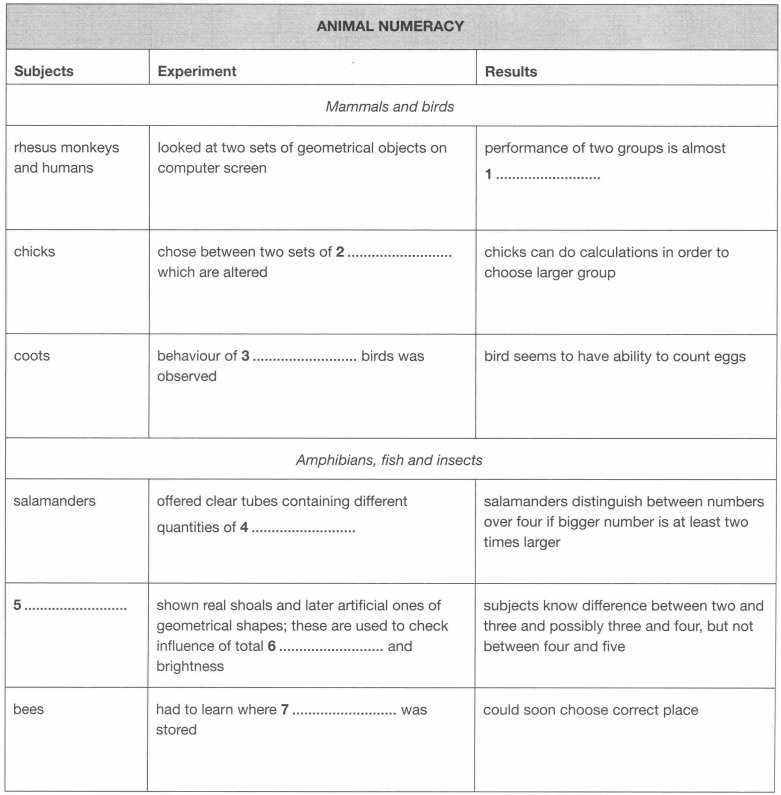
Questions 1-7. Complete the table below. Choose NO MORE THAN THREE WORDS from the passage for each answer.
Questions
8 – 13Questions 8-13. Do the following statements agree with the information given in Reading Passage 1?
In boxes 8-13 on your answer sheet, write
TRUE if the statement agrees with the information
FALSE if the statement contradicts the information
NOT GIVEN if there is no information on this
- 8
Primates are better at identifying the larger of two numbers if one is much bigger than the other.
- 9
Jurgen Tautz trained the insects in his experiment to recognise the shapes of individual numbers.
- 10
The research involving young chicks took place over two separate days.
- 11
The experiment with chicks suggests that some numerical ability exists in newborn animals.
- 12
Researchers have experimented by altering quantities of nectar or fruit available to certain wild animals.
- 13
When assessing the number of eggs in their nest, coots take into account those of other birds.
PASSAGE 2
You should spend about 20 minutes on Questions 14-26, which are based on Reading Passage 2 below.
Is it time to halt the rising tide of plastic packaging?
A
Close up, plastic packaging can be a marvellous thing. Those who make a living from it call it a forgotten infrastructure that allows modern urban life to exist. Plastics have helped society defy natural limits such as the seasons, the rotting of food and the distance most of us live from where our food is produced. And yet we do not like it. Partly we do not like waste, but plastic waste, with its hydrocarbon roots and industrial manufacture, is especially galling. In 2008, the UK, for example, produced around two million tonnes of plastic waste, twice as much as in the early 1990s. The very qualities of plastic - its cheapness, its indestructible aura - make it a reproachful symbol of an unsustainable way of life. The facts, however, do not justify our unease. All plastics are, at least theoretically, recyclable. Plastic packaging makes up just 6 to 7 per cent of the contents of British dustbins by weight and less than 3 per cent of landfill. Supermarkets and brands, which are under pressure to reduce the quantity of packaging of all types that they use, are finding good environmental reasons to turn to plastic: it is lighter, so requires less energy for transportation than glass, for example; it requires relatively little energy to produce; and it is often re-usable. An Austrian study found that if plastic packaging were removed from the supply chain, other packaging would have to increase fourfold to make up for it.
B
So are we just wrong about plastic packaging? Is it time to stop worrying and learn to love the disposable plastic wrapping around sandwiches? Certainly there are bigger targets for environmental savings such as improving household insulation and energy emissions. Naturally, the plastics industry is keen to point them out. What's more, concern over plastic packaging has produced a squall of conflicting initiatives from retailers, manufacturers and local authorities. It's a squall that dies down and then blows harder from one month to the next. 'It is being left to the individual conscience and supermarkets playing the market, says Tim Lang, a professor specialising in food policy. 'It's a mess?
C
Dick Searle of the Packaging Federation points out that societies without sophisticated packaging lose half their food before it reaches consumers and that in the UK, waste in supply chains is about 3 per cent. In India, it is more than 50 per cent. The difference comes later: the British throw out 30 per cent of the food they buy - an environmental cost in terms of emissions equivalent to a fifth of the cars on their roads. Packagers agree that cardboard, metals and glass all have their good points, but there's nothing quite like plastic. With more than 20 families of polymers to choose from and then sometimes blend, packaging designers and manufacturers have a limitless variety of qualities to play with.
D
But if there is one law of plastic that, in environmental terms at least, prevails over all others, it is this: a little goes a long way. This means, first, that plastic is relatively cheap to use - it represents just over one-third of the UK packaging market by value but it wraps more than half the total number of items bought. Second, it means that even though plastic encases about 53 per cent of products bought, it only makes up 20 per cent by weight of the packaging consumed. And in the packaging equation, weight is the main issue because the heavier something is, the more energy you expend moving it around. In view of this, righteous indignation against plastic can look foolish
E
One store commissioned a study to find precise data on which had less environmental impact: selling apples loose or ready-wrapped. Helene Roberts, head of packaging, explains that in fact they found apples in fours on a tray covered by plastic film needed 27 per cent less packaging in transportation than those sold loose. Steve Kelsey, a packaging designer, finds the debate frustrating. He argues that the hunger to do something quickly is diverting effort away from more complicated questions about how you truly alter supply chains. Rather than further reducing the weight of a plastic bottle, more thought should be given to how packaging can be recycled. Helene Roberts explains that their greatest packaging reduction came when the company switched to re-usable plastic crates and stopped consuming 62,000 tonnes of cardboard boxes every year. Plastic packaging is important, and it might provide a way of thinking about broader questions of sustainability. To target plastic on its own is to evade the complexity of the issues. There seems to be a universal eagerness to condemn plastic. Is this due to an inability to make the general changes in society that are really required? 'Plastic as a lightweight food wrapper is now built in as the logical thing. Lang says. 'Does that make it an environmentally sound system of packaging? It only makes sense if you have a structure such as exists now. An environmentally driven packaging system would look completely different. Dick Searle put the challenge another way. "The amount of packaging used today is a reflection of modern life?
Questions
Questions 14-18. Reading Passage 2 has five paragraphs A-E. Choose the correct heading for each paragraph, A-E, from the list of headings below.
List of Headings
i
A lack of consistent policy
ii
Learning from experience
iii
The greatest advantage
iv
The role of research
v
A unique material
vi
An irrational anxiety
vii
Avoiding the real challenges
viii
A sign of things to come
Questions
19 – 23Questions 19-23. Look at the following statements (Questions 19-23) and the list of people below. Match each statement to the correct person A-D.
NB You may use any letter more than once.
People
- Tim Lang
- Dick Searle
- Helene Roberts
- Steve Kelsey
Questions
24 – 26Questions 24-26. Complete the summary below. Write NO MORE THAN ONE WORD from the text for each answer.
PASSAGE 3
You should spend about 20 minutes on Questions 27-40, which are based on Reading Passage 3 below.
The growth of intelligence
No one doubts that intelligence develops as children grow older. Yet the concept of intelligence has proved both quite difficult to define in unambiguous terms and unexpectedly controversial in some respects. Although, at one level, there seem to be almost as many definitions of intelligence as people who have tried to define it, there is broad agreement on two key features. That is, intelligence involves the capacity not only to learn from experience but also to adapt to one's environment. However, we cannot leave the concept there. Before turning to what is known about the development of intelligence, it is necessary to consider whether we are considering the growth of one or many skills. That question has been tackled in rather different ways by psychometricians and by developmentalists.
The former group has examined the issue by determining how children's abilities on a wide range of tasks intercorrelate, or go together. Statistical techniques have been used to find out whether the patterns are best explained by one broad underlying capacity, general intelligence, or by a set of multiple, relatively separate, special skills in domains such as verbal and visuospatial ability. While it cannot be claimed that everyone agrees on what the results mean, most people now accept that for practical purposes it is reasonable to suppose that both are involved. In brief, the evidence in favour of some kind of general intellectual capacity is that people who are superior (or inferior) on one type of task tend also to be superior (or inferior) on others. Moreover, general measures of intelligence tend to have considerable powers to predict a person's performance on a wide range of tasks requiring special skills. Nevertheless, it is plain that it is not at all uncommon for individuals to be very good at some sorts of task and yet quite poor at some others.
Furthermore the influences that affect verbal skills are not quite the same as those that affect other skills.
This approach to investigating intelligence is based on the nature of the task involved, but studies of age-related changes show that this is not the only, or necessarily the most important, approach. For instance, some decades ago, Horn and Cattell argued for a differentiation between what they termed 'fluid' and crystallised' intelligence. Fluid abilities are best assessed by tests that require mental manipulation of abstract symbols. Crystallised abilities, by contrast, reflect knowledge of the environment in which we live and past experience of similar tasks; they may be assessed by tests of comprehension and information. It seems that fluid abilities peak in early adult life, whereas crystallised abilities increase up to advanced old age.
Developmental studies also show that the interconnections between different skills vary with age. Thus in the first year of life an interest in perceptual patterns is a major contributor to cognitive abilities, whereas verbal abilities are more important later on. These findings seemed to suggest a substantial lack of continuity between infancy and middle childhood. However, it is important to realise that the apparent discontinuity will vary according to which of the cognitive skills were assessed in infancy. It has been found that tests of coping with novelty do predict later intelligence. These findings reinforce the view that young children's intellectual performance needs to be assessed from their interest in and curiosity about the environment, and the extent to which this is applied to new situations, as well as by standardised intelligence testing.
These psychometric approaches have focused on children's increase in cognitive skills as they grow older. Piaget brought about a revolution in the approach to cognitive development through his arguments (backed up by observations that the focus should be on the thinking processes involved rather than on levels of cognitive achievement. These ideas of Piaget gave rise to an immense body of research and it would be true to say that subsequent thinking has been heavily dependent on his genius in opening up new ways of thinking about cognitive development. Nevertheless, most of his concepts have had to be so radically revised, or rejected, that his theory no longer provides an appropriate basis for thinking about cognitive development. To appreciate why that is so, we need to focus on some rather different elements of Piaget's theorising.
The first element, which has stood the test of time, is his view that the child is an active agent of learning and of the importance of this activity in cognitive development. Numerous studies have shown how infants actively scan their environment; how they prefer patterned to non-patterned objects, how they choose novel over familiar stimuli, and how they explore their environment as if to see how it works. Children's questions and comments vividly illustrate the ways in which they are constantly constructing schemes of what they know and trying out their ideas of how to fit new knowledge into those schemes or deciding that the schemes need modification. Moreover, a variety of studies have shown that active experiences have a greater effect on learning than comparable passive experiences. However, a second element concerns the notion that development proceeds through a series of separate stages that have to be gone through step-by-step, in a set order, each of which is characterised by a particular cognitive structure. That has turned out to be a rather misleading way of thinking about cognitive development, although it is not wholly wrong.
Questions
Questions 27-30. Choose the correct letter, A, B, C or D. Write your answers in boxes 27-30 on your answer sheet.
- 27
Most researchers accept that one feature of intelligence is the ability to
- 28
What have psychometricians used statistics for?
- 29
Why are Horn and Cattell mentioned?
- 30
What was innovative about Piaget’s research?
Questions
31 – 36Questions 31-36. Do the following statements agree with the views of the writer in Reading Passage 3?
In boxes 31-36 on your answer sheet, write
YES if the statement agrees with the views of the writer
NO if the statement contradicts the views of the writer
NOT GIVEN if it is impossible to say what the writer thinks about this
- 31
A surprising number of academics have come to the same conclusion about what the term intelligence means.
- 32
A general test of intelligence is unlikely to indicate the level of performance in every type of task.
- 33
The elderly perform less well on comprehension tests than young adults.
- 34
We must take into account which skills are tested when comparing intelligence at different ages.
- 35
Piaget’s work influenced theoretical studies more than practical research.
- 36
Piaget’s emphasis on active learning has been discredited by later researchers.
Questions
37 – 40Questions 37-40. Complete the summary using the list of words, A-l, below.
A
adult
B
practical
C
verbal
D
spatial
E
inquisitive
F
uncertain
G
academic
H
plentiful
I
unfamiliar
Questions
Questions 1-7. Complete the table below. Choose NO MORE THAN THREE WORDS from the passage for each answer.
Giải thích đáp án
CÂU HỎI 1 – IDENTICAL Chỗ trống cần điền đứng sau động từ “is” ⇒ cần điền danh từ | |
CÂU HỎI | VÙNG THÔNG TIN |
performance of two groups is almostidentical
| The students’ performance ends up looking just like a monkey’s. It’s practically identical.’ she says. |
CÂU HỎI 2 – BALLS OF PAPER Chỗ trống cần điền đứng sau cụm từ “two sets of” ⇒ cần điền danh từ | |
CÂU HỎI | VÙNG THÔNG TIN |
choose between two sets of balls of paper which are altered
| Researchers placed each chick in the middle of a platform and showed it two groups of balls of paper. |
CÂU HỎI 3 – FEMALE Chỗ trống cần điền đứng sau giới từ “of” ⇒ cần điền danh từ | |
CÂU HỎI | VÙNG THÔNG TIN |
the behavior of femalebirds was observed
| In one compelling example, researchers in America found that female coots appear to calculate how many eggs they have laid – and add any in the nest laid by an intruder – before making any decisions about adding to them |
CÂU HỎI 4 – FRUIT FLIES Chỗ trống cần điền đứng sau giới từ “of” ⇒ cần điền danh từ | |
CÂU HỎI | VÙNG THÔNG TIN |
offered clear tubes containing different quantities of fruit flies | Psychologist Claudia Uller’s team tempted salamanders with two sets of fruit flies held in clear tubes. |
CÂU HỎI 5 – MOSQUITOFISH Chỗ trống cần điền đứng trong cột tên các loài từ ⇒ cần điền danh từ | |
CÂU HỎI | VÙNG THÔNG TIN |
Mosquitofish (results: subjects know the difference between two and three and possibly three and four, but not between four and five) | A team at the University of Padova found that while mosquitofish can tell the difference between a group containing 3 shoal-mates and a group containing 4, they did not know a preference between groups of 4 and 5. |
CÂU HỎI 6 – SURFACE AREA Chỗ trống cần điền đứng sau mạo từ “a”, tính từ “total” ⇒ cần điền danh từ | |
CÂU HỎI | VÙNG THÔNG TIN |
shown real shoals and later artificial ones of geometrical shapes; these are used to check the influence of a total surface area and brightness
| To consider this possibility, the mosquitofish tests were repeated, this time using varying geometrical shapes in place of fish. The team arranged these shapes so that they had the same overall surface area and luminance even though they contained a different number of objects. |
CÂU HỎI 7 – SUGAR WATER Chỗ trống cần điền đứng sau trạng từ “where” ⇒ cần điền danh từ | |
CÂU HỎI | VÙNG THÔNG TIN |
| had to learn where sugar water was stored | Entomologist Jurgen Tautz sent a group of bees down a corridor, at the end of which lay two chambers – one which contained sugar water, which they like, while the other was empty… The bees quickly learned to match the number of shapes with the correct chamber. |
Questions
8 – 13Questions 8-13. Do the following statements agree with the information given in Reading Passage 1?
In boxes 8-13 on your answer sheet, write
TRUE if the statement agrees with the information
FALSE if the statement contradicts the information
NOT GIVEN if there is no information on this
- 8
Primates are better at identifying the larger of two numbers if one is much bigger than the other.
Bạn chưa trả lời câu hỏi này
Giải thích đáp án
CÂU HỎI 8 – TRUE Chú ý tới từ khóa “identifying the larger of two numbers” để tìm được Paragraph 1&2 chứa câu trả lời. | |
CÂU HỎI | VÙNG THÔNG TIN |
Primates are better at identifying the larger of two numbers if one is much bigger than the other. | Both groups performed successfully but, importantly, Brannon’s team found that monkeys, like humans, make more errors when two sets of objects are close in number. The students’ performance ends up looking just like a monkey’s….Humans and monkeys are mammals, in the animal family known as primates. |
DỊCH NGHĨA | |
Các loài linh trưởng giỏi hơn trong việc xác định số lớn hơn trong hai số nếu một số lớn hơn nhiều so với số kia. | Cả hai nhóm đều thực hiện thành công, nhưng quan trọng là nhóm của Brannon phát hiện ra rằng khỉ cũng giống như con người và mắc nhiều lỗi hơn khi hai nhóm đối tượng gần nhau về số lượng. Kết quả của học sinh giống như kết quả của khỉ….Con người và khỉ là động vật có vú, trong họ động vật được gọi là linh trưởng. |
Giải thích: Số lượng càng gần giống nhau thì linh trưởng (primates) càng dễ nhầm lẫn hay Số có giá trị càng xa nhau thì linh trưởng càng ít nhầm lẫn => nhận định đưa ra đúng ⇒ ĐÁP ÁN TRUE | |
- 9
Jurgen Tautz trained the insects in his experiment to recognise the shapes of individual numbers.
Bạn chưa trả lời câu hỏi này
Giải thích đáp án
CÂU HỎI 9 – FALSE Chú ý tới từ khóa “trained the insects” để tìm được Paragraph 5 chứa câu trả lời. | |
CÂU HỎI | VÙNG THÔNG TIN |
Jurgen Tautz trained the insects in his experiment to recognise the shapes of individual numbers. | Entomologist Jurgen Tautz sent a group of bees down a corridor, at the end of which lay two chambers – one which contained sugar water, which they like, while the other was empty. To test the bees’ numeracy, the team marked each chamber with a different number of geometrical shapes – between 2 and 6. The bees quickly learned to match the number of shapes with the correct chamber. |
DỊCH NGHĨA | |
Jurgen Tautz đã huấn luyện côn trùng trong thí nghiệm của mình để nhận ra hình dạng của các số riêng lẻ. | Nhà côn trùng học Jurgen Tautz cử một đàn ong đi dọc hành lang, ở cuối hành lang có hai ngăn – một ngăn chứa nước đường mà chúng thích, còn ngăn kia trống rỗng. Để kiểm tra khả năng tính toán của những con ong, nhóm nghiên cứu đã đánh dấu mỗi buồng bằng một số hình dạng hình học khác nhau – từ 2 đến 6. Những con ong nhanh chóng học cách khớp số lượng hình dạng với đúng buồng. |
Giải thích: Đoạn thông tin cho thấy giáo sư huấn luyện côn trùng (bees) khớp số với số lượng các hình của chúng (number of shapes), không phải nhận ra hình ảnh của một số (shape of individual number) => nhận định đưa ra sai ⇒ ĐÁP ÁN FALSE | |
- 10
The research involving young chicks took place over two separate days.
Bạn chưa trả lời câu hỏi này
Giải thích đáp án
CÂU HỎI 10 – NOT GIVEN Chú ý tới từ khóa “young chicks” để tìm được Paragraph 6 chứa câu trả lời. | |
CÂU HỎI | VÙNG THÔNG TIN |
The research involving young chicks took place over two separate days.
| Researchers placed each chick in the middle of a platform and showed it two groups of balls of paper. Next, they hid the two piles behind screens, changed the quantities and revealed them to the chick. This forced the chick to perform simple computations to decide which side now contained the biggest number of its “brothers”. Without any prior coaching, the chicks scuttled to the larger quantity at a rate well above chance. They were doing some very simple arithmetic, claim the researchers. |
DỊCH NGHĨA | |
Nghiên cứu liên quan đến gà con diễn ra trong hai ngày riêng biệt. | Các nhà nghiên cứu đặt mỗi con gà con vào giữa một cái bục và cho nó xem hai nhóm quả bóng giấy. Tiếp theo, họ giấu hai đống bóng giấy sau màn hình, thay đổi số lượng và đưa chúng cho gà con. Điều này buộc gà con phải thực hiện các phép tính đơn giản để quyết định bên nào hiện có số lượng “anh em” lớn nhất. Không cần huấn luyện trước, gà con chạy theo số lượng lớn hơn với tốc độ cao hơn rất nhiều so với khả năng. Các nhà nghiên cứu khẳng định họ đang làm một số phép tính rất đơn giản. |
Giải thích: Trong bài đúng là có đề cập tới “young chicks” và thí nghiệm (experiment), nhưng không hề nói gì tới thời gian diễn ra thí nghiệm là bao nhiêu ngày ⇒ không đủ thông tin để xác định nhận định là đúng hay sai => ĐÁP ÁN NOT GIVEN | |
- 11
The experiment with chicks suggests that some numerical ability exists in newborn animals.
Bạn chưa trả lời câu hỏi này
Giải thích đáp án
CÂU HỎI 11 – TRUE Chú ý tới từ khóa “numerical ability” để tìm được Paragraph 6 chứa câu trả lời. | |
CÂU HỎI | VÙNG THÔNG TIN |
The experiment with chicks suggests that some numerical ability exists in newborn animals. | Proof that this may be the case has emerged from an experiment testing the mathematical ability of three- and four-day-old chicks. Like mosquitofish, chicks prefer to be around as many of their siblings as possible, so they will always head towards a larger number of their kin….This forced the chick to perform simple computations to decide which side now contained the biggest number of its “brothers”. Without any prior coaching, the chicks scuttled to the larger quantity at a rate well above chance. They were doing some very simple arithmetic, claim tho researchers |
DỊCH NGHĨA | |
Thí nghiệm với gà con cho thấy rằng một số khả năng tính toán tồn tại ở động vật sơ sinh.
| Bằng chứng cho thấy đây có thể là trường hợp đã xuất hiện từ một thí nghiệm kiểm tra khả năng toán học của gà con ba và bốn ngày tuổi. Giống như cá muỗi, gà con thích ở gần càng nhiều anh chị em của chúng càng tốt, vì vậy chúng sẽ luôn hướng tới số lượng lớn hơn các đồng loại của mình….Điều này buộc gà con phải thực hiện các phép tính đơn giản để quyết định bên nào hiện có số lượng “anh em” lớn nhất. Không cần huấn luyện trước, gà con chạy theo số lượng lớn hơn với tốc độ cao hơn rất nhiều so với cơ hội. Các nhà nghiên cứu cho rằng chúng đang làm một số phép tính rất đơn giản
|
Giải thích: bài đọc cho thấy gà con (The chicks) chọn được cái có số lượng lớn hơn mà không cần huấn luyện => khả năng toán học của chicks là bẩm sinh=> nhận định đưa ra đúng ⇒ ĐÁP ÁN TRUE | |
- 12
Researchers have experimented by altering quantities of nectar or fruit available to certain wild animals.
Bạn chưa trả lời câu hỏi này
Giải thích đáp án
CÂU HỎI 12 – NOT GIVEN Chú ý tới từ khóa “nectar, fruit” để tìm được Paragraph 7 chứa câu trả lời. | |
CÂU HỎI | VÙNG THÔNG TIN |
Researchers have experimented by altering quantities of nectar or fruit available to certain wild animals.
| Why these skills evolved is not hard to imagine since it would help almost any animal forage for food. Animals on the prowl for sustenance must constantly decide which tree has the most fruit, or which patch of flowers will contain the most nectar. |
DỊCH NGHĨA | |
Các nhà nghiên cứu đã thử nghiệm bằng cách thay đổi số lượng mật hoa hoặc trái cây có sẵn cho một số loài động vật hoang dã. | Tại sao những kỹ năng này phát triển không khó để tưởng tượng vì nó sẽ giúp hầu hết mọi loài động vật tìm kiếm thức ăn. Các loài động vật đi lang thang để kiếm ăn phải liên tục quyết định cây nào có nhiều quả nhất hoặc bông hoa nào sẽ chứa nhiều mật hoa nhất. |
Giải thích: Không hề đề cập tới việc researchers thay đổi số lượng mật hoa hay quả (researchers change quantities of nectar or fruit) ⇒ không đủ thông tin để xác định nhận định là đúng hay sai => ĐÁP ÁN NOT GIVEN | |
- 13
When assessing the number of eggs in their nest, coots take into account those of other birds.
Bạn chưa trả lời câu hỏi này
Giải thích đáp án
CÂU HỎI 13 – TRUE Chú ý tới từ khóa “coots” để tìm được Paragraph 7 chứa câu trả lời. | |
CÂU HỎI | VÙNG THÔNG TIN |
When assessing the number of eggs in their nest, coots take into account those of other birds. | In one compelling example, researchers in America found that female coots appear to calculate how many eggs they have laid – and add any in the nest laid by an intruder – before making any decisions about adding to them.
|
DỊCH NGHĨA | |
Khi đánh giá số lượng trứng trong tổ của chúng, chim cuốc sẽ tính đến trứng của những loài chim khác. | Trong một ví dụ thuyết phục, các nhà nghiên cứu ở Mỹ đã phát hiện ra rằng chim cu gáy cái dường như tính toán xem chúng đã đẻ bao nhiêu trứng – và thêm bất kỳ quả trứng nào vào tổ do kẻ đột nhập đẻ – trước khi đưa ra bất kỳ quyết định nào về việc thêm chúng vào. |
Giải thích: Chim cu gáy (Coots) có chú ý tới trứng của loài chim lạ (intruder) đẻ khi tính toán số trứng (calculate the eggs) => nhận định đưa ra đúng ⇒ ĐÁP ÁN TRUE | |
Questions
Questions 14-18. Reading Passage 2 has five paragraphs A-E. Choose the correct heading for each paragraph, A-E, from the list of headings below.
List of Headings
i
A lack of consistent policy
ii
Learning from experience
iii
The greatest advantage
iv
The role of research
v
A unique material
vi
An irrational anxiety
vii
Avoiding the real challenges
viii
A sign of things to come
Bạn chưa trả lời câu hỏi này
vi
Bạn chưa trả lời câu hỏi này
i
Bạn chưa trả lời câu hỏi này
v
Bạn chưa trả lời câu hỏi này
iii
Bạn chưa trả lời câu hỏi này
vii
Giải thích đáp án
PARAGRAPH A – HEADING (vi) Chú ý tới từ khóa “irrational anxiety” trong heading. | |
HEADING | VÙNG THÔNG TIN |
An irrational anxiety | The very qualities of plastic – its cheapness, its indestructible aura – make it a reproachful symbol of an unsustainable way of life. The facts, however, do not justify our unease. All plastics are, at least theoretically, recyclable. Plastic packaging makes up just 6 to 7 per cent of the contents of British dustbins by weight and less than 3 percent of landfills. Supermarkets and brands, which are under pressure to reduce the quantity of packaging of all types that they use, are finding good environmental reasons to turn to plastic: it is lighter, so requires less energy for transportation than glass, for example; it requires relatively little energy to produce, and it is often re-usable |
DỊCH NGHĨA | |
Một sự lo lắng phi lý | |
Giải thích: Trong đoạn văn đề cập đến
⇒ heading vi | |
PARAGRAPH B – HEADING (i) Chú ý tới từ khóa “consistent policy” trong heading. | |
HEADING | VÙNG THÔNG TIN |
A lack of consistent policy | Certainly, there are bigger targets for environmental savings such as improving household insulation and energy emissions. Naturally, the tire plastics industry is keen to point them out. What’s more, concern over plastic packaging has produced a squall of conflicting initiatives from retailers, manufacturers, and local authorities. It’s a squall that dies down and then blows harder from one month to the next |
DỊCH NGHĨA | |
Thiếu chính sách nhất quán | |
Giải thích: Trong đoạn văn đề cập đến
⇒ heading i | |
PARAGRAPH C – HEADING (v) Chú ý tới từ khóa “a unique material” trong heading. | |
HEADING | VÙNG THÔNG TIN |
A unique material | Packagers agree that cardboard, metals, and glass all have their good points, but there’s nothing quite like plastic. With more than 20 families of polymers to choose from and then sometimes blend, packaging designers and manufacturers have a limitless variety of qualities to play with.
|
DỊCH NGHĨA | |
Một vật liệu độc đáo | |
Giải thích: Trong đoạn văn đề cập đến
⇒ heading v | |
PARAGRAPH D – HEADING (iii) Chú ý tới từ khóa “greatest advantage” trong heading. | |
HEADING | VÙNG THÔNG TIN |
The greatest advantage | But if there is one law of plastic that, in environmental terms at least, prevails over all others, it is this: a little goes a long way. This means, first, that plastic is relatively cheap to use – it represents just over one-third of the UK packaging market by value but it wraps more than half the total number of items bought. Second, it means that even though plastic encases about 53 per cent of products bought, it only makes up 20 per cent by weight of the packaging consumed. And in the packaging equation, weight is the main issue because the heavier something is, the more energy you expend moving it around |
DỊCH NGHĨA | |
lợi thế lớn nhất | |
Giải thích: Trong đoạn văn đề cập đến
| |
PARAGRAPH E – HEADING (vii) Chú ý tới từ khóa “Avoiding the real challenges” trong heading. | |
HEADING | VÙNG THÔNG TIN |
Avoiding the real challenges | Plastic packaging is important, and it might provide a way of thinking about broader questions of sustainability. To target plastic on its own is to evade the complexity of the issues. There seems to be a universal eagerness to condemn plastic. Is this due to an inability to make the general changes in society that are really required? |
DỊCH NGHĨA | |
Lảng tránh những thách thức thực sự | |
Giải thích: Trong đoạn văn đề cập đến
| |
Questions
19 – 23Questions 19-23. Look at the following statements (Questions 19-23) and the list of people below. Match each statement to the correct person A-D.
NB You may use any letter more than once.
People
- Tim Lang
- Dick Searle
- Helene Roberts
- Steve Kelsey
Bạn chưa trả lời câu hỏi này
C
Bạn chưa trả lời câu hỏi này
A
Bạn chưa trả lời câu hỏi này
B
Bạn chưa trả lời câu hỏi này
D
Bạn chưa trả lời câu hỏi này
A
Giải thích đáp án
CÂU HỎI 19 – C (Helene Roberts) Chú ý tới từ khóa “comparison of two approaches” để tìm được Paragraph E chứa câu trả lời. | |
CÂU HỎI | VÙNG THÔNG TIN |
Comparison of two approaches to packaging revealed an interesting result. | One store commissioned a study to find precise data on which had less environmental impact: selling apples loose or ready-wrapped. Helene Roberts, head of packaging, explains that in fact they found apples in fours on a tray covered by plastic film needed 27 per cent less packaging in transportation than those sold loose. |
DỊCH NGHĨA | |
So sánh hai phương pháp đóng gói cho thấy một kết quả thú vị. | Một cửa hàng đã thực hiện một nghiên cứu để tìm dữ liệu chính xác về phương pháp ít gây tác động đến môi trường hơn: bán táo rời hoặc đóng gói sẵn. Helene Roberts, trưởng bộ phận đóng gói, giải thích rằng trên thực tế, họ đã tìm thấy những quả táo được đóng thành bốn trên khay được bọc bằng màng nhựa cần ít hơn 27% bao bì trong quá trình vận chuyển so với những quả được bán rời. |
CÂU HỎI 20 – A (Tim Lang) Chú ý tới từ khóa “do the right thing” để tìm được Paragraph B chứa câu trả lời. | |
CÂU HỎI | VÙNG THÔNG TIN |
People are expected to do the right thing. | ‘It is being left to the individual conscience and supermarkets playing the market,’ says Tim Lang, a professor specializing in food policy.
|
DỊCH NGHĨA | |
Mọi người được kỳ vọng sẽ làm điều đúng đắn. | Tim Lang, giáo sư chuyên về chính sách thực phẩm, cho biết: “ Lương tâm của mỗi cá nhân và các siêu thị tự nắm quyền quyết định.” |
CÂU HỎI – B (Dick Searle) Chú ý tới từ khóa “UK shops” để tìm được Paragraph C chứa câu trả lời. | |
CÂU HỎI | VÙNG THÔNG TIN |
Most food reaches UK shops in good condition. | Dick Searle of the Packaging Federation points out that societies without sophisticated packaging lose half their food before it reaches consumers and that in the UK, waste in supply chains is about 3 per cent. In India, it is more than 50 per cent.
|
DỊCH NGHĨA | |
Hầu hết thực phẩm đến các cửa hàng ở Vương quốc Anh trong tình trạng tốt. | Dick Searle của Liên đoàn Bao bì chỉ ra rằng các xã hội không có bao bì phức tạp sẽ mất một nửa lượng thực phẩm trước khi đến tay người tiêu dùng và ở Anh, lãng phí trong chuỗi cung ứng là khoảng 3%. Ở Ấn Độ, tỷ lệ này cao hơn 50%. |
CÂU HỎI 22 – D (Steve Kelsey) Chú ý tới từ khóa “Complex issues” để tìm được Paragraph E chứa câu trả lời. | |
CÂU HỎI | VÙNG THÔNG TIN |
Complex issues are ignored in the search for speedy solutions. | Steve Kelsey, a packaging designer, finds the debate frustrating. He argues that the hunger to do something quickly is diverting effort away from more complicated questions about how you truly alter supply chains. |
DỊCH NGHĨA | |
Các vấn đề phức tạp bị bỏ qua trong quá trình tìm kiếm các giải pháp nhanh chóng. | Steve Kelsey, một nhà thiết kế bao bì, cảm thấy cuộc tranh luận này gây bức xúc. Ông lập luận rằng khao khát làm điều gì đó nhanh chóng đang chuyển hướng nỗ lực khỏi những câu hỏi phức tạp hơn về cách bạn thực sự thay đổi chuỗi cung ứng. |
CÂU HỎI 23 – A (Tim Lang) Chú ý tới từ khóa “the way societies operate” để tìm được Paragraph E chứa câu trả lời. | |
CÂU HỎI | VÙNG THÔNG TIN |
It is merely because of the way societies operate that using plastic seems valid. | ‘Plastic as a lightweight food wrapper is now built in as the logical thing,’ Lang says. ‘Does that make it an environmentally sound system of packaging? It only makes sense if you have a structure such as exists now.
|
DỊCH NGHĨA | |
Chỉ đơn thuần là do cách xã hội vận hành mà việc sử dụng nhựa có vẻ hợp lệ. | Lang cho biết: “Nhựa như một loại giấy gói thực phẩm nhẹ hiện được tích hợp sẵn như một thứ hợp lý. Điều đó có làm cho nó trở thành một hệ thống đóng gói thân thiện với môi trường không? Nó chỉ hợp lý nếu bạn có một kết cấu như cái tồn tại bây giờ. |
Questions
24 – 26Questions 24-26. Complete the summary below. Write NO MORE THAN ONE WORD from the text for each answer.
Giải thích đáp án
CÂU HỎI 24 – INDUSTRIAL Chỗ trống cần điền đứng sau giới từ “of”, trước danh từ “processes” ⇒ cần điền tính từ | |
CÂU HỎI | VÙNG THÔNG TIN |
However, we instinctively dislike it, partly because it is the product of industrial processes, but also because it seems to be ….. | Partly we do not like waste, but plastic waste, with its hydrocarbon roots and industrial manufacture, is especially galling.
|
CÂU HỎI 25 – INDESTRUCTIBLE Chỗ trống cần điền đứng sau động từ “be” ⇒ cần điền tính từ | |
CÂU HỎI | VÙNG THÔNG TIN |
However, we instinctively dislike it, partly because it is the product of industrial processes, but also because it seems to be indestructible | The very qualities of plastic – its cheapness, its indestructible aura – make it a reproachful symbol of an unsustainable way of life.
|
CÂU HỎI 26 – SEASONS Chỗ trống cần điền đứng sau mạo từ “the” ⇒ cần điền danh từ | |
CÂU HỎI | VÙNG THÔNG TIN |
Nevertheless, it is thanks to plastic that for many people their choice of food is no longer restricted by the seasonsin which it is available or the location of its source. | Plastics have helped society defy natural limits such as the seasons, the rotting of food and the distance most of us live from where our food is produced. |
Questions
Questions 27-30. Choose the correct letter, A, B, C or D. Write your answers in boxes 27-30 on your answer sheet.
- 27
Most researchers accept that one feature of intelligence is the ability to
Bạn chưa trả lời câu hỏi này
Giải thích đáp án
CÂU HỎI 27 – PARAGRAPH 1, 2 | |
CÂU HỎI | VÙNG THÔNG TIN |
27. Most researchers accept that one feature of intelligence is the ability to A. change our behavior according to our situation. B. reacts to others’ behavior patterns. C. experiment with environmental features. D. cope with unexpected setbacks. | Although at one level, there seem to be almost as many definitions of intelligence as people who have tried to define it, there is broad agreement on two key features. That is, intelligence involves the capacity not only to learn from experience but also to adapt to one’s environment
|
DỊCH NGHĨA | |
27. Hầu hết các nhà nghiên cứu chấp nhận rằng một đặc điểm của trí thông minh là khả năng A. thay đổi hành vi của chúng ta theo hoàn cảnh B. phản ứng với các kiểu hành vi của người khác. C. thí nghiệm về đặc điểm môi trường. D. đương đầu với những thất bại bất ngờ. | Câu hỏi đó đã được các nhà tâm lý học và các nhà phát triển giải quyết theo những cách khá khác nhau. Nhóm trước đây đã xem xét vấn đề bằng cách xác định khả năng của trẻ em trong một loạt các nhiệm vụ có mối tương quan với nhau hoặc đi cùng nhau như thế nào. |
| |
- 28
What have psychometricians used statistics for?
Bạn chưa trả lời câu hỏi này
Giải thích đáp án
CÂU HỎI 28 – PARAGRAPH 1, 2 | |
CÂU HỎI | VÙNG THÔNG TIN |
28. What have psychometricians used statistics for? A. to find out if cooperative tasks are a useful tool in measuring certain skills B. to explore whether several abilities are involved in the development of intelligence C. to demonstrate that mathematical models can predict test results for different skills D. to discover whether common sense is fundamental to developing children’s abilities | Before turning to what is known about the development of intelligence, it is necessary to consider whether we are considering the growth of one or many skills. That question has been tackled in rather different ways by psychometricians and by developmentalism. The former group has examined the issue by determining how children’s abilities on a wide range of tasks correlate or go together. Statistical techniques have been used to find out whether the patterns are best explained by one broad underlying capacity, general intelligence, or by a set of multiple, relatively separate, special skills in domains such as verbal and visuospatial ability. |
DỊCH NGHĨA | |
28. Các nhà tâm lý học đã sử dụng số liệu thống kê để làm gì? A. để tìm hiểu xem các nhiệm vụ hợp tác có phải là một công cụ hữu ích để đánh giá một số kỹ năng nhất định không B. để khám phá xem một số khả năng có liên quan đến sự phát triển của trí thông minh hay không C. để chứng minh rằng các mô hình toán học có thể dự đoán kết quả kiểm tra cho các kỹ năng khác nhau D. để khám phá xem cảm giác thông thường có phải là nền tảng để phát triển khả năng của trẻ hay không | Trước khi chuyển sang những gì đã biết về sự phát triển trí thông minh, cần xem xét liệu chúng ta đang xem xét sự phát triển của một hay nhiều kỹ năng. Câu hỏi đó đã được các nhà tâm lý học và chủ nghĩa phát triển giải quyết theo những cách khá khác nhau. Nhóm trước đây đã xem xét vấn đề này bằng cách xác định khả năng của trẻ em trong một loạt các nhiệm vụ tương quan hoặc kết hợp với nhau như thế nào. Các kỹ thuật thống kê đã được sử dụng để tìm hiểu xem những thói quen được giải thích tốt nhất bằng một năng lực tiềm ẩn rộng rãi’, trí thông minh chung, hay bằng một tập hợp nhiều kỹ năng đặc biệt nhưng tương đối riêng biệt, trong các lĩnh vực như khả năng ngôn ngữ và thị giác không gian’. |
| |
- 29
Why are Horn and Cattell mentioned?
Bạn chưa trả lời câu hỏi này
Giải thích đáp án
CÂU HỎI 29 – PARAGRAPH 3 | |
CÂU HỎI | VÙNG THÔNG TIN |
29 .Why are Horn and Cattell mentioned? A. They disagreed about the interpretation of different intelligence tests. B. The research concerned both linguistic and mathematical abilities. C. They were the first to prove that intelligence can be measured by testing a range of special skills. D. Their work was an example of research into how people’s cognitive skills vary with age.
| For instance, some decades ago, Horn and Cattell … It seems that fluid abilities peak in early adult life, whereas crystallized abilities increase up to advanced old age.
|
DỊCH NGHĨA | |
29. Tại sao Horn và Cattell được nhắc đến? A. Họ không đồng ý về cách giải thích các bài kiểm tra trí thông minh khác nhau. B. Nghiên cứu liên quan đến cả khả năng ngôn ngữ và toán học. C. Họ là những người đầu tiên chứng minh rằng có thể đo lường trí thông minh bằng cách kiểm tra một loạt các kỹ năng đặc biệt. D. Công việc của họ là một ví dụ về nghiên cứu về cách các kỹ năng nhận thức của mọi người thay đổi theo độ tuổi. | Ví dụ, vài thập kỷ trước, Horn và Cattell… Người ta nhận thấy rằng các khả năng linh hoạt đạt đỉnh cao khi mới trưởng thành, trong khi các khả năng kết tinh tăng lên khi về già |
| |
- 30
What was innovative about Piaget’s research?
Bạn chưa trả lời câu hỏi này
Giải thích đáp án
CÂU HỎI 30 – PARAGRAPH E | |
CÂU HỎI | VÙNG THÔNG TIN |
30. What was innovative about Piaget’s research? A. He refused to accept that children developed according to a set pattern. B. He emphasized the way children thought more than how well they did in tests. C. He used visually appealing materials instead of traditional intelligence tests. D. He studied children of all ages and levels of intelligence. | Piaget brought about a revolution in the approach to cognitive development through his arguments (backed up by observations) that the focus should be on the thinking processes involved rather than on levels of cognitive achievement.
|
DỊCH NGHĨA | |
30. Nghiên cứu của Piaget có gì đổi mới? A. Ông ấy không chấp nhận rằng trẻ em phát triển theo một khuôn mẫu nhất định. B. Anh ấy nhấn mạnh cách trẻ em suy nghĩ hơn là chúng đã làm tốt như thế nào trong các bài kiểm tra. C. Ông đã sử dụng các tài liệu trực quan hấp dẫn thay vì các bài kiểm tra trí thông minh truyền thống. D. Ông nghiên cứu trẻ em ở mọi lứa tuổi và mức độ thông minh. | Piaget đã tạo ra một cuộc cách mạng trong cách tiếp cận phát triển nhận thức thông qua các lập luận của ông (được hỗ trợ bởi các quan sát) rằng trọng tâm nên tập trung vào các quá trình tư duy liên quan hơn là các mức độ thành tựu nhận thức.
|
| |
Questions
31 – 36Questions 31-36. Do the following statements agree with the views of the writer in Reading Passage 3?
In boxes 31-36 on your answer sheet, write
YES if the statement agrees with the views of the writer
NO if the statement contradicts the views of the writer
NOT GIVEN if it is impossible to say what the writer thinks about this
- 31
A surprising number of academics have come to the same conclusion about what the term intelligence means.
Bạn chưa trả lời câu hỏi này
Giải thích đáp án
CÂU HỎI 31 – NO Chú ý tới từ khóa “what the term intelligence means” để tìm được Paragraph A chứa câu trả lời. | |
CÂU HỎI | VÙNG THÔNG TIN |
A surprising number of academics have come to the same conclusion about what the term intelligence means. | Although, at one level, there seem to be almost as many definitions of intelligence as people who have tried to define it, there is broad agreement on two key features.
|
DỊCH NGHĨA | |
Một lượng đáng ngạc nhiên các học giả đã đi đến cùng một kết luận về ý nghĩa của thuật ngữ trí thông minh.
| Mặc dù, ở một mức độ nào đó, dường như có nhiều người đã đưa ra định nghĩa về trí thông minh, nhưng có sự đồng thuận rộng rãi về hai đặc điểm chính |
Giải thích: bài đọc cho rằng có nhiều cách định nghĩa intelligence, còn câu hỏi lại nói nhiều học giả (academics) có chung định nghĩa về intelligence => Thông tin câu hỏi và bài đọc trái ngược nhau => nhận định đưa ra sai⇒ ĐÁP ÁN NO | |
- 32
A general test of intelligence is unlikely to indicate the level of performance in every type of task.
Bạn chưa trả lời câu hỏi này
Giải thích đáp án
CÂU HỎI 32 – YES Chú ý tới từ khóa “test of intelligence” để tìm được Paragraph B chứa câu trả lời. | |
CÂU HỎI | VÙNG THÔNG TIN |
A general test of intelligence is unlikely to indicate the level of performance in every type of task. | Moreover, general measures of intelligence tend to have considerable powers to predict a person’s performance on a wide range of tasks requiring special skills. Nevertheless, it is plain that it is not at all uncommon for individuals to be very good at some sorts of task and yet quite poor at some others.
|
DỊCH NGHĨA | |
Một bài kiểm tra chung về trí thông minh khó có thể chỉ ra mức độ hoàn thành trong mọi loại nhiệm vụ. | Hơn nữa, các thước đo trí thông minh chung có khả năng dự đoán hiệu suất của một người trong một loạt các nhiệm vụ đòi hỏi các kỹ năng đặc biệt. Tuy nhiên, rõ ràng là không có gì lạ khi các cá nhân rất giỏi trong một số loại nhiệm vụ nhưng lại khá kém ở một số loại khác. |
Giải thích: Bài test chung về trí thông minh (General test of intelligence) thì không thể chỉ ra được mức độ hoàn thành (performance) của các loại nhiệm vụ (task) => nhận định đưa ra đúng ⇒ ĐÁP ÁN YES | |
- 33
The elderly perform less well on comprehension tests than young adults.
Bạn chưa trả lời câu hỏi này
Giải thích đáp án
CÂU HỎI 33 – NO Chú ý tới từ khóa “the elderly” để tìm được Paragraph C chứa câu trả lời. | |
CÂU HỎI | VÙNG THÔNG TIN |
The elderly perform less well on comprehension tests than young adults.
| Crystallized abilities, by contrast, reflect knowledge of the environment in which we live and past experience of similar tasks; they may be assessed by tests of comprehension and information. It scents that fluid abilities peak in early adult life, whereas crystallized abilities increase up to advanced old age
|
DỊCH NGHĨA | |
Người cao tuổi thực hiện kém hơn trong các bài kiểm tra về hiểu biết so với người trẻ tuổi. | Ngược lại, trí thông minh kết tinh phản ánh kiến thức về môi trường chúng ta đang sống và kinh nghiệm trong quá khứ về các nhiệm vụ tương tự; chúng có thể được đánh giá bằng các bài kiểm tra về hiểu và thông tin. Nó cho thấy rằng các khả năng linh hoạt đạt đỉnh cao trong giai đoạn đầu trưởng thành, trong khi các khả năng kết tinh tăng lên khi tuổi già cao |
Giải thích: bài đọc cho thấy trí thông minh kết tinh tăng ở tuổi già => nhận định trái ngược thông tin trong bài => nhận định đưa ra sai⇒ ĐÁP ÁN NO | |
- 34
We must take into account which skills are tested when comparing intelligence at different ages.
Bạn chưa trả lời câu hỏi này
Giải thích đáp án
CÂU HỎI 34 – YES Chú ý tới từ khóa “comparing intelligence” để tìm được Paragraph D chứa câu trả lời. | |
CÂU HỎI | VÙNG THÔNG TIN |
We must take into account which skills are tested when comparing intelligence at different ages.
| These findings seemed to suggest a substantial lack of continuity between infancy and middle childhood. However, it is important to realize that the apparent discontinuity will vary according to which of the cognitive skills were assessed in infancy.
|
DỊCH NGHĨA | |
Chúng ta phải tính đến những kỹ năng nào được kiểm tra khi so sánh trí thông minh ở các độ tuổi khác nhau.
| Những phát hiện này dường như cho thấy sự thiếu liên tục đáng kể giữa thời thơ ấu và thời thơ ấu giữa. Tuy nhiên, điều quan trọng là phải nhận ra rằng sự gián đoạn rõ ràng sẽ thay đổi tùy theo kỹ năng nhận thức nào được đánh giá khi còn nhỏ. |
Giải thích: Chúng ta phải xem xét kỹ năng nào được kiểm tra khi so sánh độ thông minh ở các độ tuổi khác nhau => nhận định đưa ra đúng ⇒ ĐÁP ÁN YES | |
- 35
Piaget’s work influenced theoretical studies more than practical research.
Bạn chưa trả lời câu hỏi này
Giải thích đáp án
CÂU HỎI 35 – NOT GIVEN Chú ý tới từ khóa “Piaget’s work” để tìm được Paragraph E chứa câu trả lời. | |
CÂU HỎI | VÙNG THÔNG TIN |
Piaget’s work influenced theoretical studies more than practical research. | These ideas of Piaget gave rise to an immense body of research and it would be true to say that subsequent thinking has been heavily dependent on his genius in opening up new ways of thinking about cognitive development.
|
DỊCH NGHĨA | |
Sự nghiệp của Piaget ảnh hưởng đến các nghiên cứu lý thuyết nhiều hơn là nghiên cứu thực tế. | Những ý tưởng này của Piaget đã tạo ra một lượng lớn nghiên cứu và sẽ đúng khi nói rằng tư duy tiếp theo phụ thuộc rất nhiều vào thiên tài của ông trong việc mở ra những cách suy nghĩ mới về sự phát triển nhận thức. |
Giải thích: Trong bài chỉ nói chung chung là Piaget dẫn đến sự ra đời của nhiều research, nhưng không nói rõ loại nào nhiều hơn: theoretical hay practical ⇒ không đủ thông tin để xác định nhận định là đúng hay sai => ĐÁP ÁN NOT GIVEN | |
- 36
Piaget’s emphasis on active learning has been discredited by later researchers.
Bạn chưa trả lời câu hỏi này
Giải thích đáp án
CÂU HỎI 36 – NO Chú ý tới từ khóa “Piaget’s emphasis” để tìm được Paragraph E chứa câu trả lời. | |
CÂU HỎI | VÙNG THÔNG TIN |
Piaget’s emphasis on active learning has been discredited by later researchers.
| To appreciate why that is so, we need to focus on some rather different elements of Piaget’s theorizing. The first element, which has stood the test of time, is his view that the child is an active agent of learning and of the importance of this activity in cognitive development.
|
DỊCH NGHĨA | |
Sự nhấn mạnh của Piaget vào học tập tích cực đã bị các nhà nghiên cứu sau này làm mất uy tín.
| Để hiểu rõ tại sao lại như vậy, chúng ta cần tập trung vào một số yếu tố khá khác biệt trong lý thuyết của Piaget. Yếu tố đầu tiên, đã vượt qua thử thách của thời gian, là quan điểm của ông rằng đứa trẻ là một tác nhân học tập tích cực và tầm quan trọng của hoạt động này đối với sự phát triển nhận thức. |
Giải thích: bài đọc cho thấy ý kiến của Piaget vẫn còn được chấp nhận (still accepted), nhưng trong câu hỏi lại nói ý kiến này bị phản đối (discredited) => Thông tin câu hỏi và bài đọc trái ngược nhau => nhận định đưa ra sai⇒ ĐÁP ÁN NO | |
Questions
37 – 40Questions 37-40. Complete the summary using the list of words, A-l, below.
A
adult
B
practical
C
verbal
D
spatial
E
inquisitive
F
uncertain
G
academic
H
plentiful
I
unfamiliar
Giải thích đáp án
CÂU HỎI 37 – C (VERBAL) Chỗ trống cần điền đứng trước danh từ “skills” ⇒ cần điền tính từ | |
CÂU HỎI | VÙNG THÔNG TIN |
Researchers investigating the development of intelligence have shown that verbal skills become more significant with age. | in the first year of life an interest in perceptual patterns is a major contributor to cognitive abilities, whereas verbal abilities are more important later on.
|
CÂU HỎI 38 – A (ADULT) Chỗ trống cần điền đứng sau giới từ “of” ⇒ cần điền danh từ | |
CÂU HỎI | VÙNG THÔNG TIN |
One good predictor of adultintelligence is the degree to which small children are …..about their surroundings | It has been found that tests of coping with novelty do predict laterintelligence. These findings reinforce the view that young children’s intellectual performance needs to be assessed from their interest in and curiosity about the environment,
|
CÂU HỎI 39 – E (INQUISITIVE) Chỗ trống cần điền đứng sau động từ to be “are” ⇒ cần điền tính từ | |
CÂU HỎI | VÙNG THÔNG TIN |
One good predictor of adult intelligence is the degree to which small children are inquisitive about their surroundings | These findings reinforce the view that voting children’s intellectual performance needs to be assessed from their interest in and curiosityabout the environment |
CÂU HỎI 40 – I (UNFAMILIAR) Chỗ trống cần điền đứng sau mạo từ “an”, danh từ “setting” ⇒ cần điền tính từ | |
CÂU HỎI | VÙNG THÔNG TIN |
how much interest they show on finding themselves in an unfamiliarsetting. | These findings reinforce the view that voting children’s intellectual performance needs to be assessed from their interest in and curiosity about the environment, and the extent to which this is applied to newsituations, as well as by standardized intelligence testing. |
